
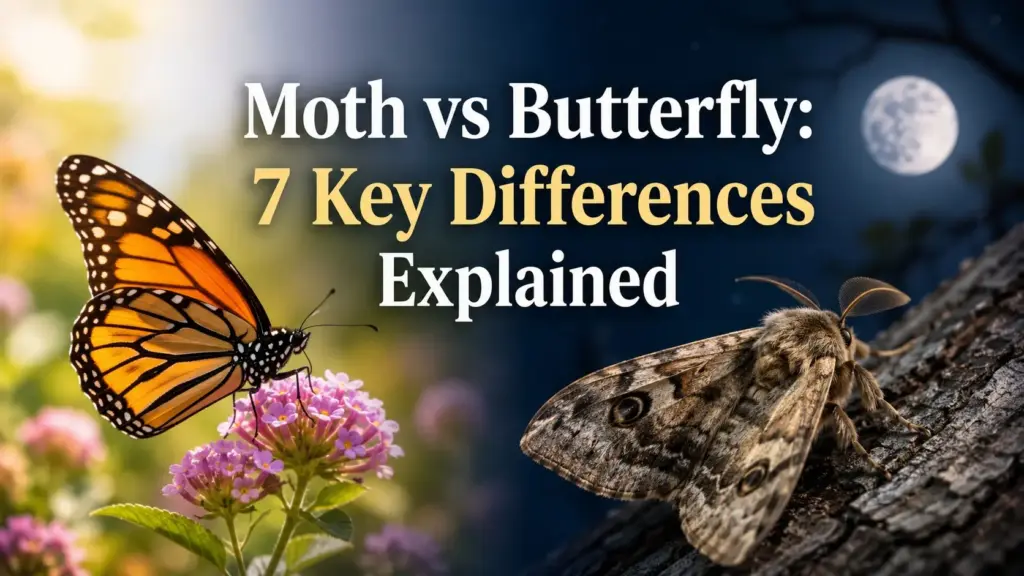

At first glance, a moth and a butterfly can look nearly identical, both have four wings, both go through metamorphosis, and both belong to the same order of insects, Lepidoptera. But spend a little time around them and the differences start to stack up fast. Some are obvious once you know what to look for.
Others are surprisingly subtle, and a handful of species exist just to break every rule you thought you learned.
This guide walks through the seven most reliable ways to tell a moth from a butterfly, why those differences exist, and what to do when nature decides not to play along.
Key Takeaways
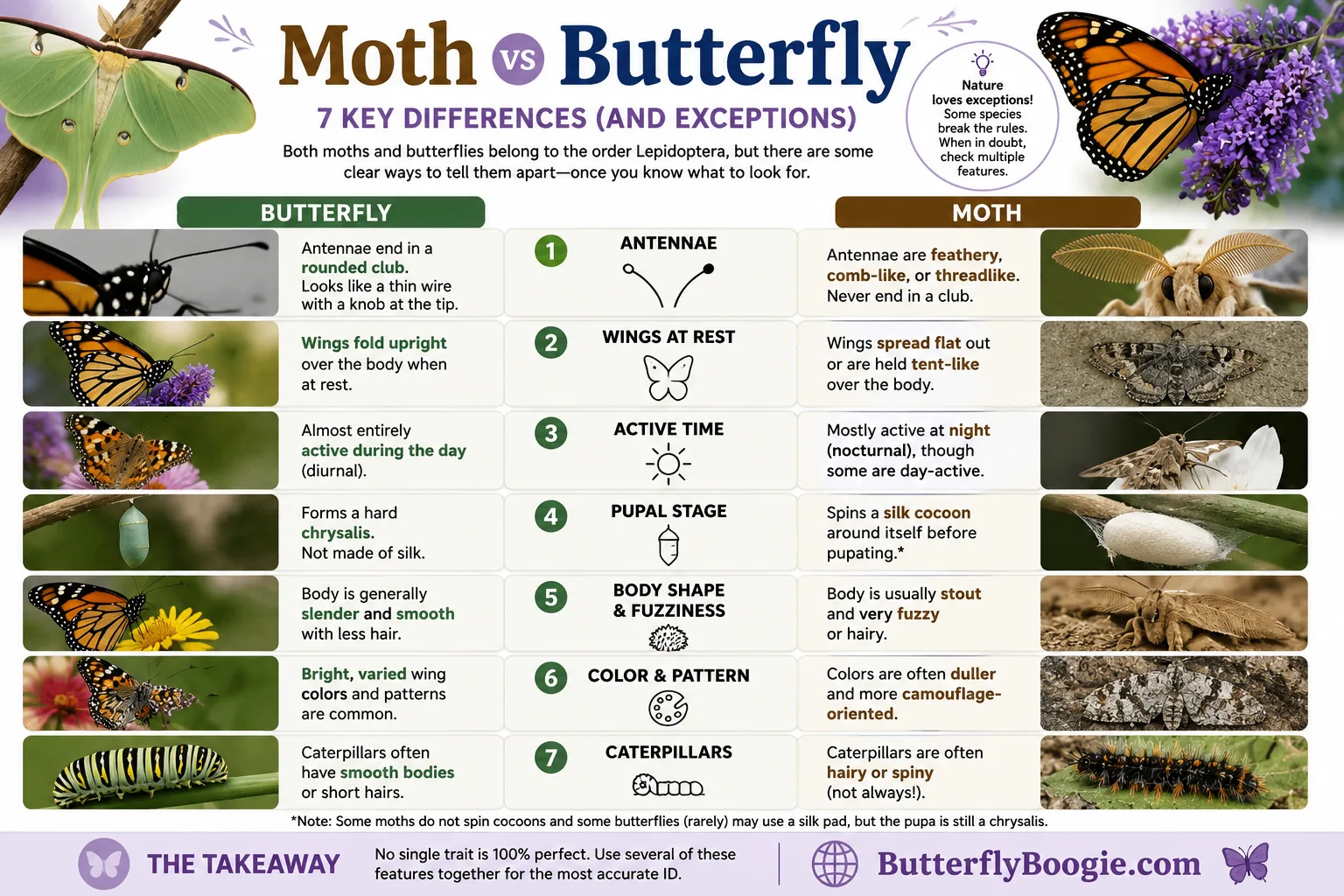
- Butterfly antennae end in a rounded club; moth antennae are feathery or threadlike with no club.
- Butterflies fold their wings upright when resting; most moths spread them flat or tent them over their bodies.
- Butterflies are almost entirely day-active; moths are largely (though not exclusively) nocturnal.
- Butterflies form a hard chrysalis; moths spin a silk cocoon, though there are notable exceptions on both sides.
Antennae: The Easiest Way to Tell
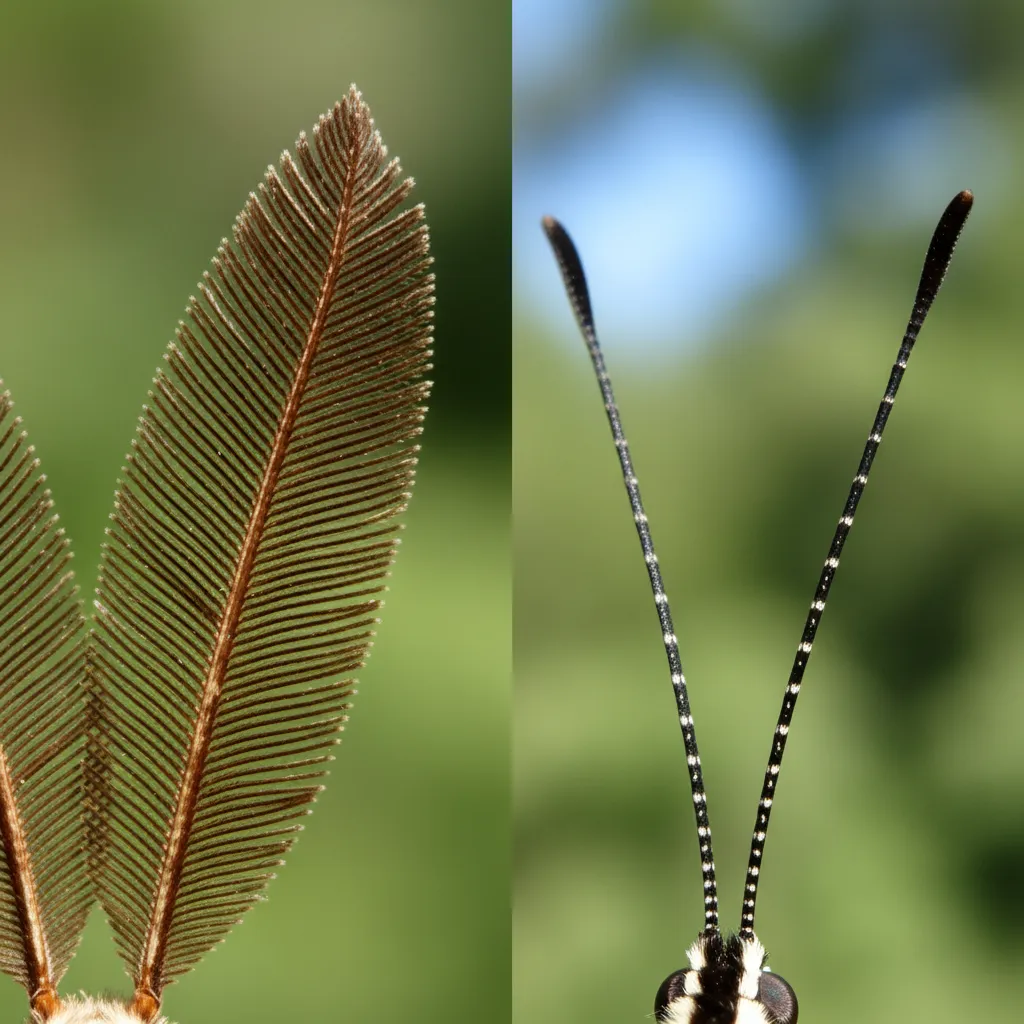
If you can get close enough to see the antennae, you basically have your answer. Butterfly antennae look like two thin wires with a small knob or club at the very tip. That clubbed end is the giveaway, no other insect group has quite the same shape, and no moth has it at all.
Moth antennae come in a wider range of styles, but none of them end in that clean club. Male moths often have feathery, comb-like antennae (called bipectinate antennae) that look almost like tiny ferns. These elaborate structures help them pick up pheromone signals from females across surprisingly large distances.
Female moths and some species of both sexes have simpler, thread-like antennae, but they still lack the club.
The antennae difference is so reliable that entomologists use it as the first sorting criterion when identifying an unfamiliar specimen in the field. If you see the club, you have a butterfly. No club?
You are almost certainly looking at a moth.
Wings at Rest
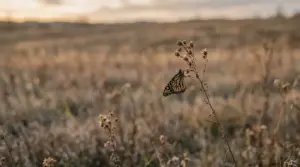
Watch what happens when either insect lands and stops moving. A butterfly will typically close its wings and hold them vertically above its body, so you are looking at the undersides of both pairs of wings pressed together. It is an elegant, folded posture that makes the butterfly look almost two-dimensional from the front.
Most moths do the opposite. They spread their wings out flat against whatever surface they have landed on, or they hold them angled back over the abdomen in a tent-like position. The spread-flat posture makes sense when you consider that moths often rest during the day and rely on camouflage to avoid predators.
Pressing those patterned wings flat against tree bark or leaf litter keeps them hidden.
A few butterflies, like the skippers, hold their wings at an odd in-between angle that can cause confusion. Skippers are actually a superfamily that sits somewhere between moths and butterflies in the family tree, which is part of why they behave a bit differently. You can read more about how butterfly anatomy shapes behavior in general.
Active Time: Day vs Night
The day/night split is one of the most well-known moth vs butterfly differences, and it holds up the majority of the time. Butterflies are diurnal, meaning they are active during daylight hours. They rely on warmth from the sun to power their flight muscles, and they use color vision to find flowers and mates.
Moths are predominantly nocturnal, though as we will get to later, that rule has plenty of exceptions. Nocturnal moths navigate using the moon and stars, which is why artificial lights so famously confuse them. The leading theory is that moths evolved to keep a light source at a constant angle as a navigation strategy, and a nearby lamp tricks them into spiraling inward.
The timing difference also shaped their relationship with plants. Butterflies tend to pollinate flowers that are open during the day, brightly colored, and often scented lightly or not at all. Moths pollinate flowers that open at night, are often white or pale (easier to see in low light), and tend to be heavily fragrant to attract pollinators that cannot see color well in the dark.
The yucca plant and the yucca moth have one of the most famous exclusive partnerships in the insect world, with each species dependent on the other for survival.
Cocoon vs Chrysalis
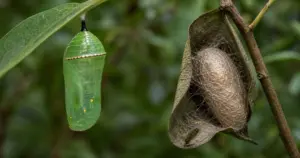
This is one of the most mixed-up distinctions in all of insect biology, so it is worth being precise. A chrysalis is the hard, smooth casing that a butterfly pupa forms around itself. It is not spun from silk.
The outer layer is actually the caterpillar’s own hardened skin, which transforms into a protective shell. Chrysalises are often green, brown, or gold, and many have textures and patterns that make them look like leaves or bark.
A cocoon is a silken wrapping that a moth caterpillar spins around itself before it pupates. The silk comes from glands in the caterpillar’s body and is the same basic material that commercial silk comes from. Some moth cocoons are thick and dense; others are loose and papery.
The pupa inside is still a pupa, but it is surrounded by that silk layer rather than just a hardened skin.
The full story of how these structures form is genuinely fascinating. The butterfly lifecycle involves a complete breakdown and reconstruction of the caterpillar’s body inside the chrysalis, a process that is still not entirely understood at the cellular level.
One caveat: some moths skip the cocoon entirely and pupate in soil or leaf litter with no silken covering. So the presence of a cocoon always means moth, but the absence of a cocoon does not automatically mean butterfly.
Body Shape and Fuzziness
Pick up (gently) a moth and a butterfly and the physical difference is immediately obvious. Moths tend to have thick, heavy-set bodies covered in dense, scale-like hairs that give them a fuzzy or furry appearance. That fuzz serves as insulation, important for a creature that needs to warm up its flight muscles on cool nights when the sun is not available.
Butterfly bodies are generally slimmer and smoother. They still have scales (all Lepidoptera do), but they are less densely packed and less hair-like. A butterfly’s abdomen is often noticeably thinner relative to its wingspan than a moth’s abdomen would be.
There is also a structural difference in the wings themselves. Most moths have a small hook or bristle called a frenulum on the hindwing that connects to the forewing, keeping both pairs of wings moving together in flight. Butterflies do not have a frenulum.
Instead, their hindwing overlaps with the forewing in a way that achieves the same coupling effect. It is a small detail, but it shows up consistently across families.
Skippers: The Butterfly That Looks Like a Moth
If you have ever watched a stocky, fast-flying insect dart between flowers and wondered whether you were looking at a moth or a butterfly, you were almost certainly looking at a skipper. Skippers are the single most common reason people second-guess a butterfly identification.
Taxonomically, skippers are butterflies. They sit in the family Hesperiidae within the superfamily Papilionoidea, the same superfamily as monarchs, swallowtails, and every other “real” butterfly. The classification has been settled by genetic analysis even though the visual cues argue otherwise.
Where they look like moths: skippers have short, thick bodies covered in dense hair, comparatively small wings, and big compound eyes. Their flight is rapid and direct, not the graceful flutter most people associate with butterflies. Britannica notes skippers can hit 37 mph in level flight, which is two to three times the speed of an average butterfly.
Where they reveal themselves as butterflies: the antennae. Skipper antennae end in a distinct club, often with a small hook at the very tip that other butterflies do not have. No moth, no matter how stocky or daytime-active, has those clubbed antennae.
One other tell: when a skipper rests, it frequently holds its forewings angled upward while its hindwings stay flat, the so-called “jet plane” posture that is unique to this family. If you see that wing position, it is a skipper.
Color and Camouflage
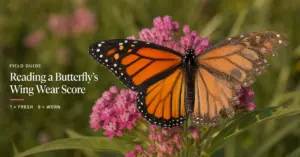
The popular image of butterflies as colorful and moths as drab is rooted in truth but overstated. Many butterfly species are genuinely spectacular, with iridescent blues, vivid oranges, and complex patterns that serve as warnings to predators or signals to potential mates. Color in butterflies is often about being seen.
Moths, on the whole, tend toward earth tones: brown, gray, buff, and cream. These colors work as camouflage against bark, soil, and dead leaves during the day when most moths are sitting still and trying not to be eaten. The muted palette is not a sign of lesser beauty, it is a survival strategy.
That said, some of the most visually striking insects in the world are moths. The Madagascan sunset moth rivals any butterfly for sheer spectacle, with wings that shift from red to green to blue depending on the angle of light. Rosy maple moths are a pastel combination of pink and yellow that looks almost artificially bright.
- Madagascan sunset moth — iridescent red, green, and blue wings that shift with the light
- Rosy maple moth — pastel pink and yellow, looks airbrushed
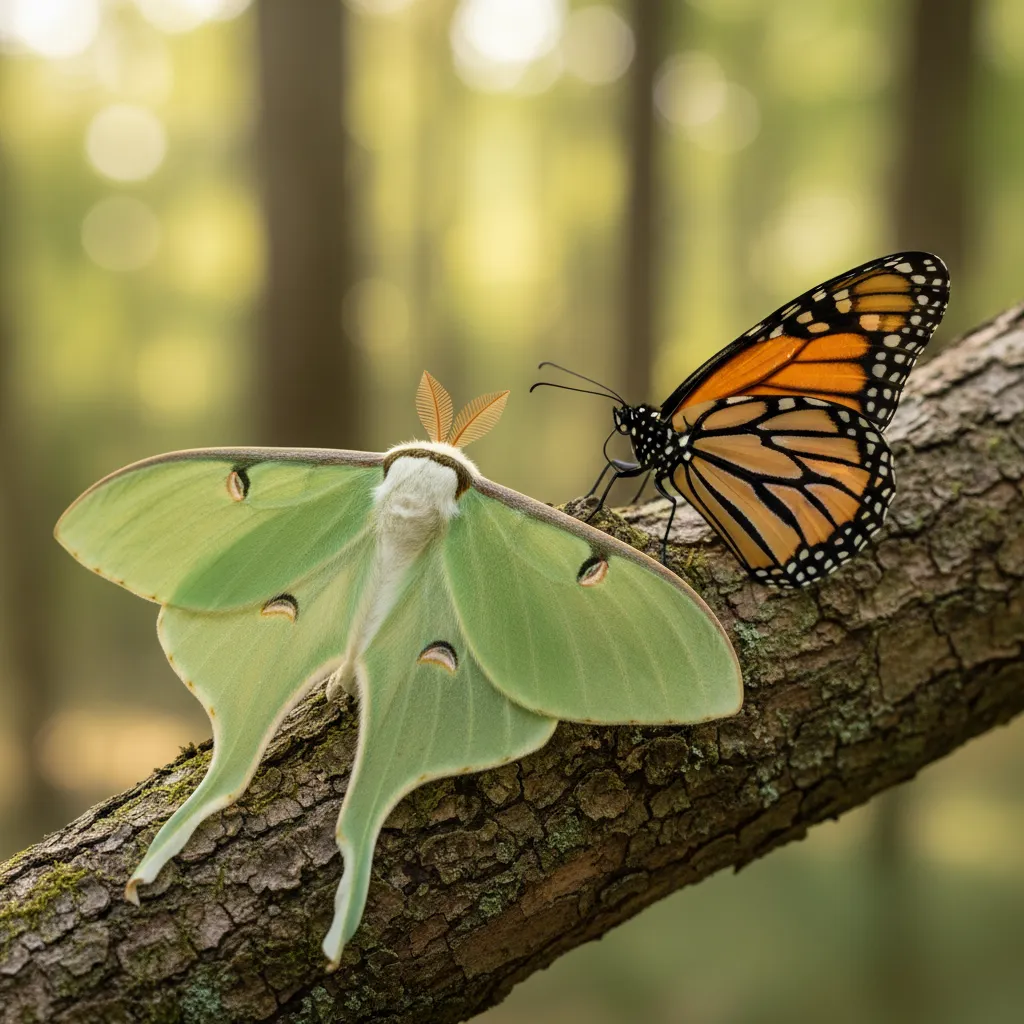
- Luna moth — pale jade green wings with long curling tails
- Atlas moth — the largest moth in the world, with copper, gold, and black patterning
- Lichen moths — vivid orange and yellow caution-tape patterning
The idea that moths are always dull is worth setting aside entirely.
Interestingly, the scales that create color in both moths and butterflies also function as sensory organs in some species. The way butterflies use their feet to taste is just one example of how much is packed into a relatively small insect body.
The Exceptions: Day-Flying Moths and Dull Butterflies
Nature is not interested in making identification easy, so there is an entire category of moths that fly in broad daylight and look exactly like butterflies while doing it.
The antenna test resolves every case: clubbed tip = butterfly, feathery or tapering = moth.
The hummingbird hawk-moth is a good example. It is active during the day, hovers in front of flowers like a hummingbird, and has a chunky, fast-moving flight style that makes people stop and stare. It looks nothing like the brown-moth stereotype.
Burnet moths and forester moths are other day-flying species with metallic colors that confuse people regularly. The luna moth and rosy maple moth are night-flying but so striking that they get held up as proof that “moths can be beautiful too,” sometimes leading people to assume they must be butterflies. Lichen moths add another wrinkle, with bright orange or yellow patterning that breaks the “moths are drab” rule completely.
On the butterfly side, the wood white and many of the browns (meadow browns, ringlets, hedge browns) are muted, drab insects that could easily be mistaken for moths at a glance. Some hairstreak butterflies rest with their wings flat in a moth-like posture. Skippers, again, bend most of the behavioral rules and have body proportions closer to moths than to other butterfly families.
The consistent test, even with all these exceptions, remains the antenna. No matter how moth-like a butterfly looks, those clubbed tips give it away. And no matter how colorful or day-active a moth is, its feathery or tapering antennae identify it correctly every time.
For a deeper look at the full classification that covers both groups, the Amateur Entomologists’ Society has accessible guides on Lepidoptera identification. The Butterflies and Moths of North America database is also one of the most thorough free resources for species-level identification.
Telling Moth and Butterfly Caterpillars Apart
Adult identification is the easier half of this question. Caterpillar identification is what people post to social media most often, and the cues are different from the adult cues.
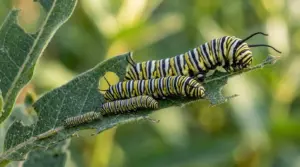
Butterfly caterpillars tend to be smooth-skinned or to have soft, evenly spaced bristles. Their bodies are typically a single bright color or a series of clean horizontal stripes, like the yellow-black-white pattern of a monarch caterpillar. When they need defense, they rely on chemistry from the host plant rather than physical deterrents.
Moth caterpillars are far more likely to be hairy, spiny, or shaggy. Many have tufts of hair in irregular patches, like the woolly bear caterpillar, the saddleback caterpillar, or the io moth caterpillar. Some moth caterpillars carry urticating hairs that cause skin irritation, which is a clue almost no butterfly caterpillar can give.
Two other cues help. Moth caterpillars frequently feed on a wider range of plants and trees, while butterfly caterpillars often specialize on a single host plant family. And butterfly caterpillars almost always make a chrysalis exposed on a leaf or stem, while moth caterpillars typically spin a silk cocoon, dig into soil, or wrap themselves in rolled leaves.
If you find a caterpillar and want a confident identification, photograph it from the side, count its legs (both true legs and prolegs), note the host plant, and check it against the Butterflies and Moths of North America database. Those four pieces of information narrow most caterpillars down to family in seconds.
- Peterson Field Guide to Moths of Northeastern North America
The standard moth ID guide for backyard mothing. - Kaufman Field Guide to Butterflies of North America
Pair this with the Peterson moth guide and you can ID almost anything. - Blacklight bulb + white sheet kit (backyard mothing)
Hang a sheet, plug in this bulb after dark, and watch moths arrive in minutes. - LED magnifier loupe (10x) for antenna ID
The clubbed-tip antenna test is way easier with magnification.
Affiliate links. We earn a small commission on qualifying purchases at no extra cost to you.
FAQ
Are moths and butterflies the same species?
No. Moths and butterflies are both members of the order Lepidoptera, but they are not the same species or even the same family. Butterflies make up a relatively small portion of Lepidoptera (roughly 20,000 species), while moths account for the vast majority of the order, with estimates ranging from 140,000 to 160,000 known species.
They share a common ancestor but diverged into distinct groups with their own families, behaviors, and physical characteristics.
Can a moth turn into a butterfly?
No. A moth caterpillar will always become a moth, and a butterfly caterpillar will always become a butterfly. The species is determined at the egg stage by genetics.
Both go through complete metamorphosis (egg, larva, pupa, adult), but the end result is fixed from the beginning. The confusion likely comes from the fact that both undergo a dramatic transformation during pupation, but the transformation stays within the species.
Do moths eat clothes or is that a myth?
Partly true. Adult clothes moths (Tineola bisselliella) do not eat fabric at all, adult moths of this species do not even have functioning mouths. The damage comes entirely from the larvae, which feed on keratin, the protein found in natural fibers like wool, silk, cashmere, and fur.
Synthetic fabrics are generally safe. The larvae are attracted to fibers that contain traces of sweat, skin oils, or food stains, which is why unwashed items stored in dark spaces are most vulnerable.
Why are moths attracted to light?
The most widely accepted explanation is called transverse orientation. Moths evolved to navigate at night using the moon or stars as a fixed reference point, keeping the light source at a constant angle as they fly. The moon is so far away that this works reliably.
An artificial light source close by creates a geometric trap: as the moth tries to maintain a constant angle to the light, it ends up circling inward in a spiral. Recent research has also suggested that moths may be confused by the upward direction of artificial light, which disrupts their sense of which way is up during flight.
Which lives longer, a moth or a butterfly?
It depends heavily on the species. As adults, most butterflies and moths live only one to two weeks, just long enough to mate and, in some cases, lay eggs. Some butterfly species that overwinter as adults, like the mourning cloak or the monarch during migration, can live for several months.
Certain moth species with non-feeding adults live only a few days. The longest-lived stage for both groups is usually the larval (caterpillar) stage, which can last months or, in some moth species in cold climates, several years across multiple winters.
Are skippers butterflies or moths?
Skippers are butterflies. They belong to the family Hesperiidae within the butterfly superfamily Papilionoidea, even though their stout bodies and fast flight make them look more like moths at a glance.
The simplest way to confirm a skipper is a butterfly is to check its antennae. Skippers have clubbed antennae with a small hook at the tip, a feature no moth shares.
How can I tell if a caterpillar is a moth or butterfly?
Look first at body texture. Moth caterpillars are usually hairy, spiny, or fuzzy, while butterfly caterpillars are smooth-skinned or have only fine bristles.
Pupation behavior also gives it away if you can wait. Butterfly caterpillars form an exposed chrysalis on a leaf or twig, while moth caterpillars typically spin a silk cocoon or hide underground to pupate.
Is a luna moth a butterfly?
No, the luna moth is a moth, despite its pale green color and dramatic tails that make people assume it must be a butterfly.
Luna moths are members of the giant silk moth family Saturniidae. They fly at night, have feathery antennae rather than clubbed ones, and only live as adults for about a week, since they emerge without functional mouthparts and cannot feed.