
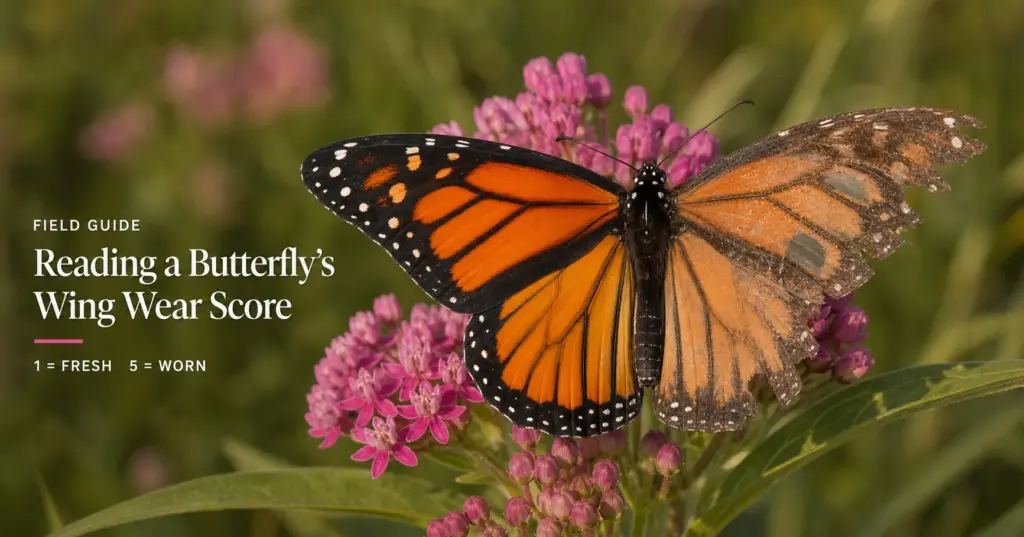

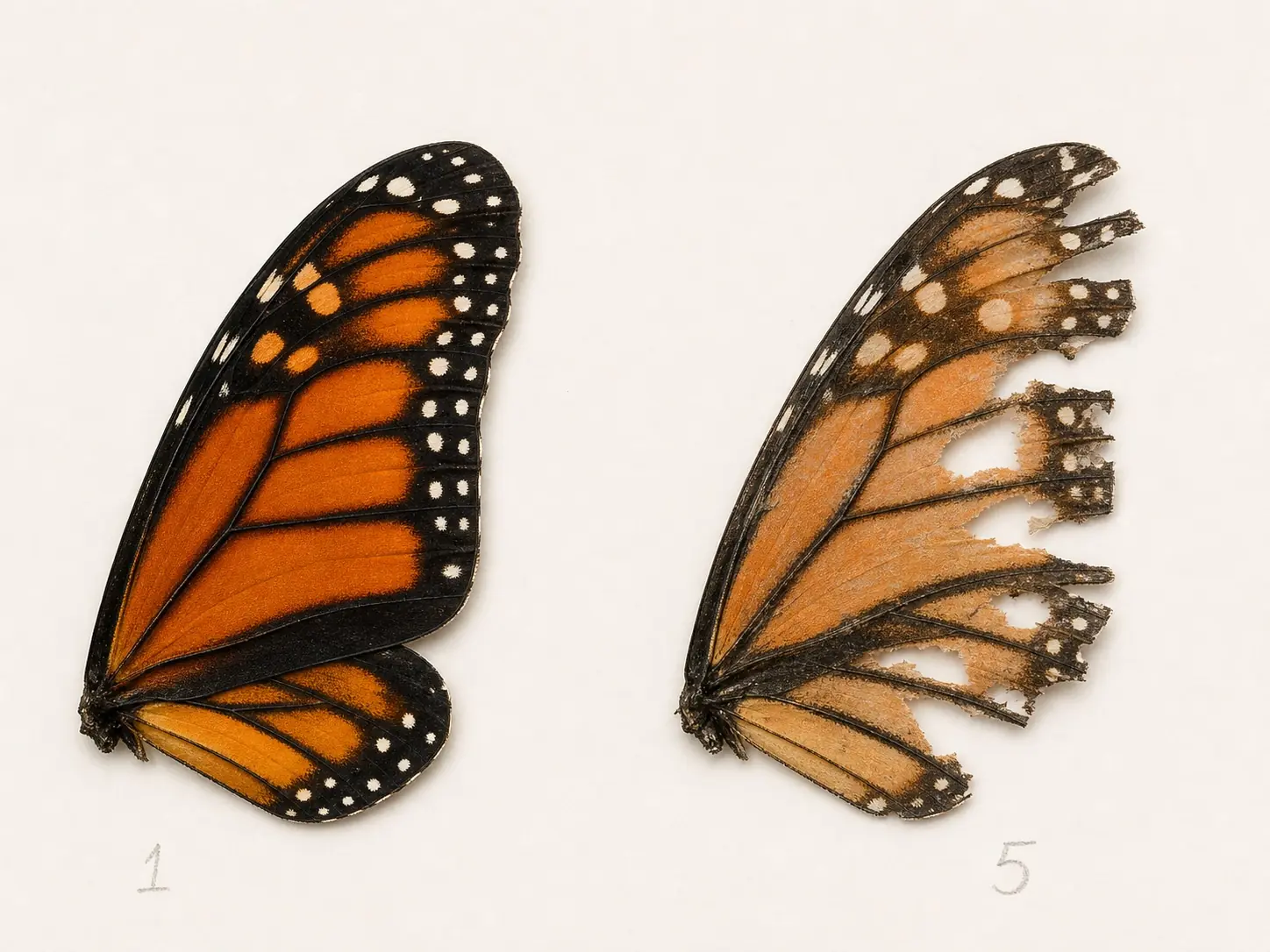
The simplest way to estimate a butterfly’s age from its wings is the 1 to 5 wing wear scale, a method published by monarch researchers in 1993 and still used today by scientists and citizen volunteers across North America. A fresh adult scores a 1, with crisp wing edges and saturated color, while a battered, see-through, sun-faded individual scores a 5 and is usually within days of dying.
The scale matters because most “is this butterfly old?” questions on social media are really asking the same thing, and a quick visual score gives a confident answer without having to catch the insect or read a research paper. The rest of this guide walks through each score, the wing features that matter most, and why a worn butterfly almost never needs human help.
Key Takeaways
- The standard wing wear scale runs from 1 (newly eclosed, no wear) to 5 (heavily damaged, near end of life), based on Malcolm, Cockrell, and Brower (1993). Scores 1 to 2 indicate a current-generation butterfly, while 4 to 5 usually means an older or overwintering individual.
- The score combines three signals you can read from a photo: edge damage along the outer wing margin, scale loss that leaves transparent patches, and overall color fading.
- Wing wear is normal life-stage aging, not injury, and a butterfly scoring a 4 or 5 cannot be saved or healed.
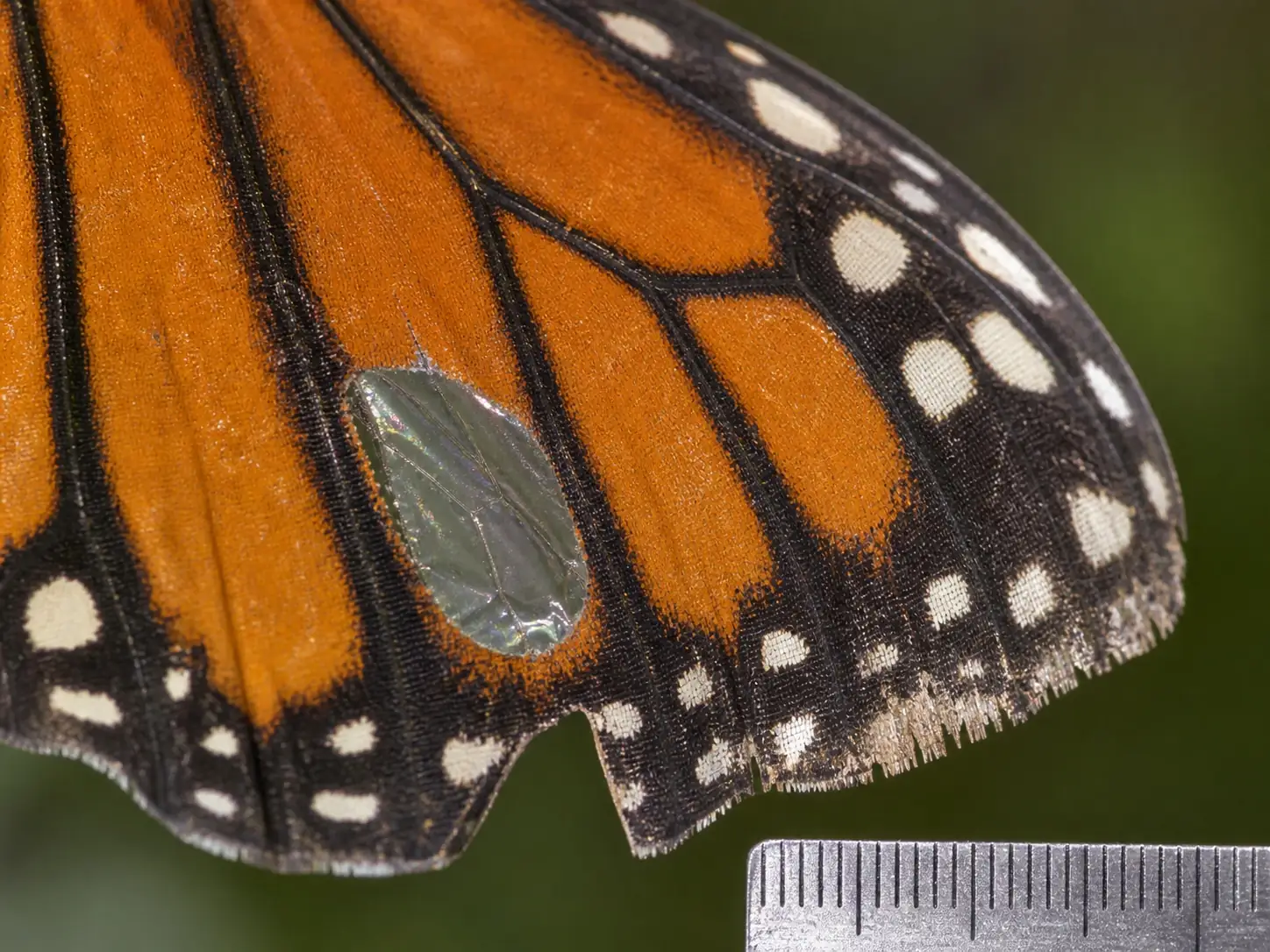
- Project Monarch Health uses a separate 0 to 4 wing damage score that tracks only edge tears, recorded next to a parasite sample taken from the abdomen.
What the 1 to 5 Wing Wear Score Actually Measures
The 1 to 5 scale was formalized by Malcolm, Cockrell, and Brower in their 1993 paper on monarch spring recolonization, and it has been the working standard for monarch age estimation ever since. The scale is used in published research and by community-science programs like Journey North and the Monarch Larva Monitoring Project.
The score is a visual judgment based on the whole wing, not a single feature. You look at the outer wing edges for chips and tears, the wing surface for missing scales (which makes patches look transparent or “scaly”), and the overall color for fading from a deep orange to a washed pale pumpkin tone.
Score-by-Score Visual Guide
The table below summarizes what each score looks like in the wild. These descriptions are written for monarchs but apply with minor color shifts to most large butterflies, including swallowtails, painted ladies, and fritillaries.
| Score | Wing edges | Scales and color | Likely age and meaning |
|---|---|---|---|
| 1 | Smooth, intact, no nicks | All scales present, deep saturated color, vein lines crisp | Newly eclosed, 0 to 3 days old, current generation |
| 2 | Tiny nicks or one shallow notch | Color still rich, no transparent patches | Roughly 4 to 10 days old, current generation |
| 3 | Small triangular tears, edges fraying | Faint scale loss near body, color softening | Two to four weeks old, age uncertain without other clues |
| 4 | Several visible bird-beak nicks or torn margins | Clear scale-loss patches, transparent windows forming, color noticeably faded | Likely 4 to 8 weeks old, may be overwintering survivor in spring |
| 5 | Large chunks missing, ragged or broken edges | Many transparent patches, color washed and pale, hairs around thorax thin | End of life, usually days from dying, almost always a previous-year individual in spring |
Why Wing Wear Builds Up
A butterfly’s wings are not living tissue once the adult emerges, so any damage is permanent. Every flight rubs scales off, every landing on a thorny stem snags an edge, and every close call with a hungry bird can leave a triangular beak-mark notch on the rear wing. This is one of the most overlooked facts in the butterfly life cycle, since most popular guides stop at the chrysalis and skip the slow grind of adult wear.
Sun also matters. The orange pigment in monarchs and many fritillaries breaks down with UV exposure, so a butterfly that spent its whole life basking on milkweed in open sun fades faster than one in a shadier meadow. Andy Davis of the University of Georgia has published several monarch studies that use wing color saturation as a separate age and fitness signal.
How Researchers Use the Score
Spring monarchs in Texas and the Gulf Coast often come back to citizen scientists with mixed scores. Volunteers tag the 4s and 5s as “overwintered” individuals, since those are likely the same butterflies that left Mexico in February or March, and the 1s and 2s as “first spring brood” born along the way.
This split is how Journey North maps the leading edge of spring migration in real time, and it is why a single wing wear score can be more useful than weighing or measuring the butterfly. Our deeper monarch context lives in the monarch butterfly migration Mexico guide.
What Wing Wear Is Not
A lot of social-media rescue posts mistake wing wear for an injury or illness, which is understandable when a butterfly looks half tattered. The Reddit post Those butterflies don’t need help, they’re just old went mildly viral in 2025 for stating the obvious truth that worn wings are normal aging, not damage that can be patched.
Wing wear is also distinct from Ophryocystis elektroscirrha (OE) infection, which produces weak, deformed wings on a butterfly that has just eclosed. A score of 5 means the butterfly flew for weeks, while a freshly emerged OE-infected monarch looks crumpled from the very first moment.
And wing wear is different from frostbite or wing-fluid problems on a hand-reared chrysalis, which result in folded or wet wings on a brand new butterfly. If you are unsure which is which, our cocoons for butterflies overview covers what a healthy eclosion looks like.
Other Scoring Systems You Might See
Project Monarch Health, run out of the Odum School of Ecology, uses a separate 0 to 4 wing damage scale that focuses only on missing chunks along the outer wing margin. A 0 means perfect edges, a 4 means roughly a quarter of the wing margin is gone, and the score is recorded next to the parasite sample taken from the abdomen.
Older European condition scales sometimes use letter grades from A (fresh) through E (very worn). These letter grades line up with the 1 to 5 numeric scale almost exactly, and either system gets you to the same age estimate.
FAQ
Can a butterfly with a 4 or 5 wing score still fly?
Yes, often surprisingly well.
Butterflies can lose up to half of a wing and still cruise normally because lift is generated mostly by the inner wing surface near the body, and the outer edges are mainly used for sharper turns.
Does wing wear mean the butterfly is sick?
No, wing wear is the visible record of a normal adult lifespan.
An adult butterfly in summer lives roughly 2 to 6 weeks, and the wings simply accumulate damage during that time the way a worn pair of shoes accumulates scuffs.
Should I help a butterfly with very ragged wings?
No, a butterfly scoring a 4 or 5 cannot be repaired and is near the natural end of its life.
Leaving fresh fruit or sugar water nearby is fine if you want to enjoy watching, but glue wing repairs, indoor nursing, and “rescue” releases do not extend the adult lifespan and can stress the insect.
How can I tell a current-year monarch from an overwintered one in spring?
Score the wing and use the 1-2 versus 4-5 split.
A monarch flying in March or April with score 4 or 5 wings is almost certainly an overwintering survivor flying north from Mexico, while a clean 1 or 2 in the same month is a freshly eclosed first-brood butterfly born along the spring migration route.
Does the 1 to 5 scale work for all butterflies, not just monarchs?
Yes, with one caveat about color.
Edge tears, scale loss, and faded pigment apply to every adult butterfly, but the color-fading signal is most obvious on warm-pigment species like monarchs, fritillaries, and sulphurs, and less reliable on already pale species like cabbage whites.
How do I score a butterfly from a photo without catching it?
A clear side-angle photo of the open wings is enough for most scores.
Aim for a sharp frame from roughly 12 to 24 inches away, with the upper wing surface visible, then zoom in to check the outer margin for tears and the inner panels for transparent patches. Our butterfly photography guide covers the camera settings and angles that capture the right detail.