



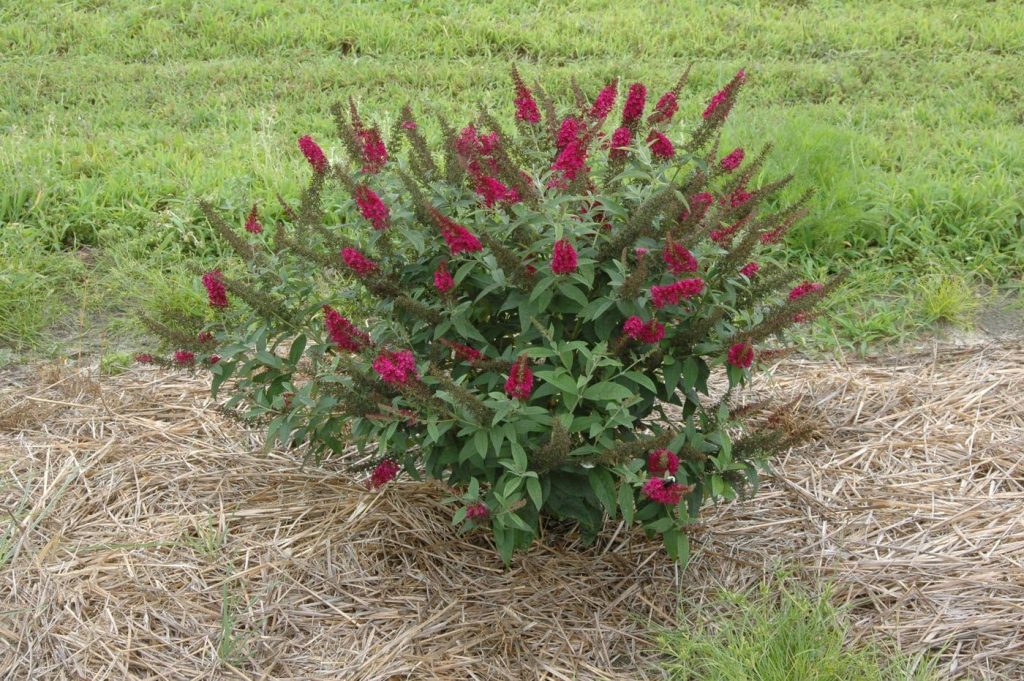
If you’ve ever watched a butterfly bush in full bloom, covered in swallowtails and monarchs on a hot July afternoon, you already understand why this shrub has become a garden staple across the country. The butterfly bush (Buddleja davidii) is a fast-growing, summer-blooming shrub that produces long, cone-shaped flower clusters in purple, pink, white, and red. It grows in USDA zones 5 through 9, tolerates a surprising amount of neglect, and rewards you with blooms from midsummer straight through fall. This guide covers everything you need to know – how to plant it, care for it, prune it, and choose the right variety for your specific yard.
Key Takeaways
- Butterfly bushes bloom all summer long and are one of the most reliable shrubs for attracting butterflies and pollinators to your yard.
- Most standard varieties grow 6 to 12 feet tall, but compact cultivars stay under 4 feet, making them workable in smaller spaces.
- Hard pruning in late winter or early spring – cutting plants back to about 12 inches – is the key to keeping butterfly bushes from getting leggy and woody.
- In some states, Buddleja davidii is considered invasive, so check your local regulations and consider sterile cultivars if you’re in a higher-risk region.
What Is a Butterfly Bush
The butterfly bush is a deciduous to semi-evergreen shrub native to central China. It was introduced to Western gardens in the late 1800s and named for the obvious reason – the nectar-rich flowers draw butterflies in numbers that can be genuinely spectacular. The genus name Buddleja honors the English botanist Adam Buddle, and there are actually over 140 species in the genus, though Buddleja davidii is by far the most widely grown in North American gardens.
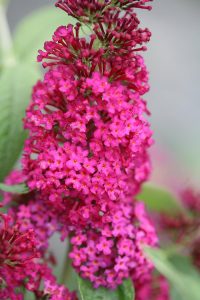
What makes butterfly bush such a popular choice is the combination of ease and performance. It grows fast – often adding 4 to 6 feet in a single season after being cut back – and the blooms just keep coming if you deadhead regularly. The flower spikes can reach 12 to 18 inches long on a healthy plant, and the fragrance is a light honey scent that you can actually smell from a few feet away on a warm day.
It’s worth noting upfront that butterfly bush feeds adult butterflies with nectar, but it is not a host plant where butterflies lay eggs or caterpillars feed. If you’re trying to build a complete habitat garden rather than just a nectar stop, you’ll want to pair it with plants that support the full butterfly life cycle. Our guide on caterpillar host plants covers those choices in detail.
How to Plant a Butterfly Bush
Butterfly bush is not fussy, but getting the planting right gives it the best possible start. The single most important factor is sunlight – this shrub needs at least 6 hours of direct sun daily, and 8 hours is better. Plants grown in too much shade produce fewer flowers and tend to get leggy and flop over.
Soil drainage matters more than soil quality. Butterfly bush actually performs better in lean, well-drained soil than in rich, constantly moist garden beds. Heavy clay that stays wet through winter is one of the quickest ways to kill one. If you’re working with clay soil, either amend it heavily with coarse sand and compost before planting, or build a raised bed. Sandy or rocky soil with average fertility is genuinely fine.
The best time to plant is spring after the last frost date for your area, which gives the shrub an entire growing season to establish its root system before winter. Fall planting works in zones 7 and warmer, but in zones 5 and 6 you’re taking a real risk – a newly planted butterfly bush in November often doesn’t have enough root development to survive a hard freeze.
When you plant, dig a hole about twice as wide as the root ball but only as deep. Set the plant so the top of the root ball sits at or just slightly above grade – never plant it low in a bowl that collects water. Backfill with the native soil, water thoroughly, and apply a 2 to 3 inch layer of mulch around the base, keeping it pulled back from the stems. For the USDA plant hardiness zone map to confirm your zone, that’s a useful reference to bookmark.
Butterfly Bush Care
Once established, butterfly bush is genuinely low-maintenance. The first season requires regular watering to help roots establish – about once a week during dry spells. After that, most established plants need supplemental watering only during extended drought. Overwatering is a more common mistake than underwatering with this plant.
On fertilizing: less is more. A single application of a balanced slow-release fertilizer in early spring is plenty. If you fertilize heavily or repeatedly through the season, you’ll get lots of lush leafy growth and fewer flowers. The plant channels its energy into foliage at the expense of blooms when it’s over-fed with nitrogen.
Deadheading – removing spent flower spikes before they go to seed – accomplishes two things. It keeps the plant looking tidy, and it pushes the butterfly bush to produce a new flush of blooms. On a well-maintained plant, you can keep the flowers coming from early July through the first hard frost of fall. The technique is straightforward: cut the spent spike back to the next set of leaves or to a side shoot that’s beginning to develop. It takes maybe 10 minutes every couple of weeks through midsummer.
Pests are rarely a serious problem. Occasionally you’ll see spider mites in very hot, dry weather, and caterpillars will sometimes munch the foliage – which is actually not a bad thing in a wildlife garden. Butterfly bush is largely resistant to deer browse, though not completely immune. If deer pressure is intense in your area, a single application of a repellent spray in early spring usually handles it.
Pruning Your Butterfly Bush
Pruning is the one area where most gardeners make a mistake with butterfly bush, and it’s usually in the direction of being too timid. These plants bloom on new growth – the flower spikes that open in July are forming on stems that grew this spring. That means if you want maximum blooms, you need to cut the plant back hard in late winter or very early spring, before new growth begins.
The standard recommendation is to cut the entire plant back to about 12 inches from the ground. I know that sounds brutal the first time you do it, especially on a mature shrub that’s 8 feet tall. But it works. By midsummer, that same plant will be 5 or 6 feet tall again and covered in blooms. Plants that are only lightly pruned tend to get increasingly woody and leggy over time, with flowers pushed to the ends of long bare stems.
Timing matters by zone. In zones 5 and 6, wait until you see the first swelling buds in spring – cutting back in January during a warm spell only to get hit with a February cold snap can damage new growth. In zones 7 through 9, late February or early March is usually safe. You can also do a light cleanup in fall by removing the spent flower stalks, but save the major pruning for spring.
One more pruning note: butterfly bush in colder zones will often die back to the ground over winter anyway. Don’t panic. The root system is almost always alive, and new growth will emerge from the base in spring. Treat it the same way – let it come back, then prune to shape once you can see what survived.
Best Butterfly Bush Varieties
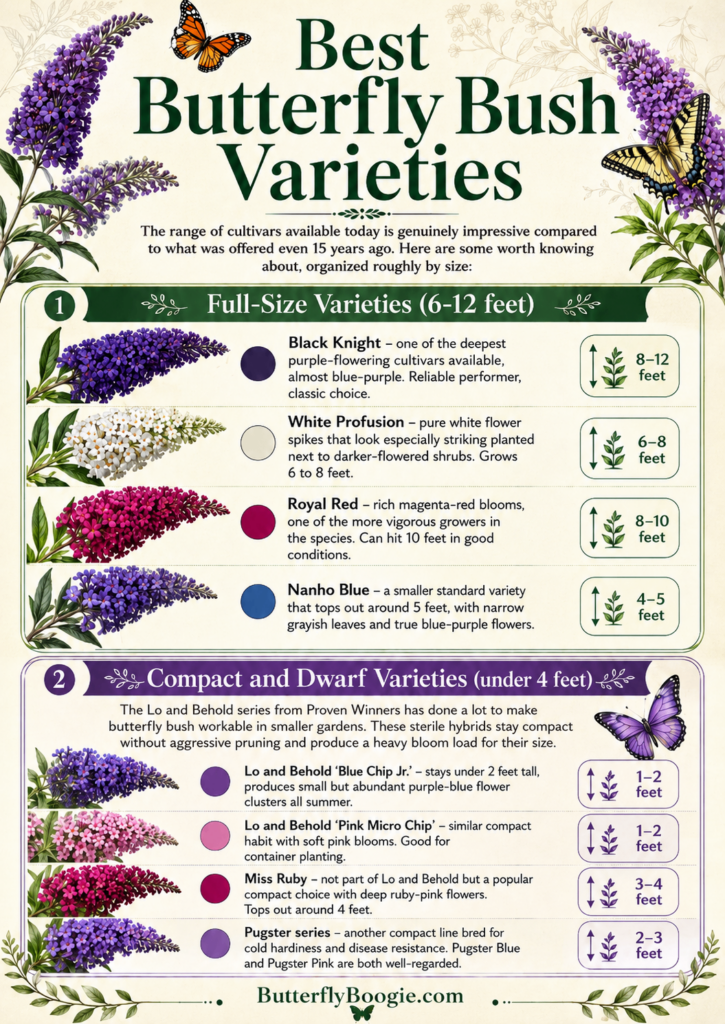
The range of cultivars available today is genuinely impressive compared to what was offered even 15 years ago. Here are some worth knowing about, organized roughly by size:
Full-Size Varieties (6-12 feet)
- Black Knight – one of the deepest purple-flowering cultivars available, almost blue-purple. Reliable performer, classic choice.
- White Profusion – pure white flower spikes that look especially striking planted next to darker-flowered shrubs. Grows 6 to 8 feet.
- Royal Red – rich magenta-red blooms, one of the more vigorous growers in the species. Can hit 10 feet in good conditions.
- Nanho Blue – a smaller standard variety that tops out around 5 feet, with narrow grayish leaves and true blue-purple flowers.
Compact and Dwarf Varieties (under 4 feet)
The Lo and Behold series from Proven Winners has done a lot to make butterfly bush workable in smaller gardens. These sterile hybrids stay compact without aggressive pruning and produce a heavy bloom load for their size.
- Lo and Behold ‘Blue Chip Jr.’ – stays under 2 feet tall, produces small but abundant purple-blue flower clusters all summer.
- Lo and Behold ‘Pink Micro Chip’ – similar compact habit with soft pink blooms. Good for container planting.
- Miss Ruby – not part of Lo and Behold but a popular compact choice with deep ruby-pink flowers. Tops out around 4 feet.
- Pugster series – another compact line bred for cold hardiness and disease resistance. Pugster Blue and Pugster Pink are both well-regarded.
If you’re specifically focused on attracting monarchs, our article on monarch butterfly bush plantings goes deeper on which varieties and placement strategies seem to work best for that species specifically.
For a broader view of what to plant alongside your butterfly bush to create a complete pollinator garden, both the best butterfly food plants guide and our overview of creating a butterfly garden from scratch are worth reading together.
Are Butterfly Bushes Invasive?
This is a legitimate question and it deserves a straight answer. Buddleja davidii is classified as invasive or a “weed of concern” in several states, particularly in the Pacific Northwest – Oregon and Washington have had documented problems with it spreading into riparian areas and disturbing native plant communities. It self-seeds prolifically, and a single mature plant can produce thousands of viable seeds that disperse by wind.
Oregon actually banned the sale of most Buddleja davidii cultivars in 2004 (with some exceptions for sterile hybrids). If you’re in the Pacific Northwest or another region where this is a concern, the sterile cultivars – particularly the Lo and Behold series and others that produce little to no viable seed – are the responsible choice. The Oregon State University Extension has well-documented resources on invasive status by region if you want to dig into the specifics for your area.
In most of the eastern and central United States, butterfly bush does not appear on invasive species lists and has not demonstrated the same spreading behavior, likely due to differences in climate and native plant competition. That said, regardless of where you garden, deadheading before seeds set is just good practice – it extends bloom time and removes the self-seeding risk entirely.
It’s also worth keeping in mind that while butterfly bush is excellent at drawing adult butterflies to your garden with nectar, a garden that truly supports butterfly populations needs more than nectar sources. Pairing your butterfly bush with a good selection of caterpillar host plants turns a pretty shrub into an actual habitat. And if you want to go even further in supporting visitors, our homemade butterfly nectar recipe is a fun way to supplement during gaps in your bloom calendar.
The Butterfly Bush Paradox
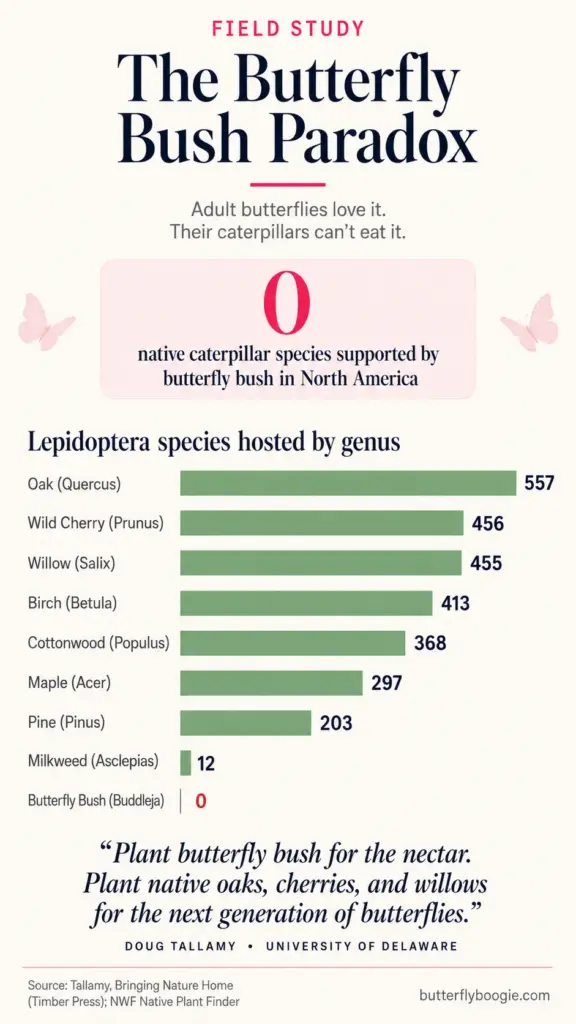
Butterfly bush is the most popular “butterfly plant” sold in North American garden centers, and it is also the only popular butterfly plant that supports zero native caterpillars. That contradiction is the heart of why conservation biologists keep raising the alarm even while gardeners keep buying the plant.
The data comes from Doug Tallamy at the University of Delaware, whose lab has spent two decades cataloging which plants feed which Lepidoptera larvae. His Lepidoptera index, published in Bringing Nature Home and maintained on the National Wildlife Federation Native Plant Finder, ranks plants by how many butterfly and moth species use them as caterpillar host plants in a given region.
The numbers, ranked
Here are the host counts for common woody plants and a few flagship herbaceous species, drawn from Tallamy’s data set. The figures are eastern US averages and shift slightly by region.
| Plant (genus) | Native Lepidoptera supported | Role in the food web |
|---|---|---|
| Oak (Quercus) | 557 | Keystone host, top of the list |
| Wild Cherry (Prunus) | 456 | Major host across the eastern US |
| Willow (Salix) | 455 | Wetland keystone |
| Birch (Betula) | 413 | Forest edge keystone |
| Cottonwood / Poplar (Populus) | 368 | Riparian keystone |
| Maple (Acer) | 297 | Backyard host |
| Pine (Pinus) | 203 | Conifer keystone |
| Milkweed (Asclepias) | 12 | Monarch obligate host |
| Butterfly Bush (Buddleja) | 0 | Nectar only, no caterpillar use |
Why the zero matters
An adult butterfly’s lifespan is short, usually two to six weeks, and it spends those weeks looking for two things: nectar and the right host plant to lay eggs on. A butterfly bush satisfies the first need beautifully but disqualifies itself from the second, since no native caterpillar can digest its leaves.
If a whole neighborhood plants butterfly bush as their “pollinator garden,” the result is a buffet for adults that already exist with nothing to feed the next generation. Tallamy summarizes the takeaway in a single line, “we are not gardening for adult butterflies, we are gardening for caterpillars,” because adults you see today started as caterpillars eating a native plant somewhere nearby.
Native alternatives that feed both
Plenty of native plants offer nectar for adult butterflies and host eggs for the next generation. A short list to mix into a bed where you might otherwise plant butterfly bush:
- Joe-Pye Weed (Eutrochium) for tall pink flower heads and host duty for the clymene moth.
- Buttonbush (Cephalanthus occidentalis) for spherical white nectar globes and host duty for several sphinx moths.
- Milkweed (Asclepias) for monarch eggs plus heavy nectar production for swallowtails and fritillaries.
- New England Aster (Symphyotrichum novae-angliae) for late-season nectar and host duty for over 100 moth species.
- Sweet Pepperbush (Clethra alnifolia) for fragrant summer blooms and host duty for the hummingbird clearwing moth.
- Ironweed (Vernonia) for deep purple nectar bowls and host duty for the American lady butterfly.
Pair one or two of these with your existing butterfly bush if you cannot bear to remove it, and you turn a nectar-only stand into a working pollinator garden.
- Lo & Behold Blue Chip Jr. butterfly bush (sterile, dwarf)
The sterile cultivar that won’t self-seed, ideal for Pacific Northwest gardeners. - Joe-Pye Weed seed packet (native nectar alternative)
Native nectar plant that supports caterpillars too, unlike butterfly bush. - Felco F-2 hand pruners
The pruners professional gardeners use for late-winter butterfly bush cutbacks. - Bringing Nature Home by Doug Tallamy
The book that started the modern native-plant movement. Cited in the paradox section above.
Affiliate links. We earn a small commission on qualifying purchases at no extra cost to you.
FAQ
How fast does a butterfly bush grow?
Very fast. After being cut back in spring, a mature butterfly bush will typically regrow 4 to 6 feet by midsummer. First-year plants from a small nursery container will usually reach 3 to 4 feet by the end of the season. After that, they establish quickly and the regrowth each year becomes more impressive.
When does butterfly bush bloom?
Most cultivars begin blooming in late June or July and continue through September or October if you keep up with deadheading. The initial flush is usually the most impressive, but a well-maintained plant will keep producing new flower spikes right up until the first hard frost.
How big do butterfly bushes get?
Standard varieties typically reach 6 to 12 feet tall and 4 to 8 feet wide at maturity. Compact and dwarf cultivars can be kept to 2 to 4 feet. The eventual size depends a lot on your pruning habits – a plant cut back hard every spring will stay more manageable than one that’s only lightly trimmed.
Do butterfly bushes come back every year?
Yes, in zones 5 through 9, butterfly bush is a perennial shrub that comes back reliably each year. In zones 5 and 6, the top growth often dies back over winter but the root system survives and sends up new growth in spring. In the warmest zones, it may hold some foliage through winter and behave more like a semi-evergreen.
Is butterfly bush deer resistant?
Moderately. Deer generally avoid butterfly bush, and it’s commonly listed on deer-resistant plant guides. However, “deer resistant” never means deer proof – in areas with high deer pressure or during late winter when other food sources are scarce, deer will browse plants they normally ignore. A repellent spray applied in early spring when new growth emerges provides good protection if deer are a persistent issue in your area.
Why isn’t my butterfly bush blooming?
The two most common reasons are insufficient sunlight and not pruning correctly. If the plant is getting fewer than 6 hours of direct sun, it will produce poor bloom. If it was not cut back hard in spring, it may be focusing energy on woody old growth rather than producing new flowering stems. Over-fertilizing with nitrogen is a third possibility – it pushes leafy growth at the expense of flowers. Try a hard cutback the following spring and hold off on any fertilizer beyond a single light application.
Can I grow butterfly bush in a container?
Yes, with the right cultivar. Compact varieties like the Lo and Behold series or Miss Ruby work well in large containers – think 15 to 25 gallon pots. Standard full-size varieties will quickly become root-bound and stressed in a container. Container-grown butterfly bush dries out faster than in-ground plants, so plan on watering more frequently, and bring the pot into an unheated garage or shed in zones 5 and 6 to protect the roots from hard winter freezes.

