




Butterflies favorite fruits tend to be the ones you’d throw away. That bruised banana sitting on your kitchen counter? A butterfly would choose it over a fresh one every single time. I started leaving overripe fruit in my garden years ago, and the difference in butterfly activity was immediate. Certain species that rarely visited my flower beds suddenly became regulars, drawn in by the sweet, fermenting scent of soft fruit baking in the sun.
Key Takeaways
- Butterflies prefer overripe and rotting fruit because fermentation breaks down sugars into forms they can access more easily through their proboscis.
- Top fruit choices include bananas, watermelon, oranges, strawberries, mangoes, and peaches, with bananas being the most universally attractive option.
- Fruit-feeding species like red admirals, question marks, mourning cloaks, and hackberry emperors are specifically adapted to seek out fruit over flower nectar.
- A simple backyard fruit feeding station can attract butterfly species that traditional nectar gardens miss entirely.
Why Butterflies Prefer Rotting Fruit Over Fresh
It seems counterintuitive that butterflies would pass up a perfectly ripe strawberry in favor of one that’s gone mushy and brown. But the preference makes total sense once you understand how they feed.
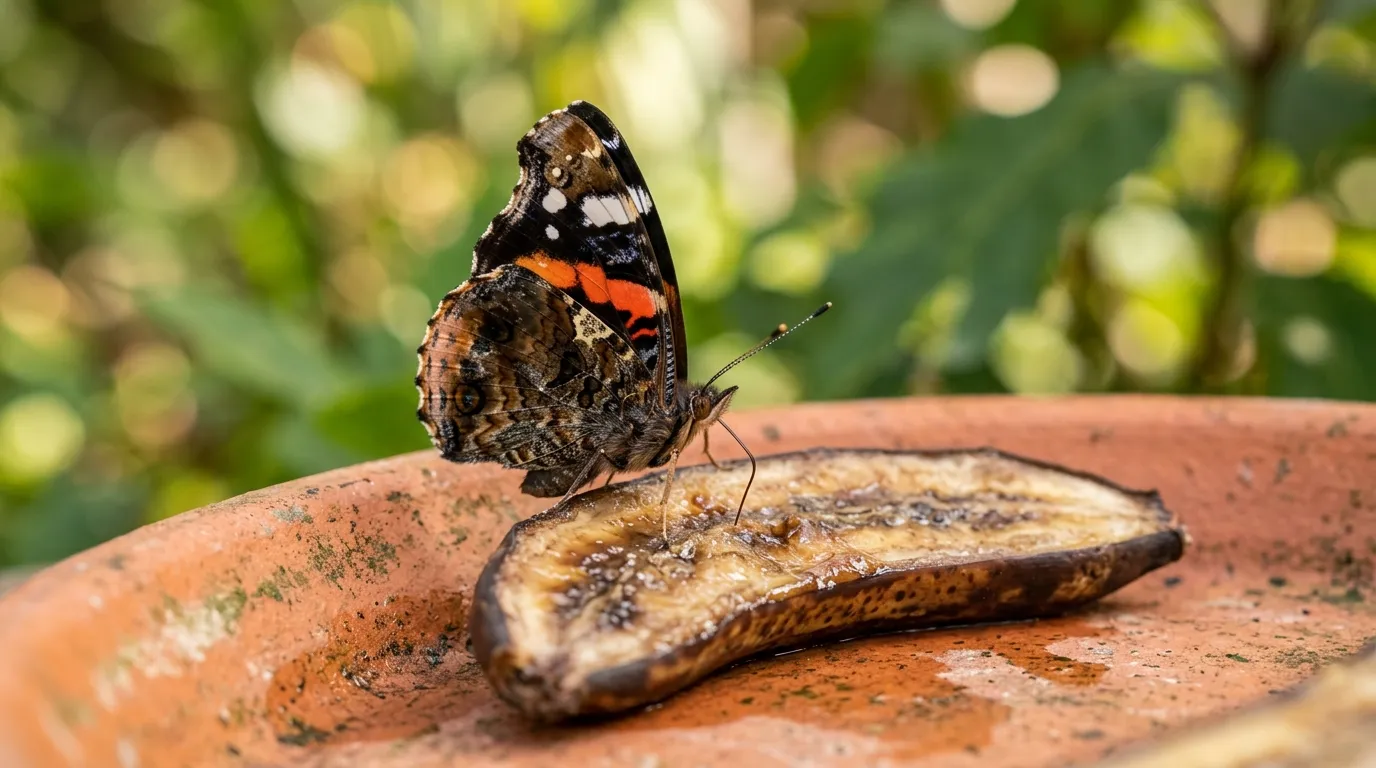
Butterflies don’t chew. They drink through a proboscis, a tube-like mouthpart that works through capillary action and muscular pumping. Fresh fruit has its sugars locked inside firm cell walls that a proboscis can’t penetrate effectively. As fruit decays, those cell walls break down, releasing liquid sugars right at the surface where a butterfly can reach them.
Fermentation adds another layer to the appeal. When fruit sits out and begins to rot, naturally occurring yeasts convert sugars into alcohol and other compounds. According to research from the journal Current Biology, many fruit-feeding butterflies are actively attracted to fermentation byproducts. The ethanol and acetic acid produced during decomposition seem to act as powerful scent signals that draw butterflies in from a distance.
Rotting fruit also provides nutrients beyond simple sugars. As organic matter decomposes, it releases amino acids, minerals, and other micronutrients that supplement the broader butterfly diet. For species that rely heavily on fruit, these decomposition byproducts are a significant part of their nutritional intake.
The Best Fruits for Attracting Butterflies
Not all fruits are created equal when it comes to butterfly appeal. Through my own backyard experiments and published entomological observations, certain fruits consistently outperform others.
Bananas are the gold standard. Overripe bananas with blackened peels have an extremely high sugar concentration and produce strong fermentation odors. I’ve had more success with banana slices than any other fruit, and butterfly researchers frequently use banana-based bait traps in field surveys for exactly this reason.
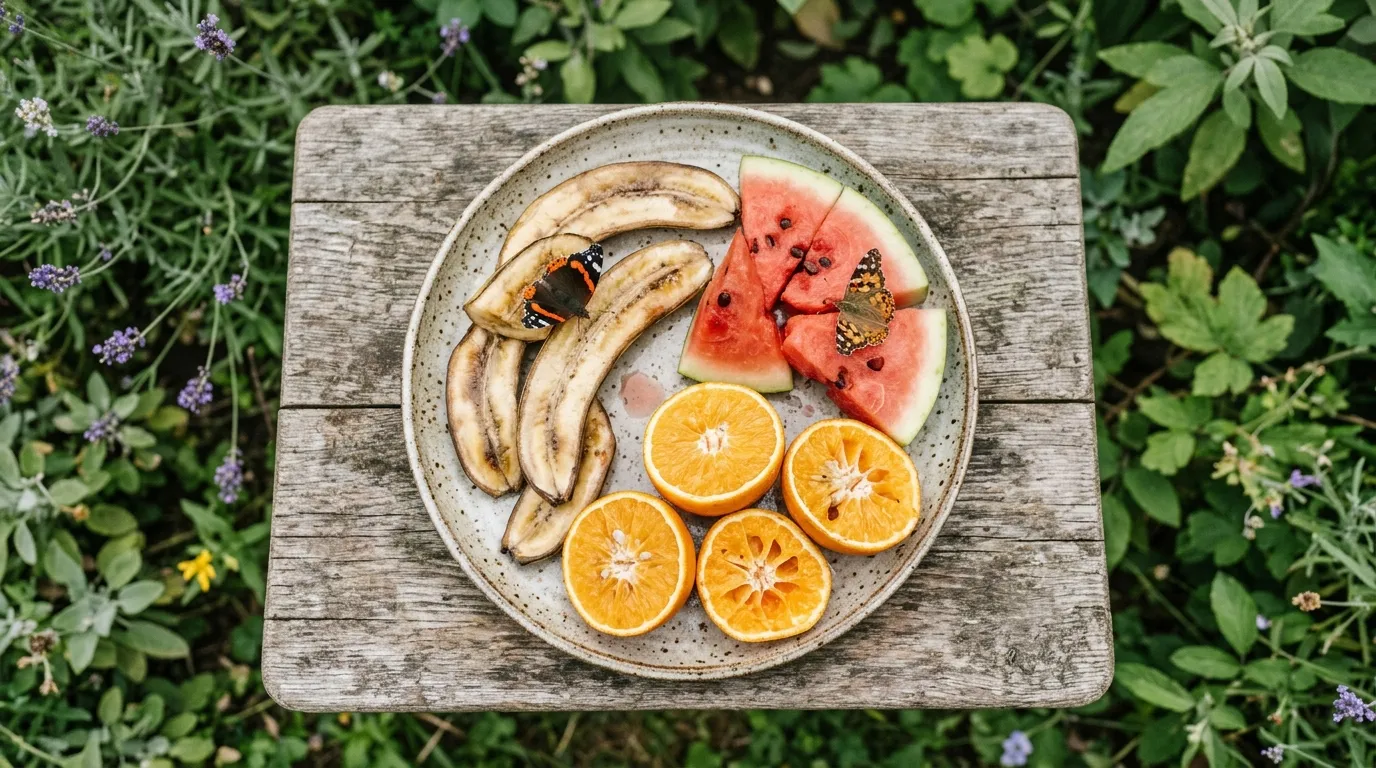
Watermelon ranks second in my experience. The high water content keeps the fruit moist and accessible longer, while its sugar content attracts a wide range of species. Cut it into chunks and leave the rind attached so it holds together as it softens.
Oranges sliced in half work well because the citrus aroma carries far and the juice pools in the exposed flesh. Grapefruits work too, though oranges seem to get more consistent attention.
Strawberries are effective once they’ve gone past their prime, turning soft and deeply red. Their small size means you’ll want to put out several at once rather than a single berry.
Mangoes and peaches both perform well during their respective seasons. Their soft, fibrous flesh retains moisture as it breaks down, creating a prolonged feeding opportunity. Mangoes in particular have an intense sweetness that seems to attract fruit feeders reliably.
For a complete guide to preparing butterfly food at home, including sugar water solutions that complement fruit feeding, check out our butterfly food recipe guide.
Which Butterfly Species Feed on Fruit
While most butterflies feed primarily on flower nectar, a significant group within the brushfoot family (Nymphalidae) are specialized or opportunistic fruit feeders. If you set up a fruit station, these are the species you’re most likely to attract.
Red admirals (Vanessa atalanta) are among the most enthusiastic fruit feeders in North America. They’ll show up at rotting fruit within hours of it being placed out, and I’ve watched them feed on the same banana slice for 20 minutes at a stretch. They also drink tree sap and mud puddle water, making them true generalist feeders.
Question marks (Polygonia interrogationis) and their close relatives, the eastern commas (Polygonia comma), are committed fruit feeders. Both species have relatively short proboscises that are better suited to lapping up surface liquids from fruit than probing deep into tubular flowers. You’ll often find them on fallen apples and pears in orchards.
Mourning cloaks (Nymphalis antiopa) are one of the first butterflies to appear each spring because they overwinter as adults. They emerge before most flowers bloom, so tree sap and early-season rotting fruit become their primary food sources. Adding fruit to your yard in late February or March can support these early risers when other food is scarce.
Hackberry emperors (Asterocampa celtis) rarely visit flowers at all. They feed almost exclusively on rotting fruit, sap, carrion, and animal droppings. If you live in an area with hackberry trees and never see these butterflies at your flower garden, a fruit station might be the way to finally bring them in.
Other occasional fruit visitors include painted ladies, common wood-nymphs, and various satyr species. Even some swallowtails will stop at fruit if they encounter it, though they rely more heavily on nectar from flowers like those used for feeding monarch butterflies.
How to Build a Fruit Feeding Station
Setting up a fruit feeding station takes about ten minutes and costs almost nothing. Here’s what works based on my own trial and error over several seasons.
Start with a shallow dish, plate, or tray. Terracotta saucers work well because their rough surface gives butterflies traction. Place it on a flat surface about two to four feet off the ground, or mount it on a post or railing. Ground-level stations work too, but elevated ones reduce ant problems and keep fruit away from slugs.
Choose a location that gets morning sun but has some afternoon shade. Full sun all day will dry out the fruit too quickly and speed up mold growth. A spot sheltered from wind is ideal since butterflies prefer calm conditions for feeding.
Cut your fruit into slices or chunks that expose the inner flesh. For bananas, peel and slice into rounds. For oranges, cut in half. For watermelon, remove the rind on one side so the flesh faces up. Place the fruit directly on the dish. No need to add water or sugar since the fruit provides everything a butterfly needs.
Replace the fruit every two days in warm weather, or whenever you see significant mold growth. A light fuzz of white mold is normal and won’t deter butterflies, but heavy black or green mold means it’s time for fresh fruit. Rinse the dish between refills to prevent bacterial buildup.
Ants will find your station. You can manage them by applying a thin ring of petroleum jelly around the post or pedestal supporting the dish. Another option is placing the dish inside a slightly larger tray filled with water, creating a moat that ants can’t cross.
According to guidelines from the North American Butterfly Association, fruit feeding stations are particularly effective in late summer and early fall when many fruit-feeding species are at peak population levels and preparing for winter dormancy or migration.
Pairing Fruit Stations With Nectar Gardens
A fruit station works best as a supplement to a nectar garden, not a replacement. The two approaches attract different species, and running both gives you the widest possible diversity of butterfly visitors.
Position your fruit station within about 15 feet of your main nectar plantings. This lets species that use both food sources move easily between them. Red admirals, for instance, will bounce between a zinnia patch and a banana plate throughout a single afternoon.
Timing matters. Your nectar garden will be busiest from mid-morning through mid-afternoon when temperatures are warmest. Fruit stations tend to attract visitors across a wider time window, including early morning and late afternoon, because fruit feeders are often more cold-tolerant than strict nectarers.
If you’re growing a garden specifically for monarchs and swallowtails, your nectar plants are doing the heavy lifting. But adding a fruit plate expands your visitor list to include all those brushfoot species that might otherwise pass your yard by entirely. The combination of both food sources, along with a homemade nectar solution for lean periods, creates a comprehensive feeding habitat that keeps butterflies coming back throughout the season.
Frequently Asked Questions
Can butterflies eat fresh fruit or does it need to be rotten?
Butterflies can land on fresh fruit, but they get very little nutrition from it. Their proboscis needs liquid sugars at the surface to feed effectively, and fresh fruit keeps those sugars locked inside firm cell walls. Overripe fruit with broken-down flesh is dramatically more useful to them. If you’re putting out fresh fruit, let it sit in the sun for a day or two before expecting butterfly visitors.
Do butterflies get drunk on fermented fruit?
There’s some evidence for it. Butterflies feeding on heavily fermented fruit have been observed flying erratically and showing reduced coordination, behaviors consistent with alcohol intoxication. A study published in Royal Society Open Science found that fruit-feeding butterflies regularly consume ethanol concentrations that would affect their nervous system. Whether this is harmful or part of their normal ecology is still debated among researchers.
Will a fruit station attract wasps and bees?
Yes, wasps and bees will also visit rotting fruit. Yellowjackets in particular are attracted to fermented fruit in late summer. You can reduce competition by placing fruit out early in the morning before wasps become active, and by using fruits like bananas that wasps find less attractive than stone fruits. If wasps become a persistent problem, moving the station to a shadier location sometimes helps since wasps prefer sun-heated food sources.
How close to my house can I put a fruit feeding station?
As close as you want. A station on a porch railing or patio table works fine. Just be aware that rotting fruit can attract fruit flies and ants if placed very close to doors or windows. A spot about 10 to 15 feet from your house is a good balance between easy viewing and keeping unwanted insects from finding their way indoors.
What time of year is best for a fruit feeding station?
Late summer through early fall is the peak window for fruit-feeding butterfly activity. Species like question marks and red admirals reach their highest population numbers during August and September. That said, mourning cloaks emerging from winter dormancy will visit fruit stations as early as late February in milder climates. You can run a station from spring through fall and adjust based on what you see showing up.
Should I use organic fruit or does it matter?
Organic is preferable when possible. Conventionally grown fruit can carry pesticide residues on the skin that may harm butterflies on contact. Washing fruit thoroughly before setting it out reduces this risk significantly. If you’re using fruit from your own garden that hasn’t been sprayed, that’s the best option of all. Grocery store fruit that’s past its prime is perfectly acceptable as long as you give it a good rinse first.


