




Most people know that butterflies start as caterpillars and end up with wings, but butterfly reproduction itself is a topic that doesn’t get nearly enough attention. The process is far more involved than two butterflies simply meeting and mating. It involves chemical signaling through pheromones, aerial courtship displays, physical positioning that can last for hours, and a highly selective egg-laying process that determines whether the next generation survives at all. Here’s what actually happens when butterflies reproduce, from the first chemical signal to the last egg placed on a leaf.
Key Takeaways
- Female butterflies release species-specific pheromones to attract males, and males respond with their own scent scales during courtship to prove they’re the right species and a fit mate.
- Butterfly mating happens in an end-to-end position where the pair connects at the abdomen, and the process can last anywhere from 20 minutes to several hours depending on the species.
- Males transfer a spermatophore during mating, a protein-rich nutrient packet that provides the female with both sperm and energy she uses for egg production.
- Females are extremely selective about where they lay eggs, using chemical receptors on their feet to test leaves and choosing only the specific host plants their caterpillars can eat.

How Butterflies Find Each Other
Butterfly reproduction starts well before any physical contact. Males and females need to locate each other across distances that can span hundreds of meters, and they rely on two main systems to do it: chemical signals and visual cues.
Pheromones are the primary long-range tool. Female butterflies release volatile chemical compounds from glands on their abdomen that drift downwind and can be detected by males from remarkable distances. Male butterflies have highly sensitive antennae covered in chemoreceptors that pick up these species-specific chemical signals. A male Cabbage White can detect a female’s pheromone plume from over 100 meters away under the right wind conditions.
Males don’t just passively wait for these signals, though. Many species patrol specific routes through their habitat, flying back and forth along edges, clearings, and flower patches where females are likely to be. According to research published by the Smithsonian Institution, male butterflies can spend the majority of their active flight time searching for mates rather than feeding.
Visual recognition also plays a role once butterflies are within sight of each other. Wing color, pattern, and even the way light reflects off wing scales help males identify females of their own species. In species like the Morpho, the iridescent blue flash of a male’s wings serves as both a territorial signal to other males and an advertisement to females.
Courtship Rituals and Displays
Once a male locates a female, courtship begins, and it’s anything but casual. The butterfly mating dance is a structured sequence of behaviors that serves a real biological purpose: it lets the female assess the male’s fitness, species identity, and genetic quality before committing to mating.
In many species, the male approaches the female from behind or below and performs a hovering display. He may flutter around her in tight circles, position himself directly in front of her face, or perform a swooping flight pattern. During this aerial performance, males of many species release their own pheromones from specialized scent scales called androconia, which are often located on the wings or leg tufts. These scent scales produce compounds the female uses to evaluate the male’s health and species membership.
Queen butterflies take this a step further. The male has hair pencils on his abdomen that he extends during flight to dust pheromone particles onto the female’s antennae. If she finds the scent acceptable, she lands and allows mating. If not, she flies away or signals rejection by raising her abdomen vertically, spreading her wings flat, or simply refusing to land.
Not all courtship happens in the air. Some species, including certain Hairstreaks, conduct their entire courtship while perched on a leaf or branch, touching antennae and releasing scent compounds at close range.
Hilltop Mating Behavior
One of the more unusual reproductive strategies in butterflies is called hilltopping. Males of certain species fly to the highest point in the local landscape, whether that’s an actual hilltop, a ridge, or just a slightly elevated area, and then perch or patrol there waiting for females.
The logic is straightforward. When butterflies are spread across a large area at low population densities, random searching becomes inefficient. By converging on a predictable meeting spot, both sexes increase their chances of finding each other.
Swallowtails are some of the best-known hilltoppers. Males of species like the Western Tiger Swallowtail will congregate on exposed hilltops, chasing away rival males and intercepting any females that fly through. According to a study published in the journal Behavioral Ecology, hilltop territories are often dominated by larger, more vigorous males, which means hilltopping acts as a natural quality filter that helps females mate with the fittest available partners.
Females that visit hilltops are typically unmated and ready to reproduce. They fly through, encounter competing males, and select a mate based on courtship performance. It’s a concentrated mating market that benefits both sexes.
The Mating Process
When a female accepts a male, the actual mating process begins. Butterflies mate in an end-to-end position, with both individuals facing away from each other and their abdomens joined at the tip. The male uses a pair of clasping organs called valvae to grip the female’s abdomen and maintain the connection.
This connected position can last anywhere from 20 minutes to over eight hours, depending on the species. During this time, the pair is vulnerable to predators since their flight ability is severely compromised. If disturbed, one butterfly (usually the larger female) will carry the other in flight, but the connection generally holds. You can sometimes spot a mated pair sitting quietly on a leaf or branch, facing opposite directions, waiting for the process to finish.
The length of mating isn’t random. Longer mating durations are associated with larger spermatophore transfers. The spermatophore is a capsule-like packet the male produces and transfers to the female’s reproductive tract during mating. It contains sperm along with a substantial package of proteins, amino acids, and other nutrients. The female breaks down these nutrients over the following days and uses them to fuel egg production. In some species, a single spermatophore can account for up to 10% of the male’s body weight.
This nutrient transfer is one reason females of many species mate multiple times, with each mating providing a fresh supply of sperm and energy for egg development. Males have a different incentive. Some species have evolved a mating plug, a hardened secretion deposited after the spermatophore that physically blocks the female’s reproductive opening and delays her ability to remate.
Egg Laying and Host Plant Selection
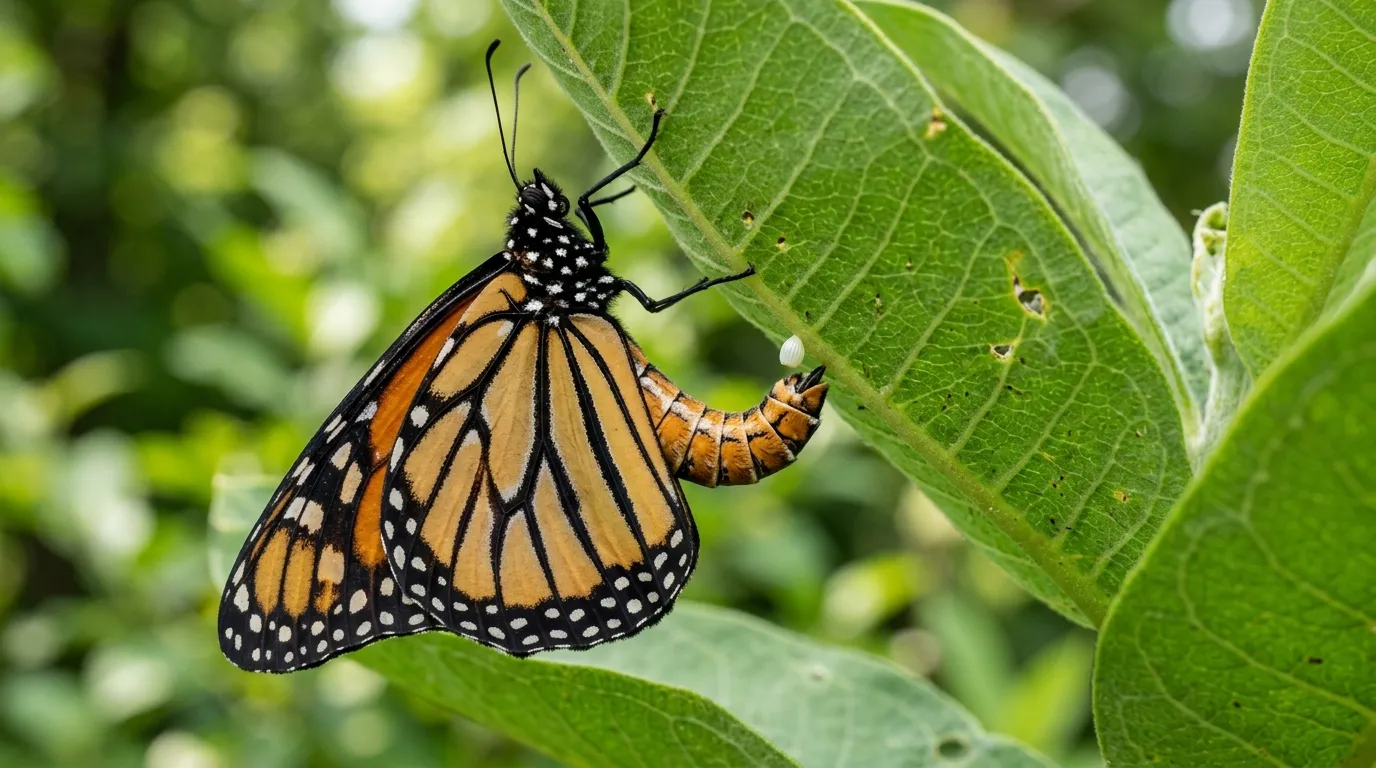
After mating, the female’s focus shifts entirely to finding the right places to lay her eggs. This is where butterfly reproduction gets remarkably precise. A female doesn’t just drop her eggs anywhere. She has chemical sensors on her front tarsi (feet) that she uses to “taste” leaf surfaces, testing each potential host plant before committing a single egg to it.
The host plant has to be exactly right. Monarch females lay exclusively on milkweed. Black Swallowtail females target plants in the carrot family. Painted Ladies use thistles, hollyhocks, and a handful of other options. If the plant chemistry doesn’t match what the caterpillar needs, the female moves on. You can read more about how this process works in this butterfly egg laying guide.
Beyond plant species, females also evaluate the condition of individual plants. They tend to avoid plants that are already heavily damaged by other caterpillars, plants that are stressed or wilting, and plants growing in deep shade where caterpillar development would be slower. Some species also avoid plants that already have eggs on them from other females, spacing out the next generation to reduce competition.
Egg placement on the plant is deliberate too. Some species lay on leaf undersides where eggs are shielded from rain and direct sun. Others place eggs near growing tips where the youngest, most nutritious leaves will be ready when the caterpillar hatches. The total number of eggs varies by species, from around 100 to over 500 across the female’s adult lifespan.
Female Selectivity and Rejection Behaviors
Female butterflies are not passive participants in reproduction. They exercise a significant degree of choice over who they mate with and when, and they have specific behaviors for turning down unwanted males.
The most common rejection signal is the “abdomen raise” posture. A female who has already mated or isn’t interested will land, close her wings, and raise her abdomen straight up in the air, making it physically impossible for the male to connect. This posture is well documented across dozens of species and is unmistakable once you know what to look for.
Other rejection tactics include rapid erratic flight to outmaneuver the male, dropping to the ground and remaining motionless, and wing-spread postures that block access. In some Pierid butterflies, recently mated females produce anti-aphrodisiac pheromones that actively repel approaching males.
Why be so selective? Mating has real costs for females. The time spent coupled is time not spent feeding or laying eggs, and there’s physical wear on wings from extended male pursuit. Since sperm from a single mating can fertilize eggs over several days, a female doesn’t always need to mate again. According to research from the American Museum of Natural History, female choice is a major driver of sexual selection in butterflies, influencing everything from male wing coloration to pheromone chemistry over evolutionary time.
Frequently Asked Questions
How long does butterfly mating last?
Mating duration varies widely across species. Some smaller butterflies complete the process in 20 to 30 minutes. Larger species like swallowtails may remain connected for two to four hours. In certain extreme cases, mating can last eight hours or longer. The duration is linked to the size of the spermatophore being transferred and the complexity of the mating plug the male deposits afterward.
Do butterflies mate more than once?
Yes, both males and females can mate multiple times. Males try to mate as often as possible, though each successive spermatophore tends to be smaller. Females often mate two or three times, gaining fresh sperm and nutrient packets from each encounter. Some species have adapted mating plugs to reduce female remating, but these are not always effective.
How do butterflies choose their mates?
Females evaluate males based on visual displays, pheromone quality, flight performance, and body size. Wing color intensity often signals good nutrition and genetic health. In hilltopping species, the ability to hold a prime territory position serves as a proxy for overall fitness. Males are less selective and will pursue any female of the correct species.
What is a spermatophore and why does it matter?
A spermatophore is a capsule-like packet the male transfers to the female during mating. It contains sperm for fertilizing eggs along with a mix of proteins, salts, and amino acids that the female metabolizes and uses as energy for egg production. In some species, the nutrients in a spermatophore can increase the number of eggs a female produces by 30% or more compared to females that only mated once. It’s a direct male investment in the next generation.
Why do female butterflies test leaves with their feet before laying eggs?
Female butterflies have chemoreceptors on their front tarsi that function like taste buds. When a female drums her feet against a leaf surface, she’s detecting chemical compounds that identify the plant species. She can also assess the plant’s health and whether it’s been treated with chemicals. This foot-testing ensures eggs are placed only on plants where caterpillars will have the right food after hatching.
Can butterflies reproduce without mating?
No. Butterflies require sexual reproduction to produce fertile eggs. Unmated females of some species will still lay eggs, but those eggs are infertile and won’t hatch. Parthenogenesis has been documented in a few moth species under laboratory conditions, but it does not occur naturally in butterflies.


