




Butterflies die from a surprisingly long list of causes, and old age is actually one of the least common. How do butterflies die? Most are killed by predators, parasites, disease, weather, or human activity long before they reach the natural end of their adult lifespan. The average adult butterfly lives just two to four weeks, and during that time it faces threats from every direction – birds, spiders, wasps, viral infections, pesticides, and even car windshields. Understanding what kills butterflies puts their short lives in perspective and explains why they produce so many eggs. The odds are stacked against every single one.
Key Takeaways
- Most butterflies never die of old age because predators, parasites, disease, and weather kill them first, often within days or weeks of emerging as adults.
- Birds are the single biggest predator threat to adult butterflies, but spiders, dragonflies, praying mantises, and robber flies also take a heavy toll across every habitat.
- Parasitoid insects like tachinid flies and braconid wasps kill butterflies from the inside during the caterpillar stage, and infection rates in some populations run above 50%.
- Human-caused mortality from pesticides, habitat destruction, vehicle collisions, and window strikes now rivals natural causes as a leading killer of butterfly populations across North America.
Natural Causes: Old Age, Cold, and Starvation
When a butterfly does manage to avoid every predator and parasite out there, it still has a built-in expiration date. Adult butterflies have a fixed amount of energy and body tissue that gradually breaks down. Their wings accumulate damage from flight, weather, and contact with vegetation. Scales flake off, membranes tear, and eventually the wings become too tattered to sustain controlled flight. Once a butterfly can’t fly, it can’t feed, and starvation follows quickly.
The natural lifespan of most adult butterflies falls between two and six weeks, though some species break this pattern dramatically. Mourning Cloaks can survive up to 11 months by overwintering as adults. Monarchs in the migratory generation live eight to nine months. But a Painted Lady or Cabbage White? Two to three weeks is the norm.
Cold weather kills large numbers of butterflies each year, particularly species caught in unexpected frosts. Butterflies are ectothermic, meaning they rely on external heat sources to maintain body function. When temperatures drop below about 55 degrees Fahrenheit, most species can’t fly. Below freezing, ice crystals form in body tissues, causing lethal cellular damage. Species that overwinter in cold climates survive by entering diapause in a freeze-tolerant life stage, but adults caught out in a late spring frost or early autumn cold snap typically don’t make it.
Starvation and dehydration are related killers. Butterflies need to feed regularly on nectar, fruit juices, or other liquid food sources. A butterfly that emerges during a drought, a cold spell that keeps flowers from blooming, or in an area where pesticides have wiped out wildflowers may simply not find enough food to sustain itself. Dehydration can kill even faster than starvation – butterflies lose moisture rapidly through their spiracles and wing surfaces, and without access to water, damp soil, or nectar, they can die within 48 hours on a hot, dry day.
How Do Butterflies Die From Predation
Predation is probably the single largest cause of butterfly death across all life stages. The list of animals that eat butterflies is extensive, and the pressure never lets up.
Birds are the dominant predators of adult butterflies in nearly every habitat. Warblers, flycatchers, orioles, tanagers, and sparrows all regularly catch butterflies on the wing or pluck them from flowers. According to researchers at Cornell Lab of Ornithology, many songbird species increase butterfly consumption during the breeding season when they need extra protein for growing nestlings. A single nesting pair of chickadees can consume thousands of caterpillars and dozens of adult butterflies over a breeding season.
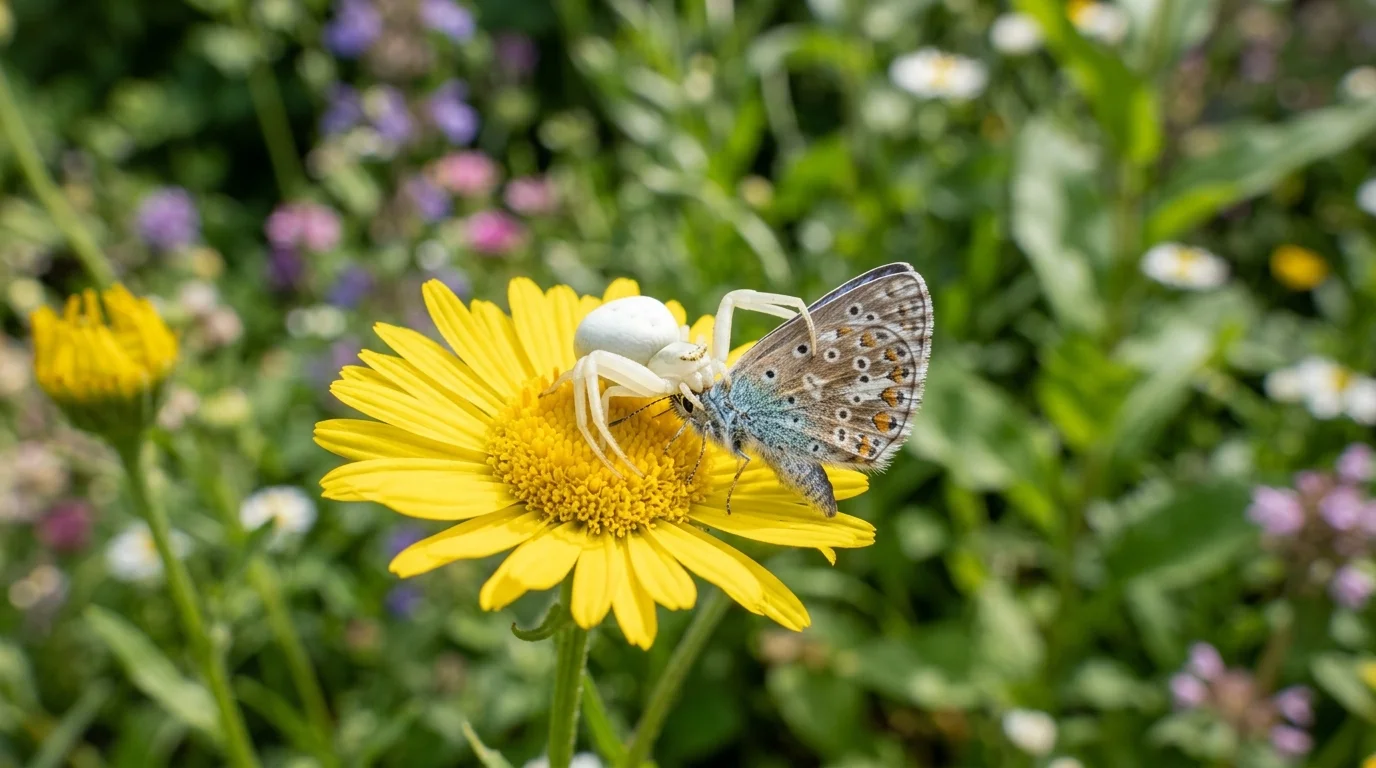
Spiders take a massive toll that often goes unnoticed. Orb weavers build webs in flight corridors and flower patches where butterflies are concentrated. Crab spiders sit camouflaged inside flowers, grabbing butterflies the moment they land to feed. I’ve seen crab spiders take down butterflies twice their size just by latching onto the proboscis as the butterfly starts to uncoil it into the flower. Jumping spiders actively stalk smaller butterfly species on leaves and stems.
Dragonflies are aerial predators fast enough to catch butterflies in open flight. Large darner dragonflies will intercept a butterfly mid-flight, grab it with their spiny legs, and consume it on the wing or from a perch. Praying mantises use a different strategy – they sit motionless near flowers and strike with their raptorial forelegs when a butterfly lands within range. The strike takes about 50 milliseconds, far too fast for the butterfly to react.
Robber flies, assassin bugs, lizards, frogs, and even mice round out the predator list. At the caterpillar stage, the threats multiply further with paper wasps, yellowjackets, ground beetles, and parasitoid wasps all targeting larvae. Most butterfly species compensate for this intense predation by producing large numbers of eggs – a female Monarch may lay 300 to 500 eggs knowing that fewer than 5% will survive to become adults.
Parasitoids That Kill From the Inside
Parasitoids are a category of killer that most people don’t know about, and they’re responsible for a staggering number of butterfly deaths at the caterpillar and chrysalis stages. Unlike a parasite that feeds on its host without killing it, a parasitoid always kills its host as part of its life cycle.
Tachinid flies are among the most common butterfly parasitoids. The adult fly lays eggs on or near a caterpillar. Some species glue eggs directly to the caterpillar’s skin. Others lay eggs on leaves that the caterpillar then eats. Once the tachinid larvae hatch, they burrow into the caterpillar and feed on its internal tissues, carefully avoiding the organs needed to keep the host alive until the fly larvae are ready to pupate. The caterpillar may appear normal for days while being consumed from the inside. When the tachinid larvae are mature, they either exit the caterpillar to pupate in the soil or consume the remaining tissues and pupate inside the caterpillar’s husk.
Braconid wasps operate similarly but with some unsettling additions. A female Cotesia wasp injects dozens of eggs into a caterpillar along with a polydnavirus – a virus that suppresses the caterpillar’s immune system so it can’t encapsulate and kill the wasp eggs. The developing wasp larvae feed inside the caterpillar for weeks. When ready, they chew through the caterpillar’s skin and spin tiny white cocoons on the outside of the still-living host. Research published by the University of Kentucky Department of Entomology has documented parasitism rates exceeding 60% in some caterpillar populations during peak wasp activity.
Chalcid wasps target chrysalises, drilling through the pupal case to lay eggs inside. The developing butterfly never emerges – instead, tiny wasps chew their way out weeks later. If you’ve ever found a chrysalis with small round exit holes, that’s the evidence of chalcid parasitism.
Disease: OE, NPV, and Bacterial Infections
Butterflies are susceptible to a range of diseases caused by protozoan parasites, viruses, bacteria, and fungi. Some of these diseases operate at low background levels in healthy populations. Others can flare into outbreaks that wipe out a significant portion of a local population.
Ophryocystis elektroscirrha (OE) is the most well-known butterfly disease, primarily affecting Monarchs. OE is a protozoan parasite that forms spores on the outside of infected adult butterflies, concentrated on the abdomen and wing scales. When an infected female lays eggs on milkweed, she deposits spores along with the eggs. Caterpillars ingest the spores while eating, and the parasite reproduces inside the caterpillar, with new spores forming during the pupal stage. Heavily infected adults emerge with crumpled wings, reduced body size, and shortened lifespans. According to research from the Project Monarch Health program at the University of Georgia, OE infection rates in non-migratory Monarch populations in southern Florida and Hawaii can exceed 70%, compared to less than 10% in migratory eastern populations.
Nuclear Polyhedrosis Virus (NPV) is a baculovirus that kills caterpillars across many butterfly and moth species. An infected caterpillar stops eating, climbs to a high position on its host plant, and liquefies. The virus breaks down the caterpillar’s body into a dark fluid packed with billions of viral particles that rain down onto the foliage below, where other caterpillars ingest them. NPV outbreaks tend to be density-dependent, flaring up when caterpillar populations are high and crowded.
Bacterial infections, particularly from Pseudomonas and Serratia species, can kill caterpillars and pupae. These bacteria often enter through wounds from predator attacks or parasitoid oviposition. Bacterial septicemia turns the caterpillar dark and limp within 24 to 48 hours. Fungal infections from Beauveria bassiana and related species can also kill caterpillars and adults, particularly in humid conditions where fungal spores thrive.
Human Causes: Pesticides, Habitat Loss, and Collisions
The human contribution to butterfly mortality has grown enormously over the past century, and it now operates at a scale that rivals all natural causes combined in many regions.
Pesticides kill butterflies both directly and indirectly. Insecticides sprayed on crops, lawns, and gardens don’t discriminate between pest insects and butterflies. Neonicotinoid insecticides are particularly damaging because they’re systemic – they’re absorbed into plant tissues, including nectar and pollen, meaning butterflies that feed on treated flowers ingest the toxin. Even sub-lethal doses of neonicotinoids can impair butterfly navigation, reduce reproductive success, and shorten lifespans. Herbicides do their damage by killing the wildflowers and host plants butterflies depend on. The widespread use of glyphosate on Roundup-Ready crops across the Midwest has eliminated milkweed from millions of acres of farmland, contributing directly to the Monarch population decline.
Habitat loss is the slower, more permanent killer. When a meadow is paved for a parking lot, a hedgerow is ripped out for field expansion, or a forest edge is cleared for development, the butterfly populations that depended on those specific plants and microclimates disappear with them. The Xerces blue butterfly went extinct in the 1940s when its San Francisco sand dune habitat was developed. The Miami Blue nearly followed in the 2000s as coastal hammock habitat in the Florida Keys was lost to development and hurricanes.
Vehicle strikes are an underappreciated source of butterfly mortality. A 2019 study estimated that billions of insects, including significant numbers of butterflies, are killed on U.S. roads annually. Butterflies are particularly vulnerable because many species fly at windshield height (three to six feet), they’re attracted to warm road surfaces for basking, and they often puddle on damp road shoulders. During migration season, stretches of highway through butterfly corridors can see heavy mortality.
Window strikes kill butterflies the same way they kill birds. Butterflies see reflected sky or vegetation in glass and fly directly into it. The impact damages wings and body structures. While individual window kills seem minor, the cumulative toll across millions of buildings adds up, particularly for urban and suburban butterfly populations.
Frequently Asked Questions
Do butterflies feel pain when they die?
Butterflies have a nervous system and nociceptors that detect harmful stimuli, but they don’t process pain the way mammals do. They lack the brain structures associated with subjective suffering. They do respond to damaging stimuli with avoidance behaviors – pulling away from a spider’s grasp, for example – but whether this constitutes “feeling pain” in any conscious sense is debated among entomologists. The current scientific consensus is that insects react to harmful stimuli without experiencing pain as we understand it.
How long can a butterfly survive without food?
Most adult butterflies can survive two to four days without feeding under moderate conditions. In cool weather, when their metabolic rate drops, they may last slightly longer. In hot, dry conditions, dehydration becomes the limiting factor, and a butterfly without access to water or nectar may die within 24 to 48 hours. Some overwintering species can survive months without feeding by entering diapause, a state of suspended metabolic activity.
What percentage of butterfly eggs survive to adulthood?
Survival rates from egg to adult are extremely low for most species, typically ranging from 1% to 5%. A Monarch female may lay 400 eggs, and on average only about 10 to 20 of those will produce an adult butterfly. Losses occur at every stage – eggs are eaten by ants and parasitized by wasps, caterpillars fall to predators and disease, and chrysalises are attacked by chalcid wasps and birds. This high attrition rate is the reason butterflies lay so many eggs.
Can a butterfly with a torn wing still survive?
It depends on how much wing area is lost. Butterflies can fly with up to about 30% of their wing surface missing, though flight becomes less efficient and more energy-costly. A small tear or chip in the wing margin is usually survivable. Losing a large portion of a hindwing is more manageable than losing part of a forewing, since the forewings provide most of the flight power. A butterfly with severely damaged wings will struggle to feed, escape predators, and find mates, so its remaining lifespan is usually shortened even if it can still fly.
What kills monarch butterflies specifically?
Monarchs face all the standard threats plus some specific ones. The OE parasite is a major killer in non-migratory populations. Milkweed loss from herbicide use has reduced breeding habitat across the Midwest. At overwintering sites in Mexico, illegal logging and severe winter storms have killed millions of butterflies in single events. Monarchs are also heavily targeted by tachinid flies and Cotesia wasps during the caterpillar stage, with parasitism rates reaching 30% or higher in some locations.
Do butterflies die after laying eggs?
Female butterflies don’t die immediately after laying eggs the way some insects do. They continue laying eggs over a period of days to weeks, feeding between bouts of egg-laying. A female will keep laying until she runs out of mature eggs or her body gives out from age and accumulated damage. The egg-laying period and the end of a female’s life often coincide simply because both are governed by the butterfly’s limited adult lifespan, not because egg-laying itself causes death.
Is climate change killing butterflies?
Climate change is affecting butterfly populations through several mechanisms. Warmer winters can disrupt diapause timing, causing butterflies to emerge before their food plants are available. Increased drought frequency reduces nectar availability and dries out host plants. Range shifts push cold-adapted species toward higher elevations and latitudes where suitable habitat may not exist. A 2021 study in the journal Science documented a 33% decline in western North American butterfly populations over the past two decades, with warming temperatures identified as a primary driver alongside habitat loss.


