




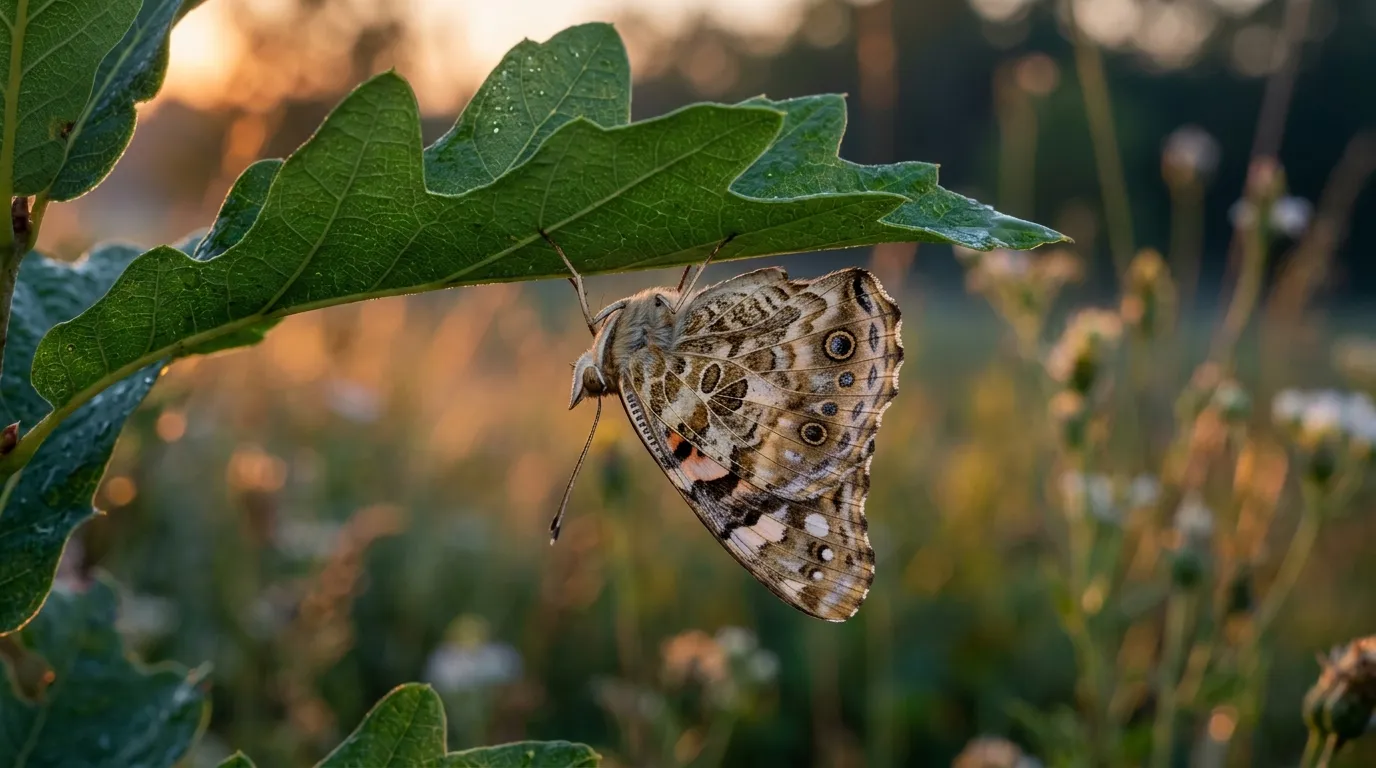
How do butterflies sleep? They don’t – at least not the way you and I do. Butterflies lack the brain structures for true sleep, but they enter a resting state called torpor that serves a similar purpose. As the sun goes down and temperatures drop, they find a sheltered spot, grip a leaf or stem with their legs, fold their wings closed, and go still until morning. I’ve found them hanging under leaves in my garden at dusk, completely motionless and unresponsive to everything short of a direct touch. It looks like sleep, and it functions like sleep. But what’s actually happening is more about temperature and survival than anything resembling a good night’s rest.
Key Takeaways
- Butterflies rest in a state called torpor rather than true sleep – their metabolism slows, body temperature drops, and they become largely unresponsive until warmth returns.
- Most species roost by hanging upside down under leaves, on stems, or in bark crevices with wings folded closed to expose camouflaged undersides.
- Temperature and light are the main triggers for roosting – cold snaps and heavy rain can force butterflies into torpor during the day, not just at night.
- Some species, particularly monarchs during migration, roost communally in clusters of hundreds or thousands for warmth and predator protection.
Torpor Is Not Sleep
When mammals sleep, the brain cycles through distinct stages including REM sleep, consolidating memories and repairing cells. Butterflies have nothing like that going on. Their nervous systems are too simple for the kind of active neural processing that defines vertebrate sleep.
What happens instead is a passive metabolic slowdown. As temperatures fall below about 15 degrees Celsius (60 Fahrenheit), a butterfly’s thoracic flight muscles can no longer generate enough heat for wing movement. The insect becomes grounded, its metabolic rate drops, and it enters torpor. Heart rate slows. Antennae stop twitching. The butterfly will respond to a serious threat – a predator grabbing at it – but minor disturbances go unnoticed.
I’ve approached roosting butterflies at dawn and gotten within an inch of their faces without any reaction. Their sensory systems are running on standby. That level of unresponsiveness goes beyond what you’d see in a sleeping dog or cat, which will stir at a nearby sound. For a roosting butterfly in cool air, the world is mostly switched off until the sun comes back.
Research on fruit flies has shown that rest deprivation impairs their function, similar to how sleep deprivation affects mammals. Whether butterflies show the same dependence on their nightly torpor hasn’t been studied as thoroughly, but the pattern suggests they genuinely need these rest periods to function normally. Their overall lifespan may well depend on getting adequate rest.
Where Do Butterflies Sleep at Night
Butterflies are picky about their roosting spots. The ideal location checks several boxes at once: sheltered from wind and rain, hidden from predators, and positioned to catch early morning sun for a quick warm-up at dawn.
The underside of leaves is the most popular choice across species. Hanging upside down beneath a leaf gives protection from rain and makes the butterfly nearly invisible to birds scanning from overhead. The folded wings present only the cryptic underside pattern – dull browns, grays, and mottled patches that look nothing like the bright upper surfaces you see during flight. A comma butterfly roosting under an oak leaf just looks like another dead leaf edge.
Grass stems and tall herbaceous plants work well too, particularly in meadow habitats where butterflies are common. A butterfly clinging to a grass blade sways with the breeze rather than fighting it, which helps it stay attached without burning energy. The lower third of the plant is preferred, where wind exposure is reduced.
Tree bark is another option, especially for species with bark-patterned undersides. Anglewings, wood nymphs, and mourning cloaks blend into rough bark so well you can stare directly at one and miss it. Bark crevices, rock overhangs, building eaves, and dense shrub interiors get used as well, particularly where natural vegetation is sparse.
Communal Roosting and Why Some Species Cluster
While most butterflies roost alone, certain species gather in groups overnight. The most famous example is monarch butterflies during fall migration. Migrating monarchs form communal roosts numbering in the hundreds or thousands, filling entire tree branches with packed clusters of orange and black wings. These stopover roosts happen along migration corridors every evening as the butterflies settle in before continuing south the next morning.
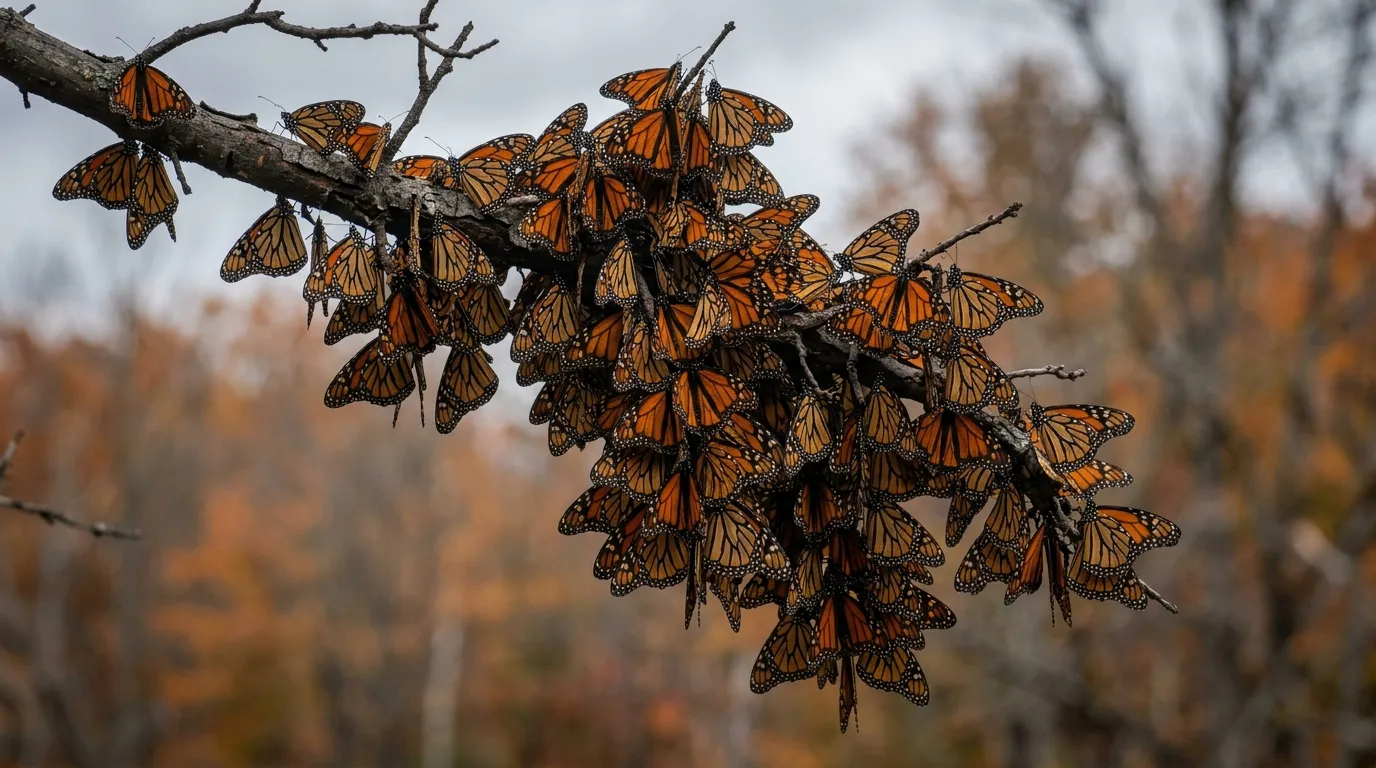
Communal roosting offers two main advantages. Clustering conserves body heat – butterflies in the center of a packed group lose less heat overnight than individuals roosting alone. There’s also safety in numbers. A bird approaching a roost cluster is more likely to startle the group and catch none than to successfully pick off an individual from a tightly packed mass.
Tropical heliconian butterflies also roost communally year-round, returning to the same branch night after night. Research from the Florida Museum of Natural History has documented heliconians using the same roost sites for weeks or months, with established pecking orders about who gets the safest interior positions. Some common North American species like zebra longwings show this behavior in southern Florida. Solitary roosting species occasionally form small clusters during cold snaps, grouping together for warmth when temperatures drop unexpectedly.
What Triggers Roosting Behavior
Two factors dominate: temperature and light. Temperature is the more powerful trigger in most situations.
Butterflies are ectotherms – their body temperature tracks the air around them rather than being regulated internally. Flight requires thoracic muscle temperatures of roughly 27 to 35 degrees Celsius depending on species. When ambient temperature falls below that threshold, the butterfly has no choice but to stop. This is why you see them becoming sluggish in late afternoon well before sunset – the air is cooling, and their muscles are losing the heat they need.
Light matters because butterflies are diurnal and navigate by sun position. As light fades, they lose both warmth and the visual cues they rely on for orientation. Most species begin searching for roost sites 30 to 60 minutes before sunset, moving slowly from perch to perch without feeding.
Rain overrides the normal light-based schedule. Even on a warm day, heavy rain forces butterflies into shelter. Their wings are covered in tiny scales that large raindrops can strip away, and waterlogged wings compromise flight. Most species can’t fly effectively in rain and will find cover and wait it out. Overcast skies suppress activity too – I’ve watched painted ladies sit motionless on stems for hours during cloudy stretches, then become active within minutes once a gap in the clouds let direct sun through.
Wing Position and Overnight Camouflage
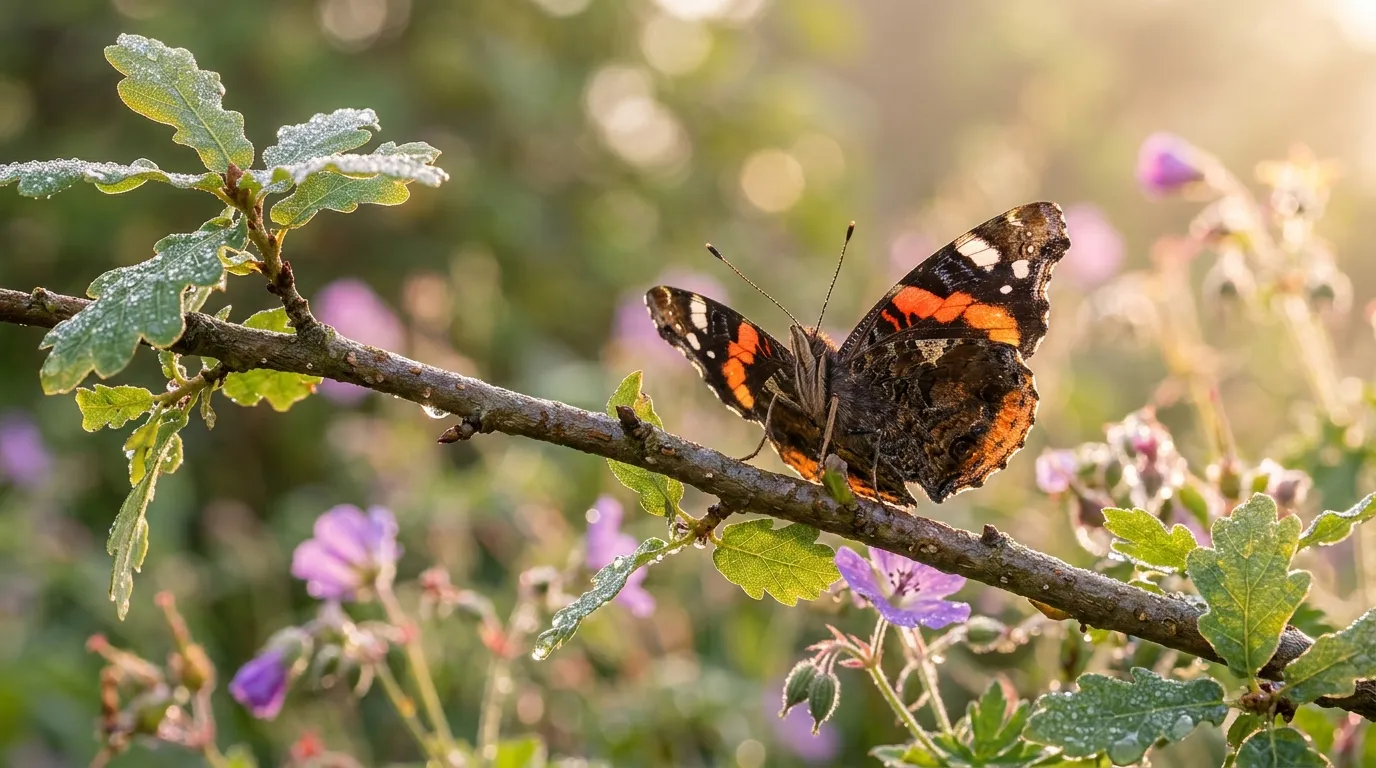
Almost all butterflies roost with their wings folded vertically over their backs, pressed tightly together. This is the opposite of the open-wing basking posture you see during active daytime hours. The folded position serves two purposes: it reduces the butterfly’s visible profile to a thin edge, and it hides the brightly colored upper wing surfaces that could attract a predator’s eye in dim light.
The underside wing patterns on many species are adapted specifically for roosting camouflage. Dead leaf butterflies in the genus Kallima have undersides that mimic a dried leaf right down to fake veins and fungal spots. North American species like the eastern comma and question mark have bark-like patterns on their underside surfaces. Even the monarch’s bright orange upper wings flip to reveal a paler, less conspicuous underside at rest.
Some skippers break this pattern and roost with wings partially open in a flat “delta” posture, pressing themselves against stems or leaves. Certain tropical species roost with wings fully open and flat against the underside of a branch, where their upper wing pattern blends into the bark surface above. Wing position during roosting is shaped by predation pressure and the specific environment each species has adapted to.
Overnight Predators and Vulnerability
A roosting butterfly is about as vulnerable as it gets. Unable to fly, largely unresponsive, and fixed in one position for hours – it’s an easy target for anything that can find it. The entire roosting strategy is built around not being found.
Nocturnal predators that take roosting butterflies include spiders, earwigs, ants, and small mammals like mice and shrews. A spider building a web near a regular roost site can catch the same butterfly returning to its favored perch. According to research from the Smithsonian Entomology Department, predation during rest periods is a meaningful source of adult butterfly mortality, though exact rates vary by habitat and season.
Early-rising birds also pose a threat. There’s a window after sunrise when the air is still cool and butterflies remain in torpor on their roost. A few species of warblers and flycatchers exploit this window by hunting along hedgerows in first light, picking off butterflies before they can warm up enough to escape. The camouflage strategies above – wing folding, cryptic undersides, choosing concealed positions – are all direct responses to this predation pressure.
How Butterflies Find Their Roost Sites
Butterflies don’t just drop wherever they happen to be when the sun goes down. In the hour before sunset, watch their behavior shift. They stop visiting flowers. Flight changes from the purposeful zigzag of foraging to a slower drift from perch to perch. They’re testing spots – landing on a leaf, staying a moment, moving on, trying another. When a position meets their criteria (shelter, grip quality, concealment), they settle and stay.
Many return to the same roost on consecutive nights. I’ve watched a red admiral use the same underside of the same hosta leaf four nights running. This site fidelity suggests some form of spatial memory, though it could be as simple as recognizing familiar visual landmarks near a spot that worked before.
Proximity to food sources plays a role too. Butterflies tend to roost within their foraging range, close enough to nectar sources to begin feeding quickly once they warm up in the morning. Woodland edges are prime roosting habitat – they offer sheltered vegetation with open meadows and garden beds nearby for morning foraging. If you maintain a butterfly-friendly garden with good habitat structure, you’re likely hosting overnight guests whether you realize it or not.
Frequently Asked Questions
Do butterflies sleep with their eyes open?
Yes, because they have no choice. Butterflies don’t have eyelids, so their compound eyes remain physically open at all times. During torpor, the visual system runs at minimal capacity. The eyes aren’t actively processing input the way they do during flight. A roosting butterfly’s sensory systems are in standby mode, and very little visual information is being registered until it warms up.
Where do butterflies go when it rains?
They seek the same sheltered spots they use for overnight roosting – undersides of large leaves, dense shrub interiors, bark crevices, and rock overhangs. Most butterflies sense the drop in barometric pressure before a storm and settle into shelter before rain actually starts. More on how weather affects their flying ability in our piece on whether butterflies can fly in rain.
Do butterflies dream?
There’s no evidence for it. Dreaming in vertebrates is linked to REM sleep, a neurological state that butterflies almost certainly don’t experience. Their brains during torpor show minimal activity rather than the cycling patterns seen in sleeping mammals and birds. The butterfly nervous system isn’t structured to support the memory replay and consolidation associated with vertebrate dreaming.
How long do butterflies roost each night?
Typically from dusk to mid-morning – roughly 8 to 12 hours depending on season and latitude. The end of roosting is temperature-dependent rather than time-dependent. On warm mornings, butterflies resume activity within 30 minutes of sunrise. On cold mornings, they stay on their roost well past mid-morning, basking with open wings until they generate enough muscle heat for flight. There’s no fixed alarm clock – it’s all about when conditions allow them to fly.
Can you keep a butterfly overnight?
If you find a butterfly that needs temporary shelter during a cold snap, place it in a ventilated container with a small piece of fruit or a cotton ball soaked in sugar water. Keep it in a cool, dark room so it enters torpor naturally. Release it the following day when temperatures are above 60 Fahrenheit and the sun is out. Keeping butterflies confined long-term is not recommended.
Do monarch butterflies sleep differently during migration?
Yes. During fall migration, monarchs form massive communal roosts containing hundreds to thousands of individuals packed onto tree branches. They cluster for warmth conservation and predator dilution, using each stopover for one or two nights before continuing south. At the overwintering sites in Mexico, communal roosting becomes semi-permanent, with millions of butterflies clustering in oyamel fir trees for months. No other North American species roosts at that scale.


