

Swallowtail butterflies are some of the most recognizable insects in the world. They show up in backyard gardens, forest edges, and open meadows across every continent except Antarctica – and once you learn what to look for, you’ll start spotting them everywhere. This guide covers the major North American species, how to tell them apart, where they live, and what their life cycle looks like from egg to adult.
Key Takeaways
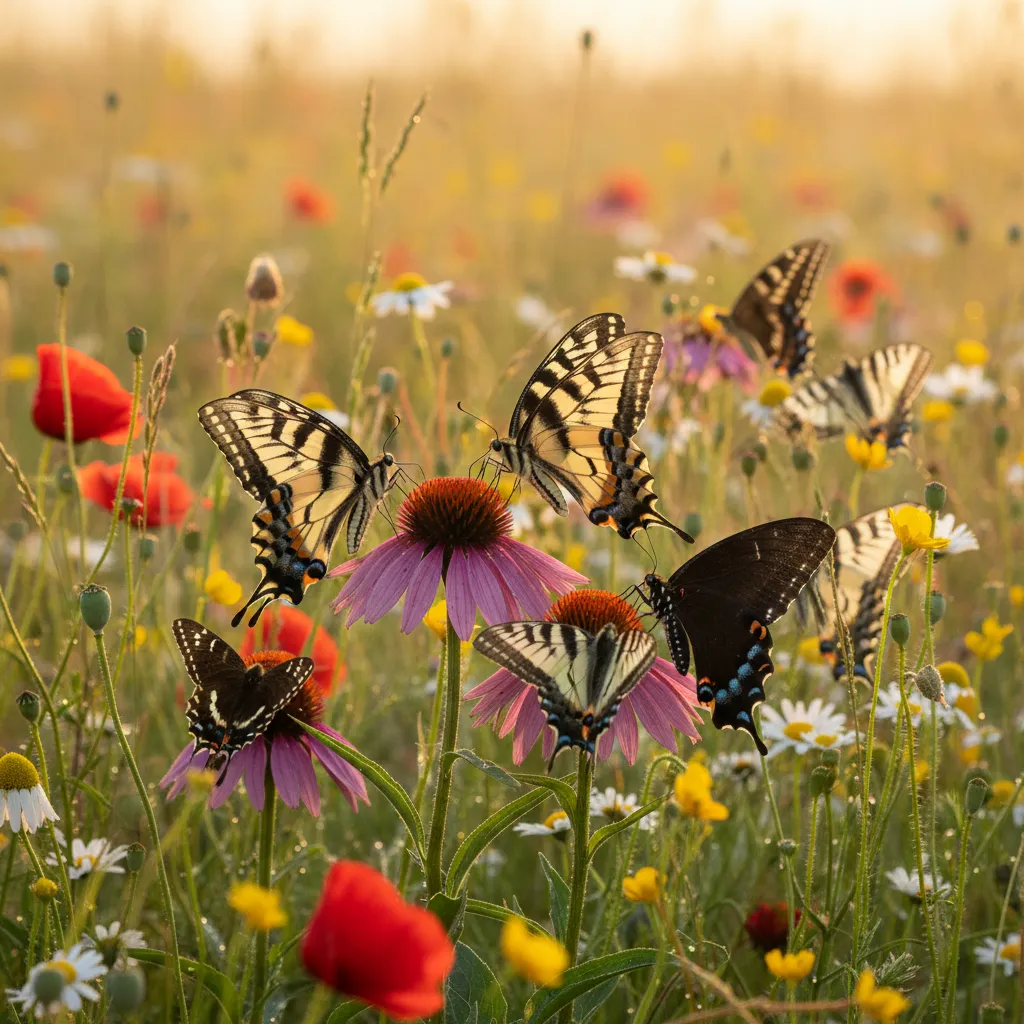
- There are over 550 swallowtail species worldwide, belonging to the family Papilionidae, with roughly 30 species found in North America.
- Most swallowtails are identified by the tail-like extensions on their hindwings, though a few species lack them entirely.
- Females of many species use mimicry, closely resembling the toxic pipevine swallowtail to deter predators.
- Planting native host plants like parsley, fennel, spicebush, and tulip tree is one of the best ways to attract swallowtails to your yard.
What Are Swallowtail Butterflies?
Swallowtail butterflies belong to the family Papilionidae, one of the oldest butterfly families on Earth. The name “swallowtail” comes from the slender tail projections on the lower hindwings that resemble the forked tail of a barn swallow. Not every species in the family has these tails – some, like the parnassians, are tailless – but the majority do, and it’s the first thing most people notice when they see one.
These are large butterflies by North American standards. Wingspans typically range from about 2.5 inches on the smaller end up to 5.5 inches for the giant swallowtail, which holds the record as North America’s largest butterfly. Their size alone makes them easy to spot as they glide over flower beds or patrol open meadows.
According to the Smithsonian Institution, Papilionidae contains around 550 described species, most of which are concentrated in tropical regions of Asia and South America. In North America, you’re most likely to encounter a handful of well-known species depending on where you live.
One trait that unites most swallowtails is how their caterpillars defend themselves. Swallowtail larvae possess a forked gland behind their head called an osmeterium. When threatened, the caterpillar extends this bright orange or yellow structure and releases a foul-smelling chemical compound that repels ants, spiders, and other predators.
It looks almost comical – like a tiny snake tongue popping out – but it works surprisingly well.
Common North American Swallowtail Species
North America has around 30 swallowtail species, but a core group accounts for most of what gardeners and naturalists see on a regular basis.
Eastern Tiger Swallowtail
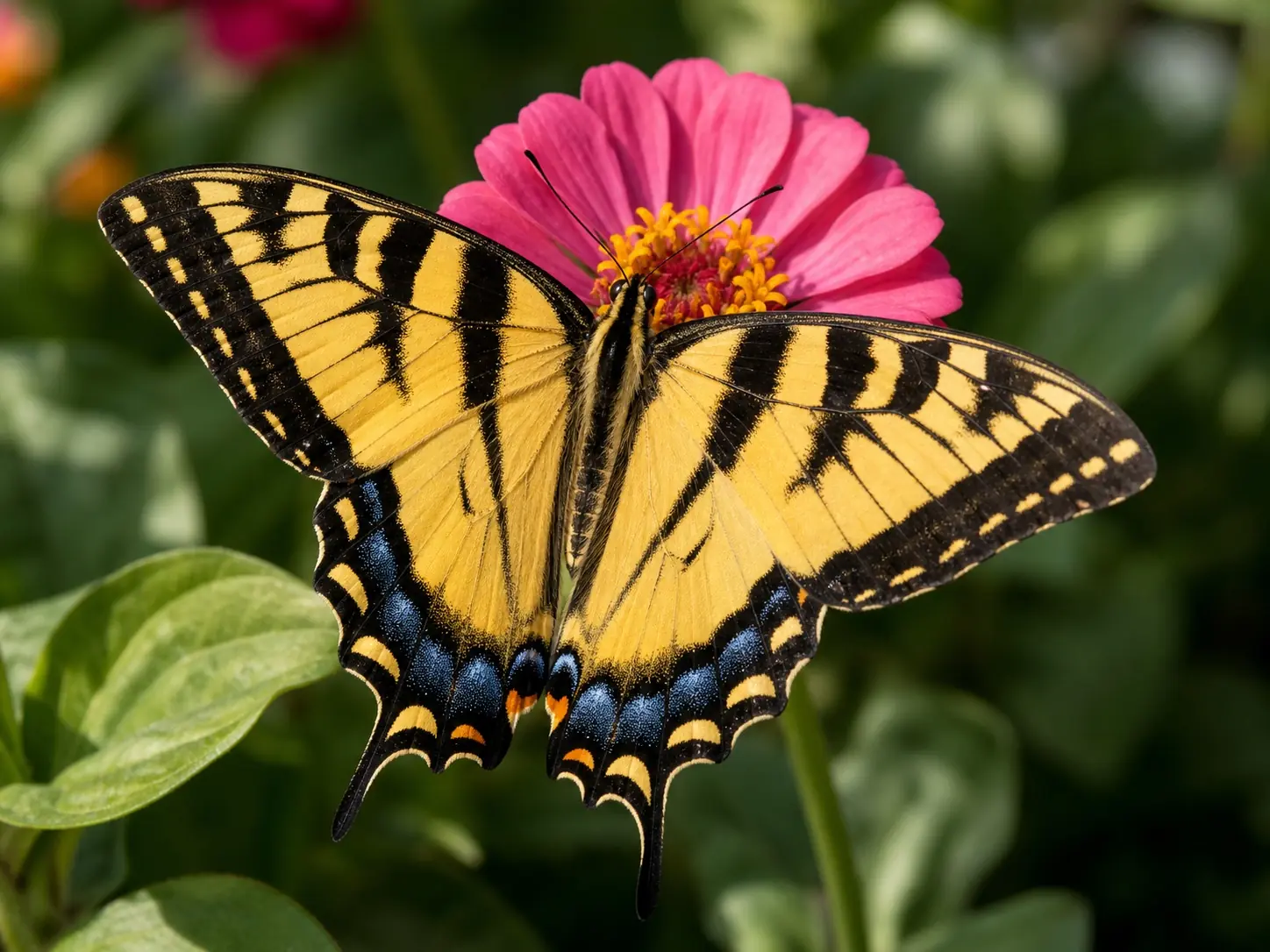
The eastern tiger swallowtail (Papilio glaucus) is probably the butterfly most people picture when they think of a swallowtail. Males are yellow with bold black tiger stripes and blue-and-orange spots near the tails. Females come in two forms – a yellow form similar to males, and a dark form that’s almost entirely black with iridescent blue on the hindwings.
The dark female mimics the pipevine swallowtail, borrowing its toxic reputation. This species is widespread east of the Rockies and visits nearly every flowering plant in a garden.
Black Swallowtail
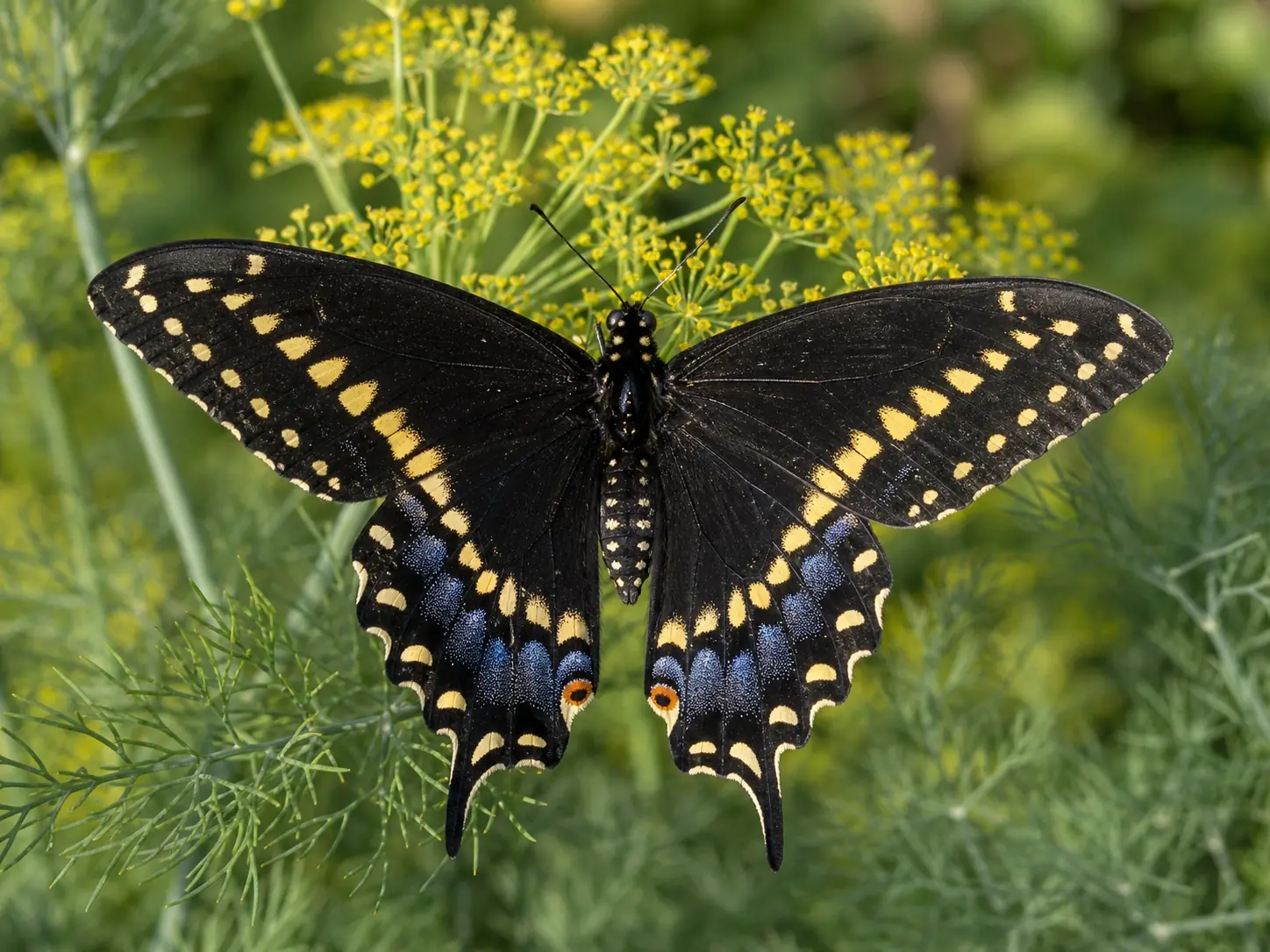
The black swallowtail (Papilio polyxenes) is the one you’ll find laying eggs on your parsley, dill, and fennel. Adults are black with yellow spots running in bands across both wings, plus blue scaling on the hindwings and small orange eyespots near the tails. Males have more yellow; females show more blue.
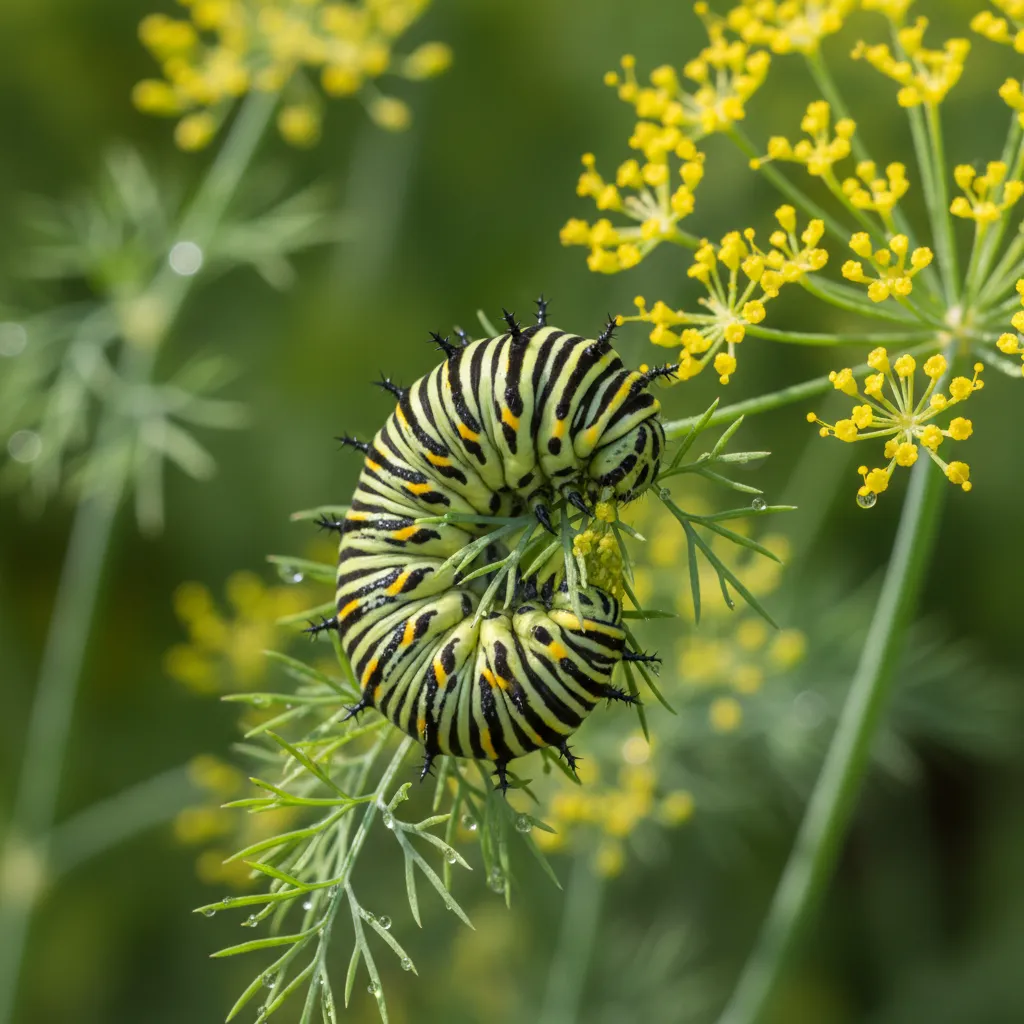
The caterpillars are striking – green with black bands and yellow dots that make them look like they’re wearing jewelry. If you want to learn more about how this species develops from egg to adult, the black swallowtail life cycle article goes into detail on each stage and how long it takes.
Spicebush Swallowtail
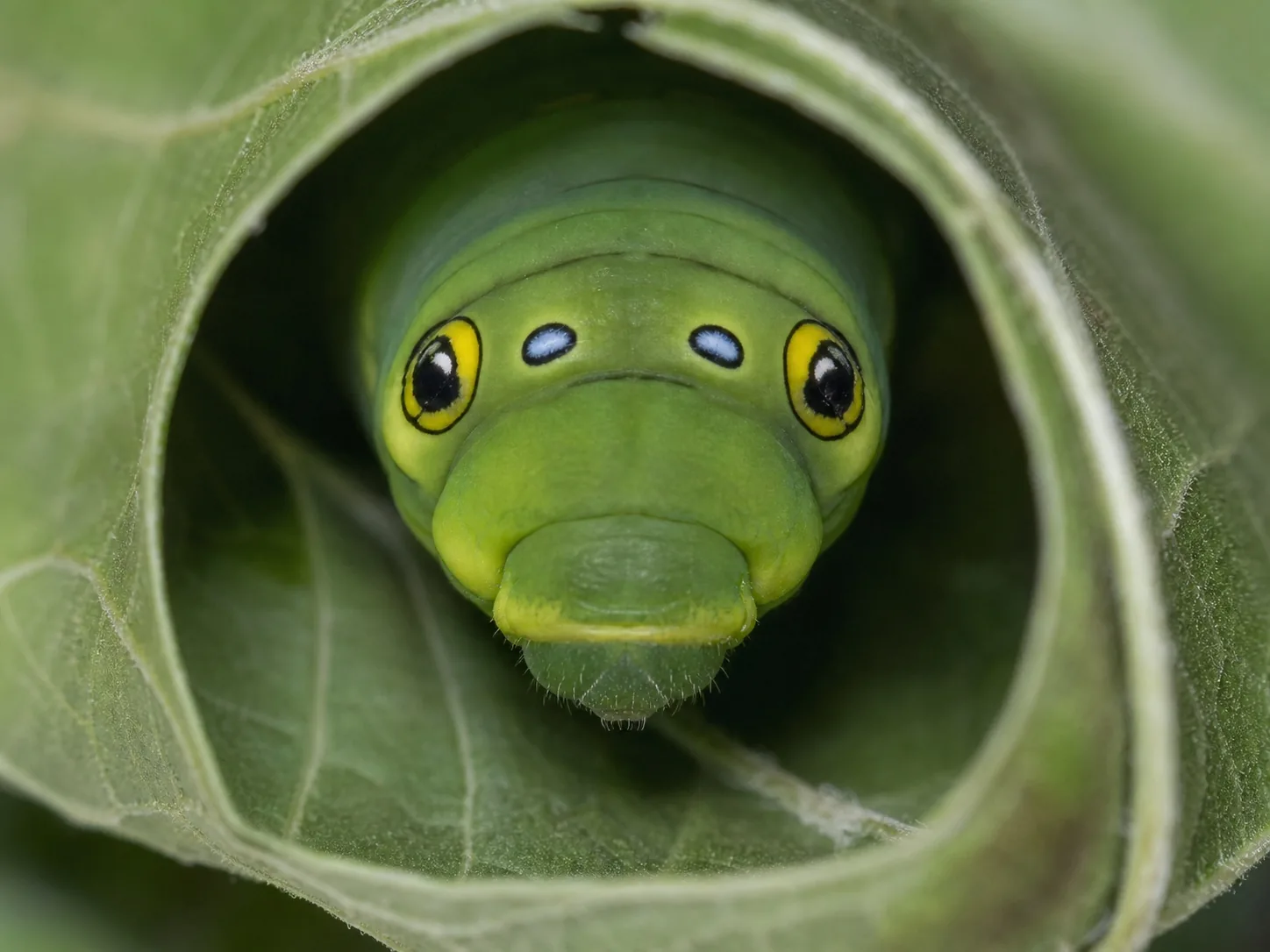
The spicebush swallowtail (Papilio troilus) is a forest-edge specialist that relies almost entirely on spicebush and sassafras as caterpillar food. Adults are dark black with pale yellow spots and, in females, a wash of iridescent blue-green across the hindwings. Its caterpillar is famous for a different defense strategy – it lives inside a rolled leaf shelter and has large false eyespots that make it resemble a snake.
The spicebush swallowtail is common across the eastern United States but less likely to wander into open suburban areas than the tiger or black swallowtail.
Giant Swallowtail
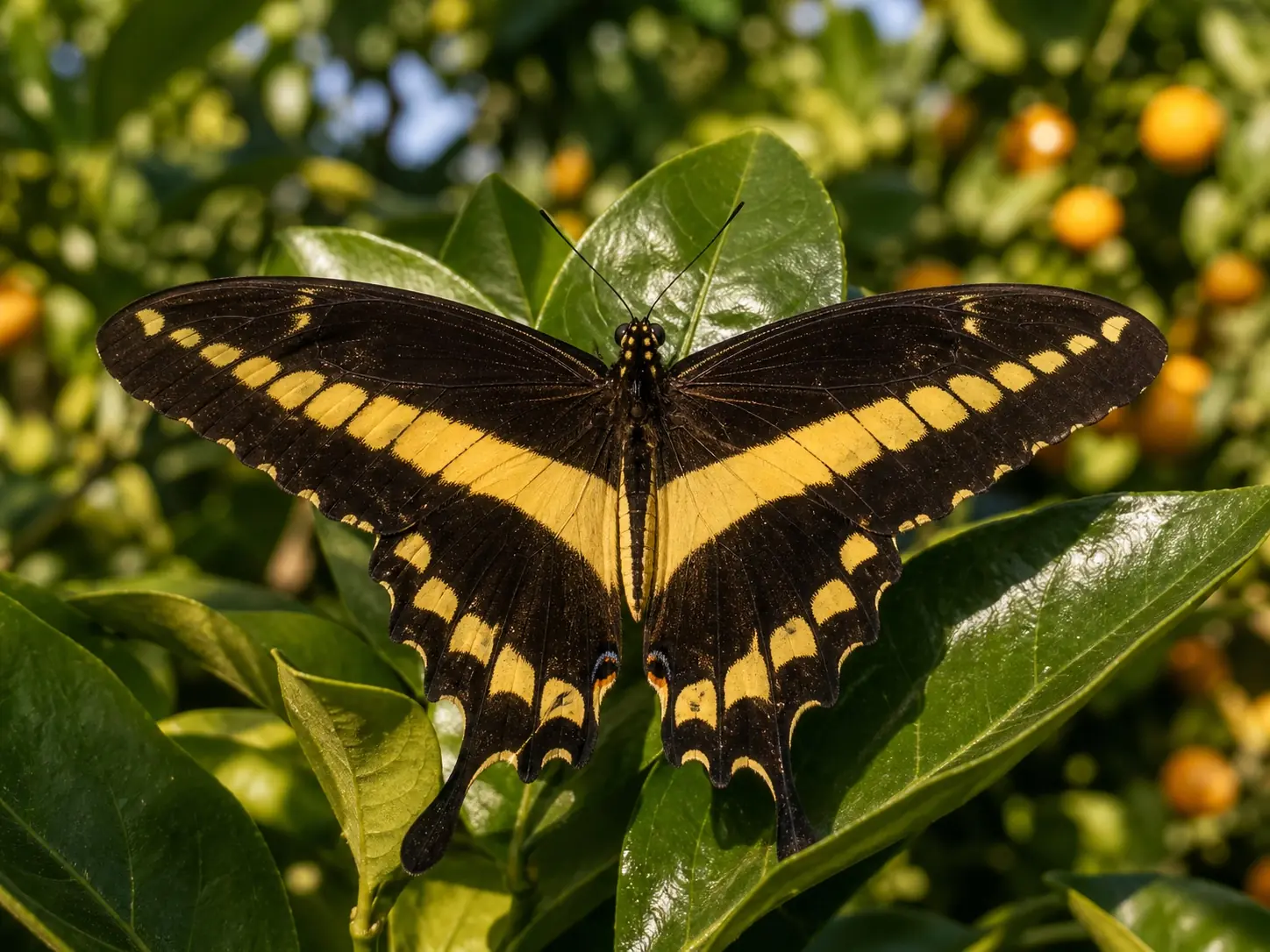
The giant swallowtail (Papilio cresphontes) is hard to miss because of its size. Its wingspan can reach 5.5 inches, and it has a distinctive pattern of yellow diagonal bands crossing a dark brown or black body. The underside is mostly yellow, which makes it look completely different from above.
Giant swallowtail caterpillars are called “orange dogs” in the South because they feed on citrus trees and can be a nuisance in orchards. In the wild, they use spicebush, prickly ash, and rue as host plants.
Pipevine Swallowtail
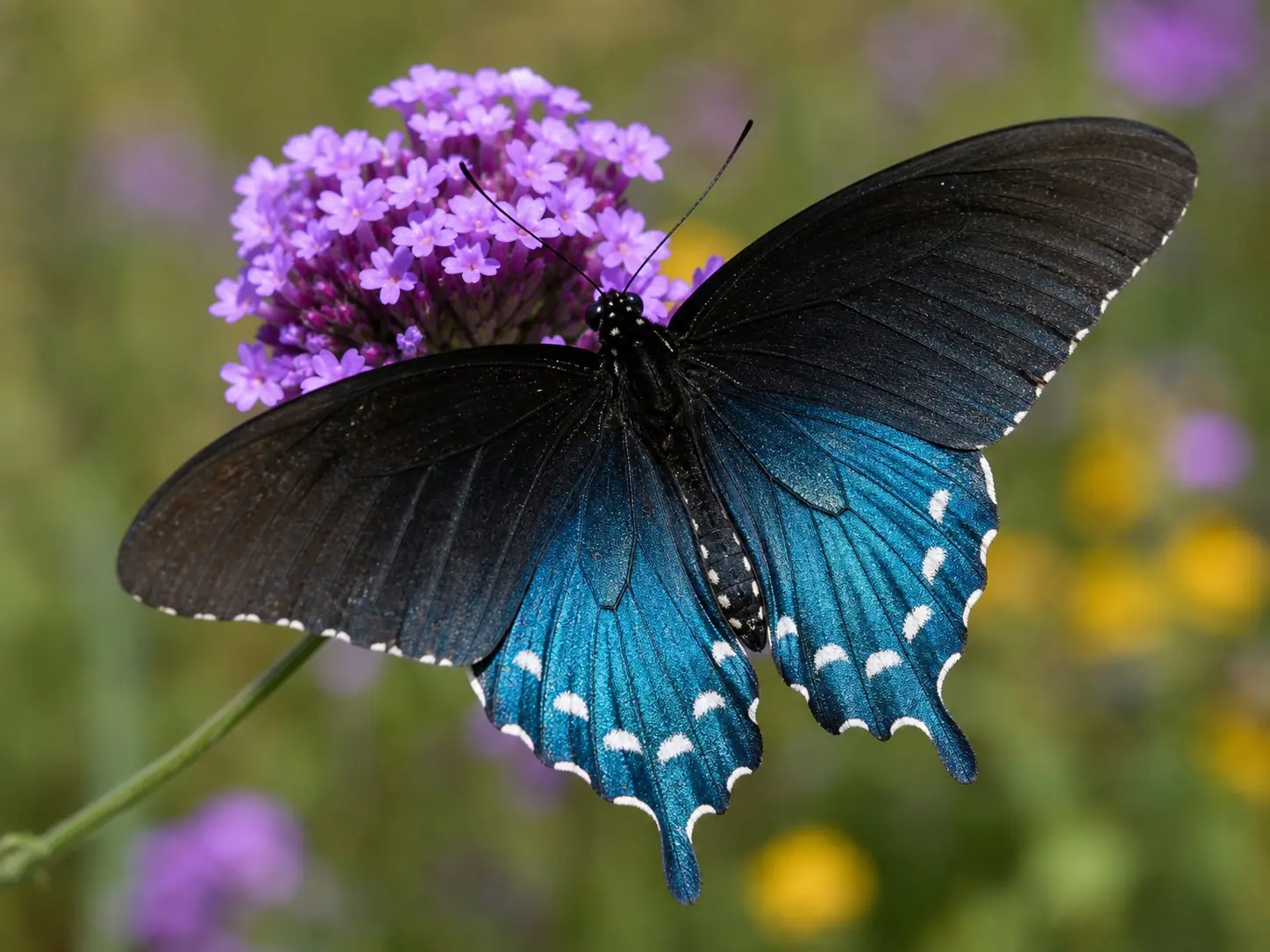
The pipevine swallowtail (Battus philenor) is special because it’s the model that multiple other species imitate. Its caterpillars feed exclusively on pipevine plants (Aristolochia spp.), which contain aristolochic acids that make the butterfly toxic to most predators. Adults are dark with a flash of iridescent blue on the hindwing upperside and orange spots on the underside.
Birds that eat one usually don’t repeat the mistake, which is why the spicebush swallowtail, dark-form female tiger swallowtail, and others have all evolved to look similar.
Zebra Swallowtail
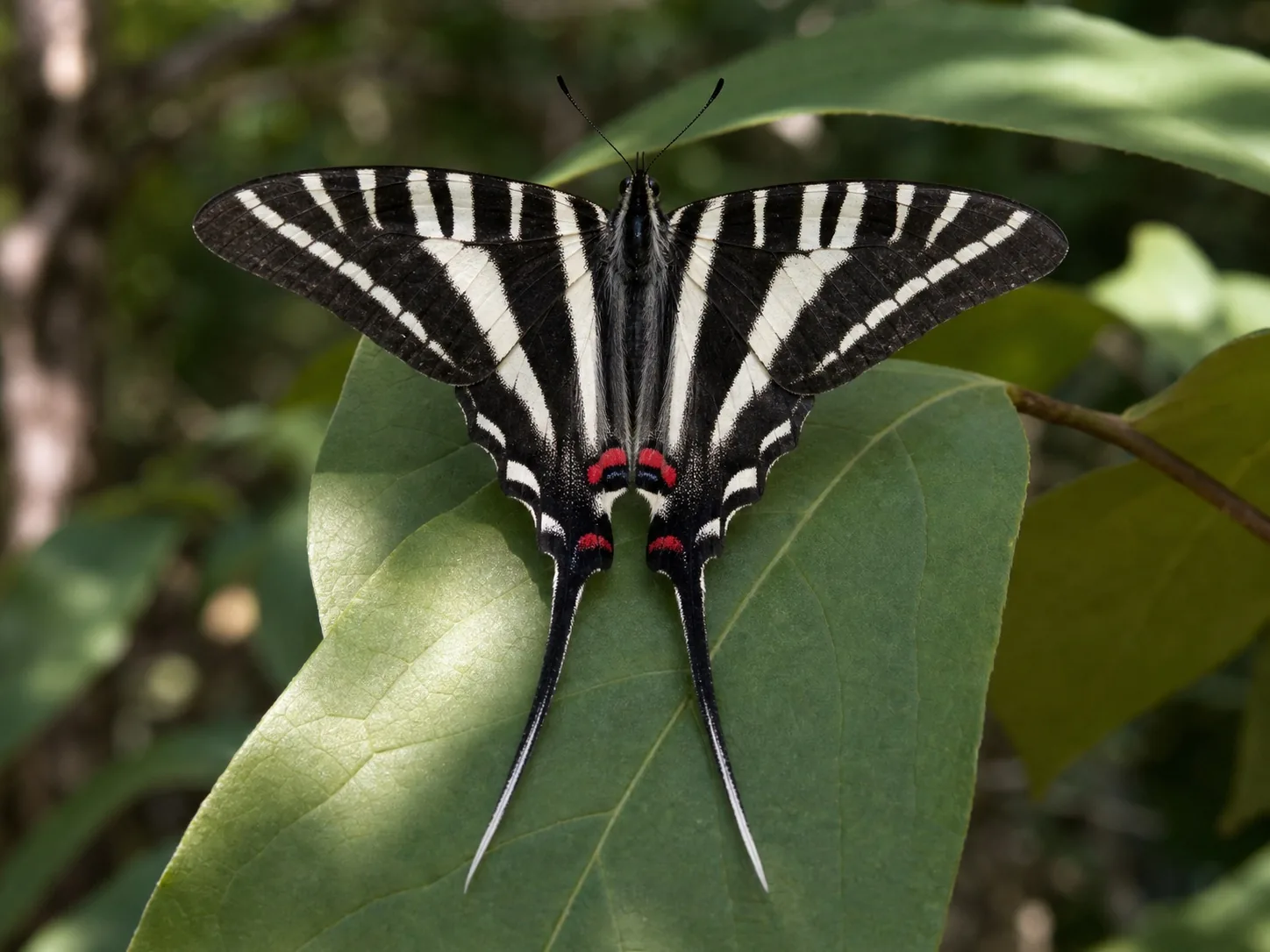
The zebra swallowtail (Eurytides marcellus) stands out immediately because its tails are much longer and more pointed than those of other North American species. The wing pattern is black-and-white striped with red markings near the tail – more graphic and geometric than the typical swallowtail look. Zebra swallowtails are tied to pawpaw trees, which are the only host plant their caterpillars can use.
You’ll find them near pawpaw patches in moist woodland areas of the eastern United States, often earlier in spring than other swallowtail species.
How to Identify Swallowtail Butterflies
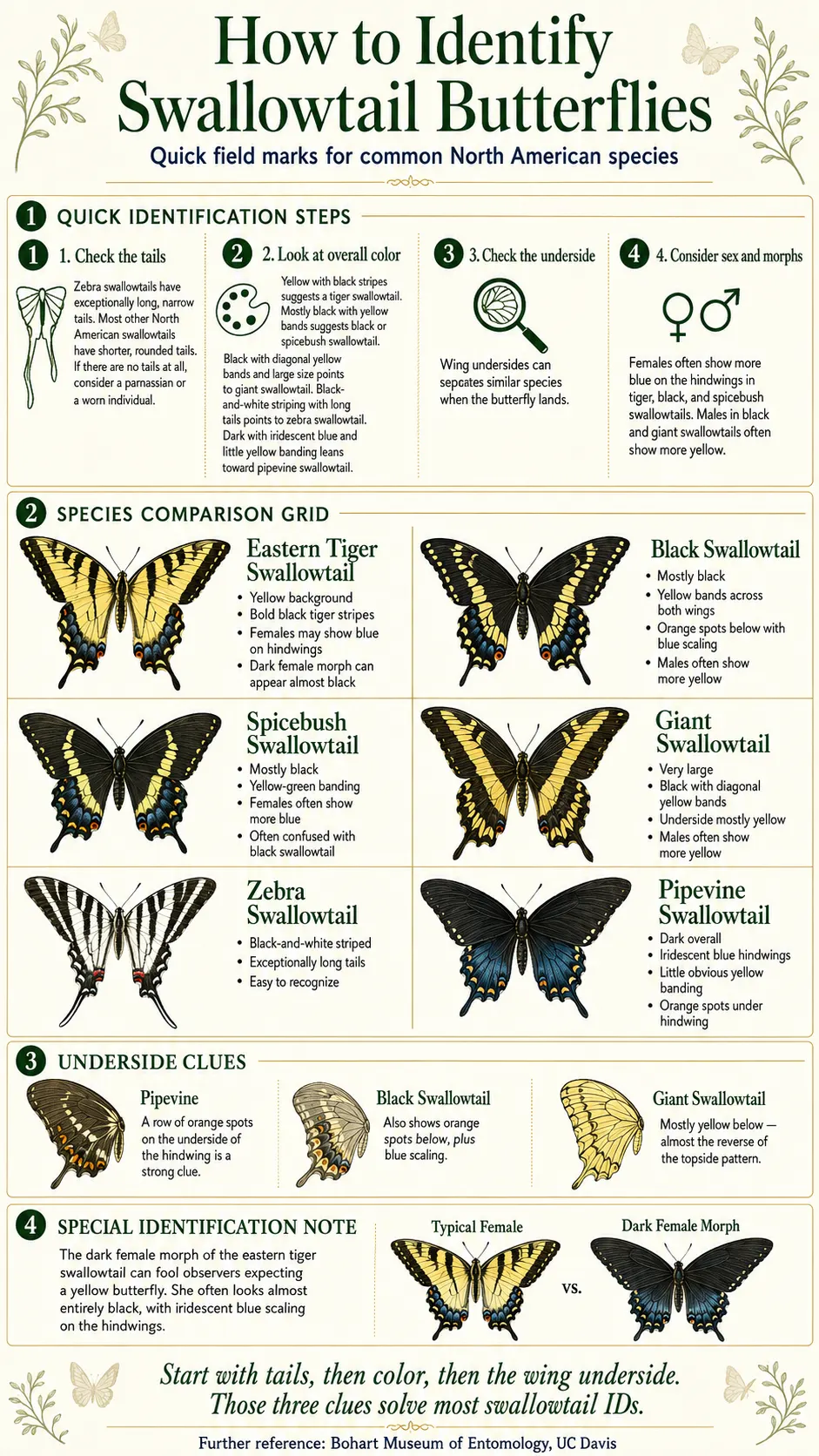
Getting to a species-level identification takes some practice, but a few features narrow things down quickly.
Start with the tail shape. Zebra swallowtails have exceptionally long, narrow tails. Most other North American species have shorter, rounded tails.
If there are no tails at all, you might be looking at a parnassian or a worn individual that lost its tails to a predator or accident.
Next, look at the overall color. Yellow background with black stripes points to the tiger swallowtail. Mostly black with yellow bands across both wings suggests the black swallowtail or spicebush swallowtail.
Black with diagonal yellow bands and a large size means giant swallowtail. Black and white striped with long tails is zebra swallowtail. Dark with iridescent blue and no obvious yellow banding leans toward pipevine swallowtail.
The underside of the wings is worth checking when the butterfly lands. Many species look similar from above but differ significantly below. The pipevine swallowtail has a row of orange spots on the underside of the hindwing that’s pretty distinctive.
The black swallowtail has a similar row of orange spots plus blue scaling. The giant swallowtail is mostly yellow below – almost the reverse of its topside appearance.
Sex matters too. In tiger, black, and spicebush swallowtails, females tend to show more blue on the hindwings. In black and giant swallowtails, males often have more yellow.
The dark female morph of the eastern tiger swallowtail can throw people off if they’re expecting a yellow butterfly – she looks almost entirely black with iridescent blue scaling.
The Bohart Museum of Entomology at UC Davis maintains resources on butterfly identification that are useful for comparing wing patterns across species if you want to go deeper on identification.
Swallowtail Butterfly Life Cycle
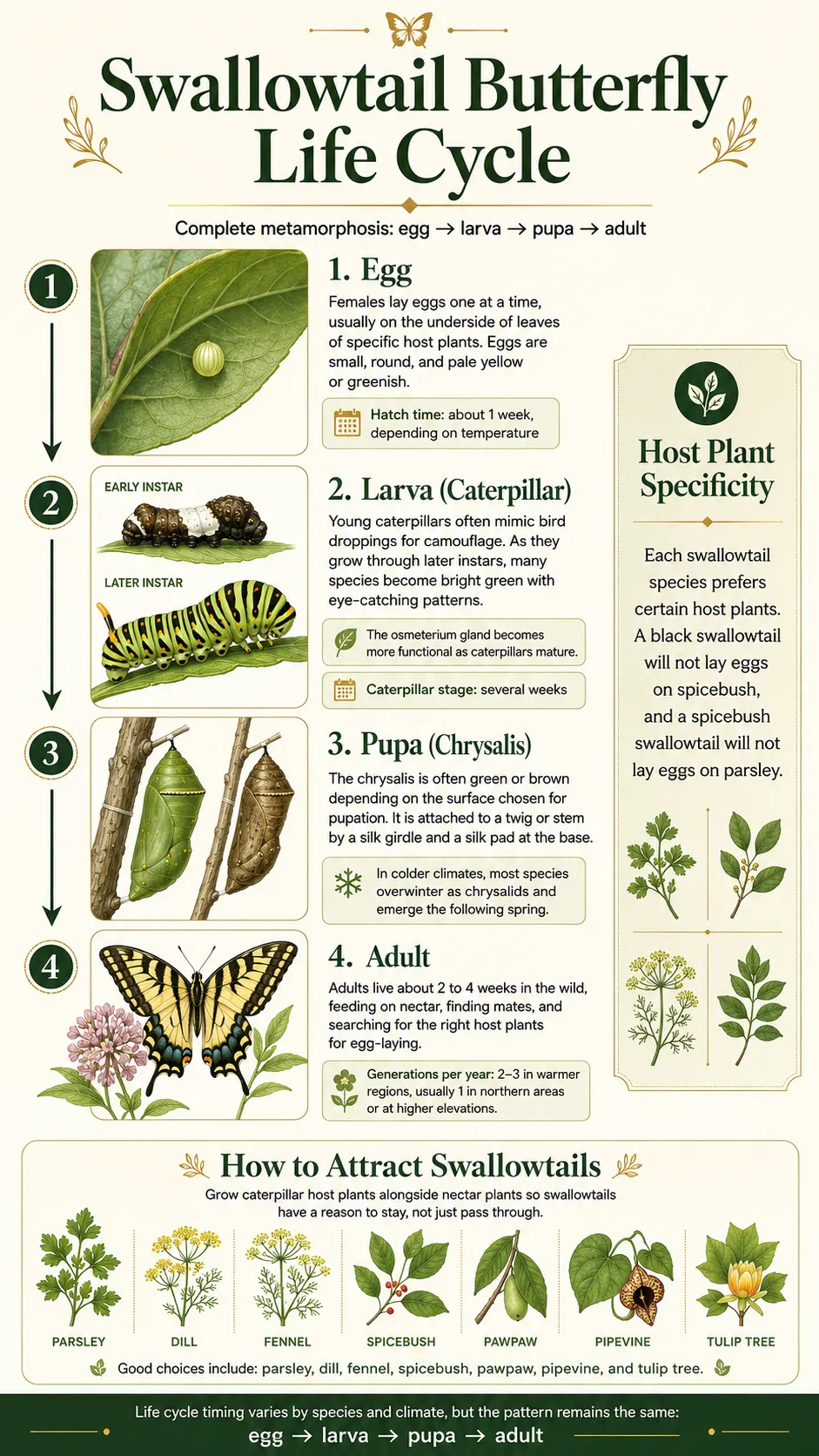
Like all butterflies, swallowtails go through complete metamorphosis – egg, larva (caterpillar), pupa (chrysalis), and adult. The timeline varies by species and climate, but the general pattern is consistent.
Females lay eggs one at a time, typically on the underside of leaves of specific host plants. Each species has its preferred plants – a black swallowtail will not lay eggs on spicebush, and a spicebush swallowtail won’t touch parsley. The eggs are small, round, and usually pale yellow or greenish.
They hatch within a week or so depending on temperature.
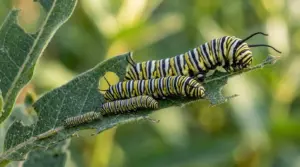
Young caterpillars (early instars) often look like bird droppings – dark brown or black with a white saddle mark. This is probably the most underrated camouflage strategy in the insect world. As they grow through later instars, many species shift to bright green with eye-catching patterns.
The osmeterium gland becomes more functional as caterpillars mature.
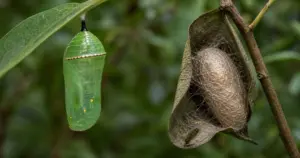
The caterpillar stage lasts several weeks before the larva finds a sheltered spot to pupate. The swallowtail chrysalis is often green or brown depending on the surface the caterpillar chose, and it’s attached to a twig or stem by a silk girdle and a silk pad at the base. Most species overwinter as chrysalids in colder climates, with adults emerging the following spring.
Adults live for roughly two to four weeks in the wild, spending their time finding nectar, locating mates, and – for females – searching for the right host plants to lay eggs. Most North American swallowtails produce two to three generations per year in warmer regions, with only one generation in northern areas or at higher elevations.
If you’re interested in attracting swallowtails to your garden, growing their caterpillar host plants alongside nectar plants gives them a reason to stay rather than just pass through. Parsley, dill, fennel, spicebush, pawpaw, pipevine, and tulip tree are all excellent choices depending on which species live in your area.
Where Swallowtails Live
Swallowtails are adaptable insects, but each species tends to favor specific habitats based on where its host plants grow. Eastern tiger swallowtails range across most of eastern North America from southern Canada down to the Gulf Coast, comfortable in forest edges, roadsides, parks, and suburban gardens. They’re one of the most habitat-flexible swallowtails in the region.
Black swallowtails prefer open areas – meadows, fields, gardens, and roadsides where their carrot-family host plants grow in abundance. You’ll find them from southern Canada through much of the continental United States and into Central America.
Spicebush swallowtails need forest habitats where spicebush and sassafras grow, so they’re less common in heavily developed areas. Zebra swallowtails are restricted to areas with pawpaw trees, which puts them primarily in moist bottomland forests of the eastern United States. The pipevine swallowtail follows its host plant (Aristolochia) across a wide range but tends to be more localized where pipevine grows naturally.
Giant swallowtails are expanding their range northward, possibly in response to warming temperatures. They were once considered mostly southern butterflies, but populations now breed as far north as the Great Lakes region and into southern Ontario.
Research from the North American Butterfly Association and citizen science programs like iNaturalist have helped track how swallowtail ranges are shifting over time, with several species showing range expansions northward over the past few decades.
- Kaufman Field Guide to Butterflies of North America
The most beginner-friendly field guide for backyard butterfly ID. - Black swallowtail caterpillar host plant seed bundle (parsley, dill, fennel)
Plant these and black swallowtails will find them within a season. - Insect Lore Live Butterfly Garden kit (painted ladies)
The classic at-home raising kit. Great for kids, simple to use. - Pop-up mesh butterfly enclosure (24-inch cube)
What you actually want if you bring caterpillars indoors.
Affiliate links. We earn a small commission on qualifying purchases at no extra cost to you.
Frequently Asked Questions
How many swallowtail butterfly species are there?
There are over 550 described species of swallowtail butterflies in the family Papilionidae worldwide. About 30 species are found in North America north of Mexico, with the greatest diversity in the southern United States and along the Pacific Coast.
What do swallowtail butterflies eat?
Adult swallowtails feed on nectar from a wide range of flowers. They’re particularly attracted to milkweed, thistle, joe-pye weed, lantana, and many garden flowers like zinnias and butterfly bush. Caterpillars are much more selective – each species uses specific host plants and won’t feed on others.
Black swallowtail caterpillars eat plants in the carrot family; spicebush swallowtail caterpillars eat spicebush and sassafras; zebra swallowtail caterpillars eat only pawpaw.
Why do swallowtails have tails on their wings?
The tails on swallowtail hindwings are thought to serve as a deflection target for predators. Birds and other predators often strike at the tail rather than the butterfly’s body, allowing the butterfly to escape with minor wing damage. Some research supports this theory – swallowtails with intact tails tend to survive predator encounters better than those without.
The tails may also resemble the antennae of a second “head,” confusing predators about which end to strike.
What is the largest swallowtail butterfly in North America?
The giant swallowtail (Papilio cresphontes) is the largest butterfly species in North America, with a wingspan that can reach 5.5 inches. It’s found across the eastern United States, the Southwest, and into Central America, and it’s expanding northward into the Great Lakes region.
Are swallowtail butterflies poisonous?
Most North American swallowtails are not toxic to predators. The exception is the pipevine swallowtail, whose caterpillars feed on pipevine plants containing aristolochic acids. These compounds are stored in the butterfly’s body and make it unpalatable to birds.
Several other swallowtail species have evolved to mimic the pipevine swallowtail’s appearance to gain some of that protection without actually being toxic themselves.
How can I attract swallowtail butterflies to my garden?
The two-part approach works best – provide both nectar sources for adults and host plants for caterpillars. For nectar, plant zinnias, lantana, milkweed, coneflowers, and bee balm. For caterpillar host plants, try parsley, dill, or fennel for black swallowtails; spicebush or sassafras for spicebush swallowtails; and pipevine (Aristolochia) for pipevine swallowtails.
Avoid pesticides in your garden, since even organic sprays can kill caterpillars feeding on your plants.