


Aglais io: The European Peacock Butterfly’s Eyespot Defense
Aglais io is the European Peacock butterfly, one of the most instantly recognizable species across Europe and temperate Asia. Each wing carries a bold eyespot – four in total when the wings are spread – and these markings do more than just look impressive. When threatened, this butterfly snaps its wings open to flash those eyespots at predators and simultaneously produces a hissing sound by rubbing the bases of its fore and hindwings together. That combination of sudden visual shock and unexpected noise has been shown to startle birds into abandoning an attack.
Key Takeaways
- Aglais io (formerly classified as Inachis io) is found across Europe from Ireland to Japan, and it is one of the longest-lived adult butterflies, overwintering in its adult form for up to 11 months.
- The four wing eyespots are a defense mechanism that mimics the eyes of a larger animal, and the butterfly backs this up with an audible hissing sound produced by scraping its wing veins together.
- Stinging nettle (Urtica dioica) is the sole larval host plant – females lay large batches of eggs on the underside of nettle leaves, and caterpillars feed gregariously in communal silk webs.
- Adults hibernate through winter in dark, sheltered spots like sheds, hollow trees, and attics, then emerge on warm days as early as late February or March to breed.
Identifying Aglais io
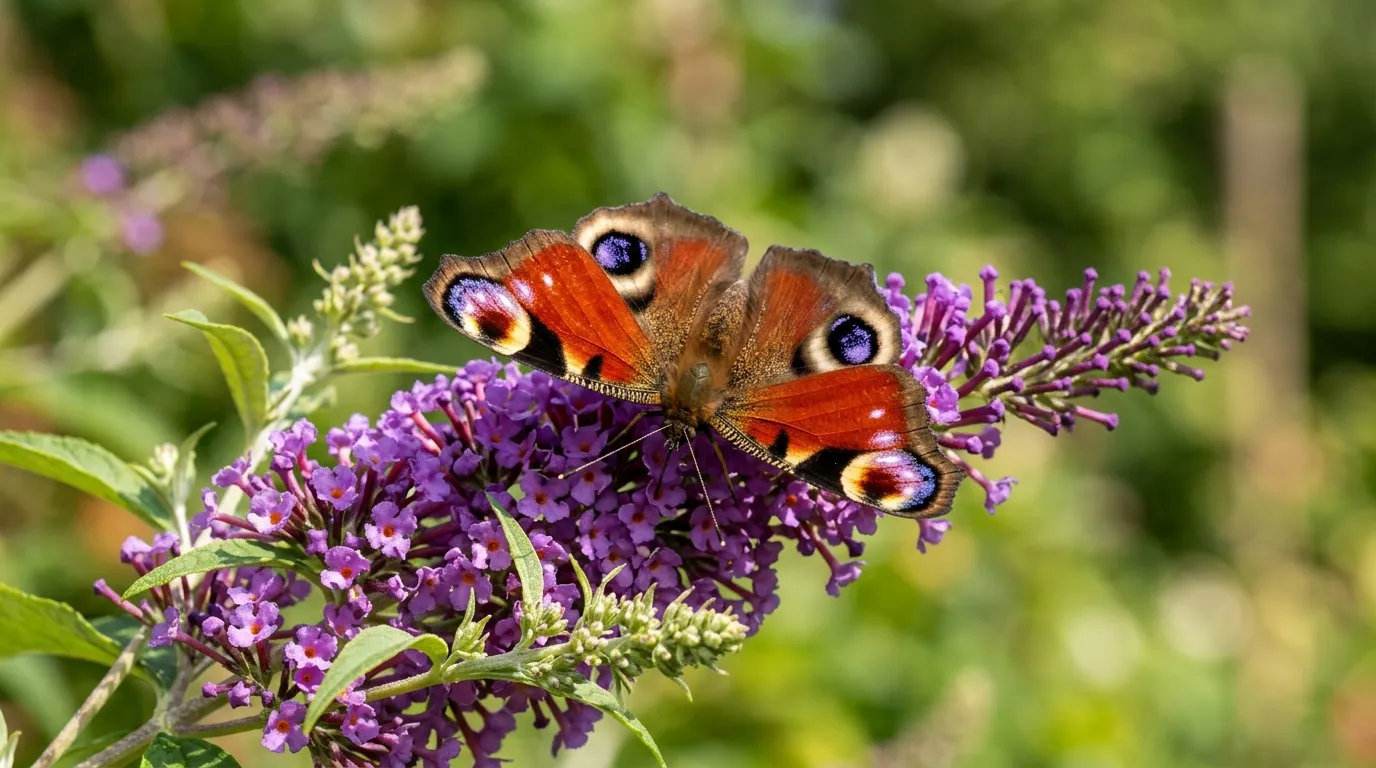
The European Peacock is hard to mistake for anything else. Adults have a wingspan of 50 to 55 millimeters. The upper wing surfaces are a deep rusty red, and each wing carries a single large eyespot. On the forewings, the eyespot is made up of blue, yellow, and black rings. On the hindwings, the eyespot is predominantly blue-black with a lighter center. When the butterfly holds its wings open, those four eyespots create the impression of a much larger face staring back at a would-be predator.
The underside tells a completely different story. Close the wings and the butterfly transforms into what looks like a dead leaf – the entire underside is dark brown to near-black with faint mottling. This dual design gives Aglais io two separate survival strategies: camouflage when at rest and intimidation when disturbed. Among common butterfly species, few other species pull off this kind of dramatic switch between cryptic and conspicuous.
Males and females look nearly identical from above. Females tend to be fractionally larger, but the difference is minor enough that field sexing based on appearance alone is unreliable. Freshly emerged adults show the richest red coloring, while overwintered specimens that appear in spring often look faded and slightly ragged at the wing edges.
Range and Habitat Across Europe and Asia
Aglais io is one of the most widespread butterflies in the Palearctic region. Its range stretches from Ireland and Britain in the west across all of mainland Europe, through Turkey and the Caucasus, and east through Central Asia to Japan. It occurs from sea level to about 2,500 meters in mountainous areas, though it is most common in lowland and mid-elevation habitats where nettles grow abundantly.
This species occupies a range of open and semi-open landscapes. Hedgerows, woodland edges, overgrown field margins, country lanes, parks, and gardens all support populations. According to UK Butterflies, it is one of the most commonly recorded species in garden butterfly surveys across England, Wales, and southern Scotland.
The butterfly’s abundance is tied directly to the availability of nettles. Any area with stands of stinging nettle – which itself thrives on nitrogen-rich, disturbed ground – is potential Peacock territory. Farmyards, compost heaps, ditch banks, and neglected corners of gardens are prime spots. In northern parts of its range, such as Scandinavia, populations thin out above about 65 degrees latitude, but the species has been documented as far north as central Norway.
Life Cycle From Egg to Adult
Females lay their eggs in large batches of 300 to 500 on the underside of stinging nettle leaves, typically choosing tall, vigorous plants growing in full sun or partial shade. Egg-laying happens in May and June after the overwintered adults have mated. The eggs are pale green and barrel-shaped, stacked in neat clusters that can cover the entire underside of a leaf.
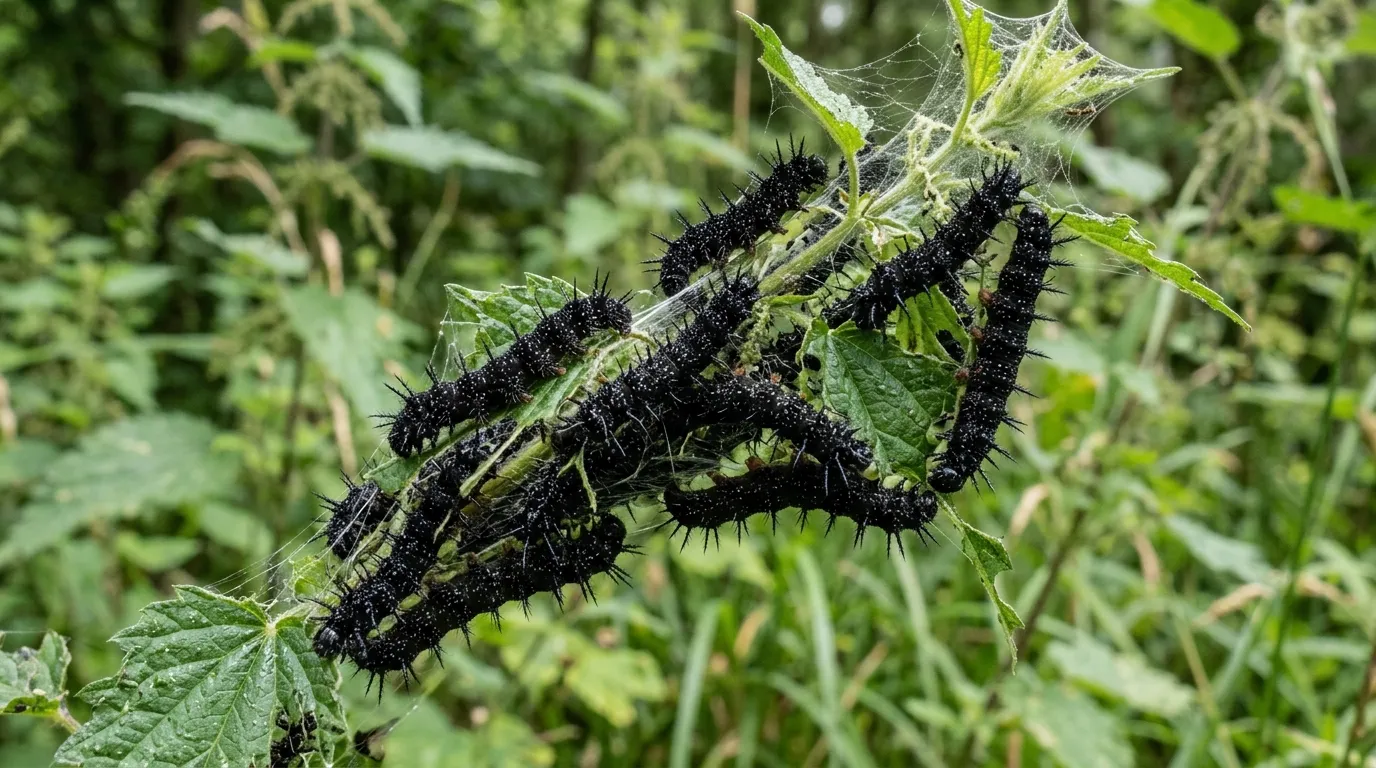
The caterpillars hatch after about two weeks and immediately begin feeding together. Young larvae spin a communal silk web over the top of their host plant, and dozens of caterpillars feed side by side within this tent. They are jet black with fine white speckles and covered in branching black spines. This gregarious phase lasts through the first four instars. By the time they reach their final instar, the caterpillars disperse and feed individually on nettle leaves nearby.
A fully grown caterpillar measures around 42 millimeters. Pupation takes place away from the food plant, often on a fence post, shed wall, or tree trunk. The chrysalis is greenish-gray or brown, angular in shape, and hangs head-down from a silk pad. The pupal stage lasts about two weeks in summer conditions. According to The Wildlife Trusts, newly emerged adults appear from mid-July onward and immediately begin feeding heavily on nectar to build fat reserves for the coming winter.
There is one generation per year across most of the range. In the warmest parts of southern Europe, a partial second brood occasionally appears in late summer, but single-brood biology is the norm. The adult butterfly lifespan for Aglais io can reach 11 months when you count the long hibernation period, making it one of the longest-lived butterfly species in Europe.
The Eyespot Defense and Hissing Sound
The eyespot defense of Aglais io is one of the best-studied anti-predator mechanisms in any butterfly. When a resting Peacock detects a threat – usually a bird investigating what looks like a dark leaf – it snaps its wings open in a sudden, jerky motion. The four eyespots, now fully exposed, create an effect that researchers believe mimics the face of a larger animal such as an owl or a cat.
But the visual display is only half the story. At the same moment the wings open, the butterfly produces an audible hissing or clicking sound. Research published by Vallin et al. in Proceedings of the Royal Society B demonstrated that this sound is generated by rubbing a thickened vein on the forewing against a corresponding structure on the hindwing. The resulting noise is within the hearing range of songbirds and lasts for several hundred milliseconds.
Experimental tests with blue tits showed that butterflies with intact eyespots and the ability to produce sound survived predation attempts at much higher rates than individuals with eyespots painted over or wings surgically prevented from rubbing together. The combination of sudden eyespot flash and hissing noise caused blue tits to flinch, jump back, or fly away entirely. Neither signal alone was as effective as both together. This multimodal defense – visual plus acoustic – is unusual among butterflies and makes Aglais io a textbook example in behavioral ecology.
When the threat passes, the butterfly folds its wings back up and becomes a “dead leaf” again. If the predator persists, the Peacock may take flight with a strong, erratic pattern designed to make itself hard to track.
Hibernation Behavior and Overwintering
Aglais io is one of a small number of European butterflies that overwinters as an adult rather than as an egg, caterpillar, or chrysalis. Starting in late August or September, adults that emerged during summer begin seeking out hibernation sites. They look for cool, dark, sheltered spaces with stable temperatures and high humidity. Natural choices include hollow trees, log piles, crevices in cliff faces, and dense ivy cover. Man-made structures are equally popular – garden sheds, garages, church towers, cellars, and attic spaces all serve as hibernacula.
Once settled, the butterfly enters a torpor state. Its metabolic rate drops dramatically, and it survives on fat reserves accumulated during its late-summer feeding binge. Body temperature tracks the ambient temperature of its shelter. The dark underwing coloring serves a dual purpose here: it provides camouflage against the rough surfaces of walls, bark, and beams, and the dark pigmentation may help the butterfly absorb warmth efficiently on any winter days when sunlight reaches its roost.
Hibernation can last from September through February or even March, depending on latitude and weather. In mild winters, individuals occasionally wake and fly on unusually warm days in January, only to return to their roost when temperatures drop again. This premature arousal burns precious fat reserves, and butterflies that wake too often during winter risk starving before spring flowers become available. Among UK butterflies, the Peacock is one of the most familiar early-spring species precisely because it emerges from hibernation so early.
Spring-emerged adults mate, lay eggs, and then die, completing a life cycle that spans nearly a full calendar year. Few other butterflies in the temperate zone match this longevity.
Attracting Aglais io to Your Garden
If you want Peacock butterflies breeding in your garden, the single most effective step is to keep a patch of stinging nettles. This does not need to be a large area. A clump of nettles roughly two meters square in a sunny or partly shaded corner gives females enough material for egg-laying. Let the nettles grow tall through spring and early summer without cutting them back. After the caterpillars have finished feeding in late June or July, you can cut the nettles down and they will regrow for a potential second use later in the season.
For adult feeding, plant nectar sources that bloom from midsummer through early autumn. Buddleia (butterfly bush), ice plant (Hylotelephium spectabile), marjoram, verbena bonariensis, and knapweed are all strong choices. The Peacock is a frequent visitor to buddleia in particular – on a warm August afternoon, a single bush can attract half a dozen or more Peacocks feeding alongside Red Admirals, Commas, and Small Tortoiseshells.
Providing hibernation habitat is another practical step. A log pile in a quiet corner, an open-fronted woodshed, or even a purpose-built butterfly hibernation box gives adults a place to overwinter. If you find a Peacock butterfly hibernating in your shed or garage during winter, leave it undisturbed. Avoid heating the space, and keep disturbance to a minimum until spring temperatures rise naturally.
One thing to avoid: pesticide spraying near nettle patches. Caterpillars are highly sensitive to insecticide drift, and even herbicide use that kills off nettles removes the only food source for the larvae. A wild, weedy corner is the best gift you can give this species.
Frequently Asked Questions
What does Aglais io mean?
Aglais is the genus name shared with the Small Tortoiseshell (Aglais urticae). The species name “io” refers to Io, a priestess in Greek mythology who was loved by Zeus. The butterfly was formerly classified as Inachis io – Inachus being Io’s father in the myth – before being moved to Aglais based on molecular evidence.
How does the Peacock butterfly make a hissing sound?
The hissing or clicking noise is produced mechanically by rubbing a hardened vein on the forewing against a vein on the hindwing. This stridulation happens when the butterfly rapidly opens and closes its wings during a defensive display. The sound is loud enough for human ears to hear at close range and falls within the auditory sensitivity of songbirds.
Where do Peacock butterflies go in winter?
Adults hibernate in dark, cool, sheltered locations. Hollow trees, log piles, sheds, garages, church porches, and cellars are all common hibernation sites. They enter torpor in September or October and remain dormant until rising temperatures in late February or March trigger emergence.
What do Peacock butterfly caterpillars eat?
The caterpillars feed exclusively on stinging nettle (Urtica dioica). Occasionally they may accept hop (Humulus lupulus), but nettles are the primary and overwhelmingly preferred host across the entire range. Females almost always choose nettles for egg-laying.
Is the Peacock butterfly endangered?
No. Aglais io is widespread and common across its range. It is not listed as threatened at any level. Populations can fluctuate from year to year depending on weather conditions and parasitoid pressure, but the species is considered stable overall. Its reliance on stinging nettle, a very common plant, helps buffer it against habitat loss.
How long do Peacock butterflies live?
Adults can live up to 11 months when the hibernation period is included. A butterfly that emerges in July, hibernates through winter, and breeds the following spring will have been alive for close to a year. Active flight life outside of hibernation totals roughly two to four months spread across summer and the following spring.