
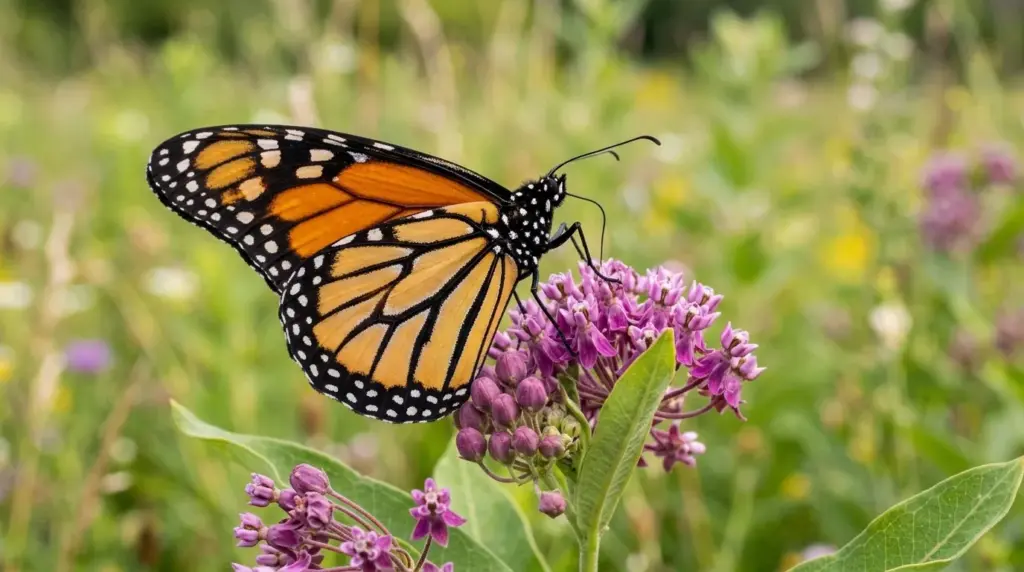

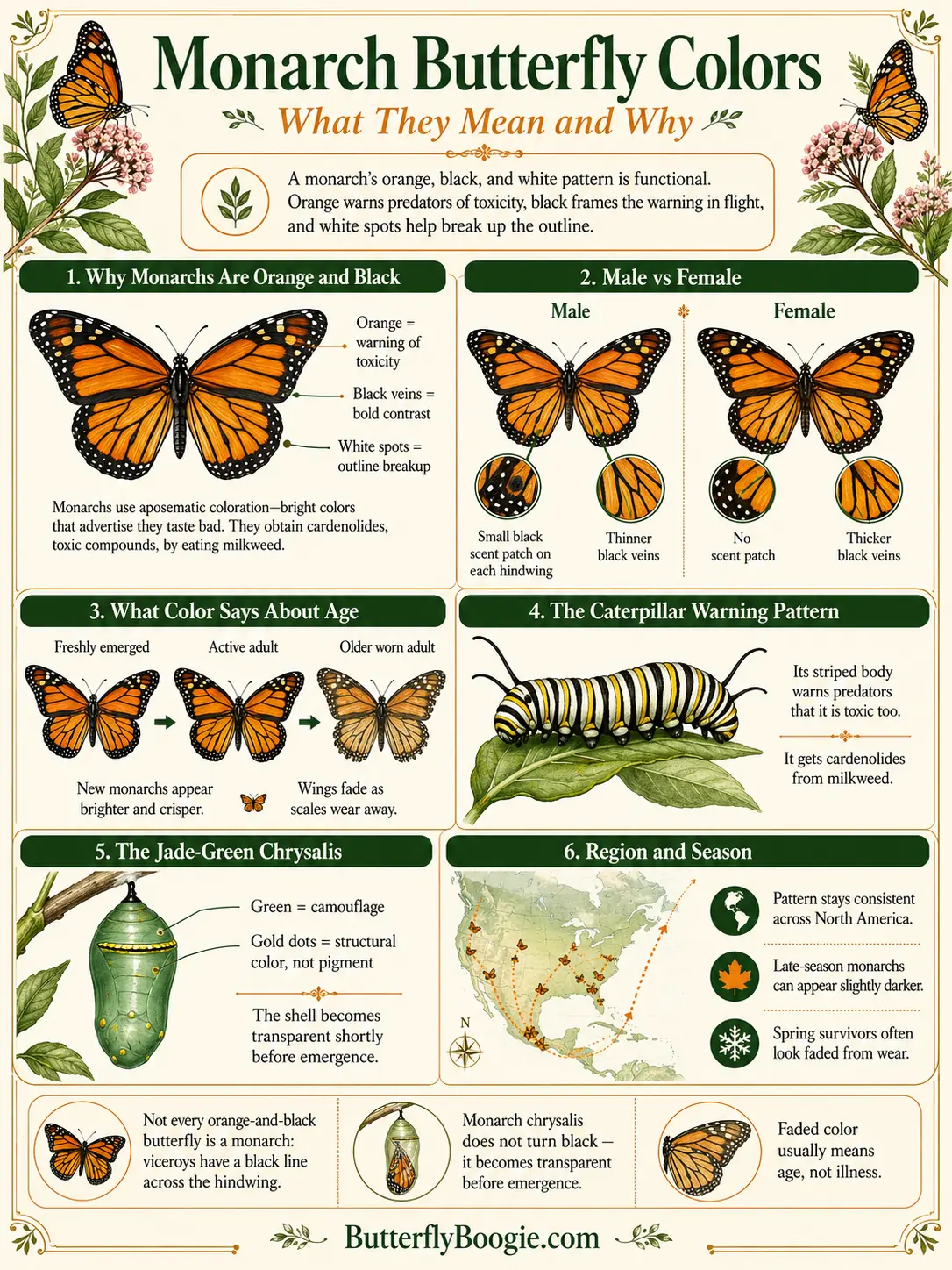
The bright orange and black pattern on a monarch butterfly’s wings is one of the most recognizable color combinations in the animal kingdom. Those monarch butterfly colors are doing a job, and a specific one. Orange signals toxicity to predators, black frames the warning so it’s visible in flight, and the white spots along the wing border help break up the butterfly’s outline against leafy backgrounds. Every shade on a monarch means something.
If you’ve ever looked closely at a monarch and wondered why it looks the way it does, or whether the colors change with age, sex, or season, this guide walks through the biology behind each color and what it tells you about the individual butterfly you’re looking at.
Key Takeaways
- Monarch butterfly wings combine bright orange, black veins, and white spots as an aposematic warning pattern, advertising to predators that the butterfly is toxic from milkweed it ate as a caterpillar.
- Males can be identified by a small black scent patch on each hindwing, while females have thicker black wing veins and no patch.
- Wing color intensity varies by age and generation, with newly emerged monarchs appearing brighter than older individuals whose scales have worn away.
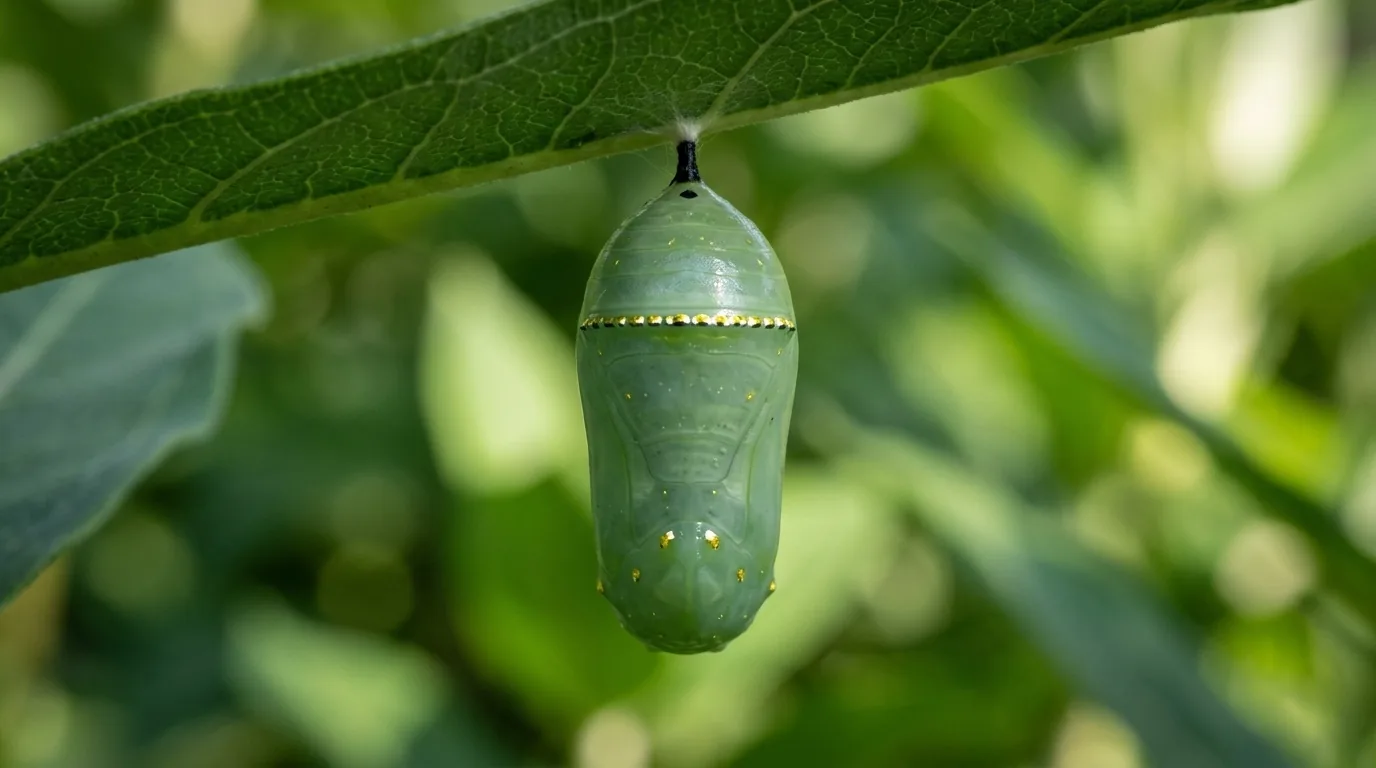
- The jade-green chrysalis with metallic gold dots is a structural color, not a pigment, caused by the way light bounces off the chrysalis surface.
Why Monarchs Are Orange and Black
Orange and black is a warning combination in nature, the same palette used by wasps, coral snakes, and poison arrow frogs. Biologists call this pattern aposematic coloration, from the Greek words for “away” and “signal.”
A predator that bites into a monarch gets a mouthful of cardenolides, toxic compounds the caterpillar absorbed from milkweed leaves. Most birds spit the monarch out and remember the color pattern. Next time they see bright orange wings flapping past, they leave it alone. The color is the warning label.
According to research published by the Xerces Society, the toxicity level in a given monarch depends directly on which milkweed species its caterpillar fed on. Some milkweeds load the caterpillar with more cardenolides than others, so monarch toxicity varies, but the warning color stays constant across the population.
Telling Male and Female Monarchs Apart by Color
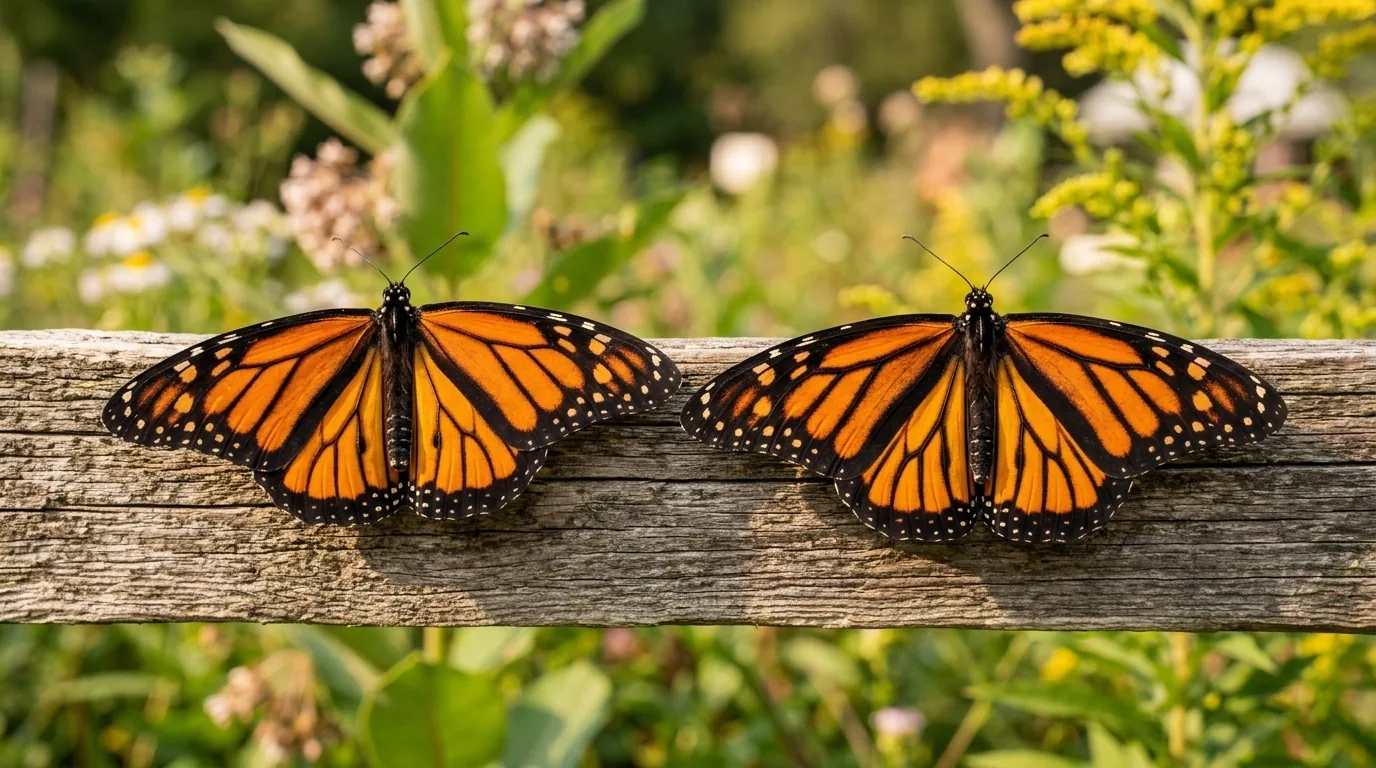
Males and females look similar at a glance, but two color cues separate them. The first is a small, dark oval scent patch located on a vein of each hindwing. Only males have it. The patch releases pheromones during courtship and is easy to spot once you know where to look.
The second cue is wing vein thickness. Female monarchs have noticeably thicker, bolder black veins running through the orange panels. Male veins are thinner, giving males a slightly more “open” appearance when their wings are spread.
If you’re watching a monarch nectar on a flower and want a quick ID, look at the hindwings first. Two dark spots means male. No spots plus bolder veins means female.
What Color Changes Tell You About a Monarch’s Age
A freshly emerged monarch is almost glowing. The orange is saturated, the black is inky, and the wing edges are crisp. Within a week or two that intensity starts to dull as tiny scales on the wings wear off from flight, rain, and brushing against vegetation.
By the end of a monarch’s life the wings can look faded, almost translucent in worn patches where scales have rubbed away completely. This fading is a straightforward aging signal, not a sign of illness. Citizen-science projects like Journey North routinely use wing wear to estimate how far and how long a tagged individual has flown.
Migratory generations, the monarchs born in August and September that fly to central Mexico, tend to start out slightly darker than summer-generation monarchs. Darker wings absorb more solar heat, which helps with the long flight south.
The Monarch Caterpillar: A Warning in Stripes
The caterpillar uses the same aposematic logic as the adult, just in a different layout. A mature monarch caterpillar wears alternating bands of black, white, and yellow, one of the clearest warning patterns any predator will ever see.
Those colors tell birds and other predators the same story the adult’s wings do: this insect is toxic, move along. The caterpillar is actively feeding on milkweed and loading its body with cardenolides, so the warning is accurate from day one of its striped stage.
The Jade-Green Chrysalis and Its Gold Dots
The monarch chrysalis is where the color story gets strange. It’s a smooth jade-green shell with a ring of what look like metallic gold dots near the top. Those dots aren’t pigment. They’re structural color, produced by microscopic layers in the chrysalis cuticle that refract light in a way that reflects a gold hue. No gold, no metal, just physics.
For a deeper look at how this structure forms and what happens inside the shell, see our guide to monarch butterfly chrysalis stages. The color shifts as the butterfly develops, eventually going transparent in the final day before the adult emerges, with orange and black wings visible through the shell.
The green itself is camouflage. A jade chrysalis hanging under a leaf blends in with surrounding foliage, buying the developing butterfly about ten to fourteen days of invisibility from birds and predatory wasps.
Do Monarch Colors Vary by Region or Season?
Across North America, monarch wing color is remarkably consistent. A monarch in Ontario looks essentially identical to one in Texas or California. Genetics keep the pattern stable because the warning only works if predators see the same signal everywhere.
What does vary is intensity. Late-summer monarchs in northern regions often appear darker than early-summer monarchs in the same area, for reasons biologists link to temperature during pupation. Cooler chrysalis temperatures produce slightly darker adults. The Monarch Joint Venture tracks this variation as part of its long-term monitoring work.
You’ll also see worn, pale monarchs in spring, the overwintered survivors who flew north from Mexico. Their colors have faded from months of activity, but they’re the same butterflies that left as vivid orange adults the previous fall.
FAQ
Are all orange and black butterflies monarchs?
No. The viceroy butterfly mimics the monarch’s orange and black pattern almost perfectly. The easiest way to tell them apart is a thin black line that crosses the viceroy’s hindwings horizontally. Monarchs don’t have that line.
Why does the monarch chrysalis turn black before the butterfly emerges?
It isn’t turning black, it’s turning transparent. The wings of the developing adult butterfly are already orange and black at that point, and you’re seeing them through the now-clear chrysalis shell. Emergence usually happens within 24 hours of this color shift.
Do monarch colors fade after death?
Yes. Pinned museum specimens lose vibrancy over decades, especially when exposed to light. Oranges shift toward pale yellow and blacks go gray. This is why natural history collections store specimens in dark drawers.
Can you tell a monarch’s health by its color?
Not reliably. Faded wings usually indicate age, not illness. A diseased monarch is more often identified by deformed wings or an inability to fly than by color alone. For signs of the parasite OE (Ophryocystis elektroscirrha), look for wings that never fully expand after emergence.
Why are some monarchs lighter orange than others?
Three factors: age, temperature during pupation, and sex. Younger butterflies are brighter, cooler pupation produces darker wings, and males tend to be slightly paler than females because their thinner veins show more orange panel area.