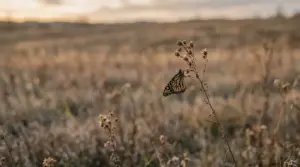



Blue Skipper Butterfly: Identifying the Iridescent Tropical Skippers
The phrase “blue skipper butterfly” sounds like it should point to a single species, but it doesn’t. It’s a loose, descriptive name that gets attached to any skipper (family Hesperiidae) showing iridescent blue scales on the wings. In practice that includes a scattered handful of tropical American species, a few African ones, and even a couple of lookalikes that aren’t particularly blue at all under average light. If you’re trying to put a firm name on a small, stocky, hook-antennaed butterfly with a bluish sheen, you’ve run into one of the classic identification puzzles in butterfly watching.
I spent a long afternoon in a cloud forest edge in Costa Rica chasing what I was sure was one species of blue skipper and ended up photographing what turned out to be three different genera, none of which I could confidently name without sending the photos to a Hesperiidae specialist. That experience is pretty typical. Skippers are the family where even experienced lepidopterists shrug and say “probably” more than they’d like to admit, and the blue-colored ones are an especially tricky subgroup.
Key Takeaways
- “Blue skipper” is not a formal species name. It’s a descriptive term that gets applied to any member of the skipper family (Hesperiidae) showing iridescent blue scales, and several unrelated species get called by this name depending on region and observer.
- The most commonly referenced species include Paracleros biblia and other iridescent tropical American skippers, along with Zera hyaspis and members of genera like Astraptes and Phocides that show blue flashes on the wing uppersides.
- These skippers live mostly in Central and South American rainforests and forest edges, though their ranges can extend into southern Mexico and occasionally into the southernmost United States for a few species.
- Identification relies on wing shape, the location and pattern of the blue iridescence, underside markings, body shape, and host plant associations. Photos from multiple angles are almost always needed for confident naming.
Why “Blue Skipper” Is a Messy Name
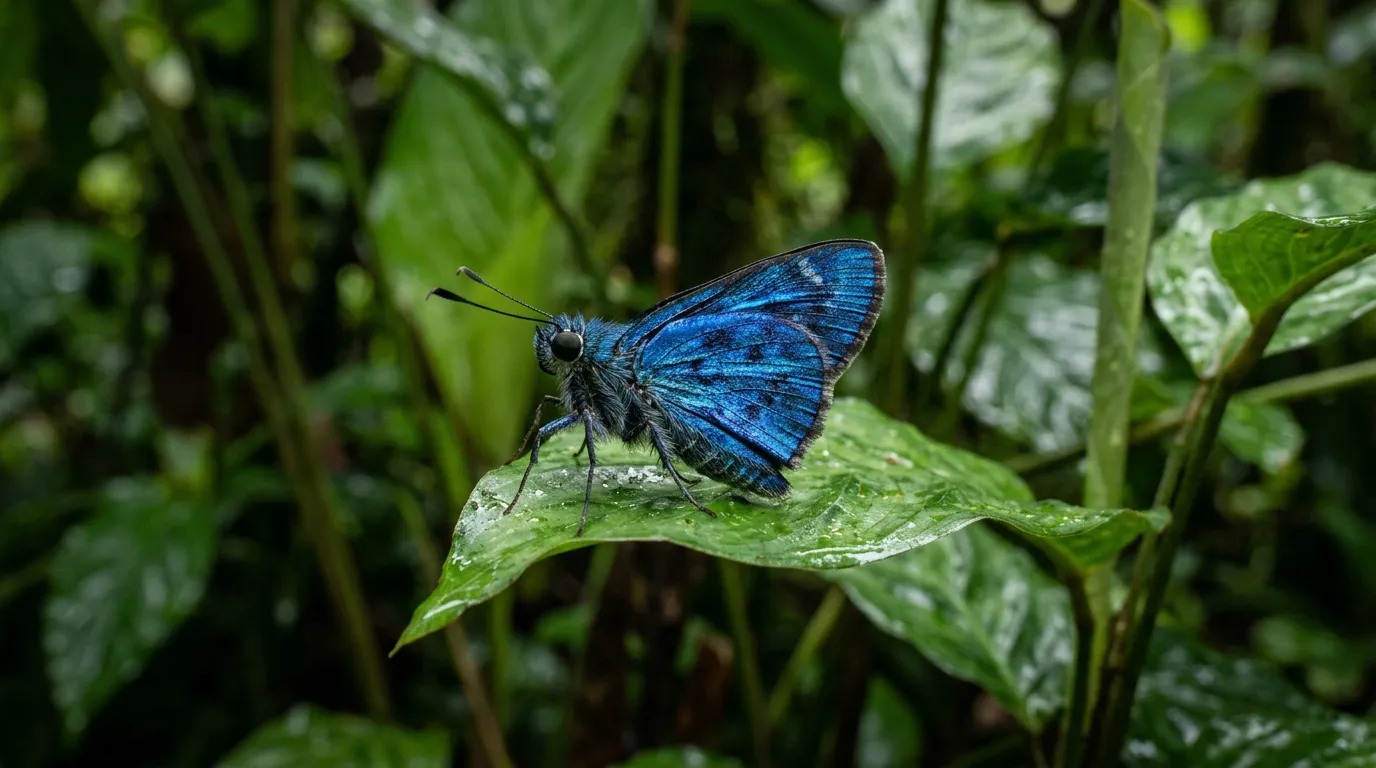
Skippers as a group are famous for being hard to identify. Hesperiidae contains around 3,500 species worldwide, most of them small, brown, and marked with subtle patterns of pale spots that vary from individual to individual. When you add iridescent blue scales into the mix, you get a small subset of species that all look vaguely similar and share the same body plan – stocky, fuzzy thorax, hook-tipped antennae, and wings held in the characteristic skipper posture with the hindwings spread flat and the forewings cocked upward at an angle.
The name “blue skipper” doesn’t appear on any official checklist. It’s an informal descriptor, so different observers use it for different species. A birder in Ecuador might apply it to a Paracleros biblia they saw on a fruiting tree. A butterfly enthusiast in Belize might use it for an Astraptes species flashing blue as it darts between sunlit patches. A field guide in Trinidad might call a Phocides pigmalion the “blue skipper” because that’s what local people say. None of these usages are wrong, but they don’t refer to the same animal.
This problem is compounded by the fact that many skippers look different depending on how light hits their wings. A species whose upper wing surface looks dark brown from directly above can light up with metallic blue from a side angle because the iridescence is produced by microscopic wing scale structures that reflect specific wavelengths only when viewed at certain angles. The same butterfly can look blue in one photograph and plain brown in another from ten seconds later. That’s not a printing error or a camera issue – it’s how structural iridescence works.
For a broader look at how skippers fit into the butterfly world and why they trip up identifiers so often, the skipper butterfly identification guide walks through the whole family and the common pitfalls.
Paracleros biblia and the Iridescent Tropical Skippers
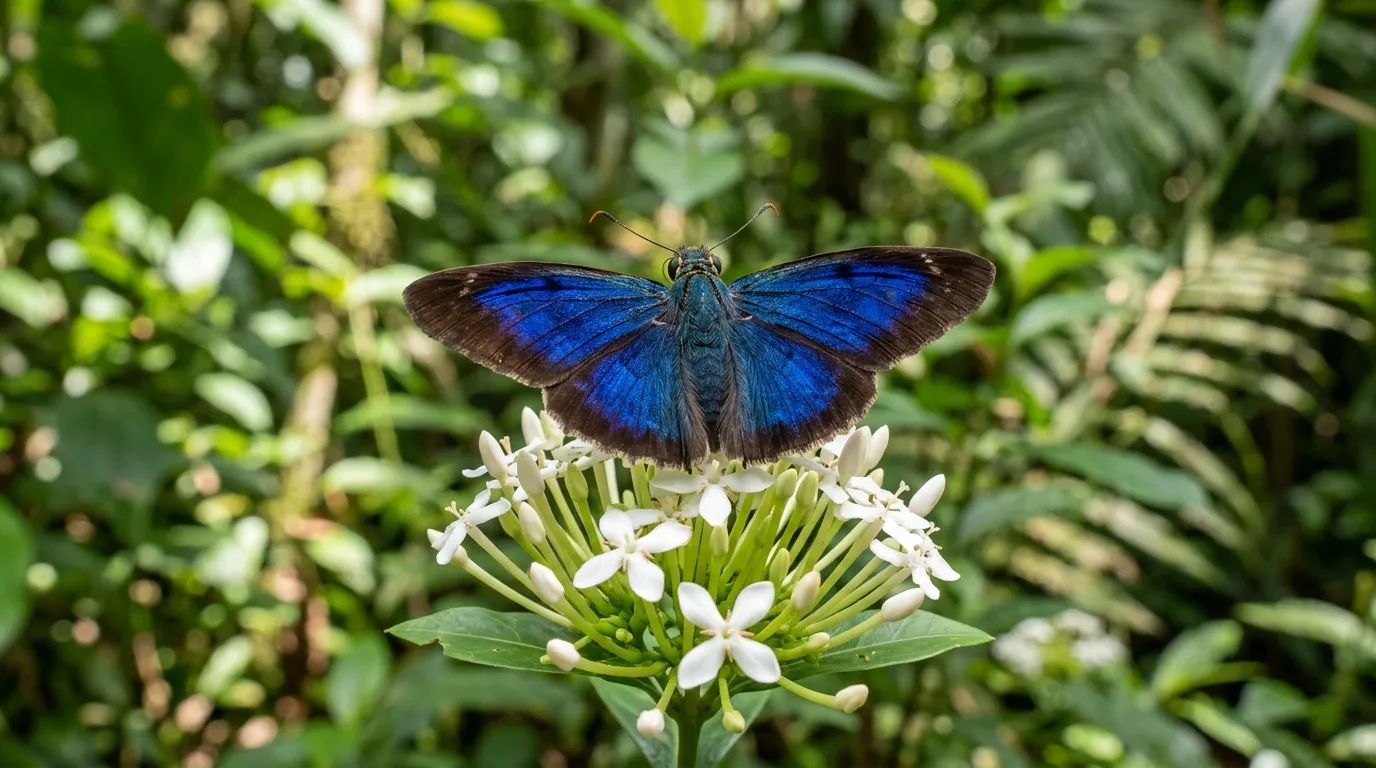
Paracleros biblia is one of the species most often referenced when people use the term “blue skipper.” It’s a small to medium skipper found through parts of Central and South America, ranging from southern Mexico down through the Amazon basin. The upper wing surface carries bright metallic blue scales across most of the forewings and hindwings, bordered by dark brown margins. The underside is much duller – brown with faint pale markings – which is typical of iridescent skippers where the bright color is only visible on the upper surface.
The species belongs to the subfamily Pyrginae, commonly called the spread-wing skippers. These butterflies rest with their wings held flat and open rather than folded upright, which is actually unusual for skippers as a whole. That flat resting posture makes the blue iridescence visible to observers and predators alike, which may be part of a signaling or mate-recognition function. Many Pyrginae males defend sunny perches along forest edges and trails, flashing their blue uppers at rivals and potential mates.
Paracleros biblia is far from the only blue iridescent tropical skipper. The genus Astraptes contains several species with blue scales, including Astraptes fulgerator, the two-barred flasher, which has bright blue-green iridescence on the forewings and a pair of distinctive white bars. Astraptes fulgerator became famous in the 2000s when DNA barcoding research suggested it might actually be a complex of ten or more cryptic species that look nearly identical but differ genetically and use different host plants as caterpillars. That research reshaped how butterfly taxonomists think about species limits in the tropics and showed how much hidden diversity exists within apparently well-known skippers.
The genus Phocides includes some of the largest and most spectacular blue skippers. Phocides pigmalion, the mangrove skipper, has brilliant iridescent blue scales on its hindwings, a wingspan of nearly two inches, and a range that extends from Florida through the Caribbean and down into South America. It’s one of the few blue skippers that regularly turns up in the continental United States, typically in southern Florida around mangrove forests where the caterpillars feed on red mangrove leaves.
Zera hyaspis and Other Confusable Species
Zera hyaspis is another species sometimes labeled a blue skipper, though it’s a little different from the clearly iridescent tropical species above. Zera hyaspis belongs to a genus of small Neotropical skippers with dark wings that carry faint bluish or greenish reflections under certain light conditions. The effect is subtler than the vivid metallic blue of Paracleros biblia or Astraptes, and observers who expect a flashy electric-blue butterfly are sometimes underwhelmed when they actually see one in the field.
The genus Zera is small – only a few species – and they all share similar morphology: small size, dark brown or black base coloration, and variable bluish tints. They’re forest butterflies that stick to understory vegetation and tend not to fly far from shade. Range extends through parts of Central America and northern South America. Unlike some of the bolder blue skippers, Zera species don’t usually perch conspicuously or advertise themselves, which makes them harder to find even where they’re locally common.
Other small skippers that get confused with true blue species include several members of the genera Urbanus and Chioides, both of which occasionally show faint blue or blue-green reflections on parts of the wing. Urbanus includes the well-known long-tailed skippers, some of which have long hindwing tails and may look bluish on fresh specimens with undamaged wings. Chioides skippers are usually brown with pale patches on the forewings, but a few species can take on a cool bluish cast in strong sunlight.
Across genera, the underlying issue is that blue iridescence in Hesperiidae evolved independently in multiple lineages. It’s not a single trait inherited from a common ancestor. That means species from widely different parts of the skipper family tree can look superficially similar without being closely related, and identification by color alone is basically guaranteed to go wrong.
Range and Habitat
Nearly all the skippers called blue skippers live in the tropical Americas, with the richest diversity in lowland rainforests and forest edges from southern Mexico through Central America and the Amazon basin. A few species extend their ranges up into the mountains of Costa Rica and Panama, into the Andes foothills of Colombia, Ecuador, Peru, and Bolivia, and out into the Atlantic forests of southeastern Brazil.
Tropical forest edge habitats are probably the best places to look for blue skippers. Open gaps along trails, river banks, landslides, and natural treefalls create the sunlit conditions where these butterflies like to perch and interact. Males of many species set up territories at sunny spots along forest edges and defend them aggressively, darting out at passing butterflies of any species to check whether they’re rivals or potential mates. If you stand quietly at a sunny trail junction in a Neotropical forest for an hour, you’re likely to see several species of iridescent skippers cycling through the same perches.
Dry forest and secondary growth can also support blue skippers, though species composition is usually different from primary rainforest. Disturbed areas around agricultural land sometimes harbor high densities of skippers that have adapted to human-modified habitats, including some blue iridescent species. Roadside flowers and gardens near forest can attract nectaring skippers as well.
In the United States, the mangrove skipper (Phocides pigmalion) is the most reliably encountered blue iridescent skipper, found in coastal southern Florida and the Keys. It’s a year-round resident there and can be seen nectaring on lantana, Spanish needles, and other flowering plants along the edges of mangrove stands. Very occasionally, strays of other tropical blue skippers have been reported from southern Texas during years of favorable weather patterns, but these are rare finds and usually require specialist confirmation.
Host Plants and Caterpillar Biology
Host plants for blue skippers vary widely because these butterflies come from different genera that evolved on different plant families. There’s no single host plant that defines the group. Knowing what plants grow at a location can actually help identify which species of blue skipper you’re seeing, because caterpillars of each genus specialize on particular plant families.
Paracleros and related Pyrginae skippers often use legume trees and shrubs as host plants, including species of Inga, Lonchocarpus, and Machaerium in Central and South American forests. Caterpillars build leaf shelters by rolling or folding leaves and silking them together, hiding inside the shelter during the day and emerging at night to feed. This shelter-building behavior is typical of skipper caterpillars across the family and provides some protection from parasitoids and predators.
Astraptes caterpillars feed on a range of plant families depending on the species. The cryptic species within the Astraptes fulgerator complex each specialize on a different plant group – some on legumes, others on members of Malpighiaceae, Convolvulaceae, and other families. This host plant specialization was one of the clues that led researchers to suspect the single named species was actually many. Caterpillars that look nearly identical but eat different plants often turn out to be distinct species when you look at their genetics.
Phocides skippers are particularly interesting because some species specialize on woody plants that few other butterflies use. Phocides pigmalion caterpillars feed almost exclusively on red mangrove leaves, a host that most Lepidoptera avoid because of the high salt content and tough leaf structure. Phocides belus and related species use trees in the family Myrtaceae, including guava and allied species. This specialization helps distinguish the genus even when adult identification is uncertain.
Zera caterpillars, to the extent they’ve been studied, appear to feed on monocot plants in the understory of wet forests, possibly including palms and various grasses. Much less is known about Zera life histories than about the more conspicuous genera, and there are almost certainly unreported host plant records scattered through regional collections and unpublished field notes.
Field Identification Tips
Identifying a blue skipper in the field is challenging, but there are a handful of features that will narrow down the options considerably.
Start with overall size and shape. The spread-wing Pyrginae skippers with flat wing posture are generally larger and stockier than the folded-wing Hesperiinae skippers. If the butterfly is perched with wings open flat, you’re probably looking at a Pyrginae species – Paracleros, Astraptes, Phocides, or one of their relatives. If the wings are held in the typical skipper jet-plane posture with hindwings spread and forewings cocked up, you’re more likely in Hesperiinae territory.
Next, look at the location of the blue scales. Is the blue concentrated on the forewings only, the hindwings only, or both? Does it cover most of the wing surface or just a patch in the middle? The blue in Phocides pigmalion is largely on the hindwings and basal forewings, while the blue in Paracleros biblia covers more of the upper surface more evenly. Astraptes fulgerator shows blue-green iridescence concentrated near the wing bases with a pair of pale bars crossing the forewings. These patterns are distinctive if you can see them clearly.
Check the underside of the wings. Blue iridescent skippers typically have dull brown undersides with some pale markings. The exact pattern of pale patches, bars, and lines on the underside is often more reliable for species-level identification than the upper surface coloration. Unfortunately, getting underside photos is hard because these butterflies usually rest with wings flat and don’t often show their undersides to observers. When they do nectar with wings closed, grab the shot.
Note the habitat and the host plants in the area. If the butterfly is perched on red mangrove in coastal Florida, mangrove skipper is by far the most likely candidate. If it’s in a Central American rainforest near fruiting Inga trees, the field of suspects is different. Adults don’t necessarily stay near their larval host plants, but the broader habitat context narrows the list of plausible species.
Take multiple photos from different angles. Because iridescent color changes with viewing angle, a photo from directly above may show plain brown where a photo from the side reveals bright blue. Capture the same individual from as many angles as you can get. If you can photograph it with wings both open and closed, even better. For tricky identifications, post the photos to a platform like iNaturalist where regional specialists can help confirm or correct your guess.
How Blue Skippers Compare to Other Blue Butterflies
Blue skippers are not the same as the blue butterflies in the family Lycaenidae, which are usually what people mean when they say “blue butterfly” in a temperate-zone context. The Lycaenidae blues – common blue, eastern tailed-blue, spring azure, and so on – are generally smaller than skippers, have slender bodies, straight antennae with club tips rather than hooks, and hold their wings folded upright when perched. They fly with delicate fluttering wingbeats, not the darting fast flight of skippers. For a detailed look at this family, the Lycaenidae butterflies guide covers their biology and identification.
Both Lycaenidae blues and blue skippers use structural iridescence to produce their color, but the specific scale structures and the viewing angles at which they appear blue are different. Lycaenidae blue typically shows best when looking straight down at the upper wing surface, while many iridescent skippers show best from side angles as the butterfly moves in and out of sunlit patches. These differences reflect independent evolutionary origins of structural color in unrelated butterfly lineages.
Another group sometimes confused with blue skippers is the metalmark family (Riodinidae), which includes some small tropical species with metallic blue or blue-green wing markings. Metalmarks are closer in size and habits to some skippers and can occupy similar forest edge habitats. They typically have slender antennae with clubs, slimmer bodies than skippers, and more delicate flight. Where skippers are the fighter pilots of the butterfly world – fast, darting, territorial – metalmarks are more measured in their movements.
True butterflies in the superfamily Papilionoidea and the skippers in Hesperoidea are sometimes treated as separate groups, though recent phylogenetic work has placed them all within an expanded Papilionoidea. The Papilionoidea butterfly superfamily guide breaks down how these groups relate and where skippers fit in the modern classification.
Behavior and Flight
Blue skippers behave like other members of Hesperiidae – which is to say, fast, erratic, and often hard to follow by eye. Their flight is powered by disproportionately large thoracic muscles packed into the stocky body, giving them the ability to accelerate, turn, and stop in midair in ways that more typical butterflies can’t match. Watching a skipper defend a sunny perch from rivals is like watching a small fighter pilot work a combat patrol.
Males of the larger Pyrginae species, including many blue skippers, establish perching territories in sunny forest gaps and defend them through aerial combat with rivals. When a passing butterfly – of any species – enters the territory, the resident male darts out to intercept it, spiraling upward with the intruder before returning to the perch if the intruder leaves. These aerial chases can be fast enough that untrained observers miss them entirely. A flash of blue and the butterfly is back on its perch before you’ve processed what happened.
Nectar feeding is the main food source for adult blue skippers, and they visit a wide variety of flowers. In lowland tropical forests, small white flowers on understory shrubs, lantana, and flowering vines on the forest edge are common nectar sources. Males of many species also puddle at damp patches of mud, wet sand, and animal droppings to obtain sodium and other minerals that supplement their nectar diet.
Some blue skippers visit rotting fruit and tree sap in addition to flowers. The fermenting sugars in rotten fruit attract many tropical butterflies, and mixed assemblages of skippers, nymphalids, and other butterflies can gather at a single fallen mango or breadfruit on the forest floor. Tree sap flows, particularly those produced by woodpeckers or insect damage, also draw crowds of butterflies and make for good photography opportunities.
Where to See Blue Skippers
If you want to find blue skippers in the field, tropical America is your destination. Costa Rica is probably the most accessible place for North American visitors, with excellent infrastructure for ecotourism and a high diversity of Hesperiidae at sites like La Selva Biological Station, Monteverde, and Corcovado National Park. Local guides can help with skipper identification, though even they often need photos reviewed by specialists.
Panama, Colombia, Ecuador, and Peru all host diverse skipper faunas, and the Amazon basin in general is rich in Hesperiidae. Butterfly-specific ecolodges exist in several countries and cater to visitors specifically interested in Lepidoptera, with gardens and fruit-baited traps that concentrate butterflies for easier observation. These lodges often maintain species lists for their properties and can tell you what blue skippers have been recorded there.
Closer to home for US observers, southern Florida is the only place in the continental United States where you can reliably see an iridescent blue skipper – the mangrove skipper (Phocides pigmalion). Everglades National Park, Key Biscayne, and the Florida Keys all have populations of this species. Time your visit for warm weather and look along mangrove-lined trails and boardwalks. The mangrove skipper often perches with wings open in sunny spots, showing its blue hindwings clearly.
For a broader sense of the butterflies you’re likely to encounter in any region, the types of butterflies common species guide is a good starting point before heading out to look for skippers.
The Taxonomy Problem
Skipper taxonomy is in a state of ongoing revision, and blue skippers are no exception. The family Hesperiidae is one of the most poorly studied butterfly groups at the species level, particularly in the Neotropics, and new species are regularly described from old museum specimens and new field collections. The ten-or-more cryptic species within Astraptes fulgerator are just one high-profile example of hidden diversity that DNA work has uncovered.
Genus-level names also shift as researchers reclassify species based on molecular data. A species that used to be in one genus may end up in another genus a few years later, which means older field guides can become out of date surprisingly fast. For skippers, checking recent literature or online resources like Butterflies of America is often necessary to get current names right. Even then, some groups are still being actively worked on and names may change again.
This taxonomic instability is frustrating for anyone trying to put confident names on their photos, but it’s a reflection of real biological complexity. Tropical butterflies really are more diverse than they look, and researchers are still catching up with the full picture. Work at institutions like the Smithsonian Entomology Department continues to reshape our understanding of how skipper species relate to each other and what features best define them.
Frequently Asked Questions
Is “blue skipper butterfly” a single species?
No. It’s a descriptive label used for any member of the skipper family (Hesperiidae) that shows iridescent blue coloring. Multiple unrelated species in genera like Paracleros, Astraptes, Phocides, and Zera all get called blue skippers depending on who is doing the naming. There is no formally recognized species with “blue skipper” as its official common name on standard checklists.
Where are blue skippers found?
Most species called blue skippers live in the tropical Americas, from southern Mexico through Central America and into the Amazon basin and Atlantic forests of South America. A few species extend their ranges into the southern United States, most notably the mangrove skipper (Phocides pigmalion) in southern Florida and the Keys. The richest diversity is in lowland rainforests and forest edges in the Neotropics.
How do I tell a blue skipper from a regular blue butterfly?
Size, body shape, antennae, and flight style are the main clues. Blue skippers have stocky bodies, hooked antenna tips, and fast darting flight. The blue butterflies in family Lycaenidae that most people see in temperate regions are smaller, slimmer, have straight club-tipped antennae, and fly with a gentle fluttering motion. Skippers also often perch with wings held flat or in the jet-plane posture, while lycaenid blues hold wings folded upright when perched.
Why does the blue color sometimes disappear in photos?
The blue in iridescent skippers is produced by microscopic structures on the wing scales that reflect blue light only at specific viewing angles. When you photograph the butterfly from an angle where the structures don’t reflect blue back to the camera, the wing looks plain brown instead. This is structural color, not pigment, and it’s the same effect that makes peacock feathers and morpho butterflies change color as you move around them. Multiple photos from different angles are often needed to capture the blue properly.
Can I see a blue skipper in the United States?
Yes, but only in limited areas. The mangrove skipper (Phocides pigmalion) is a year-round resident in southern Florida and the Florida Keys, where it lives in association with red mangrove forests. It’s the most reliably encountered iridescent blue skipper in the continental US. Occasional strays of other tropical blue skippers have been reported from southern Texas, but these are rare sightings and typically require expert confirmation to identify correctly.
What do blue skipper caterpillars eat?
It depends on the species. Caterpillars of Paracleros and related Pyrginae often use legume trees and shrubs like Inga and Lonchocarpus. Astraptes caterpillars feed on a variety of plant families depending on the cryptic species involved. Phocides pigmalion specializes almost entirely on red mangrove leaves. Other Phocides species use Myrtaceae including guava relatives. Because blue skippers come from different genera that evolved on different host plant groups, there’s no single host plant that works across the whole group.
Are blue skippers endangered?
Most of the species called blue skippers are not currently considered endangered, though data is limited for many tropical Hesperiidae. Habitat loss from deforestation is the main threat to forest-dependent species across the Neotropics, and skippers that require intact rainforest or specific host plants are likely declining in areas where their habitat is being cleared. The mangrove skipper in Florida is considered secure as long as mangrove forests are protected. For most tropical species, population trends are simply unknown because no one is monitoring them consistently.