


Papilionidae Characteristics That Define the Swallowtail Family
Papilionidae characteristics set this butterfly family apart from every other group in the order Lepidoptera. These are the swallowtails, parnassians, and birdwings – roughly 570 species spread across all continents except Antarctica. Most of them are large, colorful, and strong fliers with distinctive tail-like extensions trailing from their hindwings. But the family’s defining traits go deeper than appearance. Caterpillars in this family carry a hidden forked organ behind their heads called an osmeterium, which they deploy when threatened. No other butterfly family has it.
Whether you’re studying taxonomy, working on field identification, or just trying to figure out what landed in your garden, understanding the core Papilionidae characteristics gives you a reliable framework. This family sits within the superfamily Papilionoidea, and its members range from the familiar tiger swallowtails of North American backyards to the massive birdwings of Southeast Asia and Australasia.
Key Takeaways
- Papilionidae includes about 570 species in three subfamilies (Papilioninae, Parnassiinae, and Baroniinae), making it one of the most recognizable butterfly families on Earth.
- Most species have tail-like extensions on the hindwings, though some groups like parnassians and birdwings lack them entirely.
- All Papilionidae caterpillars possess an osmeterium, a Y-shaped organ behind the head that releases foul-smelling chemicals to repel predators – a trait unique to this family.
- Adults tend to be large-bodied with wingspans from 6 cm in smaller swallowtails to over 28 cm in Queen Alexandra’s birdwing, the largest butterfly species alive.
Physical Traits That Define Papilionidae
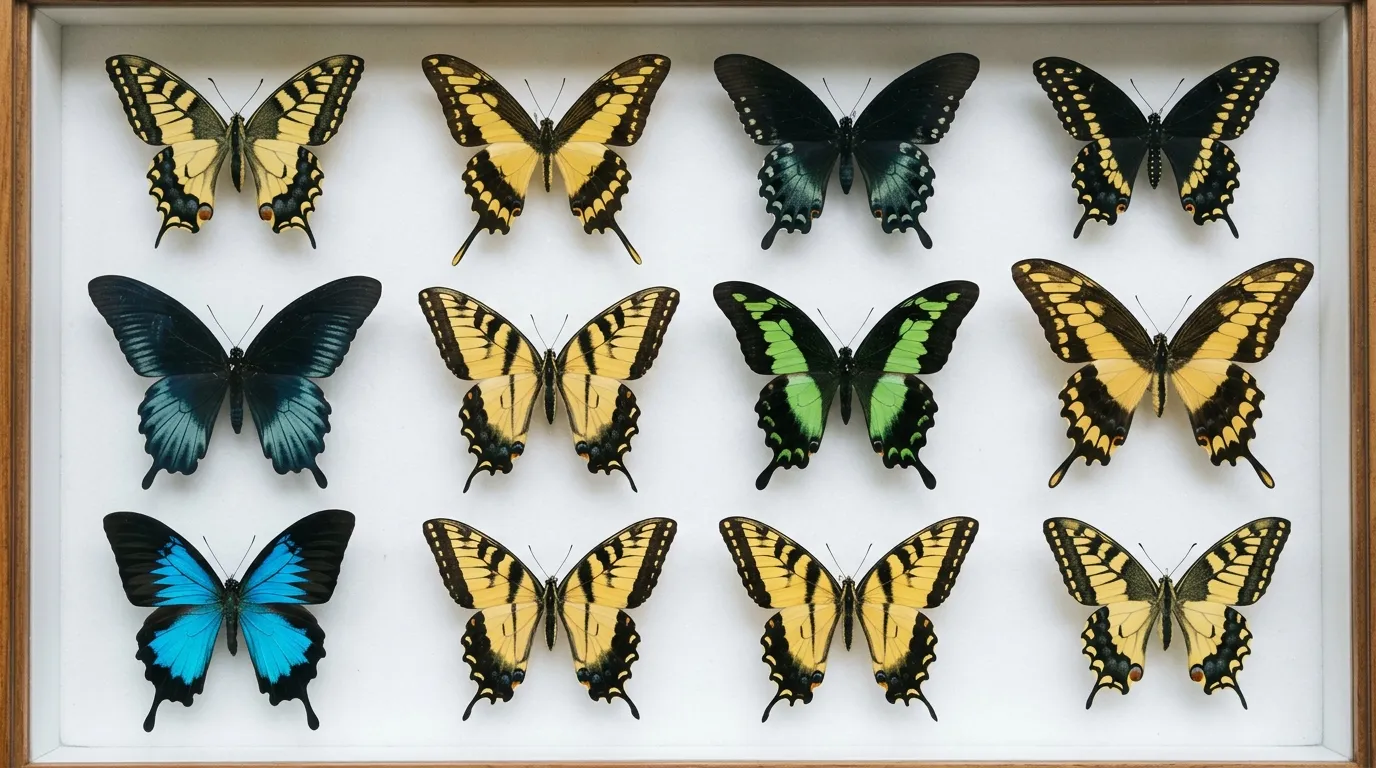
Size is the first thing most people notice. Papilionidae butterflies are among the largest in the world. Even the smaller species in the genus Graphium have wingspans around 6 to 8 cm, and many Papilio species spread 10 cm or more. At the extreme end, the birdwings of genus Ornithoptera and Troides push past 20 cm, with Queen Alexandra’s birdwing reaching wingspans up to 28 cm in females.
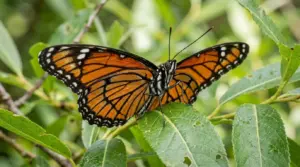
Wing shape follows a consistent pattern across most of the family. The forewings are elongated and triangular. The hindwings are rounded and, in the majority of species, carry those signature tail-like projections. These “tails” vary in length and shape. Some species have short, rounded tails. Others, like the zebra swallowtail (Eurytides marcellus), have long, ribbon-like extensions that trail behind them in flight.
Not every member of Papilionidae has tails, though. The parnassians (subfamily Parnassiinae) have rounded hindwings with no tails at all, and many birdwings lack them too. So while tails are the most visible Papilionidae characteristic in popular perception, they’re not universal within the family.
Wing Coloration and Patterns
Bold color contrasts define most swallowtail wings. Black-and-yellow striping is common across Papilio species in both North America and Asia. Many tropical species add iridescent blue, green, or red patches created by structural coloration – light refracting through microscopic wing scale architecture rather than pigment alone.
Several Papilionidae species are textbook examples of Batesian mimicry. The female eastern black swallowtail (Papilio polyxenes) mimics the pipevine swallowtail (Battus philenor), which is toxic to birds. The mimic gains protection by looking like something predators have learned to avoid. This kind of mimicry shows up repeatedly across the family, particularly in tropical Asian and African species.
The Osmeterium: A Defense Organ Found Nowhere Else
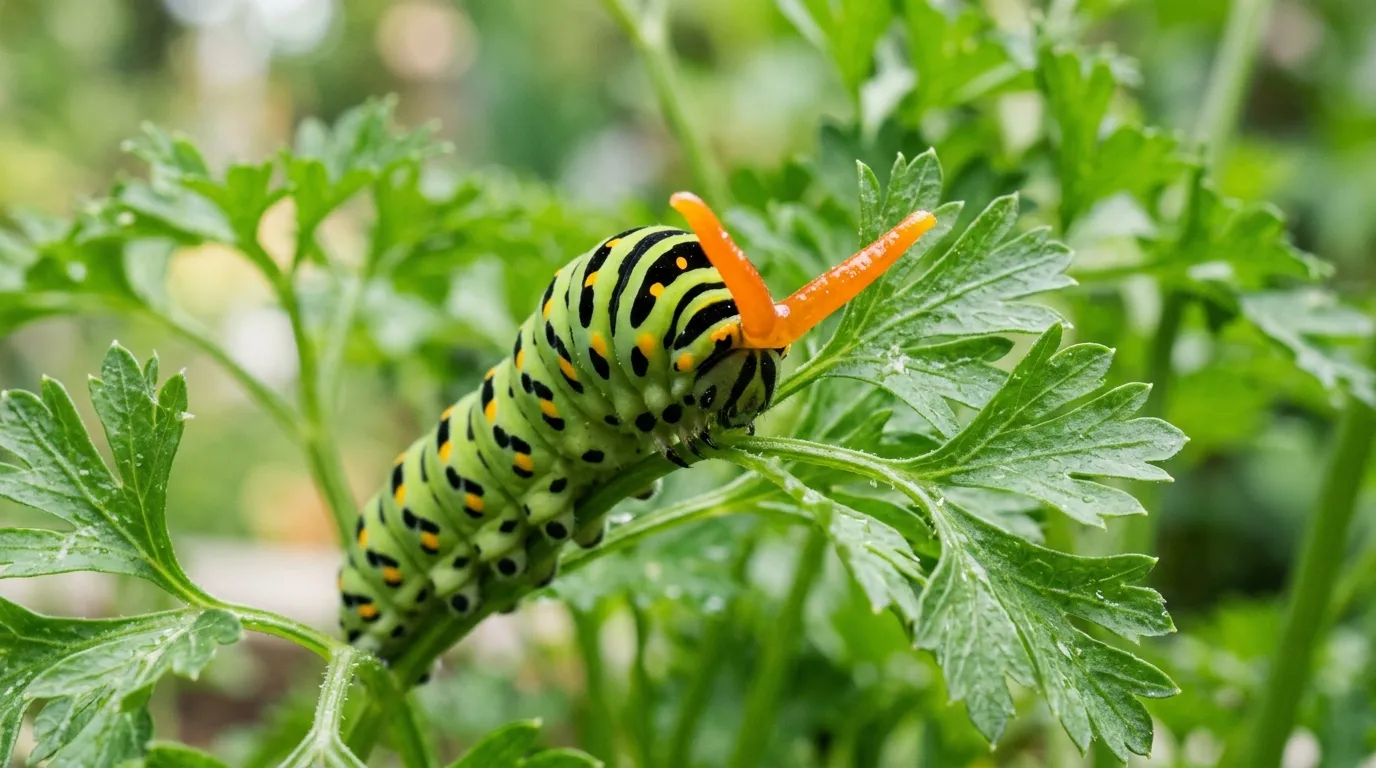
If you pick up a swallowtail caterpillar, you might see something unexpected. A bright orange or yellow Y-shaped organ suddenly appears from behind the head, and a sharp, unpleasant smell fills the air. That organ is the osmeterium, and it exists only in Papilionidae larvae.
The osmeterium stays tucked inside the prothoracic segment when the caterpillar is undisturbed. When the larva senses a threat – a bird pecking at it, an ant crawling nearby, or a parasitoid wasp investigating – it everts the organ outward and releases a cocktail of terpene-based chemicals. The specific compounds vary between species, but the effect is similar: most small predators back off quickly.
Young caterpillars tend to use their osmeterium more readily than older ones. By the final instar, many swallowtail larvae rely more on their size and coloration (often green with eyespot markings that mimic snakes) than on chemical defense. But the osmeterium remains functional throughout the larval stage in all Papilionidae species studied so far.
The Three Subfamilies of Papilionidae
Papilionidae splits into three subfamilies, each with its own set of traits and geographic range. The split is supported by both morphological evidence and molecular phylogenetics.
Papilioninae: The True Swallowtails
This is the largest subfamily, containing the majority of the family’s species. It includes the genera Papilio, Graphium, Battus, Eurytides, and others. Most species here have the classic swallowtail body plan: large size, strong angular forewings, tailed hindwings, and bold patterning. They’re found on every continent with butterflies, though diversity peaks in the tropics.
The genus Papilio alone accounts for roughly 200 species. The scientific naming of swallowtails within this genus has a long history going back to Linnaeus, and many of the names reference figures from Greek and Trojan mythology. Papilio machaon is named after the physician Machaon from the Iliad. Papilio paris references the Trojan prince.
Parnassiinae: The Apollos and Snow Butterflies
Parnassiinae looks different from what most people picture when they think “swallowtail.” These butterflies have rounded wings, no tails, and semi-translucent white or cream-colored wing membranes with red or black spots. They live primarily in mountain habitats across Central Asia, Europe, and western North America.
The genus Parnassius (the apollos) includes some of the most cold-adapted butterflies in the world. Several species fly at elevations above 4,000 meters in the Himalayas and the Tian Shan range. Their caterpillars feed on stonecrop (Sedum) and other alpine plants, and adults have a distinctive slow, floating flight pattern quite different from the rapid wingbeats of tropical swallowtails.
One unusual Parnassiinae trait: after mating, the male deposits a waxy structure called a sphragis on the female’s abdomen. This plug physically prevents her from mating again. It’s one of the most extreme mate-guarding strategies in the butterfly world.
Baroniinae: A Single Living Relic
Baroniinae contains just one species: Baronia brevicornis, found only in a small area of southwestern Mexico. It’s considered the most primitive living member of Papilionidae, with wing venation patterns closer to fossil swallowtails than to any modern species. Its caterpillars feed on Acacia trees, which is unusual for a family where most larvae eat plants in the citrus, carrot, or birthwort families.
Baronia brevicornis is small for a swallowtail, with a wingspan around 7 cm. It lacks hindwing tails and has relatively dull brown-and-yellow coloring. Despite its modest appearance, it’s one of the most scientifically significant butterflies alive because of what it tells us about the evolutionary origins of the entire family.
Flight, Behavior, and Life Cycle
Papilionidae adults are strong, directional fliers. Watch a tiger swallowtail crossing a garden and you’ll notice steady, purposeful wingbeats interspersed with short glides. Many species patrol territories or hilltop, where males fly to elevated ridges and wait for females passing through. This hilltopping behavior makes mountain trails and ridgetops productive spots for observing swallowtails.
Males of many species engage in puddling – gathering at damp soil, animal droppings, or mineral-rich surfaces to drink dissolved salts and amino acids. You’ll sometimes see groups of 10 or 20 Graphium butterflies clustered at a muddy riverbank in the tropics, pumping fluid through their bodies and expelling excess water to concentrate the nutrients they need.
The life cycle follows the standard four-stage pattern: egg, larva (caterpillar), pupa (chrysalis), and adult. Eggs are usually spherical and laid singly on host plant leaves. Caterpillars pass through five instars, often changing color dramatically between early and late stages. Early instars frequently mimic bird droppings – dark brown with white patches – while later instars shift to green with eyespot markings. Pupation happens on or near the host plant, and the chrysalis is secured by a silk girdle around the midsection, a trait shared with the family Pieridae but not most other butterfly families.
Where Papilionidae Live Around the World
Swallowtails reach their greatest diversity in tropical and subtropical regions. Southeast Asia, Central Africa, and Central and South America each host dozens of species. But Papilionidae representatives show up in temperate zones too. North America has about 30 species, Europe has around 12, and even subarctic regions support a few Parnassius populations.
Habitat preferences vary by subfamily. Papilioninae species occupy forests, meadows, gardens, and riparian corridors. Many are habitat generalists as adults, nectaring on a wide range of flowers, though their caterpillars tend to be more specific. Host plant families include Rutaceae (citrus), Apiaceae (carrot and parsley family), Aristolochiaceae (birthworts), and Lauraceae (laurels). If you grow parsley, dill, or fennel in a North American garden, you’ve probably already met the black swallowtail (Papilio polyxenes) caterpillar firsthand.
Parnassiinae species stick to alpine and montane habitats. Baroniinae occupies dry tropical forest in Mexico. The IUCN Red List tracks conservation status for many Papilionidae species, and several birdwings and apollos are listed as threatened due to habitat loss and collecting pressure.
Notable Genera and Species Worth Knowing
Papilio is the type genus and the one most people encounter first. Common North American representatives include the eastern tiger swallowtail (P. glaucus), the western tiger swallowtail (P. rutulus), and the giant swallowtail (P. cresphontes). In Europe, the Old World swallowtail (P. machaon) is the most widespread.
Graphium includes the swordtails and bluebottles of Africa and Asia. These are fast-flying, often pale-colored butterflies with elongated tails and translucent wing patches. Graphium sarpedon, the common bluebottle, is one of the most frequently seen butterflies in South and Southeast Asian gardens.
Ornithoptera, the birdwings, are the giants. Queen Alexandra’s birdwing (Ornithoptera alexandrae) holds the record for largest butterfly, but the genus also includes the strikingly colored Rajah Brooke’s birdwing (Trogonoptera brookiana) and the golden birdwing (Troides aeacus). All birdwing species are protected under CITES (Convention on International Trade in Endangered Species), with trade in wild-caught specimens restricted or banned.
Battus includes the pipevine swallowtails. Their caterpillars feed on Aristolochia vines and sequester aristolochic acid, making both larvae and adults toxic to predators. The resulting bright metallic blue of Battus philenor is a warning signal, and several non-toxic species across multiple butterfly families have evolved to mimic its appearance.
Frequently Asked Questions
What is the most obvious Papilionidae characteristic?
The tail-like extensions on the hindwings are the most visually recognizable trait, which is why the common name “swallowtail” refers to them. But from a taxonomic standpoint, the osmeterium in caterpillars is the more definitive characteristic because it appears in all Papilionidae species, while tails are absent in some subfamilies.
How many species belong to Papilionidae?
About 570 described species, spread across roughly 30 genera. The exact count shifts as taxonomists split or merge species based on new genetic data. Papilioninae holds the majority of that diversity, with Parnassiinae adding about 70 species and Baroniinae contributing just one.
Do all swallowtail butterflies have tails on their hindwings?
No. Parnassians (subfamily Parnassiinae) have rounded hindwings without any tail extensions. Some birdwings also lack tails. And within Papilioninae, a few species like the Battus polydamas group have minimal or absent tails. The name “swallowtail” is based on the most common pattern in the family but doesn’t apply to every member.
What do Papilionidae caterpillars eat?
Host plant preferences vary by genus. Papilio caterpillars in temperate regions feed primarily on plants in the citrus family (Rutaceae) and the carrot family (Apiaceae). Battus larvae eat birthwort vines (Aristolochiaceae). Parnassius caterpillars feed on stonecrops and related succulents. Baronia caterpillars eat Acacia. Each genus has evolved tight associations with specific plant chemistry.
Are any Papilionidae species endangered?
Yes. Several birdwing species are critically endangered, including Queen Alexandra’s birdwing, which is restricted to a small area of Papua New Guinea’s lowland rainforest. Multiple Parnassius species face declining populations due to climate change pushing their alpine habitats higher. All birdwings are listed under CITES Appendix II, and Ornithoptera alexandrae is on Appendix I, which bans commercial trade entirely. The Butterflies of the World database tracks species-level distribution and status information.
What separates Papilionidae from other large butterfly families?
Several features set them apart. The osmeterium is unique to Papilionidae larvae. Adults have all six legs fully functional for walking, unlike Nymphalidae where the front pair is reduced. Wing venation follows a specific pattern with a single anal vein on the hindwing. And the chrysalis is supported by a silk girdle rather than hanging freely like a nymphalid chrysalis. Taken together, these traits make Papilionidae reliably identifiable at every life stage.