


Key Takeaways
- Danaus melanippus, commonly called the White Tiger butterfly, is a milkweed-feeding species found across South Asia, Southeast Asia, and parts of Australia that shares its genus with the well-known monarch.
- Its orange and white wings with bold black veins make it easy to confuse with several look-alikes, but a few field marks set it apart from close relatives.
- At least six recognized subspecies occupy different parts of its range, each showing subtle wing pattern differences tied to geography.
- Like other Danaus butterflies, this species sequesters toxic cardenolides from its larval host plants, making it unpalatable to most predators.
What Is Danaus Melanippus?
Danaus melanippus is a medium-sized butterfly in the family Nymphalidae, subfamily Danainae – the same group that includes monarchs. You’ll find it called the White Tiger, Black-veined Danaid, or sometimes simply the “white monarch” by field observers across its range.
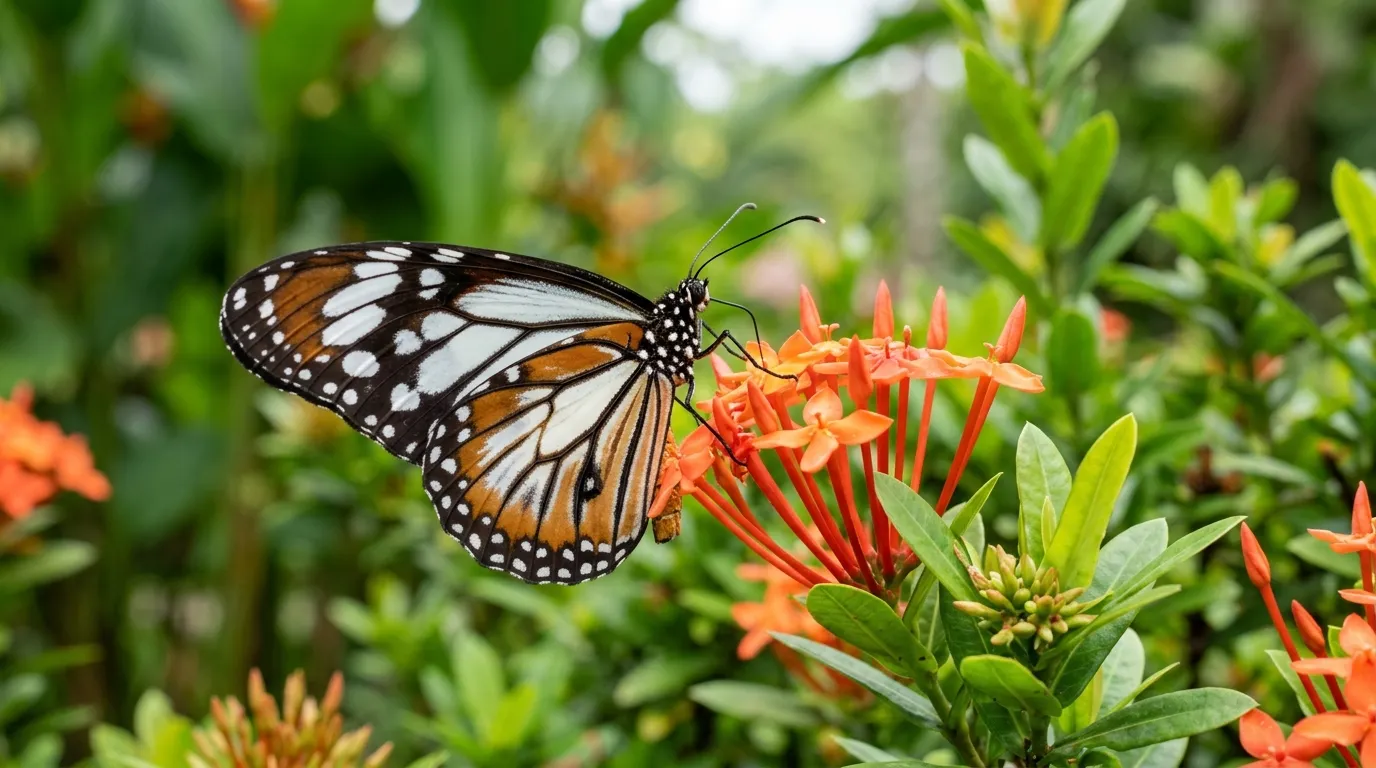
I first encountered this species in photos from a friend working in Sri Lanka, and what struck me was how much it looked like someone had taken a monarch butterfly and lightened the color palette. The ground color is a softer orange with broad white patches on the hindwing, all traced by thick black veins that give the wings a stained-glass quality.
Adults typically have a wingspan between 70 and 80 mm. Males carry a distinct dark scent patch on the hindwing, which helps with quick sex identification in the field. The body is black with white spots, a pattern shared by many Danaus species as a warning signal to would-be predators.
This butterfly belongs to the genus Danaus, which contains roughly a dozen species worldwide. Understanding where Danaus melanippus fits in that family tree helps explain its biology, because the traits that define this genus – milkweed feeding, toxicity, and slow conspicuous flight – all apply here too.
Range and Habitat Across Asia and Australia
The geographic range of Danaus melanippus stretches from the Indian subcontinent through Southeast Asia and into parts of northern Australia. That is a huge swathe of tropical and subtropical territory, and this butterfly takes advantage of varied habitats within it.
In India and Sri Lanka, you’ll find it in open scrubland, coastal areas, gardens, and the edges of deciduous forests. It tends to avoid dense closed-canopy jungle, preferring spots where its milkweed host plants grow in sunny patches.
Moving east, it’s common through Myanmar, Thailand, Vietnam, Malaysia, and the Indonesian archipelago. In these regions it occupies lowland areas up to moderate elevations, usually below about 1,500 meters. It also reaches the Philippines and, at the southern end of its range, pops up across parts of Papua New Guinea and Queensland, Australia.
Within any given area, look for Danaus melanippus in open sunny locations near its host plants. It’s a butterfly of disturbed habitats and edges – road margins, farmland boundaries, parks, and gardens all suit it well. If you’re growing any Asclepiadaceae species in a tropical garden, there’s a good chance this butterfly will show up.
Subspecies and Regional Variation
Danaus melanippus has been split into at least six recognized subspecies, and there is ongoing debate about a few more. The differences between them are mostly in wing pattern – the amount of white versus orange, the width of the black veining, and the presence or absence of small submarginal spots.
The nominate subspecies, Danaus melanippus melanippus, is found in Java and shows a fairly balanced mix of orange and white. D. m. indicus is the form found across mainland India and Sri Lanka. D. m. hegesippus occurs in the Malay Peninsula and parts of Indonesia.
Other named subspecies include D. m. edmondii from the Philippines, D. m. lotis from Sulawesi, and D. m. dravidarum from southern India. According to research published in the Natural History Museum’s butterfly database, the taxonomy within this species complex is still being refined with molecular studies.
For field identification, the subspecies differences are subtle enough that location is your best first clue. If you are photographing one in Kerala, you’re almost certainly looking at indicus. In Borneo, it would be hegesippus. The wing patterns overlap enough that geography narrows things down faster than trying to count spots.
Host Plants, Feeding, and Toxicity
Like its cousin the monarch, Danaus melanippus is a milkweed butterfly through and through. Females lay eggs on plants in the family Asclepiadaceae, and the caterpillars feed exclusively on these hosts.
Primary host plants include various species of Cynanchum, Tylophora, Calotropis, and Asclepias. In cultivated areas across India, Calotropis gigantea (the crown flower) is one of the most commonly used larval food plants. Gardeners growing tropical milkweeds in the right climate zones may well attract egg-laying females.
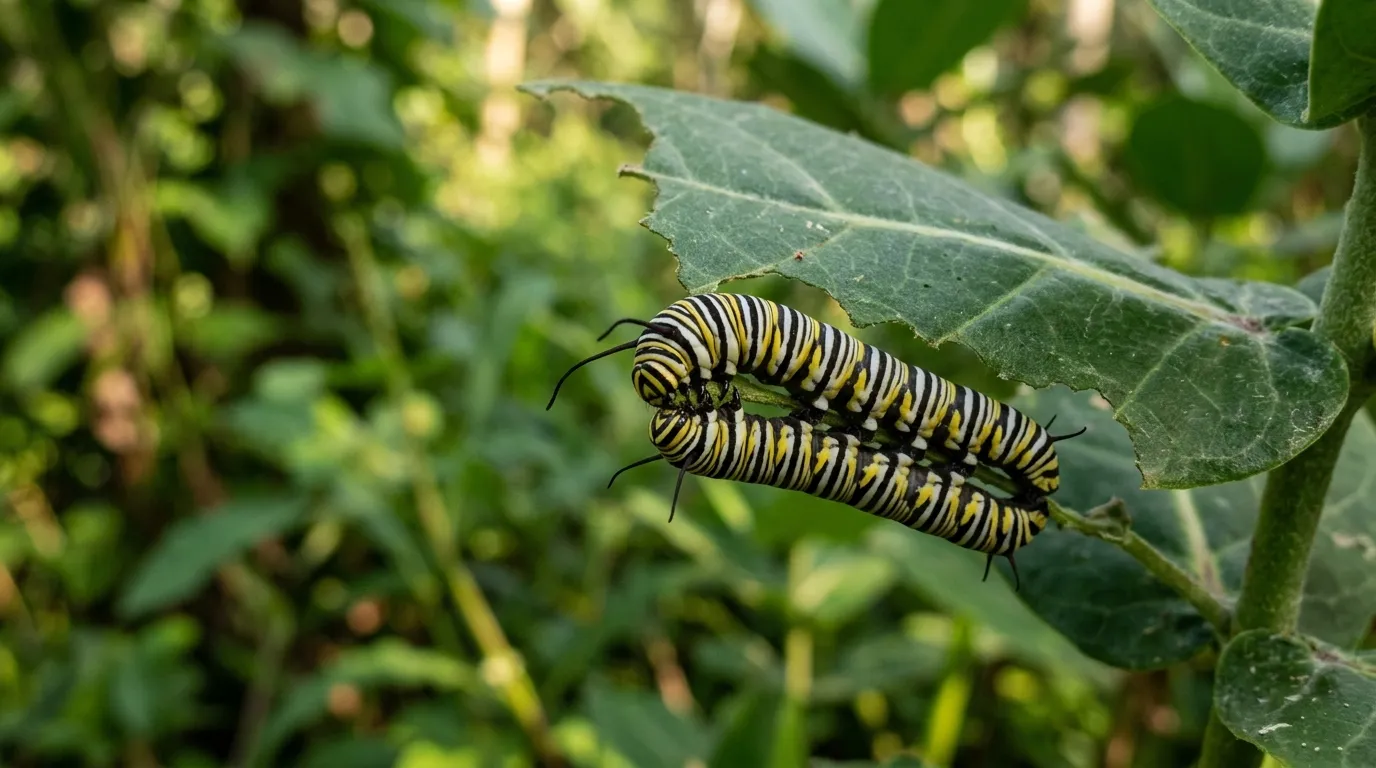
The caterpillars are striped in black, white, and yellow – a warning pattern that advertises their toxicity. As they feed on milkweed, they sequester cardenolide glycosides into their tissues. These compounds persist through pupation and into the adult stage, making both caterpillars and adult butterflies unpalatable to birds and other predators.
Adult butterflies feed on nectar from a wide range of flowering plants. They are particularly attracted to Lantana, Eupatorium, and various Asteraceae. Males also engage in “mud-puddling,” gathering at damp soil or animal droppings to obtain sodium and amino acids they need for reproduction.
Behavior, Flight, and Lifespan
Watch a Danaus melanippus in flight and you’ll immediately notice the slow, deliberate wingbeats typical of toxic butterflies. There is no frantic zigzagging here. This species floats along lazily, advertising its presence rather than trying to hide from predators. That unhurried flight style is a direct consequence of chemical defense – when you taste bad, you want to be seen and remembered.
Males establish loose territories around patches of host plants and nectar sources. They patrol these areas with that characteristic gliding flight, investigating any passing butterfly that might be a female. Courtship involves aerial pursuit followed by release of pheromones from the hindwing scent patches.
In terms of lifespan, adult Danaus melanippus can live several weeks in the wild, with some records suggesting up to two months under favorable conditions. In tropical parts of their range where breeding is continuous year-round, you can find adults in every month. In areas with a dry season, populations may shift locally or enter a period of reduced activity.
Unlike monarchs, Danaus melanippus does not undertake long-distance migrations. It may make short seasonal movements in response to monsoon patterns and host plant availability, but nothing on the scale of the famous North American monarch migration.
How It Compares to Other Danaus Species
The genus Danaus contains several species that share the same basic toolkit – milkweed feeding, cardenolide sequestration, warning coloration, and slow flight. But each has carved out its own niche.
Compared to the monarch (Danaus plexippus), Danaus melanippus is smaller and has more white in the wing pattern. The monarch’s wings are predominantly deep orange, while melanippus shows a paler orange with prominent white areas on the hindwing. The monarch is also primarily a New World species, though introduced populations exist in Australia and a few other locations.
The Common Tiger (Danaus genutia) overlaps extensively with melanippus across South and Southeast Asia and is probably its most frequent source of confusion. Genutia is more uniformly orange with less white, and its black veining tends to be thinner. The two species sometimes fly together in the same habitats, which makes careful observation important. Both are among the butterflies that resemble monarchs and can trip up observers unfamiliar with the Asian Danaus species.
The Plain Tiger (Danaus chrysippus) is another close relative found across Africa, Asia, and Australia. It differs from melanippus in having a simpler wing pattern with a solid black wingtip containing white spots, and it lacks the extensive white hindwing patches that characterize melanippus.
All of these species participate in mimicry rings with other toxic butterflies in their respective regions, reinforcing the “orange and black means danger” message for local predators. According to a study published in Philosophical Transactions of the Royal Society B, these mimicry complexes among Danaus and related genera are some of the best-documented examples of Mullerian mimicry in the insect world.
Frequently Asked Questions
Is Danaus melanippus the same as a monarch butterfly?
No. They are in the same genus, Danaus, which means they are closely related, but they are separate species. The monarch is Danaus plexippus and is primarily found in the Americas, while Danaus melanippus is an Asian and Australian species. They share milkweed feeding and similar wing patterns but differ in size, coloration, and range.
What do Danaus melanippus caterpillars eat?
The caterpillars feed exclusively on plants in the milkweed family, Asclepiadaceae. Common host plants include species of Calotropis, Cynanchum, Tylophora, and Asclepias. In many parts of India, Calotropis gigantea is the primary larval food source.
Is the White Tiger butterfly poisonous?
It is toxic rather than poisonous in the traditional sense. The caterpillars accumulate cardenolide glycosides from their milkweed host plants, and these chemicals persist into the adult stage. Birds or lizards that eat one will typically vomit and learn to avoid butterflies with that wing pattern in the future.
Where can I see Danaus melanippus in the wild?
Your best chances are in open habitats across India, Sri Lanka, Thailand, Malaysia, Indonesia, and the Philippines. Look in gardens, along roadsides, and at the edges of forests where milkweed plants grow. Butterfly parks in Southeast Asia frequently feature this species as well.
Does Danaus melanippus migrate like the monarch?
No. While it may make short local movements in response to seasonal changes like the monsoon cycle, it does not undertake the kind of long-distance multigenerational migration that monarchs are famous for. In tropical parts of its range, it breeds continuously throughout the year.
How do I tell Danaus melanippus apart from Danaus genutia?
Focus on the hindwing. Danaus melanippus has large white patches on the hindwing with heavy black veining, while Danaus genutia (the Common Tiger) has a more uniformly orange hindwing with thinner veins. When both are flying in the same area, the white hindwing patches on melanippus are the quickest way to separate them.