


Eastern Tiger Swallowtail Female | Two-Form ID Guide
The eastern tiger swallowtail female is one of the few North American butterflies that comes in two completely different color forms. Some females look just like the bright yellow-and-black striped males, while others are almost entirely dark brown or black. If you’ve ever seen a large dark butterfly in the eastern US and couldn’t figure out what it was, there’s a good chance you were looking at a dark morph female eastern tiger swallowtail (Papilio glaucus).
This dual-form trait, called sexual dimorphism with polyphenism, has puzzled butterfly watchers for generations. I remember the first time I spotted a dark morph nectaring alongside a bright yellow male – I was sure they were two different species. They aren’t. And once you understand what’s going on, identifying both forms gets a lot more straightforward.
Key Takeaways
- Female eastern tiger swallowtails exist in two color forms: a yellow morph that looks similar to the male, and a dark morph that is mostly black or dark brown with shadow stripes visible in the right light.
- The dark morph is a case of Batesian mimicry, copying the appearance of the toxic pipevine swallowtail to gain protection from predators – and dark morphs are more common in southern regions where pipevine swallowtails actually live.
- You can separate yellow morph females from males by checking the blue scaling on the hindwings: females show much more extensive blue wash along the hindwing margin compared to the thin or absent blue on males.
- Dark morph females still carry the tiger stripe pattern faintly beneath the dark pigmentation, which is the single most reliable way to distinguish them from actual pipevine swallowtails and other dark species.
Why Females Come in Two Color Forms
The dark morph female exists because of Batesian mimicry – a survival strategy where a harmless species evolves to look like a toxic one. In this case, dark morph females closely resemble the pipevine swallowtail (Battus philenor), a butterfly that is genuinely unpalatable to birds thanks to aristolochic acids absorbed from its host plants during the caterpillar stage.
Birds that have tried eating a pipevine swallowtail and gotten sick learn to avoid anything that looks similar. The dark morph female tiger swallowtail benefits from that learned avoidance without actually being toxic herself. It’s a bluff, and it works well enough that natural selection has maintained the trait across millennia.
Research from the journal Evolution has shown that the frequency of dark morphs increases in southern populations where pipevine swallowtails are more abundant. In places like Alabama and Georgia, dark morph females can make up 50% or more of the female population. Up in New England or Michigan, where pipevine swallowtails are scarce or absent, almost all females are yellow. The mimicry only pays off where the model species is common enough for predators to recognize and avoid it.
Males never produce the dark form. The genetic mechanism is sex-linked and tied to the W chromosome that only females carry. A single gene locus controls whether a female develops as yellow or dark, making this one of the cleanest examples of a simple genetic switch producing dramatically different appearances in nature.
How to Identify the Yellow Morph Female
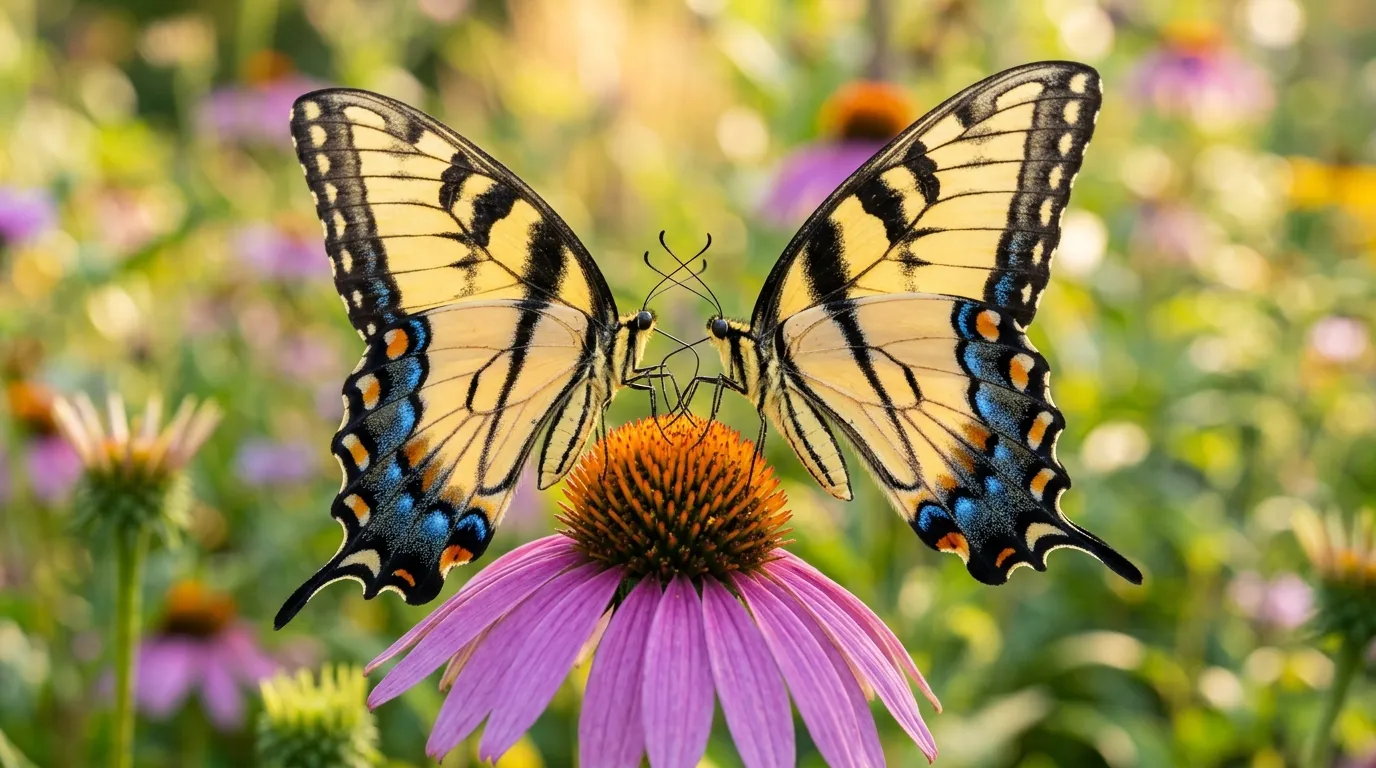
At a glance, yellow morph females look a lot like males. Both have the signature yellow wings with four black tiger stripes, black wing borders, and long swallowtails on the hindwings. But there are consistent differences once you know where to look.
The biggest giveaway is the blue scaling on the upper hindwing. Females show a broad wash of iridescent blue scales spreading inward from the hindwing margin, filling much of the space between the submarginal spots. Males either lack this blue entirely or show just a thin dusting. In good light, the difference is obvious even through binoculars.
Females also tend to have slightly broader black borders along the wing edges and more black suffusion overall, giving them a subtly darker look compared to the crisp, clean yellow of fresh males. Body size isn’t a reliable field mark since there’s a lot of overlap, but females average slightly larger than males – something you might notice when they’re side by side at a butterfly garden.
The orange spot near the inner hindwing margin (the spot closest to the body) is often more prominent in females than males, though this varies enough between individuals that it shouldn’t be your primary field mark.
How to Identify the Dark Morph Female
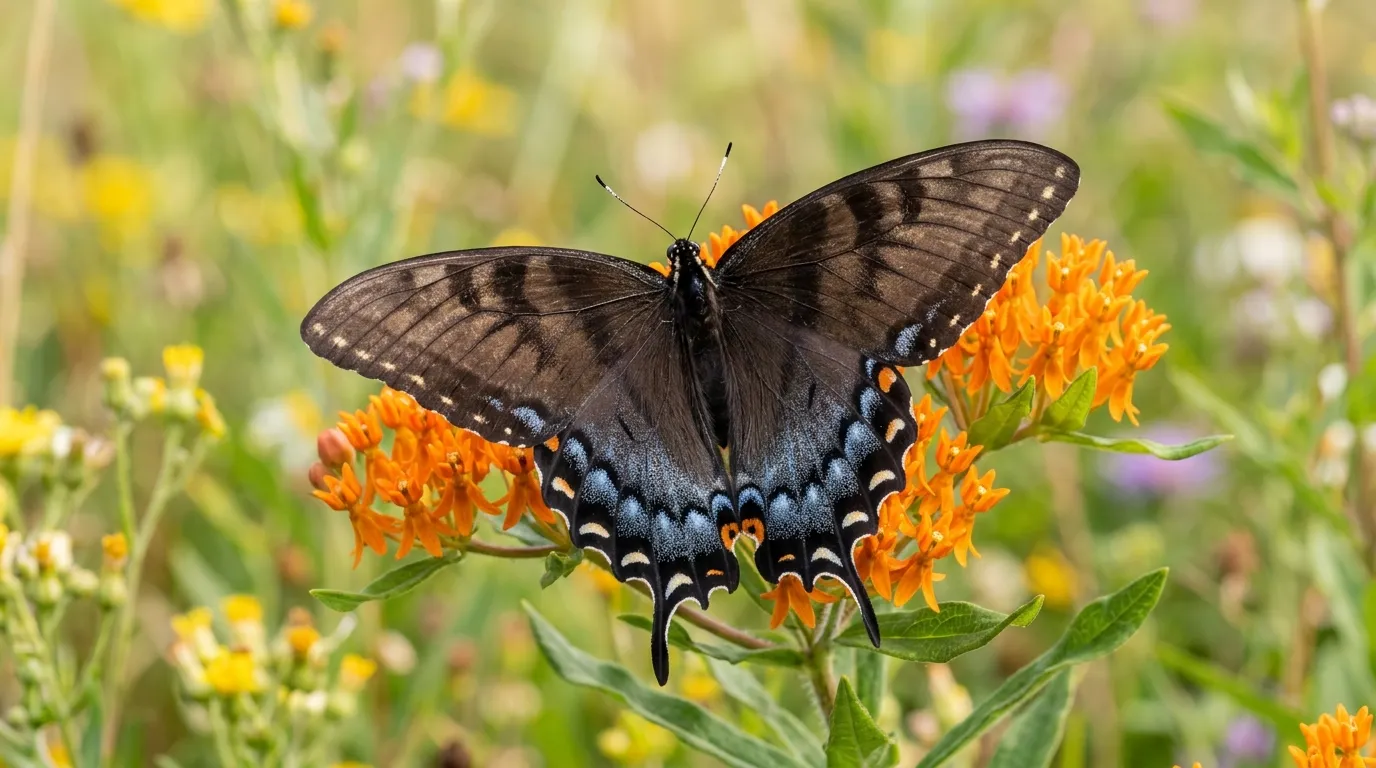
The dark morph is where identification gets really interesting – and where most confusion happens. These females have wings that are predominantly dark brown to black, with the yellow almost completely replaced by melanin pigmentation. But the tiger stripes don’t disappear. They persist as shadow stripes, slightly darker than the surrounding dark ground color, visible when the light hits at the right angle.
Those shadow stripes are your most reliable field mark. No other dark swallowtail in eastern North America shows them. When you see a large black butterfly with faint vertical darker lines across the forewing, you’re looking at a dark morph female Papilio glaucus.
Beyond the shadow stripes, dark morph females retain extensive blue scaling on the hindwing – often even more vivid than on yellow morph females. They also keep the orange and blue submarginal spots on the hindwing, and may show a row of orange spots along the forewing margin that the pipevine swallowtail lacks. The yellow spots in the hindwing margin tend to be slightly larger and more distinct than those on a true pipevine swallowtail.
The underside of the wings can be equally helpful. Dark morph females show a row of orange submarginal spots on the forewing underside that is absent or much reduced in pipevine swallowtails. The hindwing underside pattern, while dark, still shows traces of the tiger stripe layout rather than the bold single row of orange spots typical of the pipevine.
Telling Dark Morphs Apart from Similar Species
Several dark-winged swallowtails share range with the eastern tiger swallowtail, and sorting them out in the field takes practice. Here are the species most commonly confused with dark morph females.
Pipevine swallowtail (Battus philenor): The model for the mimicry. Pipevines lack any trace of tiger stripes, have a more compact body shape, and their blue-green iridescence on the hindwing upper surface has a distinct metallic quality different from the powdery blue of the tiger swallowtail. On the underside, the pipevine shows a single bold row of bright orange spots on a dark background – cleaner and more defined than the pattern on a dark morph female. Understanding where pipevine swallowtails live in the US helps narrow down which species you’re likely seeing.
Spicebush swallowtail (Papilio troilus): Another dark species often confused with dark morph tigers. Spicebush swallowtails lack tiger stripes entirely, have a greenish-blue wash on the hindwing (not powdery blue), and show a distinctive row of pale greenish spots along the forewing margin. Their flight style tends to be lower and more fluttery compared to the powerful gliding of tiger swallowtails.
Black swallowtail (Papilio polyxenes): Smaller than any tiger swallowtail, with two complete rows of yellow or cream spots across both wings and no trace of stripes. The size difference alone usually rules this one out, but worn individuals of both species can be tricky.
A study from the Penn State Department of Entomology notes that in areas where all four of these species fly together, Batesian mimicry creates a whole mimicry ring – with the pipevine swallowtail as the model and the dark morph female tiger, spicebush, and even red-spotted purple all converging on a similar dark-with-blue appearance.
Range, Habitat, and Seasonal Timing
Eastern tiger swallowtails range across the entire eastern half of North America, from southern Ontario to the Gulf Coast and from the Great Plains east to the Atlantic. Both female forms occur throughout this range, but as noted earlier, the ratio shifts predictably with latitude.
Females of both forms use the same host plants – wild cherry (Prunus), tulip tree (Liriodendron tulipifera), sweetbay magnolia, ash, and birch. If you’ve ever watched an eastern tiger swallowtail caterpillar feeding on wild cherry, it could grow up to be either a yellow or dark morph female (or a yellow male). The color form isn’t determined by diet or environment during the larval stage – it’s genetic.
Adults typically fly from late April through September in most of the range, with two or sometimes three broods. Southern populations start earlier and fly later. Females tend to spend less time at flowers and more time searching for host plants to lay eggs compared to males, who are often seen patrolling hilltops and ridgelines. Both forms have a typical adult lifespan of about two weeks in the wild.
I’ve found that the best places to observe both female forms side by side are large butterfly gardens in the mid-Atlantic and upper South – places like northern Virginia, the Carolinas, and Tennessee. These areas sit right in the sweet spot where dark morphs are common but yellow morphs still make up a significant portion of the female population.
Frequently Asked Questions
Can a female eastern tiger swallowtail be both yellow and dark at the same time?
Not exactly, but intermediate forms do occasionally appear. Some females show a pattern that’s partially darkened – heavier melanin than a normal yellow morph but not as fully dark as a true dark morph. These intermediates are uncommon and probably represent individuals where the melanin-producing gene is partially expressed. Most females fall clearly into one form or the other.
Does the dark morph actually fool predators?
Yes, and experimental research published in Science has confirmed it. In controlled studies, birds that had learned to avoid pipevine swallowtails also avoided dark morph females at significantly higher rates than yellow morph females. The protection isn’t perfect – some birds attack them anyway – but it provides a measurable survival advantage, particularly in regions where pipevine swallowtails are common.
Why don’t all females become dark morphs if it provides protection?
Because the mimicry only works where the model (pipevine swallowtail) is present. In northern areas without pipevines, birds haven’t learned to avoid dark butterflies, so the dark form provides no benefit and may actually be a disadvantage – dark butterflies absorb more heat, and the yellow form may have advantages in mate recognition. The yellow morph persists because it’s the better strategy in pipevine-free zones.
How can I tell a dark morph female from a dark morph of the Canadian tiger swallowtail?
Canadian tiger swallowtails (Papilio canadensis) do not produce a dark morph female. That trait is unique to Papilio glaucus among the North American tiger swallowtails. If you see a dark morph tiger swallowtail anywhere in eastern North America, it’s an eastern tiger swallowtail female. The two species do hybridize in a narrow zone across southern Canada and the northern US, and hybrid females occasionally show unusual darkening patterns, but true dark morphs are a glaucus-only feature.
Do dark morph females and yellow morph females behave differently?
Behaviorally, the two forms are nearly identical. They use the same host plants, visit the same nectar sources, and have similar flight patterns. Some researchers have noted that dark morph females may fly slightly lower and more slowly, possibly because their darker wings absorb heat faster and they overheat more easily in direct sun. But in practical terms, you won’t notice a behavioral difference watching them in a garden.
What determines whether a female develops as yellow or dark?
The color form is controlled by a single gene on the W sex chromosome (female butterflies carry ZW chromosomes while males carry ZZ). The dark allele is dominant, so a female only needs one copy to develop as a dark morph. The gene controls expression of melanin across the wing scales during pupal development. Temperature during the pupal stage may influence how strongly the dark coloration develops, but the basic switch between yellow and dark is genetic.