


Eastern Tiger Swallowtail | ID, Range, and Host Plants
The eastern tiger swallowtail (Papilio glaucus) is the big yellow butterfly with four black stripes that most people in the eastern United States have watched sail across their backyard at some point in summer. It’s one of the most recognizable butterflies in North America, the state butterfly of five different states, and common enough that you can find it almost anywhere east of the Mississippi with trees, flowers, and a little sunshine. What a lot of people don’t realize is that the eastern tiger swallowtail has one of the most interesting identification stories in North American lepidoptery – the females come in two completely different color forms, one yellow like the male and one almost entirely black, both flying in the same woods at the same time.
I’ve been watching this species in my own Virginia garden for years, and every season I’m reminded that there’s more to know about Papilio glaucus than the field guides let on. How dark morph females use Batesian mimicry to dodge bird predation. How the caterpillars mature through wildly different color stages. How the adults will show up reliably if you plant the right host trees. Here’s a full rundown of what makes this butterfly worth paying attention to, from range and ID to life cycle and garden attraction.
Key Takeaways
- The eastern tiger swallowtail (Papilio glaucus) is a large yellow butterfly with four bold black “tiger” stripes on each forewing, ranging across the eastern United States from southern Canada to Florida and west to the Great Plains.
- Males are always yellow, while females come in two forms – a yellow morph that looks similar to the male and a dark morph that is almost entirely black, mimicking the toxic pipevine swallowtail.
- Caterpillars feed on tulip tree, wild cherry, ash, sweetbay magnolia, and several other broadleaf trees, and they pass through four color stages before pupating.
- It is the official state butterfly of Alabama, Delaware, Georgia, North Carolina, and South Carolina, and the state insect of Virginia.
Identification and the Tiger Pattern
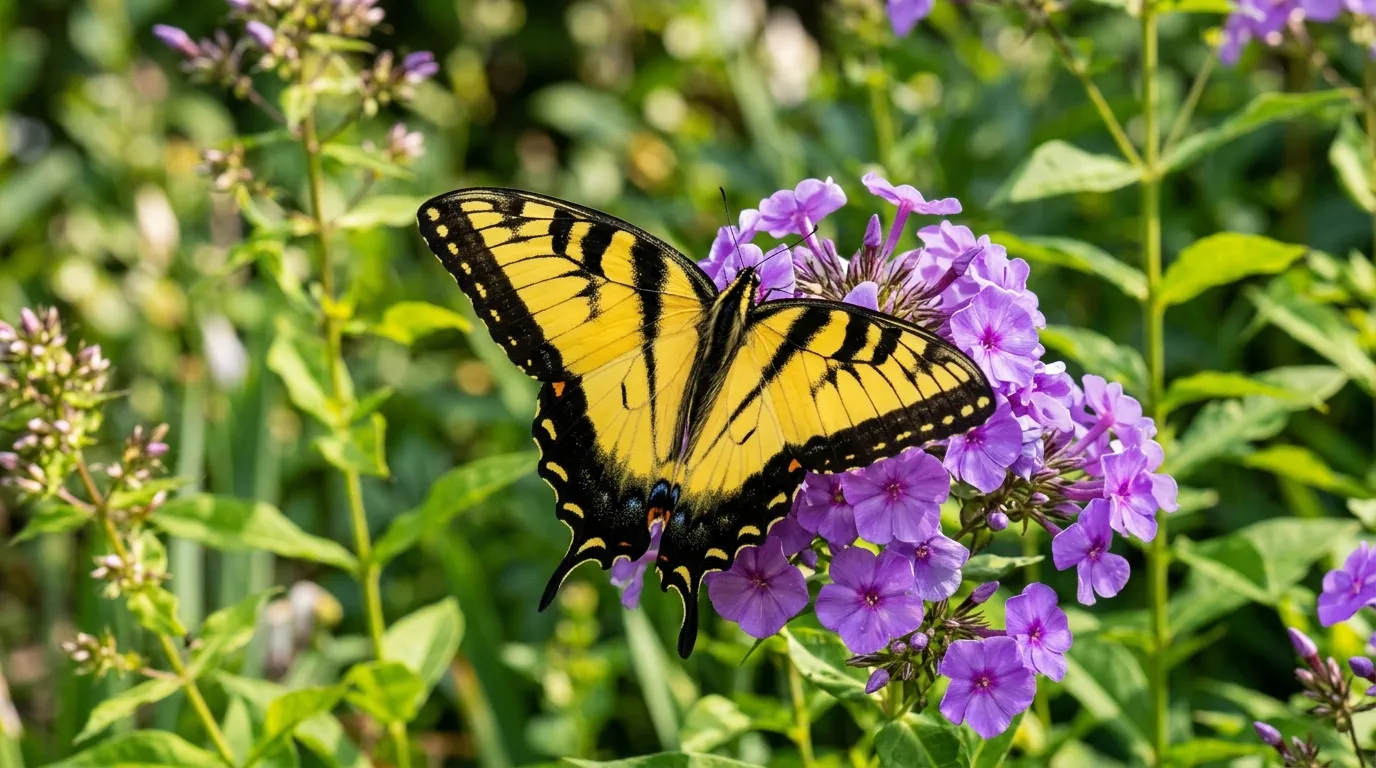
A male eastern tiger swallowtail in good light is one of the easier butterflies to identify in the eastern US. The wings are bright canary yellow with four strong black stripes running down each forewing, plus a thick black border along the outer edges of all four wings. The hindwings carry a row of blue scaling and a prominent orange spot near the tail projections, and each hindwing ends in a single long tail that gives the swallowtail family its name. Adult wingspan runs from about 3 to 5.5 inches, with individuals in the southern part of the range tending to be larger than northern ones.
Yellow morph females look very similar to males at first glance, but they carry more blue scaling across the hindwings and often show a fuller row of orange spots along the hindwing margin. Size alone doesn’t reliably separate the sexes. The clearest field mark is that blue hindwing wash – if the butterfly is mostly yellow with bold blue across the back wings, you’re looking at a female. For a deeper walk-through of sex-based ID, see our guide on female eastern tiger swallowtail identification.
The caterpillars are worth a second look too. Young instars resemble bird droppings – dark with a white saddle – which is a classic predator avoidance trick. Later instars turn bright green with two large yellow-and-black false eyespots behind the head that make the caterpillar look startlingly snake-like. If you’ve never seen the eyespots in person, they’re almost comical in how convincing they are up close. The caterpillar also has a forked orange organ called an osmeterium that it everts when threatened, releasing a foul smell. We cover the larval stage in more detail in our piece on eastern tiger swallowtail caterpillar facts.
Sexual Dimorphism and the Dark Morph Female
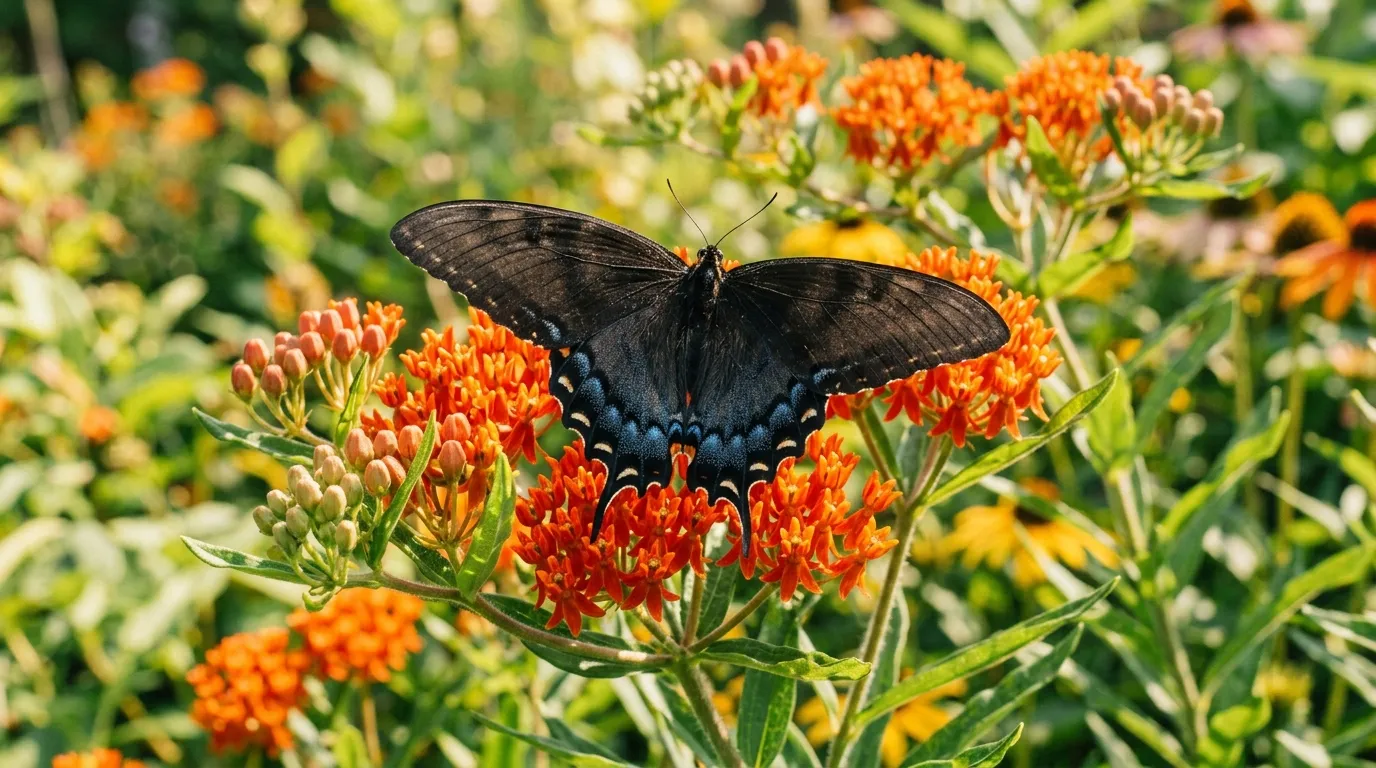
Here is where the eastern tiger swallowtail gets genuinely unusual. Females occur in two distinct color forms – a yellow form that looks like a larger, bluer version of the male, and a dark form that is almost entirely black with a faint ghost of the tiger stripes visible on the forewings and a bright iridescent blue wash across the hindwings. Both forms can hatch from the same clutch of eggs. You can walk through the same patch of woods on the same afternoon and see both morphs nectaring on the same milkweed plant.
The dark morph exists because of Batesian mimicry. In regions where the pipevine swallowtail (Battus philenor) is common, eastern tiger swallowtail females that look dark gain protection from bird predators that have learned to avoid the toxic pipevine. The frequency of dark morph females tracks the abundance of pipevine swallowtails pretty closely – in the southern Appalachians and Mid-Atlantic, where pipevine is well established, dark morph females can make up 50 percent or more of the female population. Head north into New England and New York, where pipevine swallowtails are scarce, and dark morph females become rare or disappear entirely. Males never turn dark. The dark allele is sex-linked and only expressed in females.
A US Forest Service profile notes that the dark morph is genetically controlled by a single locus on the W chromosome, which is the female-specific sex chromosome in butterflies. This makes Papilio glaucus one of the best-studied examples of female-limited mimicry in the animal kingdom.
Range and Habitat Across the Eastern US
The eastern tiger swallowtail occupies one of the broadest ranges of any North American butterfly. You can find it from southern Ontario and Quebec down through New England, across the entire eastern half of the United States to the eastern edge of the Great Plains, and south into central Florida and along the Gulf Coast. The western boundary runs roughly through eastern Colorado, eastern Wyoming, and eastern Texas, where it is replaced by the closely related western tiger swallowtail (Papilio rutulus) and the Canadian tiger swallowtail (Papilio canadensis) farther north.
Within that range, the species is a generalist when it comes to habitat. Deciduous woodlands, riparian corridors, suburban neighborhoods, city parks, country roadsides, and the edges of agricultural land all work fine. The one thing the butterfly needs is a mix of open sunlit space for nectaring and flying plus mature broadleaf trees for egg laying. You rarely see eastern tiger swallowtails deep inside closed-canopy forest. Forest edges, clearings, and stream banks concentrate them. That’s also why suburban yards with scattered ornamental trees often host more individuals per acre than unbroken woodland.
Flight season depends on latitude. In Florida and along the Gulf Coast, adults can fly almost year-round in mild winters and produce three broods. In the Mid-Atlantic and Ohio Valley, you typically get two broods – a spring flight from April into June and a summer flight from July into September. In New England and southern Canada, there is often a single brood from May into July. The species is in the family Papilionidae, and if you want a broader look at what makes this group of butterflies distinctive, our guide on Papilionidae characteristics covers the family in depth.
Host Plants and the Caterpillar’s Diet
The eastern tiger swallowtail is a host plant generalist compared to most swallowtails. Rather than relying on a single plant family, Papilio glaucus caterpillars feed on a broad list of native hardwood trees that crosses several plant families. The most important host plants across the range are tulip tree (Liriodendron tulipifera), wild black cherry (Prunus serotina), sweetbay magnolia (Magnolia virginiana), white ash (Fraxinus americana), and red maple (Acer rubrum).
Tulip tree is probably the single most productive host across the eastern US. It’s a fast-growing native that reaches 80 to 120 feet tall, and almost any wooded property in the Mid-Atlantic or southern Appalachians has at least one. Wild cherry comes in second, partly because it’s so common along fencerows and old field edges. In northern parts of the range, birches and aspens also get used. In southern swamps and floodplains, sweetbay magnolia becomes a primary host.
Females lay eggs singly on the upper surface of host tree leaves. A single female can lay 200 to 300 eggs over her adult life. The caterpillars hatch in four to ten days depending on temperature and feed on the leaves through four instars. Early instars hide on the leaf surface and resemble bird droppings. Later instars fold a leaf into a silk shelter during the day and come out to feed at night. The last instar turns yellow-brown just before pupation, and the chrysalis is formed on a twig or tree trunk where it closely resembles a broken stick. Summer chrysalides eclose in about two weeks. Fall chrysalides overwinter and emerge the following spring.
Life Cycle and Adult Behavior
The full life cycle from egg to adult takes about six to ten weeks during the warm months, though the last brood of the year enters pupal diapause and spends the winter as a chrysalis. Adults emerge from their chrysalides already sexually mature and start mating within a day or two. Males patrol habitat edges and riverbanks looking for females, while females tend to stay closer to host trees. If you sit by a stream on a sunny June afternoon in the Blue Ridge foothills, you can watch male eastern tigers passing the same spot every few minutes as they cruise their patrol routes.
Adult males are known for puddling behavior. Groups of 10, 20, or sometimes more than 50 males will gather on damp sand, mud, or the edges of drying puddles to drink dissolved salts and amino acids from the wet ground. They transfer these nutrients to females during mating as part of a spermatophore, and female reproductive success is tied to the quality of that nuptial gift. Females rarely puddle. If you see a large group of yellow-and-black butterflies crowded on a patch of wet sand in summer, you can assume they’re all males.
Adults typically live two to three weeks on the wing, though individuals in cooler conditions can stretch that closer to a month. That window is enough for females to find host trees, lay their full egg complement, and fuel themselves with nectar. For comparison with other species, our article on butterfly lifespan by species covers adult longevity across many common butterflies. Nectar preferences skew toward large, flat-topped flowers that give the big-bodied swallowtail a stable perch. Joe-Pye weed, milkweed, purple coneflower, ironweed, phlox, thistle, and lilac all work well.
State Butterfly Status and Cultural Recognition
Few butterflies have been recognized as an official state symbol by more states than the eastern tiger swallowtail. It is the official state butterfly of Alabama, Delaware, Georgia, North Carolina, and South Carolina, and it serves as the official state insect of Virginia. That six-state recognition reflects how thoroughly the species has become part of the visual identity of the American Southeast. If you grew up anywhere from Wilmington to Atlanta, chances are you saw these butterflies on wild cherry blossoms before you ever learned their name.
The eastern tiger swallowtail was also one of the earliest American butterflies documented by European naturalists. John White, a member of the Roanoke Colony expedition, painted the species in 1587, making it arguably the first North American butterfly to be depicted in Western art. Mark Catesby illustrated it again in the 1720s, and Linnaeus formally described Papilio glaucus in 1758 based on those earlier accounts. Four centuries of observation have given us a deep record of the species’ range and behavior, which is part of why it remains one of the best-studied North American butterflies.
How to Attract Eastern Tiger Swallowtails to Your Garden
Getting eastern tiger swallowtails to visit your yard is easy if you live within the species’ range. Getting them to breed and stick around takes a bit more planning. Start with nectar. A well-designed swallowtail nectar bed should include large, flat-topped flowers that bloom in succession from spring through fall. Purple coneflower, bee balm, Joe-Pye weed, milkweed, phlox, lantana, zinnia, and buddleia all pull in adults. The key is having something blooming at all times during the flight season.
If you want breeding females laying eggs on your property, you need at least one mature host tree. A young tulip tree is one of the best investments you can make. It grows fast, provides excellent shade within 15 to 20 years, and supports not just tiger swallowtails but also eastern tiger swallowtail relatives and several moth species. Wild cherry, sweetbay magnolia, and white ash are also good choices depending on your soil and climate. The Xerces Society profile on the eastern tiger swallowtail lists region-specific host plant recommendations that are worth checking before you plant.
A few practical garden tips from my own observations. Avoid pesticides completely, including Bt sprays, which kill swallowtail caterpillars along with pest caterpillars. Leave a patch of wet sand or mud somewhere sunny – a shallow plant saucer kept damp works – to give puddling males a reliable stopover. Don’t rake every leaf in the fall. Chrysalides may be overwintering on twigs and debris under your host trees, and heavy cleanup will destroy them. And if you have neighbors with tulip trees or wild cherries, your combined habitat will support more butterflies than either yard alone.
Frequently Asked Questions
Are male eastern tiger swallowtails ever dark?
No. Male eastern tiger swallowtails are always yellow with four black tiger stripes. The dark morph is strictly a female phenomenon, controlled by a gene on the W sex chromosome that males do not carry. If you see a dark swallowtail in the eastern US that looks similar in shape to a tiger swallowtail, you are looking at either a dark morph female eastern tiger swallowtail, a female black swallowtail, a spicebush swallowtail, or a pipevine swallowtail – but never a male Papilio glaucus.
What is the difference between an eastern tiger swallowtail and a western tiger swallowtail?
The two species look almost identical at a glance, but their ranges don’t overlap much. The eastern tiger swallowtail (Papilio glaucus) lives east of the Great Plains, while the western tiger swallowtail (Papilio rutulus) occupies the western US from the Rockies to the Pacific. The eastern species is slightly larger on average, produces a dark morph female, and uses tulip tree and wild cherry as primary hosts. The western species never produces a dark morph and uses willows, cottonwoods, and sycamores instead.
How many broods does the eastern tiger swallowtail have each year?
It depends on latitude. Florida and Gulf Coast populations can have up to three broods per year with adults flying from February or March through November. Mid-Atlantic and Ohio Valley populations usually produce two broods, one in spring and one in late summer. New England and southern Canadian populations typically get only one brood per year, flying from late May through July.
Where does the eastern tiger swallowtail overwinter?
As a chrysalis. The last generation of each year enters pupal diapause in late summer or fall, with the chrysalis attached to a twig, tree trunk, or piece of bark. The chrysalis looks remarkably like a dried, broken stick and is very hard to spot. It remains dormant through winter and the adult butterfly emerges the following spring when temperatures warm. No adult eastern tiger swallowtails overwinter, and there is no long-distance migration like you see with monarchs.
What do eastern tiger swallowtail caterpillars eat?
The caterpillars feed on leaves of several broadleaf trees, most commonly tulip tree (Liriodendron tulipifera), wild black cherry (Prunus serotina), sweetbay magnolia (Magnolia virginiana), white ash (Fraxinus americana), and red maple (Acer rubrum). Birches, aspens, and basswood also get used in the northern part of the range. Adults feed on flower nectar rather than leaves and prefer large, flat-topped blooms like milkweed, Joe-Pye weed, and purple coneflower.
Which states have named the eastern tiger swallowtail their state butterfly?
The eastern tiger swallowtail is the official state butterfly of Alabama, Delaware, Georgia, North Carolina, and South Carolina. Virginia designated it the official state insect rather than state butterfly, but it carries the same recognition. No other North American butterfly is represented across as many state symbols, reflecting how abundant and visible the species is throughout the American Southeast.
Is the eastern tiger swallowtail endangered or declining?
No. The eastern tiger swallowtail is one of the most common and widespread butterflies in eastern North America and has no protected status. Populations appear to be stable across most of the range, and the species tolerates suburban and urban habitats better than many specialist butterflies. Local declines have been reported in areas with heavy pesticide use or where mature host trees have been removed, but on a continental scale the species is doing well.