


Lycaenidae Butterflies: Blues, Coppers, and Hairstreaks
Lycaenidae butterflies make up the second-largest butterfly family on Earth, with roughly 6,000 described species spread across every continent except Antarctica. If you have ever watched a tiny blue or copper-colored butterfly bouncing low over a meadow, you were almost certainly looking at a lycaenid. These are overwhelmingly small butterflies – most have wingspans between 18 and 40 millimeters – but what they lack in size they make up for in sheer numbers, iridescent color, and some of the strangest larval behaviors in the insect world. Many Lycaenidae caterpillars have evolved tight relationships with ants, producing sugary secretions to buy protection from predators. That ant-caterpillar partnership, called myrmecophily, is one of the defining features of this family and something I find more interesting the more I read about it.
Key Takeaways
- Lycaenidae is the second-largest butterfly family with around 6,000 species, divided into the blues (Polyommatinae), coppers (Lycaeninae), hairstreaks (Theclinae), and harvesters (Miletinae), among other subfamilies.
- Most lycaenids are small (under 40 mm wingspan) and many males display structural iridescent colors – particularly blues – produced by microscopic wing scale structures rather than pigment.
- Roughly 75% of Lycaenidae species have some form of association with ants, ranging from loose mutualism to obligate parasitism where caterpillars live inside ant nests and feed on ant larvae.
- Common North American lycaenids include the eastern tailed-blue, spring azure, American copper, and gray hairstreak, all of which are widespread and regularly seen in gardens, fields, and woodland edges.
What Makes Lycaenidae Butterflies Different
The Lycaenidae sit within the superfamily Papilionoidea alongside swallowtails, whites, and brush-footed butterflies, but they stand apart in several ways. Size is the first thing you notice. While a monarch or swallowtail commands attention from meters away, most lycaenids are easy to overlook. A typical blue butterfly has a wingspan of 25 to 30 millimeters – about the size of a thumbnail. Coppers run slightly larger, and some tropical hairstreaks push past 50 millimeters, but as a family they are consistently small.
Color is the second standout trait. Many male lycaenids have structurally produced iridescent colors on their upper wing surfaces. The blues are the most obvious example – that shimmering powder-blue or violet color you see on a Common Blue or a spring azure is not caused by pigment. Instead, it comes from nanoscale structures in the wing scales that interfere with light waves and reflect specific wavelengths. This is why the color can appear to shift or vanish depending on the viewing angle. Females of many blue species, by contrast, are brown or dark gray above, which makes sexing them in the field straightforward.
A third family-level feature is the reduced forelegs in males. Male lycaenids have shortened front legs that are not used for walking, somewhat like the brush-footed butterflies (Nymphalidae), though the two families are not closely related. Females have fully functional forelegs. This difference occasionally causes confusion during butterfly identification, since leg structure matters for distinguishing families at close range.
Lycaenidae Subfamilies and Their Differences
Taxonomists currently recognize several subfamilies within Lycaenidae. The boundaries have shifted over the years as molecular data has reshuffled relationships, but four major groups account for the vast majority of species.
The Polyommatinae, or blues, form the largest subfamily with more than 2,000 species. These are the small, predominantly blue butterflies found in grasslands, meadows, and open habitats worldwide. Most are univoltine or bivoltine (one or two generations per year), and their caterpillars feed on legumes, clovers, and other herbaceous plants. According to research at the Florida Museum of Natural History’s McGuire Center, the Polyommatinae show the highest diversity of ant associations of any lycaenid subfamily.
The Theclinae, commonly called hairstreaks, are the second-largest group with around 1,000 species. Hairstreaks get their name from the thin, hair-like tail projections on the hindwing that many species carry. These tails, combined with small eyespots near the tail base, create a “false head” effect at the rear of the butterfly. When perched, hairstreaks often rub their hindwings together in a back-and-forth motion, making the tails wave like antennae. Predators aiming for what appears to be the head strike the expendable hindwing tails instead, and the butterfly escapes with minor wing damage.
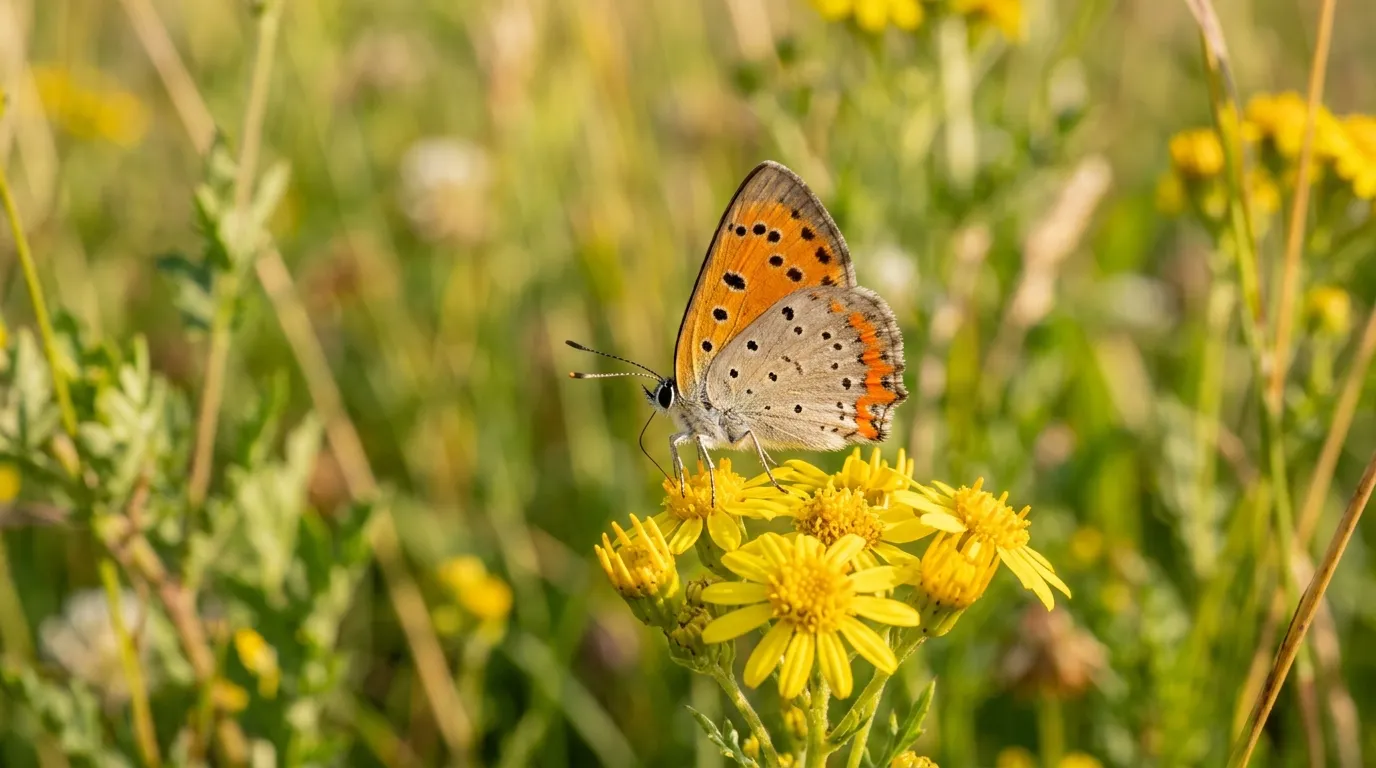
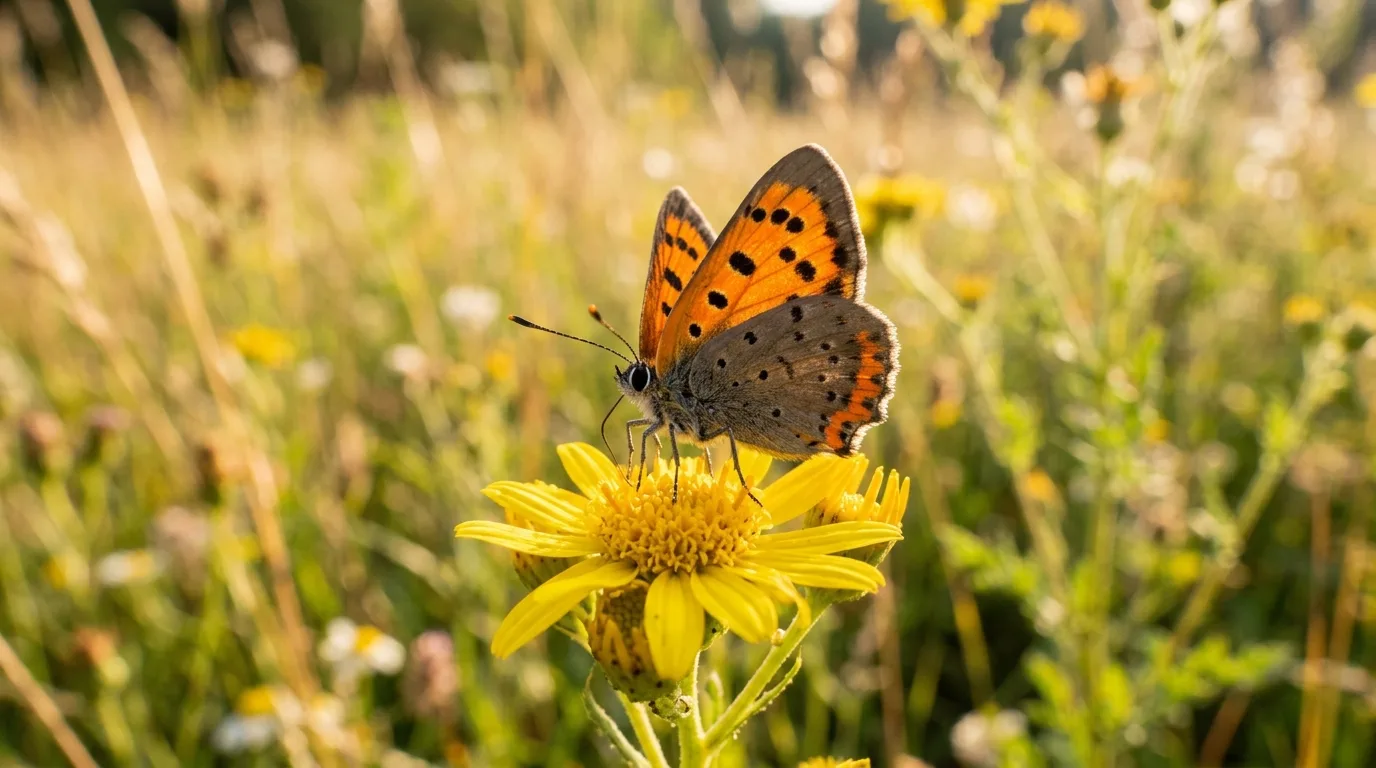
The Lycaeninae, or coppers, are a smaller subfamily of about 100 species concentrated in the Northern Hemisphere. Coppers are named for the bright orange-copper coloring on their upper wing surfaces. Unlike the structurally produced blue of the Polyommatinae, the copper color in many species comes from actual pigment combined with wing scale structure. The American copper and the large copper of Europe are representative members. Coppers tend to favor docks and sorrels (Rumex species) as larval host plants.
The Miletinae, or harvesters, are a small, unusual subfamily. The harvester (Feniseca tarquinius) is the only carnivorous butterfly in North America – its caterpillars feed on woolly aphids rather than plant tissue. Other Miletinae species in Africa and Asia also have predatory or parasitic larval habits, making this subfamily an outlier within a family that is otherwise herbivorous.
Ant-Caterpillar Mutualism in Lycaenidae
The relationship between Lycaenidae caterpillars and ants is one of the stranger stories in entomology. Roughly three-quarters of all lycaenid species have some level of association with ants, a phenomenon known as myrmecophily. The interactions range from casual and optional to obligate and species-specific.
At the simplest level, many lycaenid caterpillars possess a dorsal nectary organ (also called Newcomer’s gland) on the seventh abdominal segment. When an ant strokes this gland with its antennae, the caterpillar secretes a droplet of sugary liquid. The ant feeds on the secretion and, in return, stands guard over the caterpillar. Ants will aggressively drive away parasitoid wasps, predatory flies, and other threats that would otherwise kill the caterpillar. This mutualism benefits both sides – the ants get food, and the caterpillar gets bodyguards.
Some species take this much further. Caterpillars of the large blue butterfly (Phengaris arion) in Europe spend their first few instars feeding normally on thyme flowers, then drop to the ground. There, they produce chemicals that mimic ant larval pheromones, tricking Myrmica ant workers into carrying the caterpillar into the ant nest. Once inside, the caterpillar feeds on ant larvae for up to ten months, growing to full size while the ant colony unknowingly raises a predator. Research published in Science showed that these caterpillars also mimic the acoustic signals of ant queens, receiving priority feeding and protection even during food shortages.
Not all ant associations are mutualistic. Some lycaenid species are outright parasites of ant colonies. The relationship has clearly evolved multiple times independently within the family, which tells us there is something about lycaenid biology – probably the small caterpillar size and their secretory glands – that predisposes them toward ant interactions. Among all types of butterflies, lycaenids are the only family where ant symbiosis occurs at this scale.
Common Lycaenidae Butterflies in North America
North America hosts around 140 Lycaenidae species, and a handful of them are among the most commonly encountered butterflies on the continent. Here are four species you are likely to see.
The eastern tailed-blue (Cupido comyntas) is one of the most widespread butterflies in eastern North America. Males are bright silvery-blue above; females are mostly gray-brown with a flush of blue near the body. Both sexes have thin, thread-like tails on the hindwing and small orange-capped eyespots near the tails. You will find them in disturbed habitats – roadside ditches, lawns, parks, and field edges – wherever clovers and other small legumes grow. They produce two to four generations per year depending on latitude, so you can see them flying from April through October in many areas.
The spring azure (Celastrina ladon) is among the first butterflies to appear each year, flying as early as March in the mid-Atlantic states. It is small and pale blue above, with a chalky gray-white underside marked with faint dark spots. Spring azures use a wide range of host plants including dogwood, viburnum, blueberry, and cherry, which makes them adaptable across forest edges and suburban gardens. The adult lifespan of a spring azure is brief – typically only about four days – but their early emergence makes them an important signal that spring has arrived for butterfly watchers.
The American copper (Lycaena phlaeas) stands out immediately with its bright orange forewings marked with black spots and a dark hindwing edged in orange. It is small but conspicuous and often surprisingly territorial – males will chase away butterflies many times their size from a favored perching spot. American coppers are found in old fields, dry meadows, and disturbed ground where their host plants, sheep sorrel and curly dock, grow. Two to four broods per year are typical in most of their range.
The gray hairstreak (Strymon melinus) is probably the most widespread hairstreak in North America and arguably the most adaptable lycaenid on the continent. It ranges from southern Canada to Central America and uses an enormous list of host plants across dozens of families, including cotton, beans, mallow, and mint. The underside is gray with a thin white-bordered orange and black postmedian line and a prominent orange-capped eyespot near each hindwing tail. Gray hairstreaks are frequent visitors to gardens and are reliably found anywhere flowers are blooming in warm months.
Where to Find Lycaenidae Butterflies
Lycaenids occupy nearly every terrestrial habitat, but certain environments are especially productive. Open grasslands and meadows with diverse wildflowers tend to support the highest species richness in temperate zones. Dry, sandy areas with sparse vegetation are favored by many blues, while coppers gravitate toward disturbed or ruderal habitats where docks and sorrels thrive.
Hairstreaks are often associated with trees and shrubs. Many species are canopy-dwellers as caterpillars, feeding on oaks, hickories, or other hardwoods, and adults spend much of their time perched at treetop level. This makes them harder to observe than the ground-level blues and coppers. The best time to find hairstreaks at close range is early morning or late afternoon when they descend to nectar at flowers.
In tropical regions, Lycaenidae diversity increases dramatically. Southeast Asia, Africa, and the Neotropics each harbor hundreds of species, many of which are poorly studied. The Natural History Museum’s Lepidoptera collections include thousands of lycaenid specimens from tropical regions, and new species continue to be described regularly. Tropical hairstreaks in particular are astonishingly diverse, with metallic greens, purples, and golds that rival any butterfly family for sheer visual impact.
If you are trying to attract lycaenids to a garden in North America, planting clovers, wild buckwheat, and native legumes will bring in blues. Leaving a patch of dock or sorrel supports coppers. For hairstreaks, native oaks and other hardwood trees in or near the property give caterpillars what they need, while nectar plants like milkweed, dogbane, and native asters bring the adults down to eye level.
Frequently Asked Questions
How many species are in the Lycaenidae family?
Current estimates put the family at roughly 6,000 described species, making Lycaenidae the second-largest butterfly family after Nymphalidae. The actual number is likely higher because new species, particularly small tropical blues and hairstreaks, are still being described from collections and fieldwork each year.
Why are blue butterflies blue if they have no blue pigment?
The blue color in most Lycaenidae comes from structural coloration rather than chemical pigment. Microscopic structures in the wing scales are arranged in layers that interfere with light waves, selectively reflecting blue wavelengths. This is the same physical principle that makes the sky appear blue. When the scales are damaged or wet, the structural color can disappear, revealing the brownish pigment underneath.
Do all Lycaenidae butterflies associate with ants?
No, but about 75% of species have some level of ant interaction. The remaining 25% have no known ant association. Among the species that do interact with ants, the relationship varies from casual (ants occasionally attend caterpillars) to obligate (caterpillars cannot survive without a specific ant species). Some species are parasitic on ant colonies rather than mutualistic.
What do Lycaenidae caterpillars look like?
Most lycaenid caterpillars are slug-shaped – flattened, oval, and lacking the obvious head capsule seen in many other butterfly larvae. They are typically green or brown and blend well with their host plants. Many species have a retractable dorsal nectary organ on the abdomen that produces sweet secretions for attending ants. They tend to be small, matching the small adult size of the family.
Are any Lycaenidae butterflies endangered?
Yes, several Lycaenidae species are considered threatened or endangered. The large blue (Phengaris arion) went extinct in Britain in 1979 and was successfully reintroduced starting in 1983 using Swedish stock. The Karner blue (Plebejus samuelis) in the northeastern United States is federally listed as endangered due to habitat loss. The Palos Verdes blue (Glaucopsyche lygdamus palosverdesensis) in California is one of the rarest butterflies in the world, with populations sometimes dropping below 100 individuals.
What is the difference between a blue and a hairstreak butterfly?
Blues (subfamily Polyommatinae) are typically small with broad, rounded wings and males are often iridescent blue above. Hairstreaks (subfamily Theclinae) usually have angular wings with one or two thin tail-like projections on the hindwing and are often brown, gray, or green on the underside with intricate line patterns. Blues tend to use herbaceous plants as hosts, while many hairstreaks feed on trees and shrubs as caterpillars.