



Monarch butterflies do not survive by luck. Every stage of their life – from the moment they hatch to the moment they reach a Mexican forest thousands of miles from where they were born – depends on a set of finely tuned adaptations that have taken millions of years to develop. Some of those adaptations are chemical, some are behavioral, and some involve senses we’re still working to fully understand. Here’s a closer look at what actually makes monarchs so difficult to kill.
Key Takeaways
- Monarchs sequester toxic cardenolide compounds from milkweed throughout their larval stage, making them poisonous to most vertebrate predators as adults.
- Their orange and black coloration is a warning signal – predators learn to associate that pattern with a bad meal, which protects not just individual monarchs but the whole population.
- Monarchs navigate using a time-compensated sun compass in their antennae, allowing them to maintain a consistent southwest heading across a 3,000-mile migration.
- The migratory generation lives up to eight months – roughly five times longer than summer generations – because reproductive development is hormonally suppressed until they reach their overwintering site.
Chemical Defense From Milkweed
Monarchs have built their entire defense system around a plant that would kill most insects. Milkweed contains a class of compounds called cardenolides – cardiac glycosides that interfere with sodium-potassium pump function in animal cells. For most caterpillars, eating milkweed would be fatal. Monarchs evolved a mutation in a key protein that makes their cells resistant to cardenolide toxicity, which means they can eat the plant, absorb its toxins, and store them in their wings and bodies without any harm.
The sequestration is cumulative and begins in the larval stage. Caterpillars that feed on milkweed with higher cardenolide concentrations end up as more toxic adults. Research published in Oecologia found that cardenolide levels in adult monarchs vary significantly depending on the milkweed species they fed on as larvae – some plants produce butterflies that are far more noxious than others. Learn more about what monarchs eat and how milkweed species differ in terms of the nutrition and chemical compounds they offer.
The toxins persist through metamorphosis, which means the chrysalis and the adult butterfly retain the chemical protection built up during the caterpillar stage. A bird that eats a monarch typically vomits within minutes and avoids monarchs afterward. That learned aversion is exactly what makes this adaptation so effective at the population level.
Not all monarchs are equally toxic, and some predators have evolved partial tolerance. Black-backed orioles and black-headed grosbeaks at overwintering sites in Mexico can tolerate higher cardenolide levels than most birds, and they consume monarchs regularly. But even these specialists tend to avoid the most toxic individuals, so the variation in toxicity across the population still provides meaningful protection.
Warning Coloration (Aposematism)
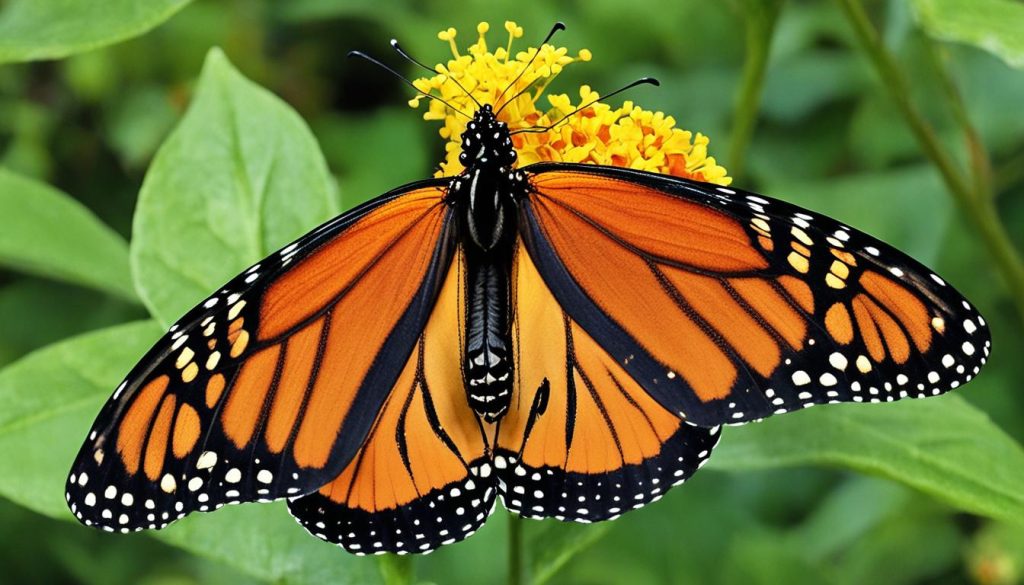
The orange and black wing pattern is not decorative – it’s a signal. This type of coloration is called aposematism, and it works by advertising toxicity to potential predators. The contrast between bright orange and bold black is highly visible to bird vision, which means the warning is clear even at a distance. Predators that have learned the hard way about monarch toxicity recognize the pattern and steer clear.
What makes this even more interesting is that the warning coloration works across generations of predators through learned avoidance. A young bird that has never seen a monarch before has no innate reason to avoid it. But after one bad experience – or after watching another bird get sick – it learns to treat that orange and black pattern as a threat cue. The pattern essentially trains the local predator population to leave monarchs alone. You can read more about how monarch butterfly colors work and what the variation in pattern means across individuals.
Viceroy butterflies famously take advantage of this by mimicking the monarch pattern. For a long time, viceroys were considered a classic example of Batesian mimicry – a harmless species copying a toxic one. Later research complicated that picture by showing viceroys are also somewhat unpalatable, making the relationship more like Mullerian mimicry between two independently defended species. Either way, the monarch pattern is doing real protective work in the ecosystem. For a broader look at how toxic butterflies use chemistry and color for defense, this overview of poisonous butterfly species covers some of the other remarkable examples.
The warning signal extends to the larval stage as well. Monarch caterpillars are banded in yellow, white, and black – a conspicuous pattern that advertises their toxicity to birds and other predators that might otherwise pick caterpillars off milkweed leaves. The signal works through the entire life cycle.
Migration and Navigation
Each fall, eastern monarch populations travel up to 3,000 miles from breeding grounds across the eastern United States and Canada to a cluster of oyamel fir forests in the mountains of central Mexico. This migration is one of the most studied long-distance animal movements in biology, and scientists are still working out the details of exactly how monarchs pull it off.
The navigation system is built around a time-compensated sun compass located in the antennae. Monarchs track the sun’s position throughout the day and adjust their flight direction based on both where the sun is and what time it is, using an internal circadian clock to compensate for the sun’s arc across the sky. This allows them to maintain a consistent southwest heading regardless of the time of day. Research from the University of Massachusetts showed that monarchs whose antennae were painted over lost directional orientation, while those with intact antennae continued navigating accurately.
There’s also evidence that monarchs can detect Earth’s magnetic field, which may serve as a backup compass when skies are overcast. Some studies suggest the magnetic sense is concentrated in the antennae as well, though the precise mechanism is still being investigated. The combination of a solar compass and a magnetic sense gives monarchs redundant navigation tools – a useful feature for an animal crossing mountain ranges and unpredictable weather systems.
Monarchs are also efficient fliers. They use thermals – rising columns of warm air – to gain altitude and then glide for long distances without flapping their wings. On good thermal days, a monarch can cover 50 to 100 miles with relatively little energy expenditure. This gliding efficiency matters a lot on a 3,000-mile trip where fuel in the form of stored fat needs to last. For more on the biology behind this journey, this deep dive into monarch migration covers the full story of how these insects find the same forests year after year.
Thermoregulation – Managing Body Temperature
Like all insects, monarchs are ectotherms – they cannot generate their own body heat the way mammals do. Flight muscles need to reach roughly 55 to 60 degrees Fahrenheit to function, and at temperatures below that, a monarch sitting in the sun may be unable to lift off at all. Managing body temperature is therefore a constant low-level challenge, and monarchs have several strategies for it.
Basking is the most visible strategy. Monarchs orient their wings perpendicular to the sun and spread them wide to absorb as much solar radiation as possible. The dark black veining and borders on their wings absorb heat faster than the orange panels do, and research suggests the wing pattern may be partly functional as a heat-collection surface in addition to its warning role. On cool mornings during migration, you’ll often see monarchs perched motionless in sunny spots before they warm up enough to continue flying.
At the overwintering sites in Mexico, monarchs cluster by the millions on tree trunks and branches. The clusters serve a thermoregulatory function – the sheer mass of bodies insulates the group against overnight cold. Monarchs at the center of a cluster maintain higher temperatures than those on the outside, and they cycle through positions throughout the day. The fir forest itself acts as a thermal buffer, keeping nighttime temperatures from dropping to lethal levels while preventing daytime temperatures from triggering premature spring activity.
During winter dormancy at the overwintering sites, monarchs enter a state of reduced metabolic activity. Their fat bodies – organs that store lipids – shrink slowly over the winter months as they burn stored energy to maintain basic functions. The timing of their spring departure is closely tied to temperature cues and day length, ensuring they leave early enough to reach milkweed growth in the southern United States before their fat reserves run out.
Reproductive Adaptations
One of the most remarkable things about monarchs is that the generation that migrates south in fall is biologically different from every other generation produced that year. Summer generations live for two to five weeks and reproduce almost immediately after reaching adulthood. The migratory generation – called the Methuselah generation – lives for seven to eight months, suppresses reproductive development entirely until spring, and uses the energy that would have gone into reproduction to fuel migration and winter survival instead.
This switch is triggered by a combination of day length and temperature. As summer ends and days shorten, monarchs entering adulthood in late summer enter a state called reproductive diapause. In females, eggs do not develop. In males, accessory glands that produce reproductive fluids remain inactive. The butterflies are not sterile – when they reach Mexico and overwintering conditions begin to ease in late February, reproductive development resumes and they head north to mate on the way to Texas, where the first spring milkweed emerges.
Female monarchs also have sophisticated host plant detection abilities. They use chemoreceptors on their tarsi – sensory organs on their feet – to taste plants before laying eggs. A female can land on a leaf, drum her feet against it, and determine within seconds whether the plant is an appropriate milkweed species for her eggs. She lays eggs singly on the underside of leaves, typically one per plant, which distributes the next generation across many individual host plants rather than concentrating larvae in one spot where food might run out.
The egg itself is ridged and ribbed in a pattern that allows it to adhere firmly to the leaf surface and resist being dislodged by rain or wind. Eggs hatch within three to five days under warm conditions, and the first thing the emerging caterpillar does is eat its own eggshell – recycling the nutrients for early growth before it starts in on the milkweed leaf below.
FAQ
How do monarchs become toxic if milkweed is poisonous to most insects?
Monarchs carry a mutation in the gene encoding the Na+/K+-ATPase enzyme, which is the cellular target of cardenolide toxins. This mutation makes the enzyme insensitive to cardenolides without losing its normal function. As a result, monarchs can ingest milkweed toxins, store them in their tissues, and use them for defense against predators – while most other insects would be harmed or killed by the same compounds.
Can monarch butterflies actually glide, or do they just flap their wings constantly?
Monarchs are capable gliders. During migration, they use rising thermals to gain altitude and then extend their wings and glide forward with minimal wing movement, losing altitude slowly as they travel. On favorable thermal days, tagged monarchs have been tracked covering over 100 miles in a single day using this soaring-and-gliding strategy. Their wing shape and relatively large surface area compared to body mass makes passive gliding efficient.
How do monarchs know to migrate south without being taught?
Migration direction and timing are genetically encoded. No monarch lives long enough to make the round trip and teach the next generation. The migratory generation inherits the behavioral program – including the circadian clock, the sun compass sensitivity, and the suppression of reproduction – through their genes. Scientists have confirmed this by raising monarchs in captivity away from any experienced migrants and observing that they still orient in the correct direction when released during fall migration.
What makes the migratory generation live so much longer than summer monarchs?
The difference comes down to juvenile hormone levels. In summer generations, juvenile hormone drives rapid reproductive development and accelerates aging. In the migratory generation, low juvenile hormone levels suppress reproduction and appear to slow physiological aging as well. The butterflies store fat rather than investing energy in eggs or sperm, and their immune function remains strong through the winter. When juvenile hormone levels rise again in spring, reproduction resumes and the butterflies age at a normal rate.
Do all monarch populations migrate?
No. The long-distance migration to Mexico is specific to the eastern North American population. Western monarchs migrate to overwintering sites along the California coast, traveling shorter distances. There are also resident monarch populations in Central America, Florida, and Hawaii that do not migrate at all, and introduced populations in Australia and the Canary Islands that are non-migratory. The migratory behavior appears to have evolved in the eastern population as a response to the seasonal loss of milkweed and cold winters across their large breeding range.


