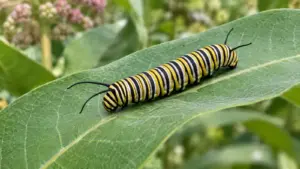



A monarch butterfly caterpillar is one of the easiest larvae to identify in a North American garden. It wears bright black, white, and yellow bands around a plump body, waves a pair of black tentacles from both the front and rear ends, and it will only eat milkweed. If you see a striped caterpillar on any plant in the genus Asclepias, you are almost certainly looking at Danaus plexippus in its larval form. Everything else about the monarch life cycle, from the toxic chemistry it builds up inside its body to the five stages it passes through, traces back to those leaves.
I have raised hundreds of these caterpillars over the years, and I still get a small thrill finding a tiny first instar hatchling on the underside of a milkweed leaf in early summer. They are specialist feeders, they grow at a ridiculous pace, and they are charismatic enough that kids and adults both get hooked on watching them develop. This guide walks through what a monarch butterfly caterpillar looks like, how to tell the instars apart, where to find them, and how to rear them at home without causing problems for the wild population.
Key Takeaways
- Monarch butterfly caterpillars have a distinctive banded pattern of black, white, and yellow stripes with two black tentacle pairs, making them one of the simplest butterfly larvae to identify in the field.
- They feed exclusively on milkweed (Asclepias species) and sequester cardiac glycosides from the plant sap, which makes both the caterpillars and the resulting adult butterflies toxic to most vertebrate predators.
- Monarch larvae pass through five instars over roughly 10 to 14 days, growing from a 2mm hatchling to a 45mm fifth instar that weighs nearly 3,000 times its starting mass.
- Finding monarch caterpillars is a matter of checking the undersides of milkweed leaves, especially on plants with recent chew marks, and rearing them successfully depends on fresh host plant supply and strict sanitation to avoid OE parasite spread.
What a Monarch Butterfly Caterpillar Looks Like
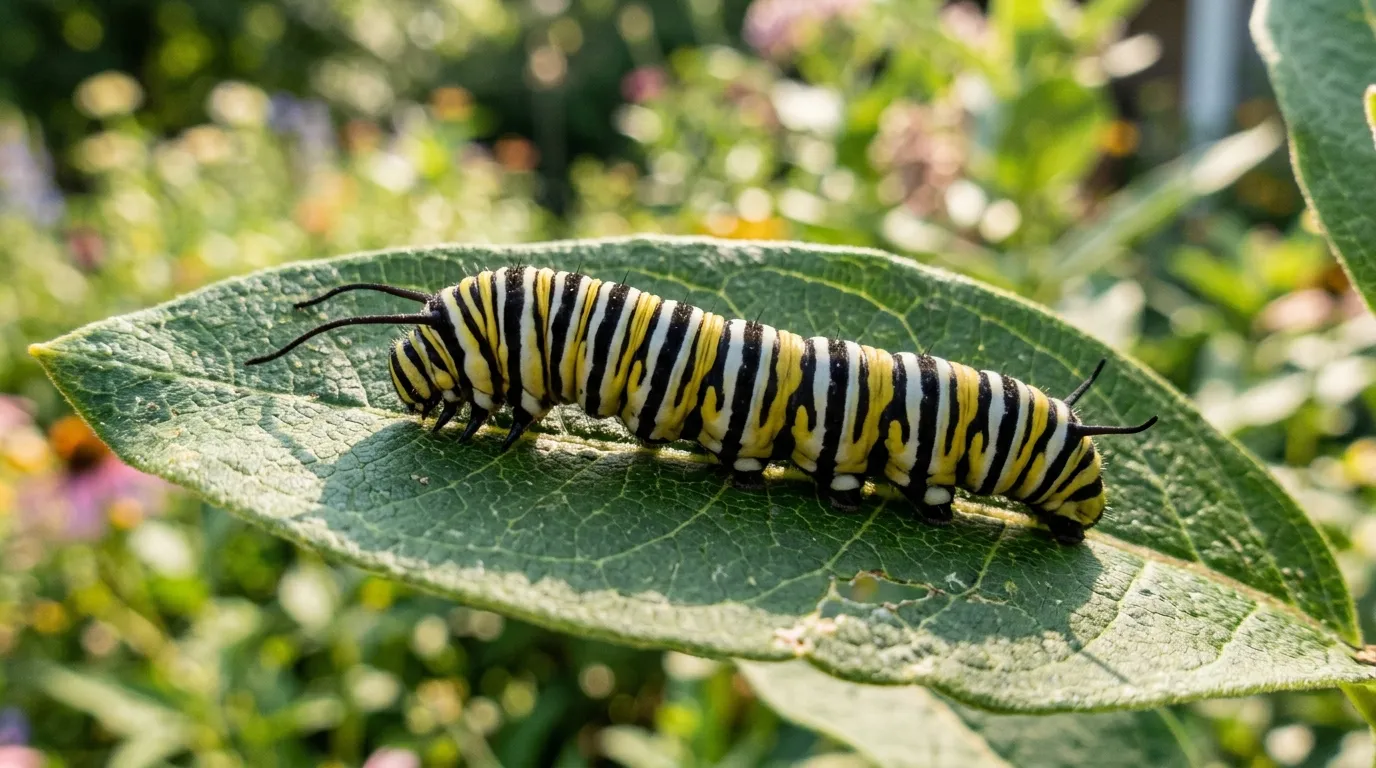
A mature monarch caterpillar is impossible to mistake for anything else in North America. The body is banded in repeating stripes of jet black, creamy white (sometimes closer to pale yellow-white), and bright lemon yellow. The bands run horizontally around the body, not along its length, so the caterpillar looks almost like it is wearing tiny striped pajamas. The head is rounded and black with white facial markings, and the legs and prolegs are darker with lighter accents.
The most telling feature for a quick ID is the pair of black filaments that sprout from both ends of the body. The longer pair sits behind the head on the second thoracic segment, and the shorter pair sits near the rear on the eighth abdominal segment. These are not antennae, and they are not stingers. They are soft, fleshy tentacles that the caterpillar uses as sensory organs. When disturbed, a monarch caterpillar will often whip those front tentacles around, which is thought to help confuse parasitoid flies and wasps looking for a landing target.
Size varies dramatically depending on which instar the caterpillar is in. A freshly hatched first instar is barely 2mm long, pale greenish white, and almost translucent. A full fifth instar ready to pupate can reach 45 to 50mm in length and fills out into a thick, heavy-bodied larva that is surprisingly hard to spot because it tucks itself under leaves while it eats. For a deeper look at the broader features of monarch butterflies, the adult form is obviously the most recognizable, but the caterpillar stage is where most of the interesting biology happens.
How to Identify a Monarch Caterpillar in the Field
The quickest way to confirm a monarch caterpillar is to check the host plant and the banding pattern together. If the caterpillar is on milkweed and it has black, white, and yellow horizontal bands with soft black tentacles on both ends, that is a monarch. No other North American caterpillar looks quite like it on that plant.
A few look-alikes can trip up beginners. Queen butterfly caterpillars (Danaus gilippus) share the same striped pattern and also feed on milkweed, but queens have three pairs of tentacles instead of two, with an extra set on the middle of the body. Soldier butterfly caterpillars look similar as well and also belong to the same genus, though they are rare outside of Florida and south Texas. Tussock moth caterpillars sometimes appear on milkweed but they are hairy, which monarchs never are.
Early instars look nothing like the classic mature caterpillar, which trips up plenty of gardeners. First and second instars are pale, tiny, and show only faint hints of the eventual striping. If you find a very small caterpillar on milkweed that has a dark head and a pale greenish body with just a suggestion of bands starting to form, that is almost certainly a young monarch. You can confirm by checking again a day or two later, because they grow fast and the stripes become obvious within 48 hours.
The Five Instars of a Monarch Butterfly Caterpillar
Monarch caterpillars pass through five distinct growth stages called instars between hatching and pupation. Each instar ends with the caterpillar shedding its skin to make room for the larger body underneath. The whole progression takes roughly 10 to 14 days under warm summer conditions, and it can stretch to 18 or 20 days when temperatures drop. Knowing which instar you are looking at is useful for timing rearing, and the differences are visible once you know what to look for.
First Instar (Days 1 to 3)
A newly hatched monarch is about 2mm long and almost transparent with a dark head capsule. Its first meal is usually its own eggshell, which is thought to provide some gut microbes and a nutritional boost. After that it starts nibbling on the milkweed leaf, making small pinprick holes rather than tearing large sections. The bands are not visible yet, and from a distance the caterpillar looks like a tiny pale grub. This stage lasts one to three days depending on temperature.
Second Instar (Days 3 to 5)
By the second instar, the caterpillar has doubled in size to around 6mm and the classic banding begins to form. Stripes are still faint and the body looks more yellow-green than the vivid contrast you see later. The tentacles are just starting to develop and appear as small bumps rather than fully formed filaments. Feeding increases at this stage, and the caterpillar starts eating through larger sections of the leaf instead of just making pinpricks.
Third Instar (Days 5 to 7)
The third instar is when a monarch caterpillar starts looking like the insect most people recognize. Bands are now clearly black, white, and yellow. Body length reaches about 10 to 14mm. The front and rear tentacles are visible and functional. At this stage the caterpillar is eating aggressively, often consuming an entire small leaf in a single day. Third instars also start to wander more, moving between leaves as they strip the plant.
Fourth Instar (Days 7 to 9)
Fourth instar caterpillars grow to around 20 to 25mm and look like a smaller version of the mature larva. The bands are vivid, the tentacles are long and mobile, and the body is thickening noticeably. This is also when you start to see the caterpillar moving frequently, sometimes leaving the host plant entirely for short walks along stems or nearby foliage. A fourth instar can defoliate a small milkweed plant in two or three days if it is the only larva present.
Fifth Instar (Days 9 to 14)
The fifth instar is the final and largest stage, reaching 45 to 50mm in length and weighing about 1.5 grams. This is the caterpillar that most people picture when they think of a monarch larva. Feeding is intense for the first few days of this instar, and then it slows and eventually stops as the caterpillar prepares to pupate. Pre-pupal caterpillars often leave the host plant entirely, wandering several feet in search of a sheltered spot to form their chrysalis. For the full stage-by-stage breakdown including timing, photos, and size charts, check out the complete guide to the five instars of a monarch caterpillar.
What Monarch Caterpillars Eat and Why Only Milkweed
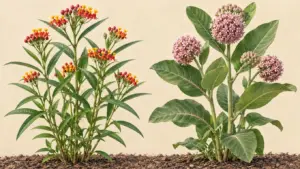
Monarch caterpillars are obligate specialists on plants in the genus Asclepias, which includes more than 100 milkweed species native to North America. They cannot complete development on any other plant. Put a monarch caterpillar on a tomato, a dandelion, or a willow, and it will starve rather than switch food sources. The specialization runs deep in the species and goes back millions of years in the ancestral lineage.
What makes milkweed special is also what makes it dangerous for most other insects. Milkweed sap contains cardiac glycosides (cardenolides), a class of steroidal compounds that are toxic to vertebrates because they disrupt sodium-potassium pumps in heart muscle cells. These same compounds are lethal to most insects too. Monarchs evolved a molecular workaround in the form of mutated sodium-potassium pump proteins that are no longer vulnerable to the toxin, and they actually sequester the cardenolides in their own tissues instead of breaking them down. A caterpillar that eats a lot of high-cardenolide milkweed grows up to be a chemically defended adult butterfly. Research from the Monarch Joint Venture documents how this chemistry carries through the chrysalis stage and into the adult, protecting the butterfly from most birds and vertebrate predators.
Different milkweed species contain different levels and types of cardenolides. Common milkweed (Asclepias syriaca) is moderate. Swamp milkweed (A. incarnata) is lower in cardenolides. Tropical milkweed (A. curassavica) and some desert species carry higher concentrations. Caterpillars raised on stronger milkweeds produce more toxic adults, but they also deal with more irritation during feeding and sometimes grow slightly slower. The broader concept of how butterflies depend on specific host plants comes up across the whole family, and the post on butterfly larval host plants covers how other species handle similar specialist relationships.
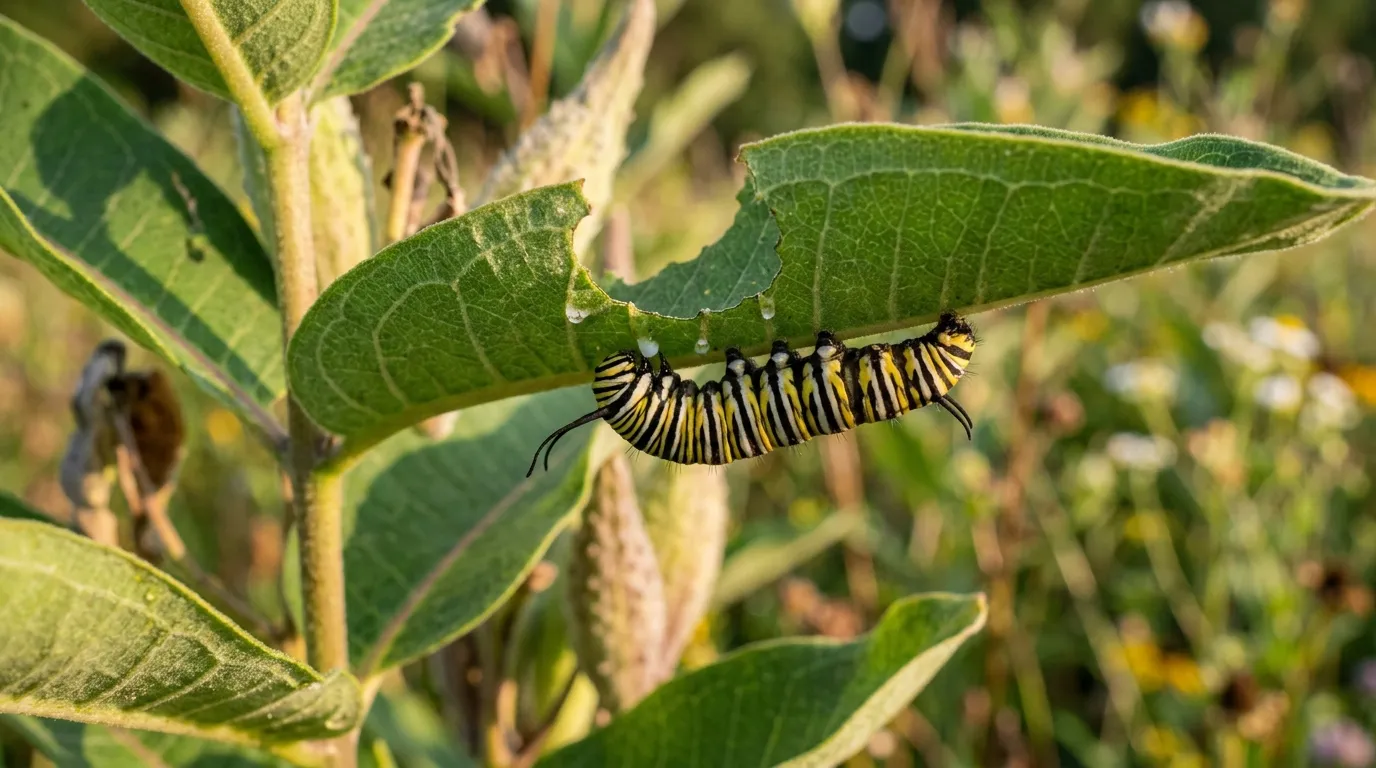
Feeding mechanics matter too. Monarch caterpillars have evolved behaviors to deal with the sticky latex sap that oozes from cut milkweed veins. Early instars often trench the leaf by chewing a small circle around their feeding area, which cuts off the sap flow to that section and lets them eat without getting glued to the plant. Later instars are strong enough to simply eat through the sap and handle the latex without trouble.
How to Find Monarch Caterpillars in the Wild
Finding a monarch caterpillar starts with finding milkweed. Once you have a patch, scan the plants systematically. The first thing to look for is damage. Monarch caterpillars leave distinctive feeding evidence in the form of chewed leaf margins, irregular holes through the middle of leaves, and small piles of dark green frass on the leaves below the feeding area. A healthy milkweed plant with recent damage almost always has a caterpillar within a few feet.
Check the undersides of leaves first. Eggs and early instar caterpillars are almost always found on leaf undersides, which gives them some protection from rain, sun, and flying predators. Work from the top of the plant downward, because females tend to lay eggs on younger, softer leaves near the growing tips. A monarch egg is about 1mm long, ridged, cream-colored, and football-shaped, and it sits upright on the leaf surface. If you see eggs, check back in three to five days for hatchlings.
Timing matters. In the northern US and southern Canada, monarch caterpillars are most abundant from late June through mid-September. In the southern US, they can be found for much longer, with multiple generations cycling through the growing season. The best time of day is mid-morning, when the caterpillars are actively feeding and easier to spot. In hot afternoons they often tuck under leaves and hold still to avoid overheating.
Public milkweed patches in prairie preserves, roadside plantings, and butterfly gardens usually have higher caterpillar density than isolated plants in a single yard. If you want to reliably find larvae for observation or rearing, plant your own milkweed patch with at least a dozen mature plants. Once established, a patch like this will reliably host eggs and caterpillars through the summer breeding season, and it gives you enough plant material to support multiple caterpillars at once.
Rearing Monarch Caterpillars at Home
Raising monarch caterpillars is one of the most rewarding projects you can do with kids or on your own, but it comes with responsibilities that a lot of guides gloss over. Done well, it teaches biology and produces healthy adult butterflies. Done carelessly, it can spread disease, produce weak migrants, and actually hurt wild populations. Here is how to do it right.
Start with a proper enclosure. A mesh butterfly cage from 12 to 24 inches tall works well for a few caterpillars. Hard plastic containers with ventilation holes work for first and second instars, but larger caterpillars need airflow and climbing room. Skip glass jars and sealed tupperware, which trap humidity and lead to mold and bacterial problems. Keep the setup in a bright room out of direct sunlight and away from heat vents.
Fresh host plant supply is the single most important factor. Monarch caterpillars eat constantly, and fifth instars can strip a milkweed stem in a day. You need to either grow enough milkweed that you can keep cutting fresh material, or collect from a large wild patch. Place cut stems in a water vase covered with foil or plastic wrap so the caterpillars cannot fall in and drown. Replace the milkweed every day or two before it wilts, and gently transfer the caterpillars onto the new cuttings with a soft brush.
Sanitation prevents OE (Ophryocystis elektroscirrha) and other problems. Clean the cage daily by removing frass and wiping down surfaces with a 10% bleach solution between broods. Do not mix caterpillars from different sources without cleaning, and avoid raising too many at once, which concentrates waste and increases disease pressure. The Xerces Society recommends keeping rearing small-scale (fewer than 10 caterpillars at a time) and releasing adults near the site where the eggs or caterpillars were originally collected.
Once a caterpillar reaches its fifth instar and stops eating, watch for pre-pupal behavior. It will wander around the enclosure, empty its gut (producing a last large frass pellet and sometimes a watery fluid), and then climb to a high point. There it spins a silk button, hangs head-down in a characteristic J shape for about 18 to 24 hours, and then molts one final time into a pale green chrysalis with gold accents. The chrysalis stage runs 10 to 14 days. When the adult emerges, let it hang and pump fluid into its wings for two to four hours before releasing. Release outdoors on a warm, sunny day, ideally during the morning, somewhere with flowers and shelter nearby. If you are new to rearing Lepidoptera in general, the guide to raising swallowtail caterpillars indoors covers a lot of the same technique with a different host plant situation and is worth reading as a comparison.
Predators, Parasitoids, and Survival Rates
Despite being chemically defended, monarch caterpillars face heavy predation and parasitism in the wild. Research reported by the U.S. Forest Service and university-led field studies puts the survival rate from egg to adult at somewhere between 2% and 10% under typical conditions. That means most caterpillars you find will never reach the chrysalis stage, which is part of why monarchs lay so many eggs – a single female can produce 300 to 500 eggs over her lifetime.
Tachinid flies are one of the biggest killers. These flies lay eggs on or inside monarch caterpillars, and the fly larvae develop internally, eventually killing the host. An infected caterpillar often looks normal until late in the fifth instar, when small white fly larvae emerge from the body. I have seen this play out in my own garden, and it is grim to watch a caterpillar you have been tracking for a week suddenly produce half a dozen parasitoid grubs.
Paper wasps and stink bugs are major generalist predators. Wasps grab smaller caterpillars and carry them back to their nests to feed larvae. Stink bugs insert their proboscis into the caterpillar and suck out the internal fluids. Ants, spiders, assassin bugs, and predatory beetles also take their share. Even a couple of chickens in the neighborhood can eat monarchs if they get access to a milkweed patch, since birds are actually more tolerant of cardenolides than the toxicity story sometimes suggests.
OE parasite infection is a separate and ongoing concern. It does not usually kill caterpillars outright, but it produces weakened adults with crumpled wings and shortened lifespans. Responsible rearing practices, planting only native milkweed in temperate climates, and avoiding year-round tropical milkweed in warm regions all help keep OE loads manageable.
Frequently Asked Questions
Are monarch butterfly caterpillars poisonous to touch?
No. Monarch caterpillars are toxic if eaten by birds or small mammals, but they are completely safe to handle with bare hands. They have no venom, no stinging hairs, and no irritating secretions. The worst thing you will get is a little sticky residue from the milkweed sap they were feeding on, and that sap can irritate sensitive eyes if you rub your face afterward, so wash your hands after handling. Kids can pick them up without any concern for injury.
What do I do if I find a monarch caterpillar but have no milkweed?
The best option is to leave it on the plant where you found it or move it to the nearest milkweed plant you can locate. Monarch caterpillars cannot eat anything else, so taking one home without a reliable milkweed source will result in starvation. If you want to rear monarchs, plant milkweed in your garden ahead of time and only collect eggs or small caterpillars once your plants are established enough to feed them through the fifth instar. Several native species grow easily from seed or plugs.
How fast do monarch caterpillars grow?
Extremely fast. A first instar hatchling weighs about 0.5 milligrams. A fifth instar ready to pupate weighs around 1.5 grams. That is a 3,000-fold increase in body mass over roughly 10 to 14 days. By comparison, a human baby would need to weigh over 20,000 pounds at two weeks old to match that growth rate. The energy comes entirely from milkweed leaves, which is why caterpillar density and plant supply need to match up for healthy development.
Can monarch caterpillars eat the flowers or seed pods of milkweed?
Yes, though they prefer leaves. Monarch caterpillars will eat milkweed flower buds, open flowers, green seed pods, and occasionally stem tissue if leaves are scarce. Buds and young seed pods actually contain higher concentrations of cardenolides than leaves, so caterpillars feeding on those parts may develop stronger chemical defenses. In a rearing setup, offering a mix of leaves and flower material gives you flexibility if leaf supply runs short.
Why does my monarch caterpillar keep falling off the plant?
A healthy monarch caterpillar grips tightly with its prolegs and does not fall unless something is wrong. Common causes are OE infection (which weakens muscle function), pesticide exposure on the milkweed, dehydration from a dried-out cutting, or the caterpillar preparing to pupate and actively wandering off the plant. If it is a fifth instar near the end of feeding, it is probably looking for a pupation spot and that is normal. If it is an earlier instar that seems weak or lethargic, check the plant source for pesticide residue and inspect the caterpillar for any signs of disease.
Can I feed a monarch caterpillar if I run out of fresh milkweed?
There is no true substitute. A few hobbyists have reported short-term success offering butternut squash or cucumber slices in emergencies, but this is not a reliable food source and will not support normal development. If you run out of milkweed mid-rearing, the fastest fix is to find a wild milkweed patch within driving distance and collect leaves or stems. Check roadside prairies, natural areas, and public milkweed plantings. Plan ahead next time by establishing a larger milkweed patch or lining up a backup supplier before starting the next batch of caterpillars.