


Understanding monarch butterfly caterpillar stages can turn a random backyard sighting into a real-time biology lesson. I’ve raised monarchs for several seasons now, and watching each caterpillar pass through all five instars still holds my attention. From a tiny, nearly invisible hatchling to a plump, striped larva ready to pupate, the entire process takes about 10 to 14 days. Each stage brings visible changes in size, color pattern, and behavior that you can track if you know what to look for.
Key Takeaways
- Monarch caterpillars pass through five instars (growth stages), molting their skin between each one, with the whole larval period lasting roughly 10 to 14 days on milkweed.
- Each instar can be identified by the caterpillar’s body length, stripe pattern development, and the length of its black tentacles (filaments) on the front and rear ends.
- Milkweed is the only food source for monarch caterpillars at every instar, and a single larva may consume 20 or more full-sized milkweed leaves before pupating.
- After completing the fifth instar, the caterpillar leaves its host plant, forms a J-shape, and sheds its skin one final time to reveal the jade-green chrysalis.
What Are Instars and Why Do Caterpillars Molt?
An instar is simply the phase between two molts. Insects with exoskeletons can’t grow continuously the way mammals do. Their outer skin is rigid, so when the body inside outgrows it, the caterpillar has to shed that old skin and expand into a new, larger one underneath.
Monarch caterpillars go through this process four times during the larval period, creating five distinct instars. Each molt takes a few hours. The caterpillar stops eating, stays very still, and then wriggles out of its old skin headfirst. It often eats the shed skin afterward for the nutrients.
If you’re watching a caterpillar that suddenly goes motionless on a leaf for half a day, don’t worry. It’s almost certainly preparing to molt. The head capsule will appear to slip forward slightly before the skin splits behind it. For a full visual breakdown of each stage, see our guide on all 5 monarch caterpillar instars explained.
First and Second Instars: The Tiny Early Days
A first instar monarch caterpillar is almost comically small. When it chews its way out of the egg, it measures about 2 to 6 millimeters long. Its body is pale, translucent, and mostly lacking the bold white, yellow, and black stripes people associate with monarchs. The tentacles on the thorax and rear are barely visible nubs at this point.
First instars feed by scraping at the leaf surface rather than eating through the whole leaf. If you look closely, you’ll see tiny window-pane holes where the caterpillar has eaten the tissue from one side but left the opposite epidermal layer intact. This stage lasts about one to two days.
The second instar is a noticeable step up in size, reaching roughly 6 to 9 millimeters. The banding pattern starts to appear as faint lines, and the front pair of tentacles begins to elongate. The caterpillar now eats through the entire leaf rather than just scraping the surface. This stage also lasts about one to two days, depending on temperature.
Mortality is highest during these first two instars. The caterpillars are small enough to be picked off by ants, spiders, and lacewing larvae. Rain can wash them off their host plant. According to data from the Monarch Joint Venture, survival from egg to adult in the wild sits at roughly 2 to 10 percent, with most losses happening in these earliest stages.
Third and Fourth Instars: Stripes Lock In
By the third instar, a monarch caterpillar is starting to look like the caterpillar most people picture. It measures about 10 to 14 millimeters and displays clear white, yellow, and black bands around its body. The front tentacles are now distinctly visible, and the rear pair has also grown longer.
The feeding rate picks up significantly during the third instar. The caterpillar begins eating entire leaves from the edges inward, and you can start to notice actual leaf damage on your milkweed plants. This stage runs about two days.
Fourth instar caterpillars range from roughly 13 to 25 millimeters. The stripe pattern is now fully formed with thick, well-defined bands. The tentacles on both ends are proportionally long and clearly function as sensory organs that wave around when the caterpillar is disturbed or exploring.
One useful identification trick at this stage: look at the front tentacles relative to the body. In the third instar, they’re still somewhat stubby compared to body width. By the fourth instar, they’re long and whip-like. This feature alone can help you distinguish between the two stages without needing a ruler.
Fifth Instar: The Final Feeding Push
The fifth instar is where things get dramatic. The caterpillar balloons from about 25 millimeters to a full 45 to 50 millimeters (nearly two inches) and can gain a huge percentage of its total body mass during these final three to four days before pupation. This is the stage most people notice on their milkweed because the caterpillar is large enough to spot easily.
A fifth instar monarch eats aggressively. A single caterpillar can strip several large milkweed leaves per day during this stage. If you’re raising monarchs, this is when you’ll burn through your milkweed supply fastest. It’s a good idea to have backup plants or cuttings ready.
The stripe pattern in the fifth instar is bold and fully saturated. The bands are sharply defined alternating rings of white, yellow, and black. The front tentacles may reach 10 to 11 millimeters long. The rear pair is shorter but still prominently visible. The body is plump, cylindrical, and the prolegs grip firmly onto stems and leaves.
All of this eating is building the fat reserves the caterpillar needs to fuel its transformation inside the chrysalis. The caterpillar doesn’t eat after it pupates, so every calorie consumed during the fifth instar has to sustain the complete reorganization of its body tissues. These monarch butterfly characteristics begin taking shape during this hidden pupal stage.
Milkweed: The Only Menu Option
Monarch caterpillars are obligate feeders on milkweed plants in the genus Asclepias. There are over 100 species of milkweed native to North America, and monarchs will use many of them. Common milkweed (Asclepias syriaca), swamp milkweed (A. incarnata), and tropical milkweed (A. curassavica) are among the most frequently used species.
This relationship isn’t just about nutrition. Milkweed contains toxic cardiac glycosides called cardenolides that the caterpillar sequesters in its body tissues. These compounds make the caterpillar (and later the adult butterfly) taste terrible and are potentially toxic to predators like birds. The bold striping pattern functions as warning coloration, advertising that toxicity to anything considering eating it.
The concentration of cardenolides varies between milkweed species. Tropical milkweed tends to have higher concentrations than common milkweed. Some researchers have raised concerns about planting non-native tropical milkweed in temperate zones because it doesn’t die back in mild winters and may encourage monarchs to skip migration, potentially increasing parasite loads from Ophryocystis elektroscirrha (OE). The U.S. Fish and Wildlife Service recommends planting native milkweed species appropriate to your region whenever possible.
The ongoing loss of milkweed habitat across the monarch’s breeding range is one of the primary drivers behind why monarch butterflies are endangered. Widespread herbicide use in agricultural areas has eliminated milkweed from millions of acres of farmland since the 1990s.
From J-Hang to Chrysalis
When the fifth instar caterpillar has eaten its fill, its behavior changes abruptly. It stops feeding and begins wandering away from the milkweed plant, sometimes traveling several feet to find a suitable pupation site. This wandering phase can last several hours.
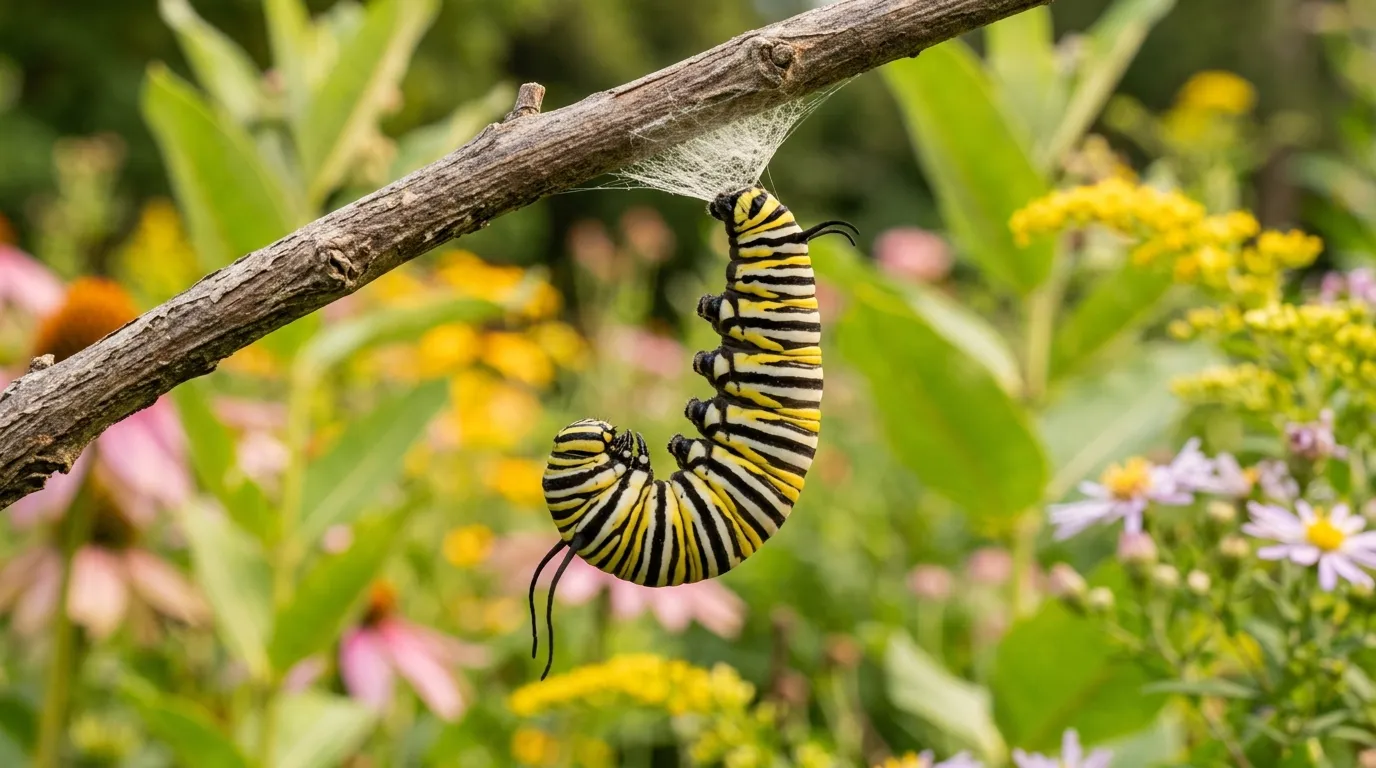
Once it finds a spot, the caterpillar spins a small silk pad on the underside of a horizontal surface. It hooks its rear prolegs (the cremastral hooks) into this silk pad and releases its grip with the rest of its body, hanging upside down in a distinctive J-shape. The caterpillar will hang in this J position for roughly 12 to 18 hours.
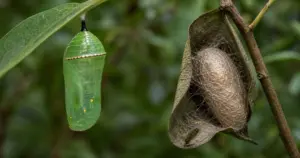
Then the final larval molt begins. The skin splits behind the head and peels upward toward the cremaster. Underneath is not another caterpillar but the smooth, soft chrysalis casing. The freshly exposed chrysalis is initially soft and somewhat amorphous. Within about an hour, it hardens and takes on its characteristic jade-green color with a line of gold dots near the top.
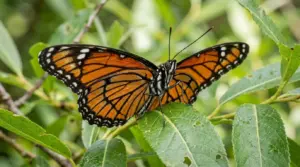
From this point, the chrysalis stages proceed day by day over about 10 to 14 days until the adult butterfly emerges. The green casing gradually becomes transparent in the final day or two, revealing the orange and black wing pattern folded inside.
Frequently Asked Questions
How long does each monarch caterpillar instar last?
Each instar lasts roughly one to three days, with the first two instars on the shorter end (one to two days each) and the fifth instar taking three to four days. The total larval period from hatching to pupation runs about 10 to 14 days. Temperature plays a significant role in timing. Warmer conditions speed development, while cooler weather slows it down. At temperatures below 60 degrees Fahrenheit, development can stall almost entirely.
How can I tell which instar a monarch caterpillar is in?
Size is the fastest indicator. First instars are under 6 millimeters and lack clear stripes. Second instars show faint banding and measure 6 to 9 millimeters. Third instars display distinct stripes and reach about 10 to 14 millimeters. Fourth instars are 13 to 25 millimeters with fully formed patterns and long front tentacles. Fifth instars are 25 millimeters or longer with bold, saturated stripes and the longest tentacles. Tentacle length relative to body size is one of the most reliable visual cues for separating the middle instars.
Can monarch caterpillars eat anything other than milkweed?
No. Monarch caterpillars are specialist herbivores that feed exclusively on plants in the milkweed family (Asclepiadaceae). Without milkweed, they will starve. Female monarchs lay eggs only on milkweed plants, and the newly hatched caterpillar typically eats its eggshell first before beginning to feed on the leaf beneath it. If you find a monarch caterpillar on a non-milkweed plant, it has wandered there by accident and needs to be moved to milkweed to survive.
Why did my monarch caterpillar stop moving?
A motionless monarch caterpillar is almost always preparing to molt. Before each molt, the caterpillar enters a resting phase that can last anywhere from a few hours to most of a day. Its head capsule may appear slightly detached or pushed forward. As long as the body still looks plump and the color hasn’t turned dark brown or black, it’s likely fine. If the caterpillar has turned limp, shriveled, or discolored, it may have been affected by disease, parasitoids, or pesticide exposure.
How many milkweed plants does one monarch caterpillar need?
A single monarch caterpillar will consume roughly 20 to 30 milkweed leaves over its entire larval development, with the vast majority eaten during the fourth and fifth instars. For common milkweed, that works out to approximately one to two full-sized plants per caterpillar. If you’re planting milkweed to support monarchs, plan for at least six to eight plants to support a small number of caterpillars while leaving enough foliage for the plants to recover and continue producing leaves through the season.
What predators eat monarch caterpillars despite their toxicity?
While cardenolides deter many predators, several species have adapted to handle them. Paper wasps, Chinese mantids, stink bugs, and certain spiders readily eat monarch caterpillars, especially small early instars. Tachinid flies lay eggs on caterpillars, and the fly larvae consume the host from inside. A parasitic wasp called Pteromalus cassotis attacks monarch chrysalises. According to research from the University of Kansas Monarch Watch program, predation and parasitism collectively account for most caterpillar mortality in natural settings.