


Pipevine Swallowtail Range | Where They Live in the US
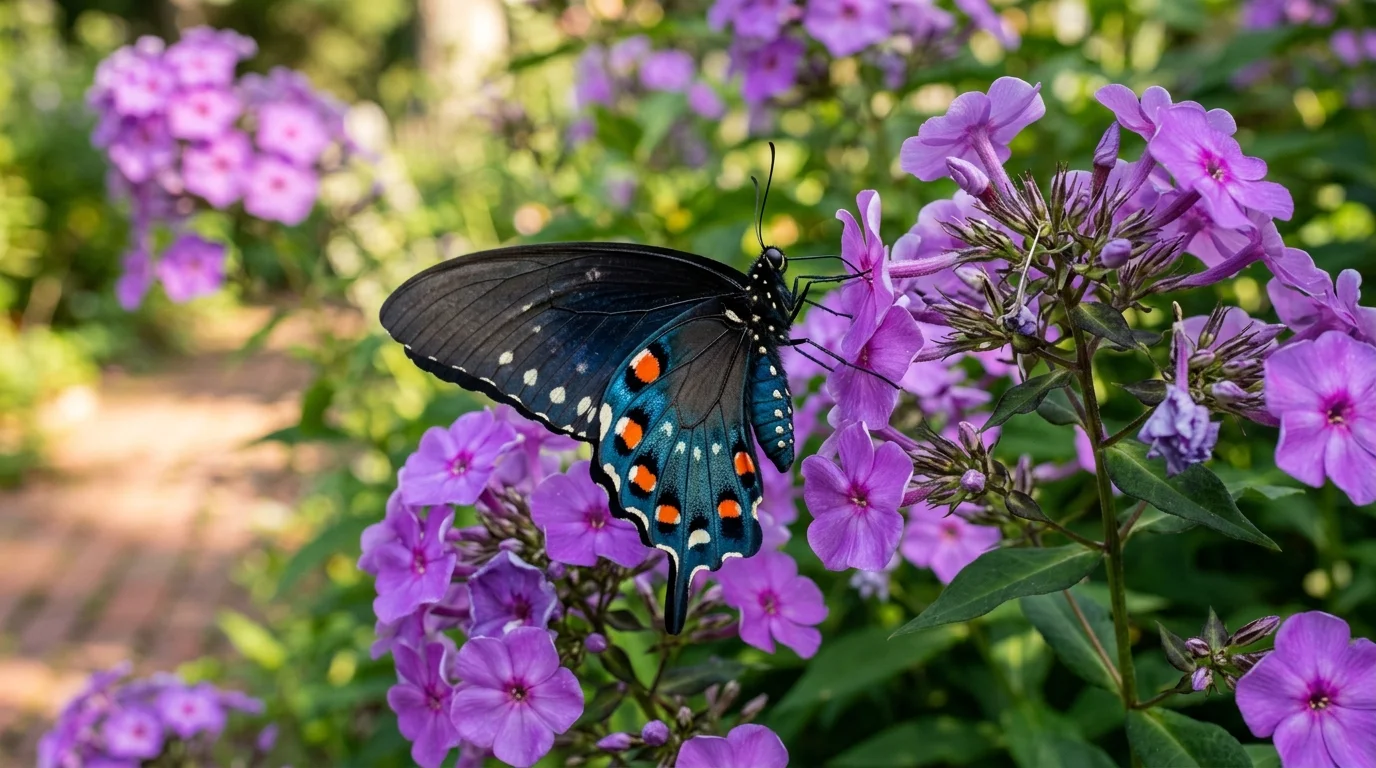
The pipevine swallowtail range covers a broad but somewhat patchy swath of the United States, running from New England down through the Southeast, across the Gulf states, and up the Pacific Coast into Oregon. Battus philenor follows its host plant, and where Aristolochia (pipevine) grows natively, you will almost certainly find this iridescent blue-black butterfly. I have watched them in Virginia woodlands and California foothills, and the pattern holds – no pipevine, no pipevine swallowtail.
Unlike generalist swallowtails that can feed on dozens of plant families, Battus philenor is locked into a relationship with Aristolochia species. That single dependency shapes everything about where you can and cannot find this butterfly across the country.
Key Takeaways
- The pipevine swallowtail has two main population centers in the US: the eastern and southeastern states (roughly Virginia to Florida and west to Texas), and a separate Pacific Coast population in California and Oregon tied to Aristolochia californica.
- Battus philenor caterpillars feed only on Aristolochia (pipevine/Dutchman’s pipe) species, so the butterfly’s range directly mirrors where these host plants grow natively or have been planted in gardens.
- Seasonal range expansion pushes pipevine swallowtails north of their breeding range each summer, with strays appearing as far north as southern Canada, though they cannot survive winter in those areas.
- Compared to the eastern tiger swallowtail or black swallowtail, the pipevine swallowtail has a more restricted and fragmented range because of its specialist diet.
Eastern and Southeastern US: The Core Pipevine Swallowtail Range
The heart of the pipevine swallowtail’s range runs through the southeastern United States. This is where the butterfly is most consistently abundant, where multiple broods fly each year, and where the native host plants – primarily Aristolochia serpentaria (Virginia snakeroot) and Aristolochia macrophylla (Dutchman’s pipe) – grow in rich woodland understories.
In states like Virginia, North Carolina, Tennessee, Georgia, Alabama, and Mississippi, pipevine swallowtails are a common sight from April through October. The Appalachian Mountains provide ideal habitat with their mix of deciduous forest, rocky slopes, and creek drainages where Aristolochia thrives in the dappled shade. I have had my best luck finding concentrations of this species along woodland edges near creek bottoms in the Blue Ridge – the kind of spot where pipevines scramble up tree trunks and form dense tangles.
South Carolina and Georgia mark the region where the butterfly is probably at peak abundance. Warm temperatures allow multiple flight generations per year (typically three in the Deep South compared to one or two further north), and several Aristolochia species overlap in range there. Florida has pipevine swallowtails primarily in the northern and central parts of the state, with Aristolochia tomentosa and A. serpentaria providing host plants. South Florida sees occasional strays but lacks reliable breeding populations.
Moving west, the range extends solidly through Arkansas, Louisiana, eastern Texas, and eastern Oklahoma. The piney woods and bottomland hardwood forests of the Gulf Coast provide continuous habitat. Texas is interesting because the butterfly’s range extends further west along river corridors than you might expect – populations exist along the Edwards Plateau and into the Hill Country wherever Aristolochia grows along limestone creek banks.
The Pacific Coast Population
Separated from the eastern populations by the Great Plains and Rocky Mountains, a distinct population of pipevine swallowtails lives in California and southern Oregon. This western group relies almost entirely on a single host plant: Aristolochia californica, the California pipevine. The plant grows naturally in foothill woodland and chaparral habitats of the Coast Ranges, Sierra Nevada foothills, and the Sacramento and San Joaquin Valleys.
In California, Battus philenor is common in counties like Sonoma, Napa, Solano, Contra Costa, and throughout the Sierra foothills from El Dorado County south to Kern County. The butterfly also reaches into southern Oregon’s Rogue River Valley and parts of the Siskiyou Mountains. These western populations fly earlier in the year than their eastern counterparts – adults may appear as early as February in the San Francisco Bay Area during warm winters, with peak flight in March and April before the California dry season sets in.
The Pacific Coast population is genetically distinct enough from eastern populations that some researchers have questioned whether it should be treated as a separate subspecies. The adults look practically identical, but the timing of their life cycle is shifted to match California’s Mediterranean climate rather than the summer-rainfall pattern of the eastern US. The chrysalis stage in California populations can last through the long dry summer and into fall, a much longer diapause than eastern pupae typically undergo.
State-by-State Presence Guide
Here is a breakdown of where you can expect to find pipevine swallowtails across the US. I have grouped states by how reliably the butterfly occurs there, based on breeding records and documented sightings from sources like the Butterflies and Moths of North America database.
Abundant breeding populations (multiple broods annually): Virginia, West Virginia, Kentucky, Tennessee, North Carolina, South Carolina, Georgia, Alabama, Mississippi, Louisiana, Arkansas, eastern Texas, Missouri, southern Illinois, southern Indiana, southern Ohio, California (foothill regions), southern Oregon.
Regular breeding populations (one to two broods): Maryland, Delaware, southern Pennsylvania, southern New Jersey, northern Florida, Oklahoma, Kansas (eastern counties), Arizona (southeastern sky islands).
Uncommon or irregular (strays and temporary colonies): Connecticut, New York, Massachusetts, Michigan, Iowa, Nebraska, northern Pennsylvania, Wisconsin, Minnesota, New Mexico, Colorado (rare strays along Arkansas River corridor).
Absent or extremely rare: Maine, New Hampshire, Vermont, North Dakota, South Dakota, Wyoming, Montana, Idaho, Utah, Nevada, Washington (though the general butterfly diversity in the Pacific Northwest includes other swallowtail species).
Arizona deserves a special mention. The southeastern sky island mountains – the Chiricahuas, Huachucas, and Santa Ritas – support small populations of Battus philenor tied to Aristolochia watsonii, a desert pipevine. These populations are isolated from both the main eastern range and the California population, making them a third distinct regional group.
The Aristolochia Connection: Why Host Plants Control the Range
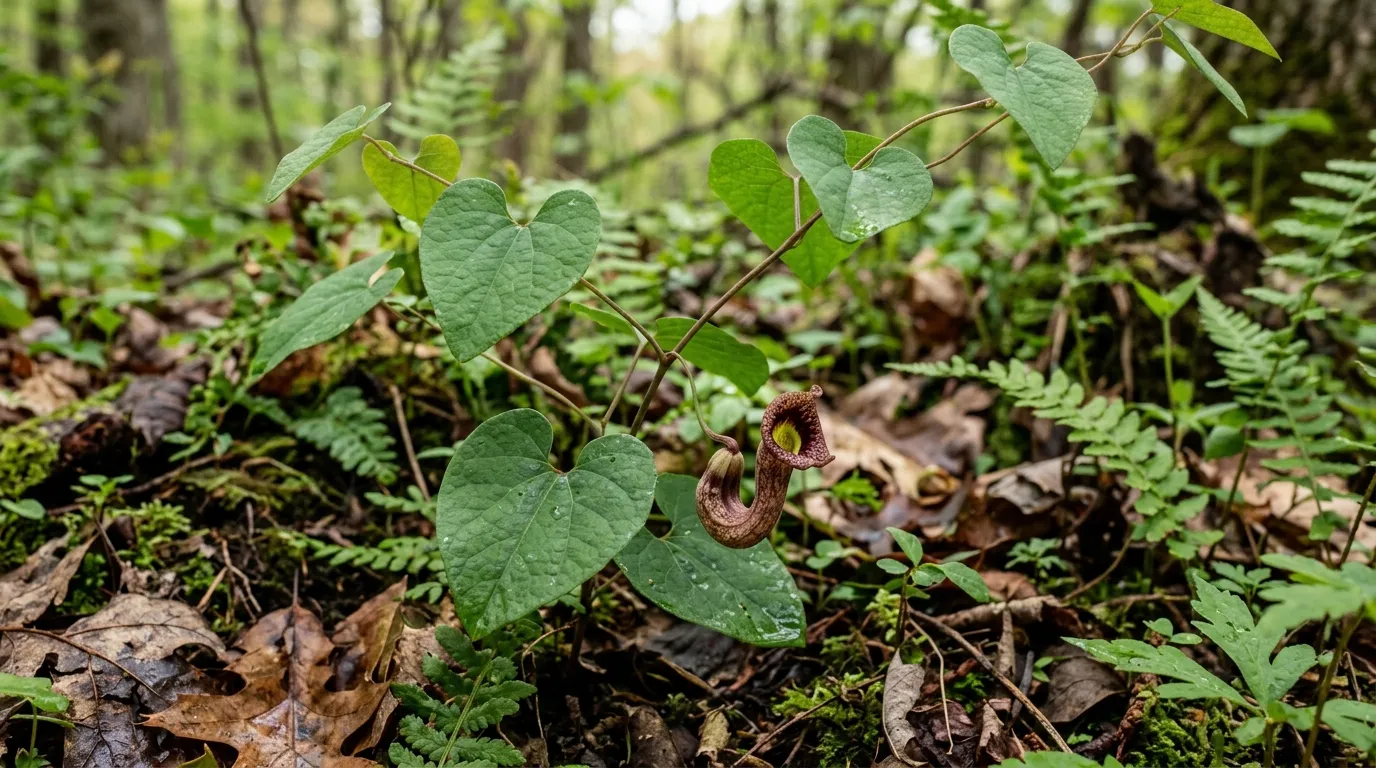
No other factor shapes the pipevine swallowtail range as directly as the distribution of its host plants. The caterpillar diet is restricted entirely to Aristolochia species. Females will not lay eggs on anything else, and newly hatched caterpillars will starve rather than eat a substitute plant. This is about as strict a host plant relationship as you will find among North American butterflies.
Nine Aristolochia species are native to the US, but only a handful support significant butterfly populations. Aristolochia serpentaria (Virginia snakeroot) is the most widespread eastern host, growing in rich mesic forests from Connecticut to Florida and west to Texas. Aristolochia macrophylla (Dutchman’s pipe) occurs in the Appalachians and has also been widely planted as an ornamental vine – which has actually helped expand the butterfly’s urban and suburban range in some areas.
Aristolochia tomentosa (woolly pipevine) covers the lower Mississippi Valley and Gulf Coast. Aristolochia californica handles the entire Pacific Coast population. And Aristolochia watsonii supports the isolated Arizona sky island colonies. Where these plants have been lost to development or forest clearing, the butterfly disappears. Where gardeners plant Aristolochia, new colonies sometimes establish. A USDA Forest Service profile of Aristolochia serpentaria confirms the plant’s status as a conservation concern in several northeastern states, which has direct implications for the butterfly’s northern range limits.
The aristolochic acids that caterpillars sequester from these plants also make adult butterflies toxic to birds, which is why the pipevine swallowtail serves as the model species in one of North America’s best-known Batesian mimicry complexes. The spicebush swallowtail, dark morph female tiger swallowtail, red-spotted purple, and female Diana fritillary all mimic the pipevine swallowtail’s dark coloring – but only within the pipevine swallowtail’s range where predators have learned to avoid that pattern.

Seasonal Range Expansion and Migration
Pipevine swallowtails are not true migrants like monarchs, but they do exhibit seasonal northward dispersal. Each summer, individuals push beyond the established breeding range into areas where Aristolochia may be scarce or absent. This is how pipevine swallowtails occasionally turn up in southern Michigan, central Pennsylvania, or even southern Ontario.
These northward wanderers do not survive the winter. Unlike monarchs that fly south to specific overwintering sites, stray pipevine swallowtails that push north simply die when cold weather arrives if they cannot find Aristolochia to breed on or if the climate is too harsh for their pupae to survive winter dormancy. The butterfly overwinters as a chrysalis in its core range, and pupae need to be insulated by leaf litter in regions where the ground freezes. The adult lifespan of a pipevine swallowtail is roughly two to four weeks, so the adults you see in July in New York state are not the same individuals that flew in Georgia in April – they are the offspring of a northward-expanding population.
Climate warming has started to shift the range boundaries. Records from iNaturalist and BAMONA over the past two decades show pipevine swallowtails appearing more regularly in areas where they were once considered rare strays – parts of southern New England, the northern Midwest, and higher elevations in the Appalachians. Whether these represent permanent range expansion or just temporary responses to warm years remains to be seen.
How Pipevine Swallowtail Range Compares to Other Swallowtails
The pipevine swallowtail’s range is notably more restricted than most other common US swallowtails, and the reason comes back to diet. The eastern tiger swallowtail (Papilio glaucus) uses wild cherry, tulip tree, ash, birch, and several other widespread tree species as hosts – giving it a range that blankets the entire eastern half of North America from southern Canada to the Gulf. The black swallowtail (Papilio polyxenes) feeds on plants in the carrot family, which grow practically everywhere, so it ranges across nearly the entire contiguous US.
The giant swallowtail (Papilio cresphontes) uses citrus and prickly ash, giving it a range similar in breadth to the pipevine swallowtail but weighted more toward the southern tier. The spicebush swallowtail (Papilio troilus) mirrors the pipevine swallowtail’s eastern range fairly closely, since spicebush and sassafras have distributions that overlap with Aristolochia. But even the spicebush swallowtail has a somewhat broader range because its hosts are more common in suburban and disturbed habitats.
The western tiger swallowtail (Papilio rutulus) fills the Pacific states much more broadly than the western pipevine swallowtail population, since its host plants (cottonwood, willow, sycamore) grow along waterways throughout the western US. The pipevine swallowtail is a specialist through and through living in a generalist’s world – its range would be much larger if Aristolochia grew more widely.
Frequently Asked Questions
Are pipevine swallowtails found in all 50 states?
No. Pipevine swallowtails have been documented in roughly 35 to 40 states, but regular breeding populations exist in far fewer – probably 25 to 30 states. They are absent from most of the northern Great Plains, the northern Rocky Mountain states, and the Pacific Northwest north of southern Oregon. Hawaii and Alaska have no populations at all.
Can I attract pipevine swallowtails to my garden if I’m outside their range?
You can plant Aristolochia to provide potential habitat, but if you are well outside the species’ range, it is unlikely the butterflies will find your garden. In areas at the edge of the range, planting native Aristolochia species has occasionally led to new colonies establishing. Gardeners in central Missouri, southern Illinois, and the mid-Atlantic have reported success attracting breeding females by planting Aristolochia macrophylla or A. tomentosa.
Why are pipevine swallowtails more common in the Southeast than the Northeast?
Two factors work together: warmer temperatures that allow more broods per year and more diverse Aristolochia species. The Southeast has at least four native Aristolochia species compared to one or two in New England. More host plants mean more caterpillar food, which supports denser butterfly populations. Longer warm seasons also mean adults can fly from March through November in Georgia versus May through August in Connecticut.
Do the eastern and western pipevine swallowtail populations ever mix?
Rarely, if ever. The Great Basin, Rocky Mountains, and Great Plains create a wide gap with no native Aristolochia and harsh winter conditions. The Arizona sky island populations represent the closest geographic link between east and west, but those colonies are small and isolated themselves. Genetic studies suggest the California population has been separated from eastern populations for thousands of years.
Is the pipevine swallowtail range expanding or shrinking?
The picture is mixed. In some northern areas, warmer winters appear to be allowing the butterfly to establish breeding populations where it was previously only a stray. But in parts of the Southeast, habitat loss – particularly the clearing of rich bottomland forests where Aristolochia serpentaria grows – has reduced local populations. The net effect depends on the region. Urban and suburban gardeners planting Aristolochia are creating new habitat patches that may help offset some of the natural habitat losses.
How does the pipevine swallowtail’s range compare to its mimics’ ranges?
Several species mimic the pipevine swallowtail, and all of them have ranges that extend well beyond where the model actually lives. The spicebush swallowtail and dark morph female eastern tiger swallowtail both occur in areas with few or no pipevine swallowtails. This is one of the puzzles of the mimicry system – the mimicry is most effective where the model is common, but the mimic species persist in areas where birds have never encountered the model. Researchers suspect the mimicry may still offer partial protection in those fringe areas because some birds migrate through the pipevine swallowtail’s core range and carry the learned avoidance with them.
What is the best time of year to see pipevine swallowtails?
In the Southeast, early spring (March to April) brings the first brood, and they fly through late October. In California, peak flight is February through May. In the northern parts of their range (Pennsylvania, Ohio, southern New York), June and July are the prime months. Adults are most active on warm, sunny mornings and are strongly attracted to pink, purple, and red flowers – azaleas, thistles, and milkweeds are reliable nectar plants across the range.