


The queen butterfly (Danaus gilippus) is the monarch’s closest North American relative, sharing the same genus and many of the same survival strategies – but it’s a different species with its own range, behavior, and field marks. Queens are smaller than monarchs, darker brown rather than orange, and lack the heavy black vein lines that make monarchs so recognizable. They live primarily in the southern United States, Mexico, and Central America, and while they do move around seasonally, they don’t pull off anything close to the monarch’s famous multi-generational migration. If you’ve seen a brownish-orange milkweed butterfly in Texas, Arizona, or Florida and thought “that looks like a monarch, but something’s off,” you were probably looking at a queen.
Key Takeaways
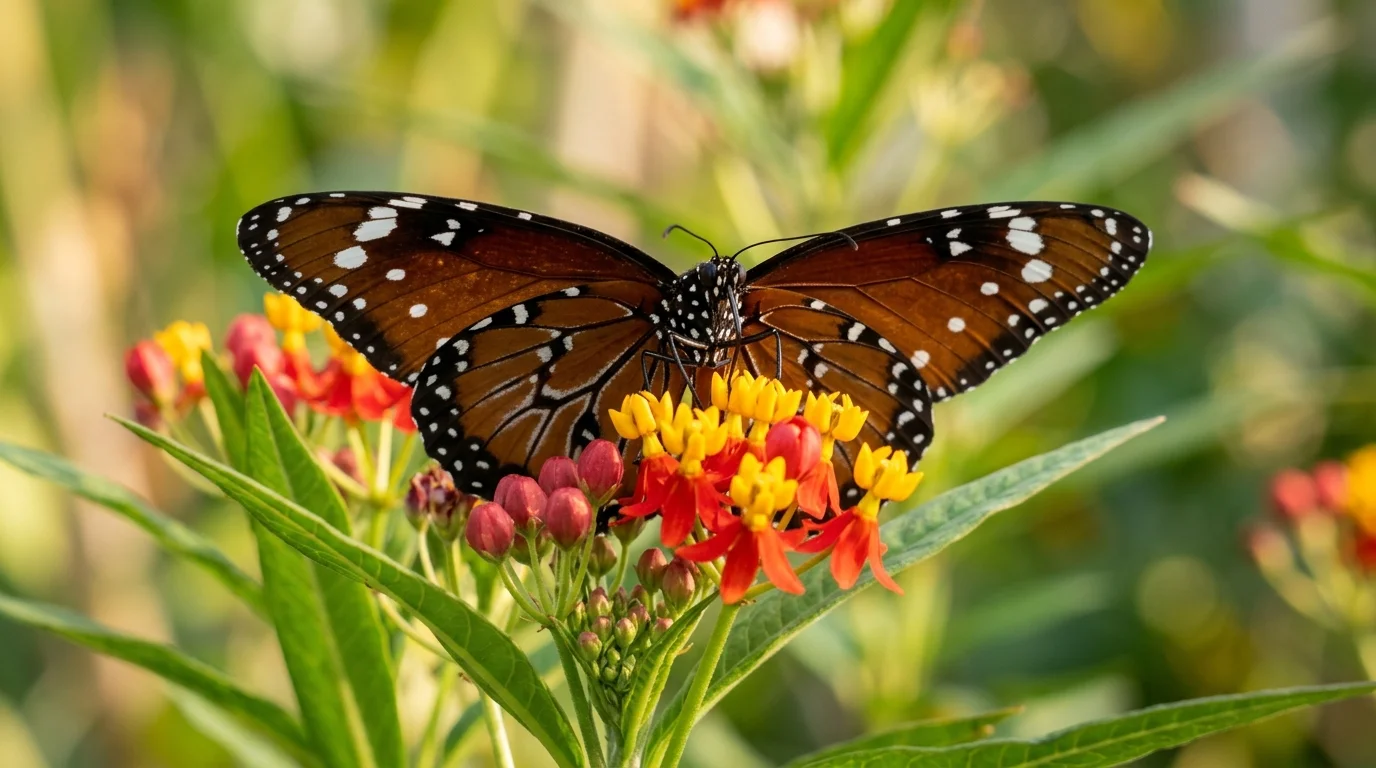
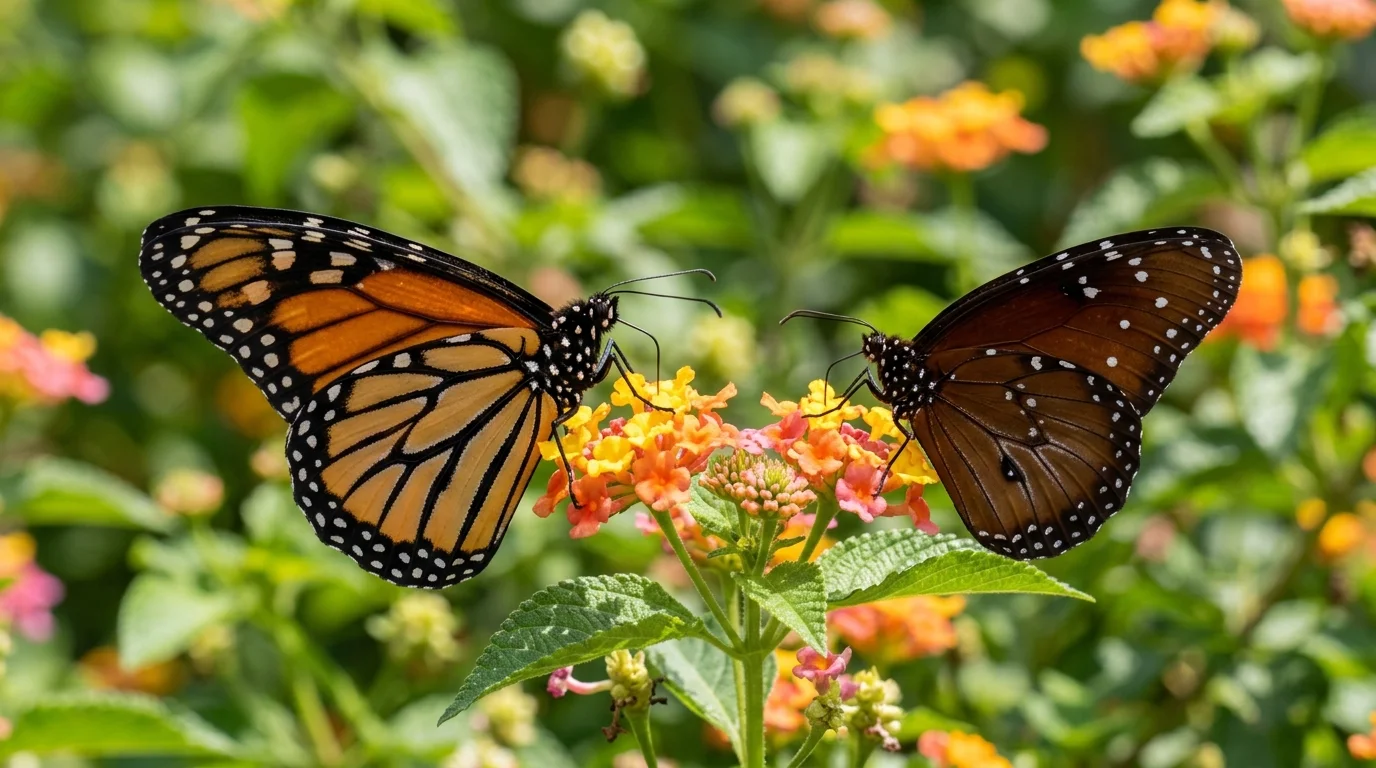
- Queen butterflies are darker chestnut-brown with white spots scattered across the forewings, while monarchs are brighter orange with bold black vein lines – this vein pattern difference is the single fastest way to tell them apart.
- Queens range across the southern US from Florida to California, through Mexico and Central America, and are year-round residents in most of their territory rather than long-distance migrants.
- Like monarchs, queen caterpillars feed on milkweed and retain toxic cardenolides into adulthood, making both species unpalatable to birds – this shared toxicity creates a textbook case of Mullerian mimicry.
- Queen butterflies produce multiple generations per year in warm climates, breeding nearly continuously in southern Texas and Florida where freezes are rare.
How to Tell a Queen Butterfly from a Monarch
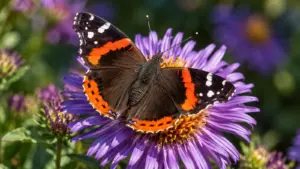
This is the question that comes up more than any other with queens, and for good reason. At a distance, especially in flight, queens and monarchs can look similar enough to cause real confusion. Both are medium-to-large orange-brown butterflies that visit the same flowers and often fly in the same habitats across the southern US. But side by side, the differences are clear.
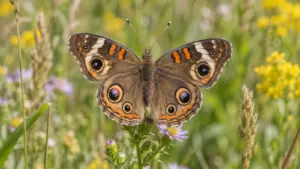
The most obvious difference is the wing veining. Monarchs have thick black veins running across bright orange wings, creating a stained-glass window pattern that’s visible from ten feet away. Queens lack this. Their wings are a uniform dark chestnut-brown to mahogany color without prominent vein outlines. Instead, queens have scattered white spots across the dorsal (upper) forewing surface, something monarchs don’t show on top.
Size is another reliable clue. Queens average a wingspan of 2.8 to 3.3 inches, while monarchs run 3.5 to 4.0 inches. That half-inch difference is noticeable in the field, especially when you see both species at the same flower patch. Queens also have a slightly faster, more erratic wingbeat compared to the monarch’s characteristic slow, gliding flight.
The underside of the hindwing seals the identification. Monarchs show the same bold black-veined orange pattern below as above. Queens show a warm brown ground color with black veining that’s thinner and less contrasting, plus white spots along the margins and scattered across the surface. I’ve found that flipping mentally to “does this butterfly have bold black veins or not?” answers the monarch-versus-queen question correctly about 95% of the time. For a broader look at species that share this resemblance, there’s a useful comparison at butterflies that look like monarchs.
Range and Habitat of the Queen Butterfly
Queens are a warm-climate species. In the United States, they’re resident across a southern belt running from Florida through the Gulf Coast states, across Texas, New Mexico, Arizona, and into southern California. They’re common in southern Texas year-round and reach their highest densities in the Rio Grande Valley, where milkweed grows through most of the year.
South of the border, queens range through most of Mexico and Central America, reaching into northern South America. A separate subspecies, Danaus gilippus berenice, occupies the Caribbean and southern Florida. The species does show up occasionally as far north as Kansas, Nebraska, or even the Midwest during summer, but these northern sightings represent dispersing individuals rather than established breeding populations.
Habitat preferences lean toward open, sunny areas with milkweed: desert scrub, grasslands, roadsides, agricultural edges, and suburban gardens. In south Texas, I’ve seen queens nectaring in parking lot islands where tropical milkweed was planted as an ornamental. They’re adaptable butterflies that thrive anywhere their host plants grow, and they tolerate heat and aridity much better than monarchs do. While monarchs concentrate in moister habitats, queens are comfortable in the dry scrublands of the Sonoran Desert where afternoon temperatures push past 100 degrees.
Queen Butterfly Migration and Seasonal Movement
One of the biggest ecological differences between queens and monarchs is migration – or rather, the queen’s lack of it. Monarchs famously travel thousands of miles between their breeding grounds and overwintering sites in central Mexico. Queens do nothing of the sort.
Queens are largely sedentary. In southern Texas, Florida, and Mexico, they’re present and breeding year-round. In the northern edges of their range – places like central Texas, the Oklahoma panhandle, or inland Southern California – populations may shift southward or to lower elevations during winter cold snaps. But these movements are short-distance, irregular, and driven by weather rather than an internal migratory program.
Researchers at the University of Florida have documented seasonal abundance changes in queen populations that suggest some north-south movement, with numbers peaking in northern parts of the range during late summer and fall. This looks superficially like migration, but tracking data shows it’s more accurately described as range expansion during favorable conditions followed by die-back during winter freezes. The butterflies that show up in Kansas in August probably didn’t fly there from Mexico with a predetermined destination – they drifted northward through successive generations as milkweed became available.
This difference from monarchs connects directly to the conservation challenges facing monarch populations. Monarchs depend on specific overwintering sites and an intact migratory corridor. Queens, by staying put in warm areas year-round, avoid those vulnerabilities entirely.
Host Plants and the Life Cycle
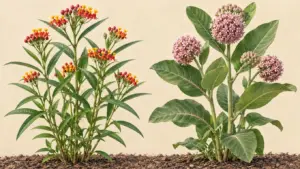
Queen caterpillars feed on milkweed, just like monarch caterpillars. The primary host plants include tropical milkweed (Asclepias curassavica), which is the dominant host across much of the queen’s range, along with native species like antelope horns (Asclepias asperula), zizotes milkweed (Asclepias oenotheroides), and climbing milkweed (Funastrum cynanchoides). In desert habitats, queens also use rush milkweed (Asclepias subulata) and other arid-adapted Asclepiad species that monarchs rarely touch.
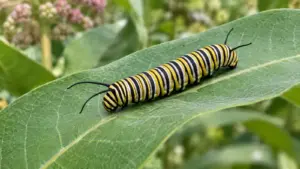
The life cycle follows the standard four-stage pattern. Females lay single pale green eggs on the undersides of milkweed leaves. The eggs hatch in 3 to 5 days. The caterpillars are banded in black, white, and yellow – similar to monarch caterpillars but with an extra pair of fleshy filaments. Monarch caterpillars have two pairs of black filaments (one at each end), while queen caterpillars have three pairs. That third pair, located in the middle of the body, is the quickest way to separate the two as larvae.
Caterpillars feed for about two weeks before pupating. The chrysalis is pale green with gold spots, very similar to a monarch chrysalis but slightly smaller and often a bit more rounded in shape. Adults emerge after 7 to 12 days depending on temperature. The entire egg-to-adult cycle takes roughly 4 to 6 weeks, and in frost-free areas, queens can cycle through six or more generations per year. Their adult lifespan averages about 2 to 4 weeks, though winter-generation adults in subtropical areas may survive longer as breeding slows during the cooler months.
All those milkweed meals serve a defensive purpose. Queen caterpillars sequester cardenolide glycosides from the milkweed sap, storing these bitter, toxic compounds in their bodies through pupation and into adulthood. A bird that bites into a queen butterfly gets a mouthful of chemicals that trigger nausea and vomiting. One bad experience is usually enough to teach a predator to leave queen butterflies alone.
Mullerian Mimicry with Monarchs
The queen-monarch resemblance isn’t an accident, and it isn’t the kind of mimicry where a harmless species copies a toxic one (that’s Batesian mimicry). Both queens and monarchs are genuinely toxic. Both feed on milkweed as larvae. Both accumulate cardenolides. When two unpalatable species evolve to look similar, scientists call it Mullerian mimicry, named after the German naturalist Fritz Muller who first described the principle in 1878.
The logic is straightforward. A predator needs to learn which prey to avoid by having a bad experience. If two toxic species look different, the predator has to sample each one separately – meaning both species lose some individuals to “education.” If the two species look alike, a predator that tries one automatically avoids both. The cost of educating predators gets shared, and fewer individuals of either species get eaten during the learning process.
Research published in the journal Nature has confirmed that birds generalize their avoidance across the queen-monarch complex. Blue jays trained to avoid monarchs also refused queens, and vice versa. The shared warning pattern – brownish-orange wings with dark borders and white spots – works as a unified signal across both species.
There’s a third player in this mimicry ring too. The viceroy butterfly (Limenitis archippus), once considered a Batesian mimic of the monarch, has been shown to be mildly unpalatable itself, making the monarch-queen-viceroy complex a three-way Mullerian mimicry system. In Florida and the Gulf Coast where all three species overlap, they form a reinforcing warning pattern that benefits every member of the group.
Queen butterfly toxicity does vary depending on the milkweed species the caterpillar ate. Larvae raised on Asclepias curassavica, which contains high concentrations of cardenolides, produce more toxic adults than those raised on lower-toxicity milkweed species. Some individual queens may be only weakly toxic, basically freeloading on the bad reputation built by their more toxic relatives. This variation adds a Batesian mimicry element within what is otherwise a Mullerian system – a complexity that researchers at the University of Florida have studied in depth.
Frequently Asked Questions
Are queen butterflies rare?
No. Queen butterflies are common throughout their range, particularly in southern Texas, Arizona, and Florida. They’re one of the most frequently encountered butterflies in the Rio Grande Valley and the Sonoran Desert region. Because they breed year-round in frost-free areas and use widely available milkweed species, their populations remain stable. They don’t face the same decline pressures as monarchs because they don’t depend on a single migratory route or specific overwintering sites.
Can queen butterflies and monarchs interbreed?
Hybrids between queens and monarchs have been produced in laboratory settings, but they are extremely rare in the wild. The two species have different courtship behaviors and pheromone systems that normally prevent cross-mating. Lab-produced hybrids tend to be sterile or have reduced fertility, which is typical when closely related but distinct species are crossed. In areas where both species are abundant, like south Texas milkweed patches, they coexist without interbreeding.
Do queen butterflies visit the same flowers as monarchs?
Yes, there’s significant overlap in nectar preferences. Queens visit lantana, milkweed flowers, shepherd’s needle, mistflower, and various composites. In desert areas, queens also nectar on desert marigold, brittlebush, and mesquite flowers that monarchs rarely encounter because monarchs don’t inhabit those arid environments. Both species are generalist nectar feeders that will visit whatever is blooming.
How do queen butterfly caterpillars differ from monarch caterpillars?
Both caterpillars have black, white, and yellow banding, but the number of fleshy filament pairs is the key difference. Monarch caterpillars have two pairs of filaments – one near the head and one near the rear. Queen caterpillars have three pairs, with an additional set in the mid-body area. Queen caterpillars also tend to be slightly smaller at maturity and may show more white in their banding pattern compared to monarchs.
What is the queen butterfly’s wingspan compared to the monarch?
Queens are noticeably smaller. A typical queen spans 2.8 to 3.3 inches (7 to 8.4 cm), while monarchs span 3.5 to 4.0 inches (8.9 to 10.2 cm). In the field, this size difference is easiest to notice when both species are feeding at the same flower cluster. The queen looks compact next to the monarch’s broader, more expansive wings.
Can anything eat a queen butterfly if it’s toxic?
Some predators have evolved ways around the toxicity. Black-backed orioles and black-headed grosbeaks eat monarchs and queens at overwintering sites in Mexico, selectively feeding on body parts with lower cardenolide concentrations. Certain parasitic flies and wasps attack queen caterpillars and pupae without being affected by the toxins. Chinese mantids and crab spiders also take adults regardless of their chemical defenses. The toxicity reduces predation significantly but doesn’t eliminate it.