



Skipper Butterfly Identification: A Field Guide
Skipper butterfly identification trips up even experienced butterfly watchers. These small, fast-flying insects sit in an odd spot on the family tree – technically butterflies, but so different from the showy swallowtails and brushfoots that many people assume they’re moths. With roughly 250 species in North America alone, the family Hesperiidae makes up a huge chunk of what you’ll encounter on any summer walk through a meadow or garden.
Skippers earned their common name honestly. Watch one for thirty seconds and you’ll see it: short, explosive bursts of flight that look more like skipping across the air than the lazy floating of a monarch or a painted lady. That flight style, combined with their compact bodies and muted colors, makes them easy to dismiss. But once you start paying attention, skippers become some of the most rewarding butterflies to identify.
Key Takeaways
- Skippers belong to the family Hesperiidae and are true butterflies within the superfamily Papilionoidea, though their stocky bodies, oversized heads, and hooked antennae set them apart from all other butterfly families.
- North American skippers fall into three main subfamilies: spread-wing skippers (Pyrginae), grass skippers (Hesperiinae), and giant skippers (Megathyminae), each with distinct resting postures and body shapes that help with quick field sorting.
- Wing position at rest is one of the fastest identification shortcuts – spread-wings hold their wings flat, grass skippers often use the “jet plane” position with forewings angled up and hindwings held flat, and giant skippers fold their wings tightly.
- Four common species – the silver-spotted skipper, fiery skipper, common checkered-skipper, and long-tailed skipper – give you a solid starting framework for skipper butterfly identification across most of the US.
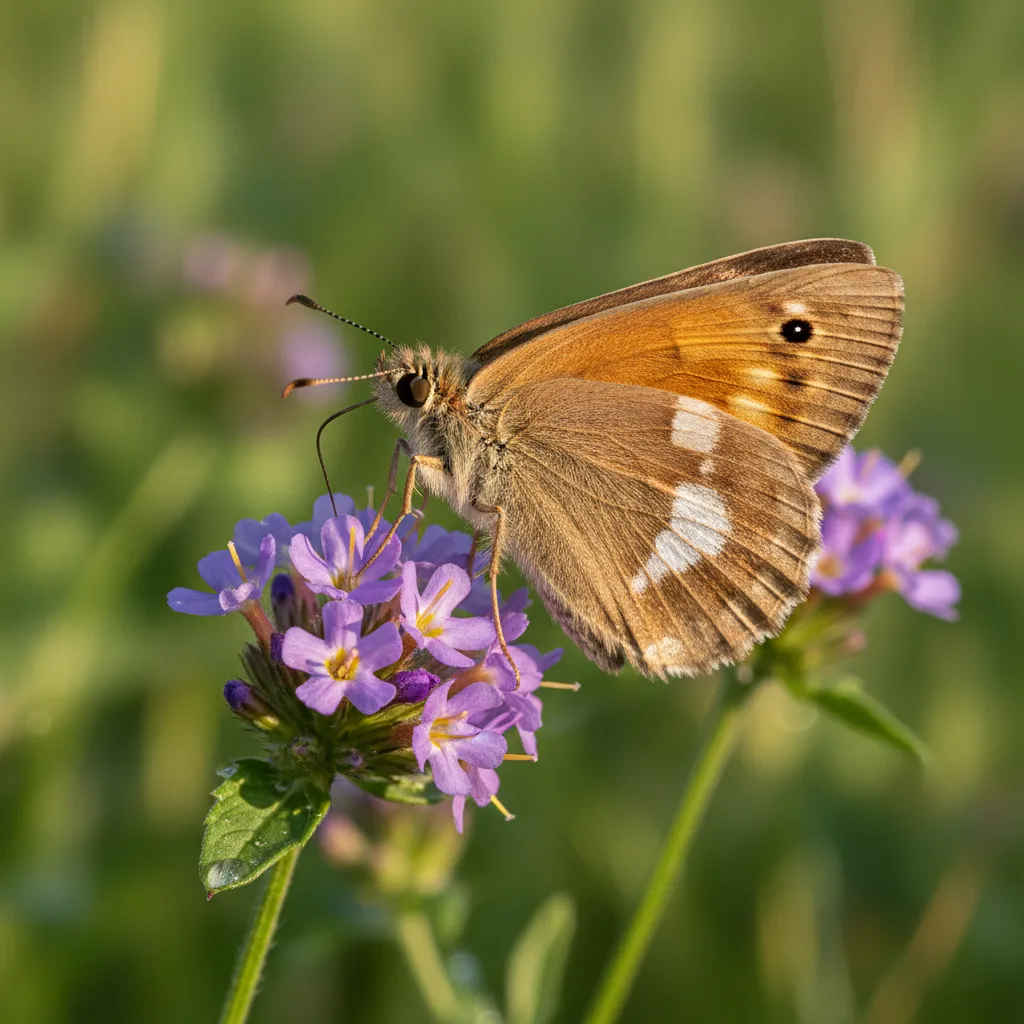
What Makes a Skipper a Skipper
Before sorting through individual species, it helps to know what puts a butterfly into the skipper family in the first place. Skippers share a set of physical traits that, taken together, separate them from every other type of butterfly you’ll find in the field.
The body is the first thing you’ll notice. Skippers are thick through the thorax, with a muscular build that supports their rapid, powerful flight. Their heads are unusually wide – often as broad as or broader than the thorax. That wide head houses massive flight muscles and oversized compound eyes, both adaptations for a life spent making fast, agile maneuvers through dense vegetation.
Then there are the antennae. Most butterflies have antennae that end in a simple club shape. Skipper antennae also have a club, but the tip curves backward into a hook called a nudum. This hooked tip is so consistent across the family that it’s almost diagnostic on its own. If you can get a good look at the antenna tip through binoculars or a photo, you can confirm “skipper” before worrying about anything else.
Wing shape rounds out the picture. Skipper wings tend to be proportionally smaller relative to body size compared to other butterflies. This gives them that characteristic buzzy, darting flight – more moth-like than butterfly-like to the untrained eye. According to the Butterflies and Moths of North America database, Hesperiidae contains over 3,500 species worldwide, making it the second-largest butterfly family on the planet.
The Three Skipper Subfamilies
Once you’ve confirmed you’re looking at a skipper, the next step in skipper butterfly identification is figuring out which of the three main North American subfamilies it belongs to. Each group has a different gestalt – a combination of size, shape, color palette, and resting posture that you’ll start recognizing with practice.
Spread-wing skippers (Pyrginae) rest with their wings spread flat, like most conventional butterflies. Many species are patterned in black, brown, gray, and white – checks, bands, and mottled patches rather than solid blocks of color. The checkered-skippers, duskywings, and cloudywings all fall here. This is the most diverse skipper subfamily in North America, and many species can be difficult to tell apart without close examination of wing pattern details.
Grass skippers (Hesperiinae) are typically smaller and tend toward orange, tawny, and brown tones. Their signature resting posture is the “jet plane” position: forewings raised at a steep angle while hindwings stay flat, creating a V-shaped profile when viewed head-on. Their caterpillars feed almost exclusively on grasses and sedges. This is the group that gives people the most trouble, because many species are small, orange-brown, and superficially very similar.
Giant skippers (Megathyminae) are the least commonly encountered group. These are large, robust skippers – some approach the size of small swallowtails – with rapid, direct flight. Their caterpillars bore into the roots and stems of yuccas and agaves, which limits their range primarily to the American Southwest and adjacent regions. If you’re in Arizona, New Mexico, or West Texas and see a skipper that seems unreasonably large, you may be looking at one of the Megathymus or Agathymus species.
Four Common Skippers You Should Know
Building a mental library of a few widespread, frequently encountered species is the fastest way to improve your skipper butterfly identification skills. These four species cover different subfamilies and regions, and knowing them gives you strong reference points for comparison when something unfamiliar shows up.
Silver-spotted skipper (Epargyreus clarus): This is the gateway species for skipper identification. It’s large for a skipper, common across the entire continental US, and carries a field mark that jumps out from across a garden – a big silver-white patch on the hindwing underside. No other common North American skipper has anything like it. The upper wings are dark brown with golden-orange forewing spots. They nectar eagerly at butterfly bush, zinnias, and joe-pye weed.
Fiery skipper (Hylephila phyleus): A grass skipper common in lawns and open grassy areas throughout the southern US, reaching into the north during late summer dispersal flights. Males are bright orange above with a jagged black stigma (a scent patch) on the forewing. Females are duskier brown with scattered orange spots. The hindwing underside on both sexes shows small dark spots scattered on an orange (male) or olive-brown (female) background. Their short antennae and strong association with turfgrass lawns make them one of the more recognizable grass skippers.
Common checkered-skipper (Burnsius communis): A spread-wing skipper found across most of the US in open, disturbed habitats – roadsides, vacant lots, garden edges. The pattern is a checkerboard of blue-gray and white on a dark base, with a fuzzy blue-gray body. Males are paler and more strongly patterned than females. These low-flying skippers often bask on bare ground with wings spread flat. Residents of California and the West will run into the very similar white checkered-skipper, which requires close wing pattern comparison to separate.
Long-tailed skipper (Urbanus proteus): Immediately identifiable by the long tail extensions on the hindwings – no other common US skipper has tails like these. The body and wing bases are covered in iridescent blue-green scales that flash in sunlight. This tropical species is resident in the Deep South and strays northward in summer. Gulf Coast gardeners know it as the “bean leaf roller” because caterpillars roll themselves up in bean leaves.

Field Identification Tips That Actually Work
Identifying skippers in the field is different from identifying swallowtails or brushfoots. The colors are subtler, the species are smaller, and many of them won’t sit still for long. Here are the approaches that produce the best results.
Photograph first, identify later. Skippers are one group where field identification through binoculars often isn’t enough for species-level ID. A few clear photos – especially of the hindwing underside – will let you zoom in on the small spots, streaks, and color tones that separate similar species. The hindwing underside is more useful than the upper surface for most grass skippers. Get in the habit of circling to the side or below a perched skipper to capture that angle.
Pay attention to size and flight behavior. Within a single meadow, you might see grass skippers in two or four distinct size classes. The smaller ones zip low through the grass; the bigger ones tend to perch higher and fly more aggressively. Size alone won’t give you a species name, but it narrows the candidates quickly. The North American Butterfly Association has found that flight period timing is another strong filter – many similar-looking grass skippers fly at different times of year.
Check the stigma on male grass skippers. Males in Hesperiinae often carry a forewing stigma – a dark patch of specialized scent scales. The shape and position of this stigma varies between species and is one of the most reliable characters for separating similar orange-brown grass skippers.
Learn your local duskywings as a set. The Erynnis genus contains roughly a dozen North American species of brown spread-wing skippers that are the hardest group to sort out. Study which species occur in your region and learn the two or four features that separate them locally. The Butterflies of America project can help narrow candidates by range and flight period.
Don’t ignore habitat. A skipper sitting in the middle of a salt marsh is drawing from a very different species pool than one nectaring in a mountain meadow at 8,000 feet. Habitat narrows your options before you even look at the wings. Grass skippers in particular tend to be tightly linked to specific grassland types, and certain species are strong indicators of habitat quality.
Frequently Asked Questions
Are skippers actually butterflies or moths?
Skippers are true butterflies. They belong to the superfamily Papilionoidea along with swallowtails, whites, brushfoots, and all other butterfly families. Older classification systems sometimes placed skippers in their own superfamily between moths and butterflies, but modern molecular studies have confirmed they sit firmly within the butterfly clade. Their stocky bodies and fast flight give them a moth-like appearance, but the clubbed antennae and daytime activity are pure butterfly traits.
How many skipper species are in North America?
Approximately 275 skipper species have been recorded in North America north of Mexico, with additional strays from Mexico and the Caribbean turning up in southern border states. That makes Hesperiidae the most species-rich butterfly family on the continent, surpassing even the brushfoots (Nymphalidae). The highest diversity is in the southern US, particularly Texas, Arizona, and Florida, where tropical species reach the northern edges of their ranges.
Why do grass skippers hold their wings in that unusual position?
The “jet plane” posture, with forewings raised and hindwings flat, is thought to serve thermoregulation. By angling the forewings, a grass skipper can expose dark wing bases to sunlight for warming while keeping reflective hindwing undersides positioned to radiate excess heat. The posture may also help with quick takeoff by keeping flight muscles pre-loaded. On cool mornings, many grass skippers will bask with wings fully spread instead.
What do skipper caterpillars look like?
Most skipper caterpillars are smooth-bodied, cylindrical, and greenish, with a notably large head that is often a different color from the body. Many species build leaf shelters by folding host plant leaves together with silk. Grass skipper larvae live at the bases of grass clumps in silken tubes, and giant skipper larvae bore into yucca stems and roots. Compared to the showy caterpillars of swallowtails and monarchs, skipper larvae are well-hidden and seldom noticed.
What’s the best time of year to find skippers?
Skipper diversity peaks in late summer and early fall across most of the US, roughly July through September. That’s when the highest number of species fly simultaneously, including residents and late-season colonizers that have dispersed northward. Spring fliers like Juvenal’s duskywing emerge as early as April. In southern Texas and Florida, some species fly year-round, and midwinter butterfly counts there often record a dozen or more skipper species.
Can I attract skippers to my garden?
Absolutely. Skippers are among the most frequent garden visitors, partly because they’re not picky about flower color or shape. Low-growing nectar plants like lantana, verbena, and ageratum are especially attractive to the smaller grass skippers. Taller plants like butterfly bush, ironweed, and blazing star draw the larger species like silver-spotted skippers and long-tailed skippers. Leaving a patch of native grasses unmowed gives grass skipper females a place to lay eggs, which can sustain a local breeding population right in your yard.