


Spicebush Swallowtail Butterfly | ID, Range & Garden Tips
The spicebush swallowtail butterfly (Papilio troilus) is one of eastern North America’s most recognizable swallowtails, and for good reason. Those blue-green hindwings set against jet-black forewings make it stand out from every other dark swallowtail in the garden. I see them regularly from late spring through early fall in my yard, almost always cruising near their namesake host plant.
If you’ve ever spotted a large black butterfly with a sweep of blue or teal across the lower wings and a row of orange spots tucked underneath, you were likely watching a spicebush swallowtail. They’re widespread, fairly common, and one of the easier swallowtails to attract to a home garden once you know what they need.
Key Takeaways
- The spicebush swallowtail butterfly ranges across the eastern United States and into southern Ontario, flying from April through October depending on latitude.
- Males show blue hindwing coloring while females lean blue-green, and both sexes carry distinctive orange spots on the hindwing underside.
- Caterpillars feed on spicebush, sassafras, and tulip tree leaves and use large fake eyespots to mimic green snakes as a defense against birds.
- Planting native spicebush (Lindera benzoin) is the single best way to support this species in your yard.
How to Identify a Spicebush Swallowtail
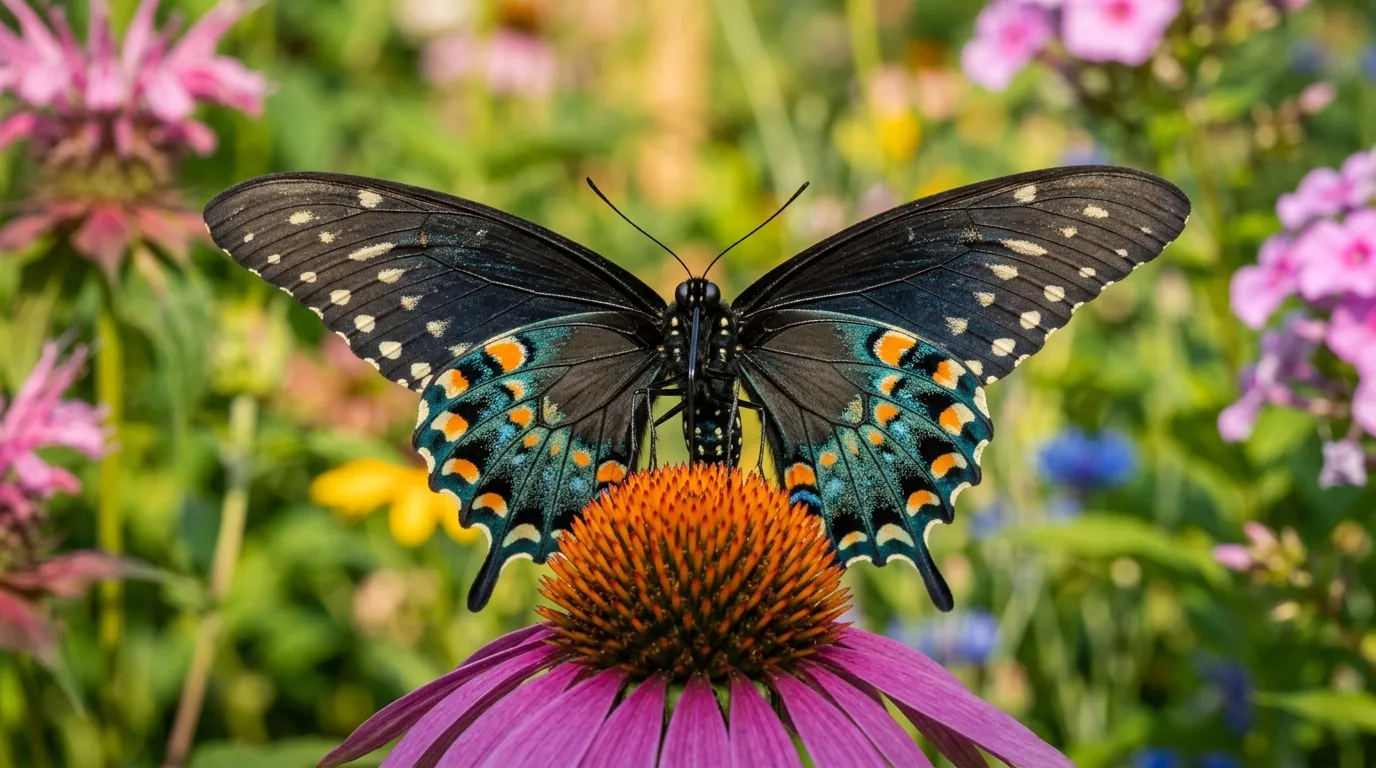
Spicebush swallowtails have a wingspan of 3.5 to 4.5 inches. The upper side of both wings is primarily black, but the hindwings carry a wide wash of color that extends across most of the wing surface. On males, that color is a true blue. On females, it shifts toward a dusty blue-green or teal. Both sexes display a row of pale, moon-shaped spots along the outer margin of the hindwings.
Flip the wings over and identification gets even easier. The hindwing underside shows two rows of bright orange spots against a dark background. Those orange spots are a reliable field mark that separates this species from the pipevine swallowtail, which has a single row of orange spots but with a much more vivid blue iridescence on top.
The forewing carries a row of white or cream dots along the margin. A single tail extends from each hindwing, shaped like a narrow spoon – a classic swallowtail feature. In flight, this species tends to move with a steady, sailing pattern, pumping its wings less frantically than some of the smaller swallowtails. You can often spot one coasting along a woodland edge before it drops down to nectar on a flower.
Male vs Female Spicebush Swallowtails
Telling males from females comes down to color once you train your eye. Males have a cooler, true blue sheen on the hindwings. Females lean warmer, showing that distinctive blue-green or teal wash instead. The difference is easiest to see in direct sunlight when the wings are open flat.
Females also tend to be slightly larger on average. Their bodies are a bit thicker, which makes sense given that they’re carrying eggs. Behaviorally, you’ll notice males patrolling along edges of wooded areas and streams, looking for mates. They follow a regular flight path and circle back to the same spots repeatedly.
Females spend more of their time close to host plants, searching for suitable leaves to lay eggs on. If you have spicebush or sassafras in your yard and notice a large black butterfly slowly circling the plant, landing briefly on leaves, that’s almost certainly a female checking foliage quality before depositing a single egg on the underside of a leaf. For a deeper look at this species and its behavior, check out our full spicebush swallowtail profile.
Range and Habitat
The spicebush swallowtail is strictly an eastern species. Its range stretches from southern Ontario and the Great Lakes region south to Florida, and west to about the eastern edge of the Great Plains. You’ll find them in every state east of a rough line running from Minnesota down through eastern Texas. They’re absent from the western half of the continent entirely.
Within that range, they favor deciduous and mixed woodlands – the same habitats where spicebush and sassafras grow naturally. Woodland edges, stream corridors, roadside ditches bordered by trees, and suburban yards with mature landscaping all attract them. I’ve noticed they tend to avoid wide-open areas with no tree cover, preferring to stay near the dappled shade of the forest edge.
Flight season varies with geography. In the Deep South, adults can appear as early as March and fly through late October, producing two or sometimes three broods per year. Farther north in New England and the upper Midwest, you might see only one generation, with adults on the wing from June into August. The species overwinters as a chrysalis, tucked into leaf litter or attached to a low branch. Like many swallowtails, their adult lifespan averages about two weeks once they emerge.
Host Plants and Caterpillar Stages
The spicebush swallowtail gets its common name directly from its primary host plant: spicebush (Lindera benzoin). This native shrub grows in the understory of eastern forests, thriving in moist, partially shaded areas. Females strongly prefer it for egg-laying, and the caterpillars do well on the aromatic leaves.
Sassafras (Sassafras albidum) is the second most important host. In some parts of the range where spicebush is scarce, sassafras becomes the primary food plant. Tulip tree (Liriodendron tulipifera) also serves as a host, though it’s used less frequently. All three plants belong to the laurel family (Lauraceae), so the caterpillars are keyed into a specific set of leaf chemistry. For a complete breakdown of which plants work best and where to source them, see our spicebush swallowtail host plants guide.
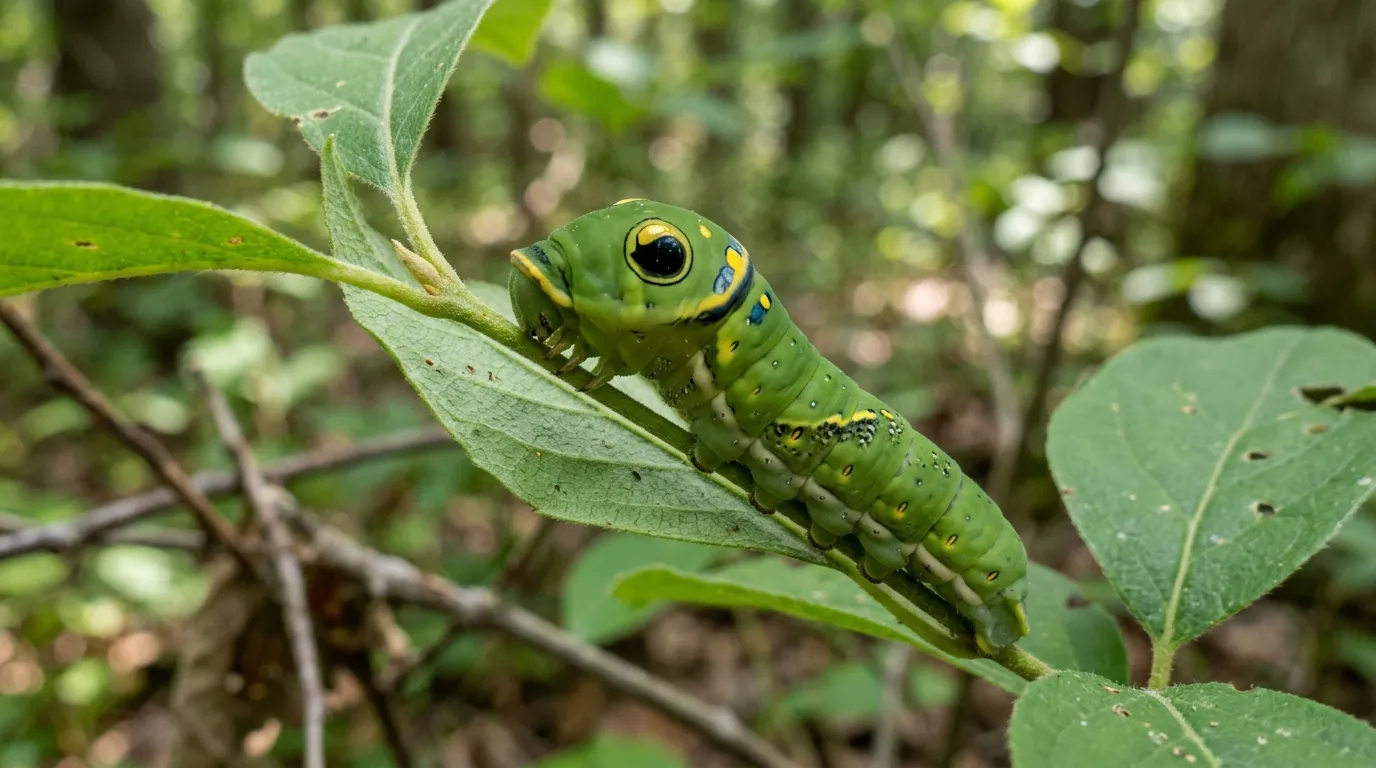
The caterpillars themselves are some of the most interesting in North America. Early instars are brown and white, mimicking bird droppings – a common camouflage strategy. But by the fourth and fifth instars, they transform into bright green or sometimes orange larvae with two enormous fake eyespots near the head. Those eyespots, combined with a swollen thorax, give the caterpillar a convincing resemblance to a small green snake. When disturbed, they can also extend a forked, orange organ called an osmeterium from behind their head, releasing a foul smell. Birds tend to leave them alone.
One interesting behavior: older caterpillars fold a leaf around themselves using silk, creating a shelter where they rest during the day and feed at night. If you’re searching for them on your spicebush, look for leaves that are folded in half lengthwise with silk holding the edges together. Peel one open gently and you’ll often find a plump green caterpillar with those oversized eyespots staring back at you. We’ve documented each growth stage in our spicebush swallowtail caterpillar growth guide.
How to Attract Spicebush Swallowtails to Your Garden
The single most effective step is planting native spicebush. A mature specimen can support multiple caterpillars per season, and females actively seek it out. Spicebush tolerates partial shade, prefers moist but well-drained soil, and grows well as an understory shrub in USDA zones 4 through 9. According to the National Wildlife Federation’s native plant database, Lindera benzoin supports multiple Lepidoptera species beyond just this swallowtail.
If your yard is too sunny or dry for spicebush, sassafras is a solid alternative. It’s a small tree that tolerates a wider range of soil conditions, including drier and sandier sites. Sassafras does want full sun to part shade, so it fits into more landscape situations than spicebush does. Just keep in mind that sassafras spreads by root suckers, so give it room or be prepared to manage the offshoots.
For nectar sources, spicebush swallowtails visit a wide range of flowers. Some of the best performers in my garden have been bee balm, joe-pye weed, ironweed, lantana, and butterfly bush. They’ll also visit zinnias and phlox reliably. Aim for a mix of blooming times so there’s always something available from spring through fall.
Avoid broad-spectrum insecticide use near host plants and nectar sources. Even Bt (Bacillus thuringiensis) – which is often marketed as a “safe” caterpillar control – will kill swallowtail larvae just as effectively as it kills pest caterpillars. The Xerces Society offers guidance on pollinator-safe pest management if you need to control other insects in the same area.
One more tip: leave leaf litter in place under your host plants through winter. Spicebush swallowtail chrysalises overwinter in and among fallen leaves on the ground. Raking or blowing that litter away in fall can destroy the next generation before it ever gets a chance to emerge. A research note published by the North American Butterfly Association emphasizes the importance of undisturbed leaf litter for overwintering Lepidoptera.
Frequently Asked Questions
Are spicebush swallowtails rare?
No, they’re considered common throughout most of their eastern range. Populations remain stable in areas with intact woodland habitat. They’re less abundant in heavily urbanized or agricultural landscapes where host plants have been cleared, but they’re not listed as threatened or endangered in any state.
What is the difference between a spicebush swallowtail and a pipevine swallowtail?
Both are dark swallowtails with blue hindwings, but they differ in several ways. Pipevine swallowtails have a more intense, iridescent blue on the upper hindwing and only a single row of orange spots underneath. Spicebush swallowtails have a subtler blue or blue-green wash and carry two rows of orange spots on the hindwing underside. Their caterpillars look completely different too – pipevine caterpillars are dark with orange spines, while spicebush caterpillars are green with eyespots.
Do spicebush swallowtail caterpillars really look like snakes?
Yes, the resemblance is surprisingly convincing. Late-instar caterpillars have a swollen thorax and two large eyespots that create the illusion of a snake’s head. When threatened, they rear up and extend an orange, forked osmeterium that mimics a snake’s tongue. The effect is strong enough to startle birds and small predators. Studies have shown this mimicry significantly reduces predation rates.
Can spicebush swallowtails survive without spicebush?
Yes, because they also use sassafras and tulip tree as host plants. In areas where spicebush doesn’t grow or has been removed, sassafras often fills the role as the primary caterpillar food source. That said, spicebush is their preferred host where it’s available, and gardens with it tend to attract more egg-laying females than those relying on sassafras alone.
How many broods do spicebush swallowtails have per year?
It depends on location. In the southern part of their range (the Gulf states and Southeast), they typically produce two to three broods from March through October. In the northern parts – New England, the upper Midwest, and southern Canada – they usually manage just one brood, with adults flying from June into August. The last brood of the season produces chrysalises that overwinter and emerge the following spring.
Where do spicebush swallowtails lay their eggs?
Females lay single eggs on the underside of host plant leaves, primarily spicebush and sassafras. They’re selective about which leaves they choose, often testing several before committing. Each egg is round, pale green, and placed individually rather than in clusters. A single female may lay eggs on multiple plants over the course of her adult life.