


Where Are Butterflies Found? A Guide to Global Distribution
Where are butterflies found? Pretty much everywhere on Earth except Antarctica and the highest arctic tundra. Around 18,500 species are spread across six continents, ranging from sea-level mangrove swamps in Indonesia to alpine meadows above 18,000 feet in the Andes. The distribution isn’t even, though – tropical rainforests hold the vast majority of species, while temperate and polar regions support a much smaller but often dense population of specialized species. Understanding where butterflies live tells you a lot about climate, plant diversity, and the reasons some places are overrun with butterflies while others have almost none.
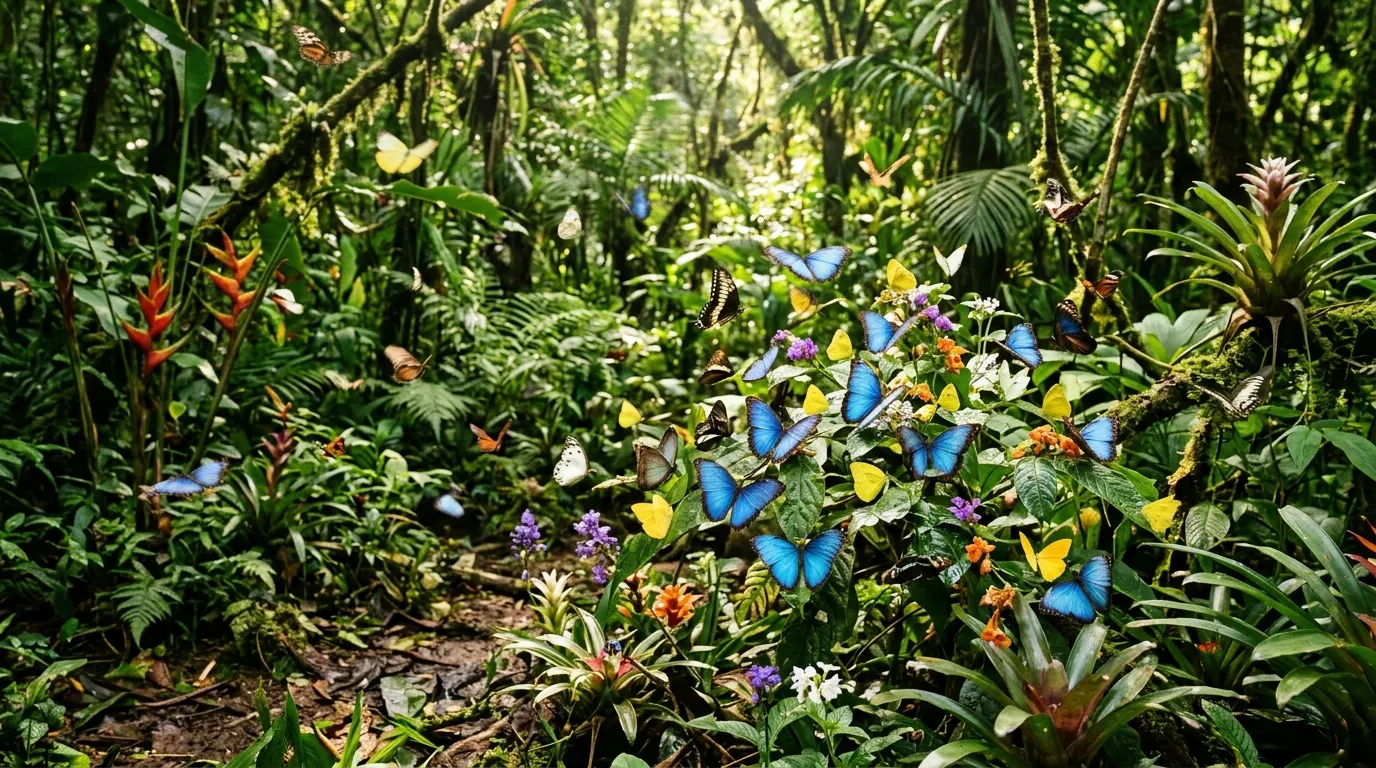
I once stood in a clearing in the Peruvian Amazon and counted more than 40 butterfly species in under an hour without moving. Morphos, heliconians, owl butterflies, and dozens of tiny skippers I couldn’t identify kept landing on wet sand and damp clothing. A week later I was hiking in Scotland and saw three butterflies the whole day. Both experiences were memorable, but they show how dramatically butterfly abundance shifts across latitudes. The tropics are where the diversity lives, and the farther you get from the equator, the fewer species you encounter.
Key Takeaways
- Butterflies live on every continent except Antarctica, with approximately 18,500 described species worldwide. The Amazon Basin alone holds over 7,000 species, making it the most diverse butterfly region on the planet.
- Southeast Asia, Central and South America, and tropical Africa contain roughly 90 percent of global butterfly species. Temperate Europe and North America host around 700 species each, while the Arctic supports fewer than 40.
- Altitude range runs from sea level to over 18,000 feet, with specialized high-elevation species like the Apollo butterflies in the Alps and the Andean satyrs evolving to survive thin air and freezing nights.
- Butterflies thrive where host plants, nectar sources, and sunlight overlap. Rainforest edges, alpine meadows, savanna woodlands, and garden landscapes all support large populations, while dense closed-canopy forest and true deserts support fewer.
The Amazon and South America: The Butterfly Capital of the World
If you want to see the most butterflies in the shortest time, go to the Amazon. The Amazon Basin supports more butterfly species than any other region on Earth, with estimates ranging from 7,000 to 7,500 described species and probably hundreds more still undocumented. Peru alone has over 4,000 recorded species – more than the entire continent of Africa. Ecuador, Colombia, Brazil, and Bolivia are similarly rich.
Several factors explain this concentration. Tropical rainforest provides year-round warmth, consistent rainfall, and an enormous variety of host plants. The Amazon contains an estimated 40,000 plant species, and since most butterflies specialize on one or a few plant families for their caterpillar stage, plant diversity drives butterfly diversity almost directly. The Smithsonian Tropical Research Institute has documented that a single hectare of Amazonian forest can contain more butterfly species than all of Canada.
Famous Amazonian groups include the iridescent blue morphos that flash through forest clearings, the clearwing butterflies with transparent wings, and the owl butterflies with huge false eyespots. Heliconians are particularly well-studied here because of their chemical defenses, mimicry rings, and complex breeding behaviors. If you spend time on a jungle trail after a rain, you’ll probably see mixed groups of yellow sulphurs gathered at puddles alongside bright red postman butterflies and black-and-white zebra longwings.
The Andes mountains running along the western edge of South America add another dimension. As elevation rises from lowland rainforest through cloud forest into paramo grasslands, the butterfly community shifts entirely every few thousand feet. Cloud forest butterflies tend to be smaller and darker, better at warming up in cool misty conditions. High-altitude species like the Andean satyrs live in windswept grasslands above tree line and have evolved dark coloring and fuzzy bodies to absorb and retain heat.
Southeast Asia: The Other Great Butterfly Region
Southeast Asia rivals the Amazon for butterfly diversity, with particularly high species counts in Indonesia, Malaysia, Thailand, Vietnam, and the Philippines. The island of Borneo alone has over 1,000 butterfly species, and New Guinea supports an estimated 800 species including some of the largest butterflies in the world. The Queen Alexandra’s birdwing of Papua New Guinea has a wingspan approaching 10 inches, making it the largest butterfly species anywhere.
The region’s geography explains a lot of its diversity. Thousands of islands separated by ocean have allowed populations to evolve in isolation, producing closely related species that differ from one island to the next. The combination of stable tropical climate, old rainforests, and this archipelago effect has created hotspots of endemism where dozens of species exist only on a single island or mountain range.
Birdwings are the iconic group of Southeast Asia and Australasia. Their massive size, slow flapping flight, and brilliant metallic greens and golds make them some of the most spectacular butterflies anywhere. They’re restricted almost entirely to this region because their caterpillars feed on Aristolochia vines that don’t grow elsewhere. Swallowtails in general reach peak diversity here, with species like the common Mormon and the great Mormon showing complex mimicry patterns where females look nothing like males.
Butterfly watchers often visit Malaysian national parks like Taman Negara, Indonesian sites on Sumatra and Sulawesi, and Thai reserves in the north near Chiang Mai. Many of the butterfly species you see in tropical conservatories around the world originated in Southeast Asia and are farmed in butterfly houses in the region for export.
Africa: Rainforests, Savannas, and Surprises
Africa has around 4,000 butterfly species, concentrated heavily in the Congo Basin and West African rainforests. The Democratic Republic of the Congo, Cameroon, Gabon, and Uganda hold most of the species-rich forest habitat. Unlike the Amazon, African rainforests have been more fragmented by ice ages and long-term climate shifts, which has shaped the distribution of species in unusual ways.
The giant African swallowtail and the African queen are among the most recognizable species. Charaxes butterflies – a group of fast-flying, fruit-feeding species with powerful wings and often spiny hindwings – reach their peak diversity in Africa, with around 180 species across the continent. They’re notoriously hard to photograph because they rarely stop moving and often feed high in the canopy.
African savannas support a different butterfly community adapted to seasonal dry periods. Acraeas and pierids (whites and sulphurs) are common in open grassland and woodland, where they feed on acacia flowers and grass-dependent host plants. Madagascar, though biogeographically separate from the African mainland, has around 300 butterfly species with a very high rate of endemism – meaning many species exist nowhere else on Earth.
South Africa’s Cape region, with its fynbos shrubland, holds a surprising number of specialized butterflies that depend on specific plants found nowhere else. The brenton blue is one of South Africa’s rarest butterflies, restricted to a few square miles of coastal habitat near the town of Brenton-on-Sea. It exemplifies how isolated pockets of unique vegetation can produce highly localized butterfly distributions.
Temperate Europe and North America
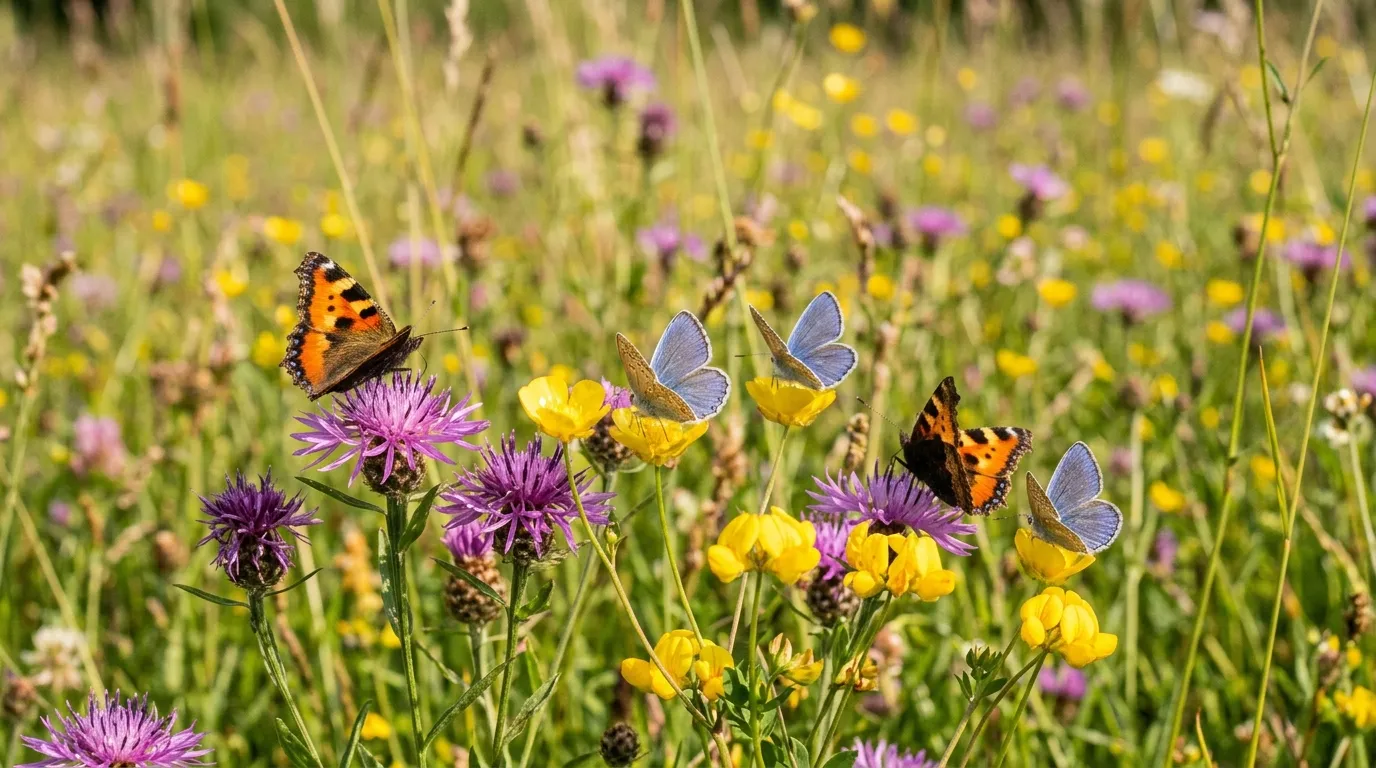
Temperate regions have far fewer butterfly species than the tropics, but they often have greater abundance per species and more accessible watching opportunities. Europe hosts around 480 butterfly species, with concentrations in southern regions like Spain, Italy, Greece, and the Balkans. The Alps, Pyrenees, and Carpathians support specialized mountain species that exist nowhere else.
North America has around 750 butterfly species north of Mexico. The richest areas are in the Southwest – particularly southern Arizona, southern Texas, and New Mexico – where tropical species from Mexico cross the border and mix with temperate species. The Chiricahua Mountains of Arizona alone host over 250 species because they sit at the convergence of Sonoran desert, Rocky Mountain, and Sierra Madre Occidental faunas. A single canyon there can produce more species in a weekend than most northern states in a year.
The UK has just under 60 resident butterfly species, which is low compared to mainland Europe but still includes some specialized rarities. Chalk grasslands in southern England support species like the Adonis blue and the silver-spotted skipper that depend on specific host plants growing only in alkaline soils. The rarest British butterflies are restricted to a handful of protected reserves where their host plants still grow.
Temperate butterflies have to deal with winter, which shapes their distribution and behavior in ways tropical species don’t face. Some migrate southward in autumn, others hibernate as adults, and many overwinter as eggs or chrysalises. The migration routes of temperate species like the monarch, painted lady, and red admiral connect temperate breeding grounds to subtropical overwintering sites each year.
The Polar Limits and Altitude Records
Butterflies reach farther north and higher in altitude than most people realize. In the Arctic, around 30 to 40 butterfly species survive above the Arctic Circle in Canada, Alaska, Scandinavia, and Siberia. The polar fritillaries and arctic blues complete their entire life cycles during a brief summer window of six to eight weeks. Some species, like the polar fritillary, take two full years to develop from egg to adult because summers are too short to fit the whole life cycle into a single season.
Arctic butterflies are dark-colored and fuzzy, adaptations for absorbing solar radiation and retaining heat in a climate where air temperatures rarely exceed 50 degrees Fahrenheit. They fly low to the ground, taking advantage of the warmer microclimate near dark soil and rocks, and become active on sunny days even when the air is cold. The arctic fritillary and the Melissa arctic range as far north as Ellesmere Island at 82 degrees latitude, making them among the northernmost insects on Earth.
Antarctica is the only continent with no butterflies. The combination of extreme cold, lack of host plants, and months of total darkness in winter prevents any butterfly from surviving there. A few moths exist on subantarctic islands, but no true butterfly has ever been recorded south of the Antarctic Convergence.
At the opposite extreme, the highest-flying butterflies live in the Andes and Himalayas. Species of Paralasa and various Andean satyrs have been recorded above 18,000 feet in Peru, Bolivia, and Tibet. These mountain butterflies face thin air, intense UV radiation, and freezing nighttime temperatures. They spend most of their time basking on warm rocks and flying only during narrow windows when the sun hits their wings directly. The Apollo butterfly of the European Alps is another high-altitude specialist, typically found between 3,000 and 8,000 feet but capable of surviving much higher.
Habitats Where Butterflies Thrive
Butterflies need three things wherever they live: sunlight, nectar sources, and host plants for their caterpillars. The habitats where these overlap densely are the places butterflies thrive, and those habitats aren’t always the ones people expect.
Forest edges and clearings are typically richer than dense closed-canopy forest. Deep interior rainforest has surprisingly few butterflies at ground level because most of the flowering and host plant activity is happening 100 feet up in the canopy. Open edges, river banks, light gaps from fallen trees, and trailsides concentrate butterflies because they combine direct sunlight with nectar plants. This is why walking a forest trail usually produces more sightings than bushwhacking through untrailed forest.
Meadows and grasslands support high densities of butterflies when they contain a mix of native wildflowers. Alpine meadows in the Rocky Mountains, Alps, and Himalayas are particularly productive during short summer flowering periods. The combination of intense sunlight, temperature stratification near the ground, and concentrated flowering creates conditions where dozens of species can be active at once. Chalk grasslands, fynbos, savanna, and prairie remnants all fall into this category of open sunlit habitat with diverse host plants.
Wetland edges and river margins concentrate butterflies through “mud-puddling” behavior, where males gather at damp soil to extract sodium and minerals they need for reproduction. A single puddle in a tropical forest trail can attract 30 or 40 butterflies of multiple species packed shoulder to shoulder. Wetlands themselves – swamps and marshes – support specialized butterflies whose host plants grow in saturated soil. Gardens and agricultural landscapes, when managed without heavy pesticide use, can support substantial butterfly populations, particularly species that use common weeds and grasses as host plants. For a deeper look at butterfly habitats across the world, the range of suitable environments is wider than most people assume.
Famous Butterfly Watching Destinations
Some regions have become pilgrimage sites for butterfly watchers because of their accessibility, diversity, or specific iconic species. Each offers a different experience of where butterflies live and why.
Monarch overwintering sites in Michoacan, Mexico, are among the most famous butterfly destinations on Earth. From November through March, millions of monarchs cluster on oyamel fir trees in high-altitude forests, covering branches so densely that the limbs sag under their weight. Sanctuaries like El Rosario and Sierra Chincua attract thousands of visitors each winter. The experience of walking into a grove where monarchs blanket every branch is unlike anything else in the natural world.
The Chiricahua and Huachuca Mountains of southern Arizona are the top destination for butterfly watchers in the United States. Over 250 species have been recorded in these ranges, with peak diversity in August and September after summer monsoon rains. Ramsey Canyon and Madera Canyon are the most accessible sites, with lodges and visitor centers catering to butterfly and hummingbird enthusiasts.
In Peru, the Tambopata Reserve and Manu National Park offer some of the best tropical butterfly viewing anywhere. Clay licks along river banks attract hundreds of butterflies to feed alongside parrots and macaws, and forest trails produce constant sightings of morphos, heliconians, and skippers. Costa Rica’s cloud forests at Monteverde and the lowland forests of the Osa Peninsula are more accessible alternatives with high butterfly diversity and excellent infrastructure for visitors.
For European butterflies, the French and Italian Alps in July produce spectacular displays of Apollo butterflies, alpine blues, and mountain fritillaries in flowering meadows. The Sierra de Gredos in Spain is known for its endemic Spanish moon moth and a rich butterfly community. In Africa, Kakamega Forest in Kenya and Kibale in Uganda are top sites for rainforest butterflies, while South Africa’s Kirstenbosch and fynbos reserves produce specialized Cape species.
Frequently Asked Questions
Which continent has the most butterfly species?
South America has the most butterfly species of any continent, with estimates of 7,500 to 8,000 species concentrated heavily in the Amazon Basin and the Andes. Peru alone has over 4,000 recorded species – more than the entire continent of Africa. The combination of tropical climate, old rainforests, complex topography, and enormous plant diversity drives this concentration.
Are there butterflies in the Arctic?
Yes. Around 30 to 40 butterfly species live above the Arctic Circle in Canada, Alaska, Scandinavia, and Siberia. Species like the polar fritillary and arctic blue complete their life cycles during brief six to eight week summer windows. Some species take two years to develop because a single summer isn’t long enough to complete the full egg-to-adult sequence. Arctic butterflies are typically dark-colored and fuzzy for heat absorption.
Are there butterflies in Antarctica?
No. Antarctica is the only continent with no butterfly species. The combination of extreme cold, months of total darkness in winter, lack of suitable host plants, and the absence of any land-based plant ecosystems large enough to support caterpillars means butterflies cannot survive there. A few flightless midges and moths exist on some subantarctic islands, but no butterflies have ever been recorded on the Antarctic continent itself.
How high can butterflies live?
Butterflies have been recorded flying above 18,000 feet in the Andes and Himalayas. Andean satyrs and certain Paralasa species in Tibet live at elevations where oxygen levels are roughly half what they are at sea level. These high-altitude species bask on warm rocks to raise their body temperature and fly only during narrow midday windows when sunlight is strongest. Most butterflies, though, live between sea level and about 8,000 feet.
Why do tropical forests have more butterflies than temperate ones?
Year-round warmth means tropical butterflies don’t need to solve the winter problem, so they can invest evolutionary effort in diversifying instead. Tropical rainforests also contain far more plant species than temperate forests, and since most butterflies specialize on specific host plants, plant diversity translates directly into butterfly diversity. Tropical habitats are also geologically older in many cases, giving species more time to evolve and specialize.
Do butterflies live in deserts?
Yes, though diversity is lower than in wetter habitats. Desert butterflies like sootywings, checkered whites, and various hairstreaks survive by timing their life cycles to brief wet seasons when host plants grow. The Sonoran Desert in Arizona and northern Mexico has surprising butterfly diversity after summer monsoon rains, when species that have been dormant as pupae emerge to breed on newly sprouted vegetation. True sand deserts like the Sahara’s core support very few butterflies.
Where is the best place to see butterflies in the wild?
For raw diversity, the Amazon Basin in Peru, Ecuador, or Brazil is unmatched. For accessibility combined with high diversity, Costa Rica’s cloud forests and the Chiricahua Mountains of southern Arizona are excellent choices. For a once-in-a-lifetime spectacle, the monarch overwintering sanctuaries in Michoacan, Mexico, during January and February are unforgettable. European butterfly watchers often head to the French or Italian Alps in July, while African butterfly enthusiasts visit Kakamega Forest in Kenya or Kibale in Uganda.