
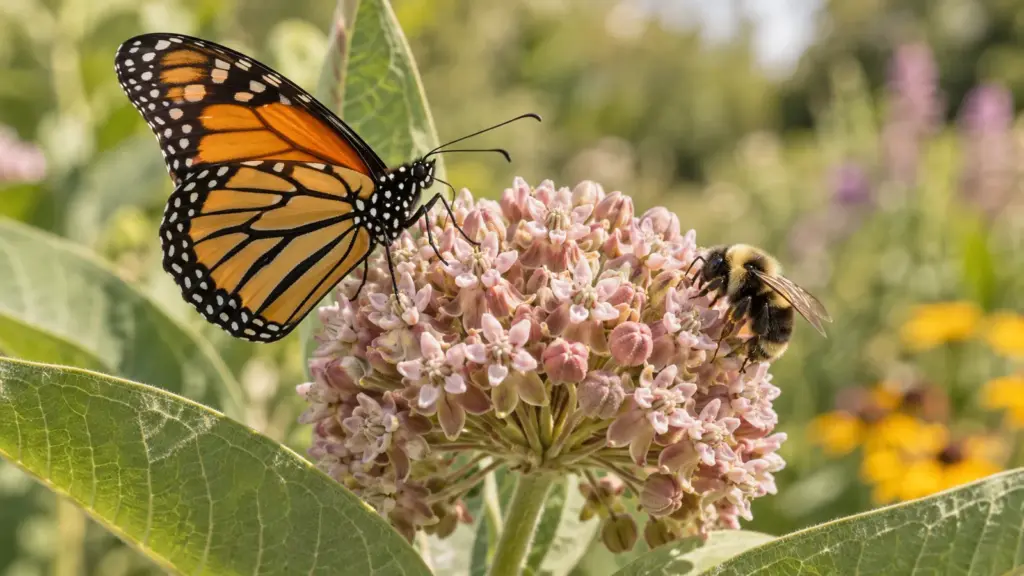

In the butterflies vs bees pollination contest, bees win on a per-visit basis, since they carry and deliver far more pollen. Butterflies still matter, though: one study of Texas cotton estimated that non-bee insects, mainly hoverflies and butterflies, could contribute as much as $120 million a year in extra harvest.
The numbers below come from field studies and national estimates. Together they show where butterflies fall short, where they punch above their weight and what that means for your garden.
Key Takeaways
- Bees are the more effective pollinators per visit, largely because butterflies pick up little pollen on their long legs and narrow tongues.
- Across 39 crop studies on five continents, non-bee insects made 25% to 50% of all flower visits and delivered pollination similar to bees overall.
- In Texas cotton, bees handled about two-thirds of pollination, and other insects, mainly hoverflies and butterflies, may contribute as much as $120 million a year.
- Some plants rely on butterflies, such as a rhododendron whose toxic pollen keeps bees away.
Butterflies vs Bees: The Numbers
| Study or estimate | What it measured | What it found |
|---|---|---|
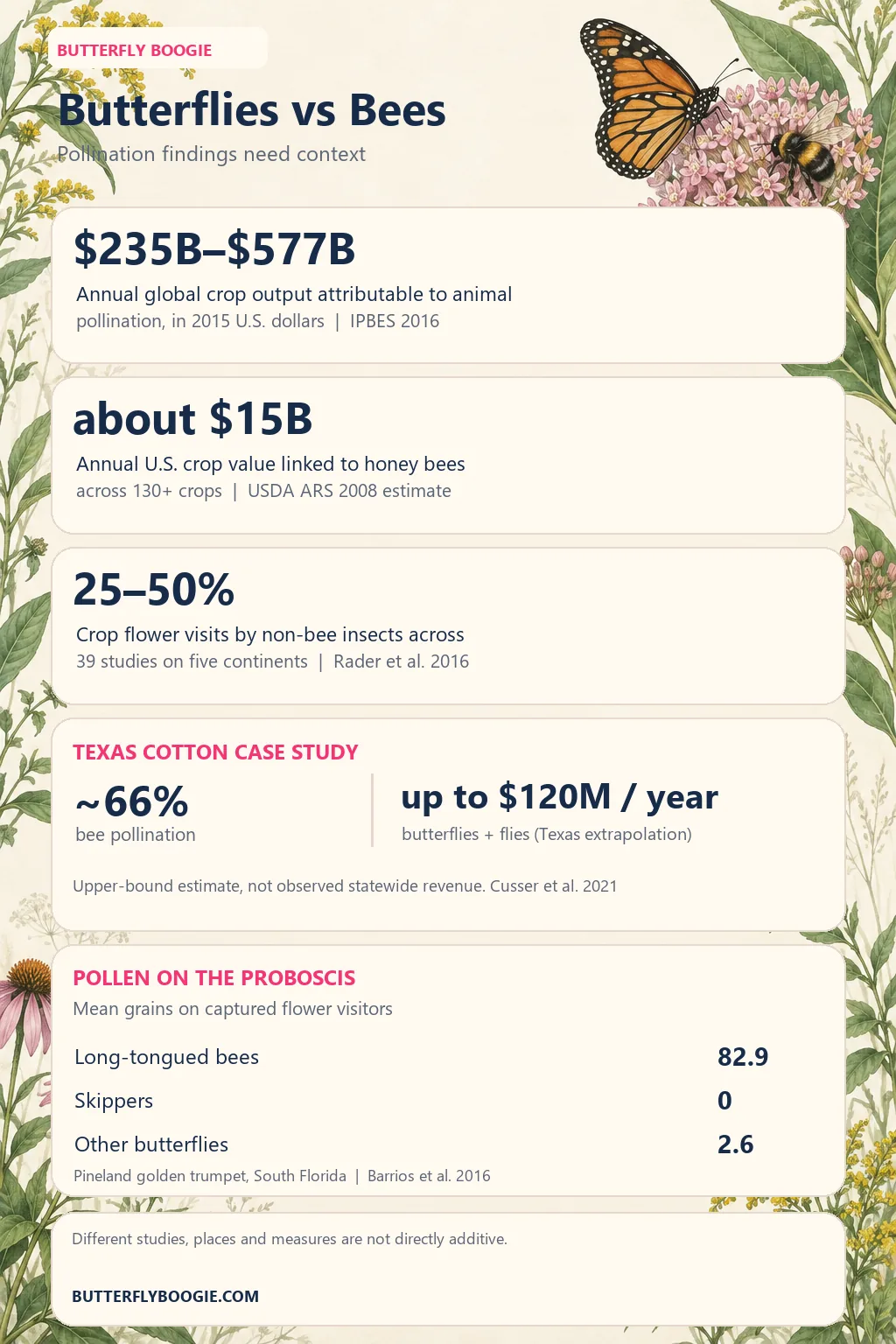
| IPBES global assessment, 2016 | Food production that depends on pollinators | $235 billion to $577 billion a year worldwide |
| USDA | U.S. crops pollinated by honey bees | About $15 billion a year, across more than 130 crops |
| Rader et al., PNAS, 2016 | 39 crop studies on five continents | Non-bees made 25% to 50% of flower visits, with pollination similar to bees overall |
| Texas cotton study | Who pollinates cotton flowers | Bees about 66%; non-bee insects may contribute up to $120 million a year |
| Barrios et al., AoB Plants, 2016 | Pollen on proboscides of sampled visitors to a Florida wildflower | Long-tongued bees averaged about 83 grains; most butterflies carried none |
Why Bees Move More Pollen
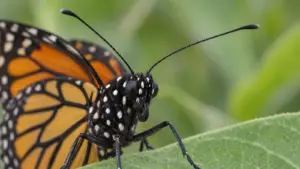
Body design explains most of the gap. The USDA Forest Service notes that butterflies stand high on long, thin legs, pick up little pollen on their bodies and have no special structures for collecting it.
Bees are the opposite. They are fuzzy, land right in the flower and in many species carry pollen home on purpose.
A 2016 study in AoB Plants by Barrios, Pena, Salas and Koptur measured this on the pineland golden trumpet in South Florida. Skippers visited the flowers most often, but sampled long-tongued bees carried an average of about 83 pollen grains on their proboscides, while most butterflies carried none.
The study found that tongue width mattered more than tongue length. A butterfly’s slender proboscis slips past the pollen, while a bee’s wider mouthparts pick it up.
Where Butterflies Add Real Value
Frequency makes up for a lot. A 2016 review of 39 crop studies in PNAS by Romina Rader and colleagues found non-bee insects, a group that includes butterflies, made 25% to 50% of all flower visits.
They were less effective per visit but visited more often. The two effects balanced out, so non-bees delivered pollination similar to bees.
Cotton shows what that could be worth. Coverage in Science of a study of Texas cotton reported that bees did about two-thirds of the pollination, while other insects, mainly hoverflies and butterflies, could contribute as much as $120 million a year by pollinating flowers bees skipped.
An earlier University of Texas at Austin study of 12 South Texas sites found that more diverse pollinators could raise cotton production by up to 18%. The researchers encouraged farmers to protect the natural habitat those pollinators need.
Plants That Depend on Butterflies
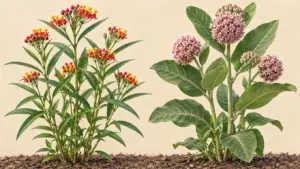
Some flowers are built for butterflies. The Forest Service describes them as brightly colored in red, yellow or orange, grouped in clusters with landing platforms, open by day and holding nectar deep inside.
Butterflies can also see red, which bees cannot. That lets red, tube-shaped flowers attract butterflies while bees overlook them.
One rhododendron takes it further. A 2024 study in Annals of Botany found butterflies deposited more pollen per visit on Rhododendron molle than bumblebees, whose collecting appears to be discouraged by toxins in the pollen.
For more on how butterflies move pollen, see our guide to how butterflies pollinate.
What This Means for Your Garden
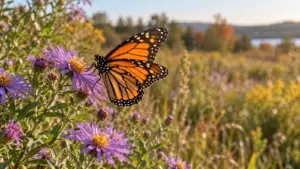
You don’t have to choose. A garden that feeds both bees and butterflies gets the heavy pollen movers and the frequent, far-ranging visitors.
- Plant clusters of bright, flat-topped or tubular flowers that give butterflies a place to land.
- Add open, bowl-shaped flowers that bees work easily.
- Keep something in bloom from spring to fall so both groups find food all season.
- Skip broad-spectrum insecticides, which harm bees and butterflies alike.
Our list of the best butterfly plants and our look at what colors attract butterflies can help you plan.
FAQ
Are butterflies better pollinators than bees?
Not per visit. Bees carry and deliver much more pollen, but butterflies visit often and still add real value to crops and wildflowers.
How much are pollinators worth?
The IPBES global assessment put the food production that depends on pollinators at $235 billion to $577 billion a year.
In the U.S., the USDA says honey bees pollinate about $15 billion worth of crops each year.
Do butterflies pollinate crops?
Yes. In Texas cotton, hoverflies and butterflies may contribute as much as $120 million a year by pollinating flowers bees miss.
Why are butterflies less effective pollinators?
They stand high on long legs and feed through a narrow tongue, so little pollen sticks to them.
They also lack the pollen-carrying structures many bees have.