

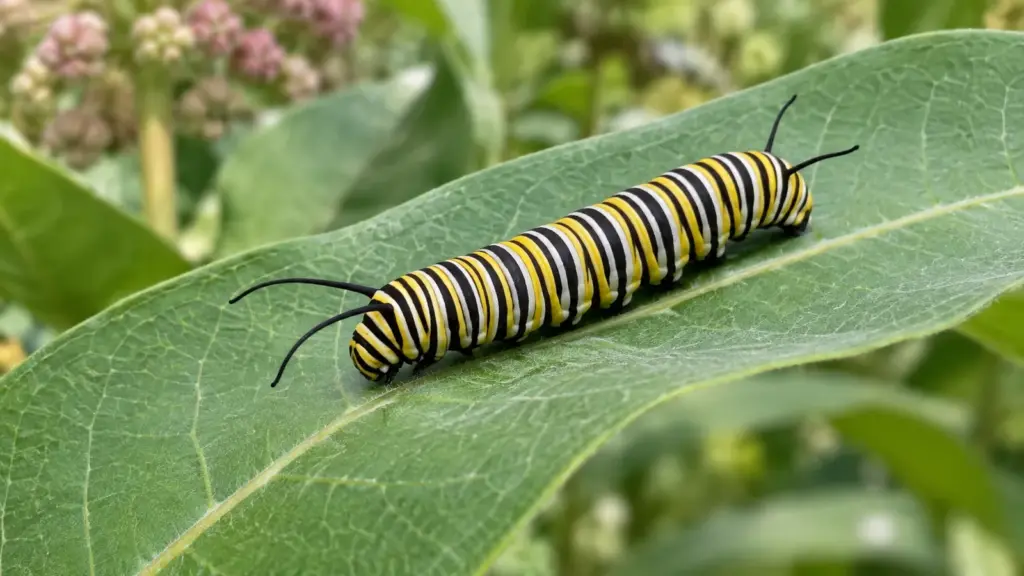

Monarch butterfly parasites fall into three main groups: the OE protozoan, tachinid flies and parasitic wasps. In a study of more than 20,000 caterpillars raised by volunteers, tachinid flies alone killed 9.8 percent, and from 2018 to 2020 roughly one in five monarchs sampled tested positive for OE.
Here are the numbers behind each one, where they come from and what they mean for anyone raising or planting for monarchs.
Key Takeaways
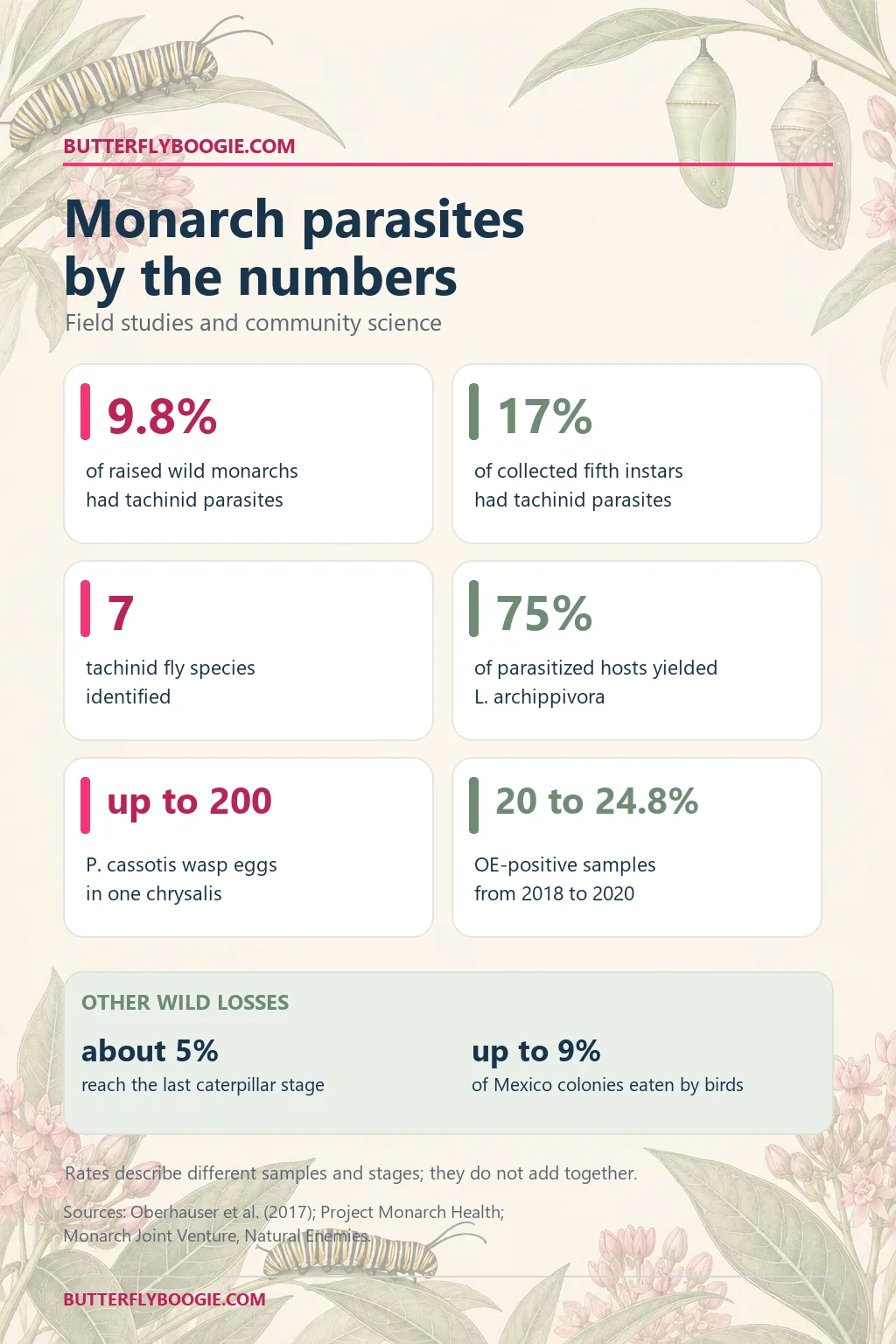
- Tachinid flies parasitized 9.8% of monarchs raised in the Monarch Larva Monitoring Project, rising to 17% of caterpillars collected in their final stage.
- OE turned up in 20% to 24.8% of samples tested by Project Monarch Health from 2018 to 2020.
- The wasp Pteromalus cassotis can lay up to 200 eggs inside a single chrysalis.
- Migration keeps parasites in check, so resident populations that stop migrating carry far more OE.
Monarch Parasites at a Glance
| Parasite | What it attacks | How common | Source |
|---|---|---|---|
| OE (Ophryocystis elektroscirrha) | Caterpillars swallow spores and emerge as infected adults | 20% to 24.8% of samples, 2018 to 2020 | Project Monarch Health |
| Tachinid flies, at least 7 species | Caterpillars, emerging from the late caterpillar or chrysalis | 9.8% overall, 17% of final-stage caterpillars | Oberhauser et al. 2017 |
| Pteromalus cassotis wasp | Chrysalis | Up to 200 eggs in one chrysalis | Monarch Joint Venture |
| Braconid wasps | Details still limited | At least one species reported | Monarch Joint Venture |
OE: The Parasite Monarchs Carry Everywhere
OE is a single-celled parasite that lives only in monarchs and their close relatives. Infected females scatter spores on their eggs and the milkweed around them, and caterpillars swallow the spores when they eat, according to Project Monarch Health.
How common it is depends on whether a population migrates. Fewer than 8% of eastern migrants are heavily infected, compared with about 30% of western migrants and over 70% of the non-migratory monarchs in South Florida.
Across all samples, community scientists found OE in 24.6% of monarchs in 2018, 20% in 2019 and 24.8% in 2020, according to the Project Monarch Health results. Infection was highest in the southern U.S., where resident monarchs breed year-round.
The Monarch Joint Venture notes that OE can cut non-migratory monarch populations by 50%. Our guide to tropical vs native milkweed explains how year-round milkweed helps OE spread.
Tachinid Flies: 9.8% of Monarchs Raised
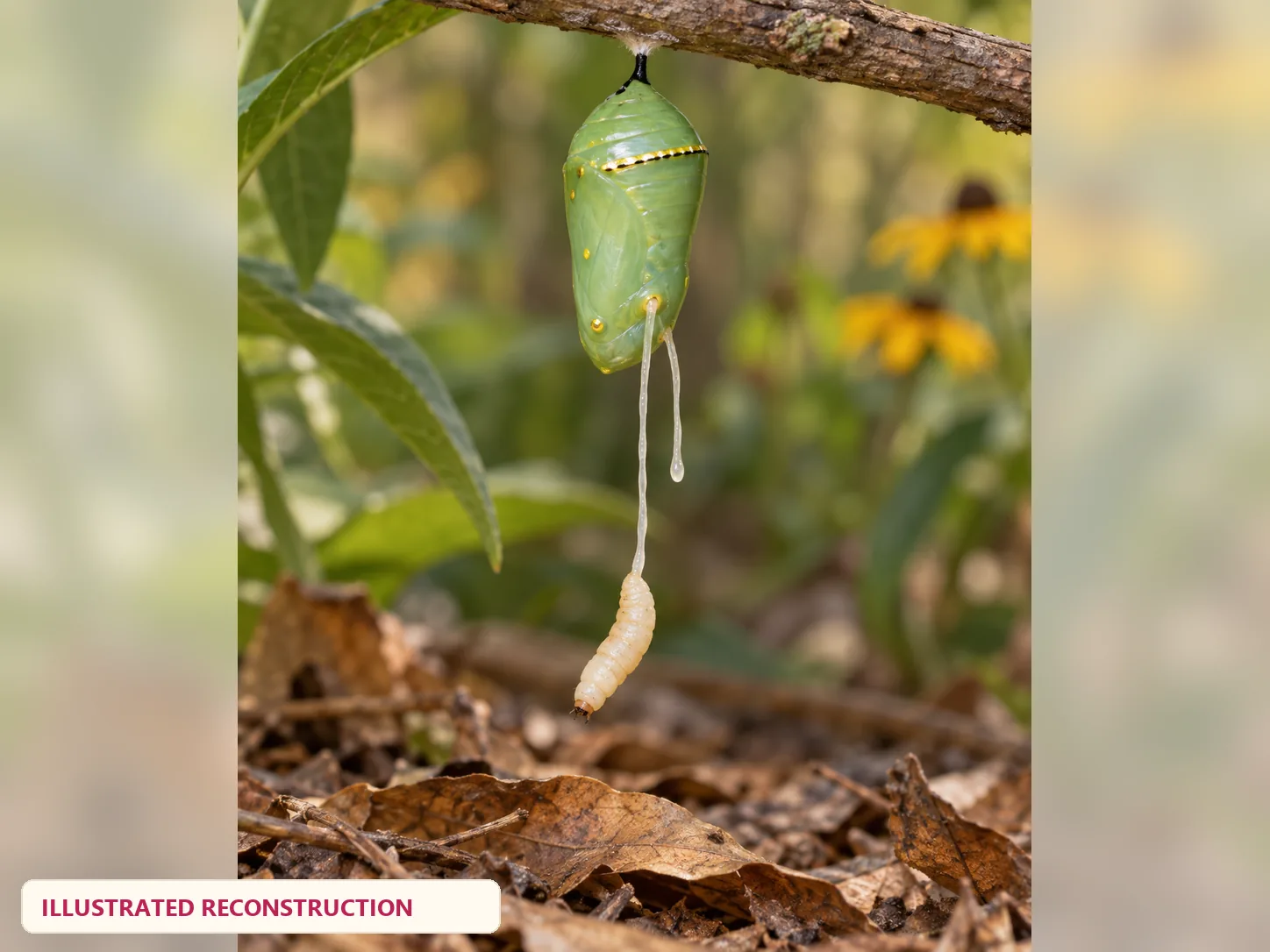
Tachinid flies are the monarch’s main parasitoids, meaning their young develop inside the caterpillar and kill it. Some species lay eggs on the caterpillar’s skin, and the fly larvae eat their way through their host from the inside.
The best numbers come from the Monarch Larva Monitoring Project, where volunteers raised more than 20,000 wild monarchs. Karen Oberhauser and colleagues reported the results in the Annals of the Entomological Society of America in 2017.
Overall, 9.8% of the monarchs were parasitized. The rate climbed as caterpillars grew and reached 17% for those collected in their fifth and final stage, which fits the fact that older caterpillars have spent more days exposed to flies.
The team identified seven tachinid species from 466 parasitized monarchs. One species, Lespesia archippivora, was recovered from 75% of parasitized hosts, and it attacks many kinds of moth and butterfly caterpillars.
If you raise monarchs, you may see the signs. Pale threads hanging from a caterpillar or chrysalis are fly larvae lowering themselves to the ground to pupate.
Parasitic Wasps Inside the Chrysalis
The wasp Pteromalus cassotis attacks the chrysalis. A female can lay up to 200 eggs inside a single monarch chrysalis, and the tiny adult wasps emerge from the empty casing weeks later, according to the Monarch Joint Venture.
A related wasp, Pteromalus puparum, will try to parasitize monarch pupae in the lab, but its young fail to develop. At least one braconid wasp species has also been recorded in monarchs.
Parasites vs Predators
Parasites are only part of what monarchs face. The Monarch Joint Venture estimates that only about 5% of monarchs reach the last caterpillar stage, with ants, spiders and wasps taking many of the rest, and fire ants are a major predator in Texas.
Birds matter in winter. In the Mexican colonies, black-backed orioles and black-headed grosbeaks eat up to 9% of the butterflies, according to the same source, and our look at monarch caterpillar survival rates breaks down the losses stage by stage.
What Gardeners and Monarch Raisers Can Do
Planting native milkweed helps more than anything, since it dies back in winter and keeps monarchs migrating. Our overview of butterfly diseases and predators covers other threats in the garden.
- Raise small numbers of caterpillars and give each one clean space and fresh leaves.
- Clean containers between batches, since OE spores survive on surfaces.
- Watch for crumpled wings or struggling adults, which can signal heavy OE infection.
- Take part in Project Monarch Health, which tests adult monarchs for OE with a simple tape sample.
For day-to-day rearing tips, see our monarch caterpillar care guide.
FAQ
What percentage of monarchs have OE?
Project Monarch Health found OE in 20% to 24.8% of samples from 2018 to 2020.
Heavy infection ranges from under 8% in eastern migrants to over 70% in South Florida’s resident monarchs.
What are the white strings hanging from my monarch chrysalis?
They are almost always tachinid fly larvae leaving the host to pupate. The monarch inside won’t survive.
How common are tachinid flies in monarchs?
About 9.8% of wild monarchs raised in the Monarch Larva Monitoring Project were parasitized, and 17% of final-stage caterpillars.
Can a monarch survive OE?
Lightly infected monarchs can live and breed normally.
Heavily infected ones often emerge with deformed wings or die during migration.