


Catching Butterflies: Ethics, Laws, and Best Practices
Catching butterflies is legal for most common species in the United States, but it comes with ethical responsibilities and legal limits that every collector and casual enthusiast should know. The answer to whether it’s OK depends entirely on what you’re catching, why, where, and how you handle the butterfly afterward. A kid chasing cabbage whites across a backyard lawn? That’s fine. Netting a federally listed Miami blue on a Florida key? That’s a federal crime with fines up to $50,000.
I’ve been on both sides of this. I’ve watched researchers handle specimens with careful precision during population surveys, and I’ve seen well-meaning people accidentally crush wing scales by gripping too hard. The difference between responsible catching and harmful catching comes down to knowledge – knowing the species, knowing the technique, and knowing when the net should stay in the bag.
Key Takeaways
- Catching common butterfly species is legal on most public and private land, but federally protected species like the Karner blue, Miami blue, and Schaus swallowtail carry strict penalties under the Endangered Species Act.
- Proper net technique uses a soft, fine-mesh aerial net with a swift sweeping motion followed by a gentle twist to close the bag – never slam the net rim down on a butterfly resting on a surface.
- Catch-and-release works best when you limit handling time to under 60 seconds, hold butterflies by the closed wing base near the thorax, and release them in the same habitat where they were caught.
- Alternatives like photography, citizen science apps such as iNaturalist, and butterfly surveys offer ways to engage with butterflies without any physical contact at all.

Is Catching Butterflies Legal?
For the majority of common butterfly species, yes. There is no blanket federal law in the United States that prohibits catching butterflies. You can net a painted lady, a cabbage white, a monarch, or a black swallowtail without breaking any law in most states and most locations. The legal issues start when protected species enter the picture.
The Endangered Species Act (ESA) protects specific butterfly species from collection, harassment, and habitat destruction. As of 2026, federally listed butterflies include the Karner blue, Schaus swallowtail, Miami blue, Saint Francis’ satyr, Fender’s blue, and several others. Taking any of these without a federal permit is illegal regardless of where you catch them.
State laws add another layer. California restricts collecting in state parks without a scientific collecting permit. Many states protect species that aren’t federally listed but are state-listed as threatened or endangered. Oregon protects the Oregon silverspot fritillary under state law in addition to its federal ESA listing. Some counties and municipalities have their own ordinances covering butterfly collecting in public parks.
Location matters too. National parks prohibit collecting any organisms, including insects, without a research permit. National forests generally allow it for personal, non-commercial use. State parks vary by state. Private land requires landowner permission. Before you swing a net anywhere unfamiliar, check the regulations for that specific jurisdiction.
The Ethics of Catching Butterflies
Legal permission and ethical responsibility are two separate questions. Just because you can catch something doesn’t always mean you should. The ethical calculus depends on the population status of the species, your purpose, and the impact your collection has on the local breeding population.
Collecting a few common species from a healthy population has negligible ecological impact. Research from multiple universities has confirmed that recreational collecting of abundant species does not drive population declines. The things that actually harm butterfly populations – habitat loss, pesticide exposure, climate change – operate on a completely different scale than someone with a net taking a handful of individuals from a field of thousands.
That said, catching butterflies from small, isolated populations is a different story. If a colony has only a few dozen individuals – maybe a rare hairstreak clinging to a single ridgetop or a blue restricted to one meadow – removing even two or four adults can matter. Small populations are vulnerable to every mortality source, and collection adds one more on top of predation, weather, and habitat pressure.
The purpose behind catching also shapes the ethical question. Scientific collecting for museum specimens, population research, or species identification serves a documented purpose. Educational programs that teach children about butterfly life cycles and lifespans by allowing brief handling create lasting interest in conservation. Catching butterflies purely to kill and display them as decorative art is harder to justify, though opinions vary among entomologists on this point.
Proper Net Technique for Catching Butterflies
If you’re going to catch butterflies – for science, education, or catch-and-release observation – technique matters. Poor technique injures or kills butterflies. Good technique lets you capture, examine, and release them with minimal harm.
Choosing the Right Net
Use an aerial butterfly net, not a fishing landing net or a bug net from a toy store. A proper aerial net has a lightweight aluminum or carbon fiber handle (about 3 feet long), a round hoop (12 to 18 inches in diameter), and a deep, fine-mesh bag made of soft nylon or polyester. The bag should be at least twice as deep as the hoop diameter so it can fold over to contain the butterfly after the swing.
The mesh needs to be fine enough that legs, antennae, and proboscis parts don’t poke through and get snagged. Coarse mesh tears wings and traps appendages. The Entomological Society of America recommends 30 to 40 mesh count (holes per inch) for butterfly nets, though many commercial nets in this range work fine.
The Swing and Capture
The basic aerial catch works like this. Approach the butterfly from behind or slightly to the side. Swing the net in a smooth arc that intercepts the butterfly’s flight path, leading slightly ahead of where it’s heading. Once the butterfly enters the bag, twist the handle 180 degrees to fold the bag over the hoop rim, trapping the butterfly inside the closed mesh pocket.
Never slam the net straight down on a butterfly sitting on a flower or the ground. That’s how you crush them against hard surfaces. If the butterfly is perched, position the net opening above and slightly behind it, then sweep forward and down in one motion so the butterfly flies upward into the bag as it tries to escape. The butterfly’s natural escape instinct works in your favor here.
Practice on common, abundant species first. Cabbage whites are excellent practice targets because they fly slowly, they’re everywhere, and populations are enormous. Once you can consistently catch cabbage whites without damaging them, you’ll have the muscle memory for more challenging species.
Catch-and-Release Best Practices
If you’re catching butterflies to observe, photograph, or identify them rather than to keep specimens, the goal is minimizing stress and physical damage during the encounter. Here’s what works.
Keep handling time short. Sixty seconds or less from capture to release is a reasonable target. The longer a butterfly spends in a net or in your hand, the more scales it loses, the more energy it burns, and the more stressed it becomes. Have your camera, field guide, or hand lens ready before you make the catch.
Hold butterflies correctly. Reach into the net and gently press the wings together above the butterfly’s back. Then grip the wings near the base, close to the thorax, between your thumb and forefinger. This grip gives you control without putting pressure on the wing membranes where scales are most easily lost. Never squeeze the thorax itself – that can injure the flight muscles underneath.
Release in the right spot. Let the butterfly go in the same area where you caught it, preferably near nectar flowers or its preferred habitat. Releasing it in an unfamiliar location forces it to spend energy reorienting, and if you’ve moved it far from its home range, it may not find its way back to resources it knows.
Avoid catching in extreme conditions. On very hot days (above 95 degrees F), handling adds dangerous heat stress. On windy days, released butterflies struggle to fly and become easy predator targets. Early morning when butterflies are still warming up is a bad time for catch-and-release because you’re interrupting their thermoregulation.
When You Should Not Catch Butterflies
Some situations call for leaving the net at home entirely. Knowing when not to catch is just as much a skill as knowing how to catch.
Protected species are the obvious first case. If you cannot positively identify the butterfly before netting it, and there’s any chance it could be a protected species in your area, don’t swing. In regions where a listed species flies alongside similar-looking common species – like areas where the federally listed Fender’s blue overlaps with the common silvery blue – the risk of accidentally taking a protected individual is real.
Egg-laying females deserve a pass. A female butterfly actively ovipositing on a host plant is contributing directly to the next generation. Interrupting her, even briefly, costs time and eggs. If you catch her and she drops her remaining eggs in your net instead of on the host plant, those eggs are effectively wasted. You can usually tell a female is laying by watching her behavior – she’ll land on leaves, curl her abdomen down to the leaf surface, and pause briefly before moving to the next leaf.
Mating pairs should also be left alone. Catching a mating pair separates them prematurely, which can mean the female doesn’t receive a full sperm packet. That single interrupted mating event could reduce the number of fertile eggs she produces for the rest of her life. If you see two butterflies flying connected, just watch and appreciate it.
Very small or visibly struggling populations are another no-go. If you’re in a habitat where you see only a handful of individuals of a given species over an hour of searching, that population may be under stress from factors already reducing its numbers. Adding collection pressure – even catch-and-release – adds one more disturbance to an already marginal situation.
Alternatives to Catching Butterflies
You don’t need to put hands on a butterfly to study, appreciate, or contribute to science around it. Several approaches give you close engagement with zero physical impact.
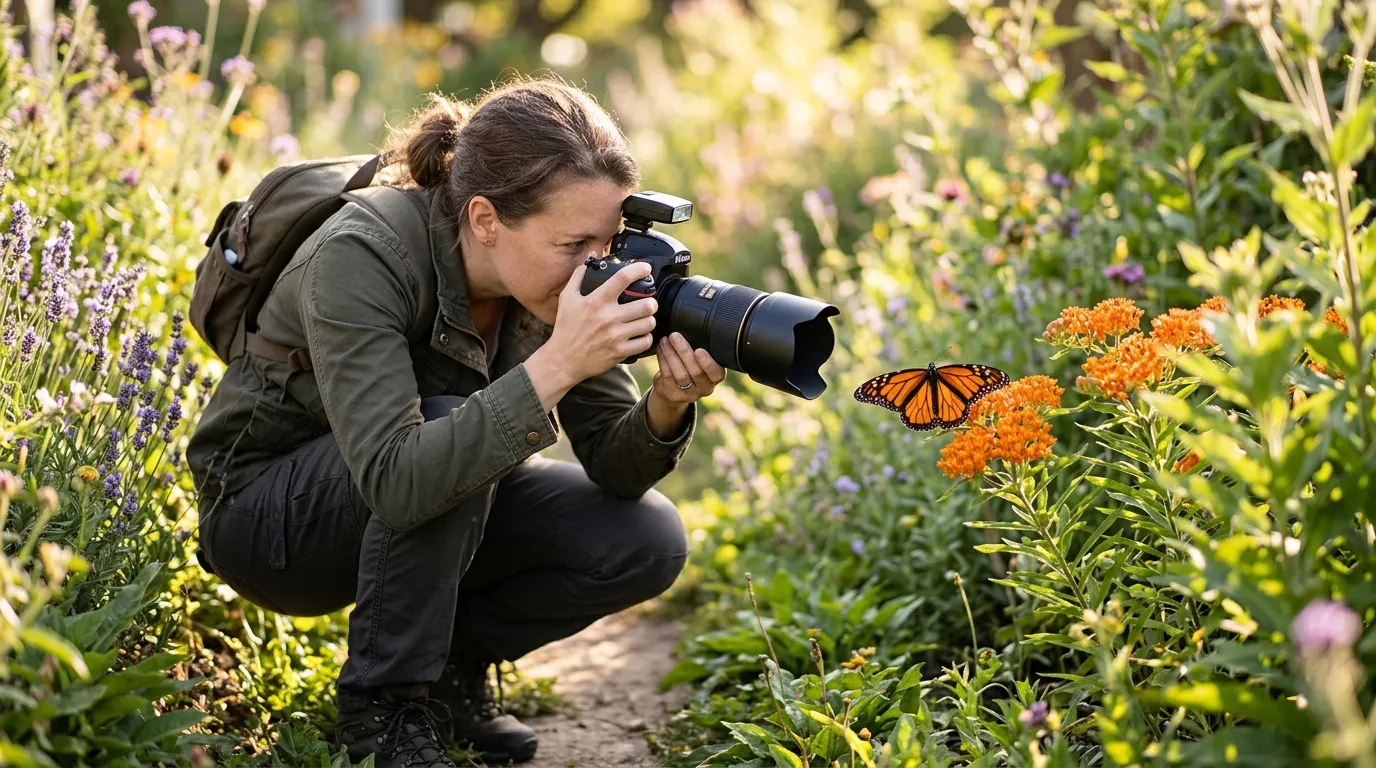
Photography has largely replaced collecting for species documentation in the field. A decent macro lens or even a modern smartphone camera can capture wing patterns, ventral markings, and antenna details with enough resolution for species identification. Platforms like iNaturalist accept photo submissions and use AI-assisted identification combined with community expert review to confirm species. Many butterfly survey programs now accept photo records as valid data points alongside traditional specimen-based records.
Citizen science programs let you contribute directly to butterfly research. The North American Butterfly Association (NABA) runs annual Fourth of July butterfly counts modeled on the Christmas Bird Count. The Xerces Society coordinates community-based monitoring for at-risk species. These programs train volunteers in field identification and data recording, and the resulting datasets shape conservation policy at state and federal levels.
Gardening for butterflies creates observation opportunities right outside your door. Planting host plants and nectar sources brings butterflies to you instead of requiring you to chase them across a field. A well-designed butterfly garden lets you watch oviposition, find caterpillars, observe puddling behavior, and photograph adults at close range – all without a net. When butterflies are feeding on flowers six feet from your patio, identification becomes much easier than trying to ID a fast-flying individual 30 yards away.
Rearing caterpillars indoors is another way to engage deeply with butterfly biology without wild-catching adults. Finding eggs or early-instar caterpillars on host plants, raising them through pupation, and releasing the adults after emergence gives you front-row access to the full life cycle. It’s arguably more educational than netting adults, and the released butterflies are in perfect condition with no handling damage.
Scientific Collecting: When Catching Serves Conservation
It’s worth pointing out that responsible butterfly collecting has a long and productive relationship with conservation. Museum specimen collections dating back over 200 years provide irreplaceable baseline data on species ranges, flight periods, and population genetics. DNA extracted from pinned specimens has resolved taxonomic questions that could not have been answered any other way.
Modern population monitoring studies sometimes require physical capture for mark-recapture surveys. Researchers net butterflies, mark them with a small dot of paint or a tiny numbered tag on the hindwing, release them, and then recapture marked individuals later to estimate population size and movement patterns. This technique has been used extensively with monarchs, Melissa blues, and several fritillary species. The brief handling involved in marking causes minimal measurable harm, and the population data generated directly supports habitat protection efforts.
Genetic sampling also requires catching. Researchers sometimes clip a tiny piece of wing margin – less than 2 mm – for DNA analysis. The butterfly loses a negligible amount of wing area and can fly normally after release. These tissue samples help scientists map genetic diversity across populations and identify genetically isolated groups that may need targeted conservation attention.
The key distinction between scientific collecting and casual collecting isn’t the act itself. It’s the purpose, the permit structure, and the data trail. Researchers operate under institutional review, maintain detailed records, deposit specimens in curated collections, and publish findings that inform land management decisions. That infrastructure of accountability makes scientific collecting categorically different from hobbyist collecting, even when the physical actions look similar.
Frequently Asked Questions
Is it illegal to catch monarch butterflies?
No. Monarchs are not federally listed under the Endangered Species Act as of 2026, though they are classified as a candidate species. You can legally catch and release monarchs in most states. Some states may have specific regulations around monarchs during certain seasons, so check local rules. The situation could change if monarchs receive formal ESA listing in the future.
Can catching butterflies hurt them even if I release them?
Yes, if done improperly. Wing scales lost during handling don’t grow back, and significant scale loss reduces the butterfly’s ability to regulate body temperature and can make it more visible to predators. Rough handling can also damage wing veins, break legs or antennae, and strain flight muscles. Proper technique minimizes these risks, but some level of disturbance is unavoidable whenever you physically handle a butterfly.
What happens if I accidentally catch a protected species?
Release it immediately and carefully. Accidental capture followed by immediate release is unlikely to result in enforcement action, though technically any “take” of a listed species violates the ESA. The practical approach is to know which protected species occur in your area before you go out collecting, so you can avoid catching them in the first place. State wildlife agencies publish lists of protected species and their known locations.
Do butterflies feel pain when caught?
Butterflies lack the nervous system structures associated with pain processing in vertebrates. They don’t have nociceptors in the way mammals do. They do respond to physical stimuli with stress behaviors – struggling, wing fanning, and attempts to escape – but current evidence suggests these are reflexive responses rather than pain perception as humans understand it. That doesn’t mean handling should be careless; stress responses still cost the butterfly energy and can cause physical injury.
What’s the best time of day to catch butterflies?
Mid-morning to early afternoon, roughly 9 AM to 2 PM on warm sunny days. By this time butterflies have warmed up enough to be active and visible, but they’re also alert and flying, which makes clean aerial catches possible. Very early morning catches on torpid, cold butterflies feel like cheating and cause more stress because you’re disrupting their warm-up period. Late afternoon works too, though many species become less active as temperatures drop.
Should children be allowed to catch butterflies?
Supervised butterfly catching is one of the best ways to get children interested in nature and biology. The key is teaching gentle handling from the start – show kids how to hold the wings closed, how to look without squeezing, and how to release quickly. Start with abundant species like cabbage whites and painted ladies. A child who spends an afternoon learning to catch and release butterflies is far more likely to grow into an adult who cares about habitat conservation than one who only sees butterflies on a screen.