


The Jamaican monarch butterfly (Danaus cleophile) is a Caribbean endemic that most butterfly enthusiasts never get to see in person. It shares the Danaus genus with the famous North American monarch, but it is a distinctly different species – smaller, darker, and tied to a life cycle that plays out entirely on the islands of Jamaica and Hispaniola. If you have spent any time studying monarchs, meeting this species feels like finding a cousin you didn’t know existed. I think of it as one of the most underappreciated butterflies in the Western Hemisphere.
Sometimes called the Jamaican queen, this butterfly occupies a narrow geographic range and faces pressures that its continental relatives do not. Understanding it means understanding how island ecology shapes a species from the ground up.
Key Takeaways
- The Jamaican monarch butterfly (Danaus cleophile) is a non-migratory species found only in Jamaica and Hispaniola, making it one of the few Caribbean-endemic milkweed butterflies.
- It is noticeably smaller and darker than the North American monarch (Danaus plexippus), with deep chocolate-brown wing coloring and narrower white spotting along the wing margins.
- Its caterpillars feed on Caribbean-native milkweed species, particularly Asclepias curassavica and Asclepias nivea, which provide the same cardiac glycoside defense found in other Danaus species.
- Habitat loss from deforestation and urban development across Jamaica and Hispaniola represents the primary threat to this species, which has no migratory escape route to fall back on.
How to Identify the Jamaican Monarch Butterfly
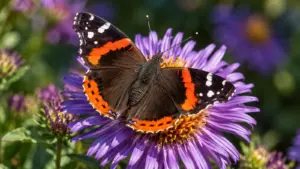
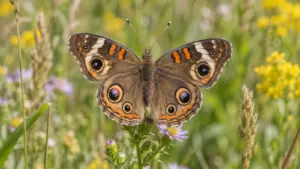
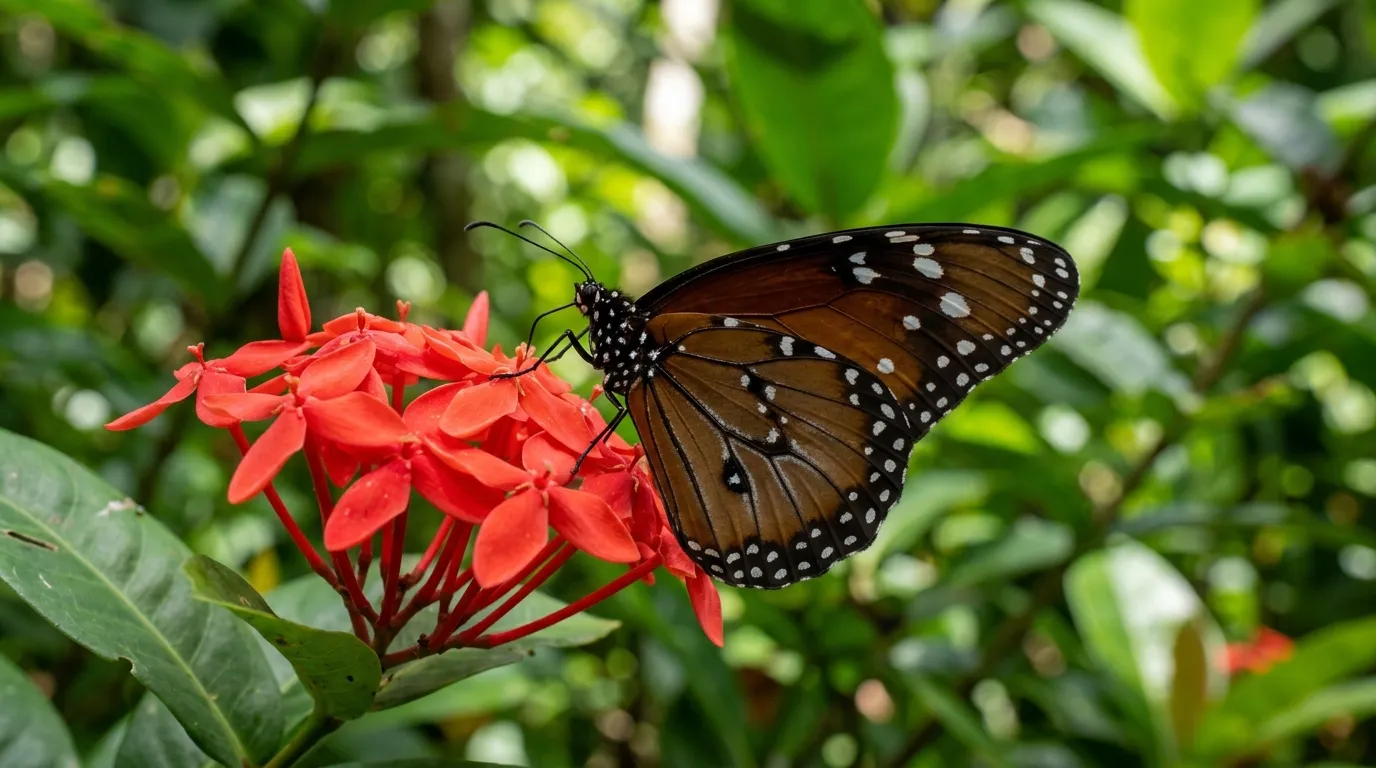
If you know what a North American monarch looks like, identifying the Jamaican monarch butterfly becomes a game of “spot the differences.” The overall wing shape is similar – broad forewings, rounded hindwings – but the color palette is shifted dramatically. Where Danaus plexippus shows bright orange with bold black veining, Danaus cleophile wears a deep chocolate-brown to dark tawny-orange base color. The veins are still outlined in black, but because the ground color is so much darker, the contrast is less dramatic.
The white spotting along the wing margins is present in both species, but on the Jamaican monarch it tends to be more restricted. You will notice fewer white dots and smaller ones, especially on the hindwings. The underside of the wings is paler than the upperside, as with most Danaus species, but still significantly darker than what you would see on a typical North American monarch.
Size is another clear separator. The Jamaican monarch has a wingspan of roughly 7 to 8 centimeters, compared to 9 to 10 centimeters for Danaus plexippus. In the field, the difference is noticeable but not extreme. When seen flying, the Jamaican monarch has the same gliding flight style typical of the Danaus genus – slow, deliberate wingbeats interspersed with long glides.
If you are trying to separate it from other butterflies that look like monarchs, the combination of smaller size, dark coloration, and Caribbean location makes identification straightforward once you are aware the species exists.
Range and Habitat of Danaus cleophile
The Jamaican monarch butterfly lives on just two Caribbean islands – Jamaica and Hispaniola (Haiti and the Dominican Republic). There are occasional unconfirmed reports from nearby islands, but the established breeding populations are limited to those two locations. This is one of the smallest natural ranges of any Danaus species worldwide.
Within Jamaica, the species is found across a range of elevations but shows a preference for mid-elevation forests and forest edges between roughly 300 and 1,500 meters. It does well in areas where native vegetation persists alongside some degree of human disturbance – coffee plantations, rural garden edges, and secondary forest clearings. On Hispaniola, it occupies similar habitats, though the population distribution is less well-documented.
Unlike the North American monarch, which undertakes a spectacular multi-generational migration across thousands of miles, the Jamaican monarch butterfly is entirely non-migratory. It stays put year-round. This is a defining feature of the species and one that carries significant conservation implications. A migratory species can shift its range in response to local habitat loss. A non-migratory island endemic cannot.
The butterfly is active throughout the year in Jamaica, with no distinct seasonal diapause. The tropical climate of both islands supports continuous breeding, and you can find adults on the wing in any month. Population density does fluctuate with rainfall and flowering cycles, but there is no single “season” for this species the way there is for monarchs in temperate North America.
Host Plants and Larval Ecology
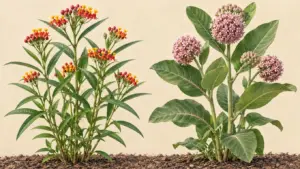
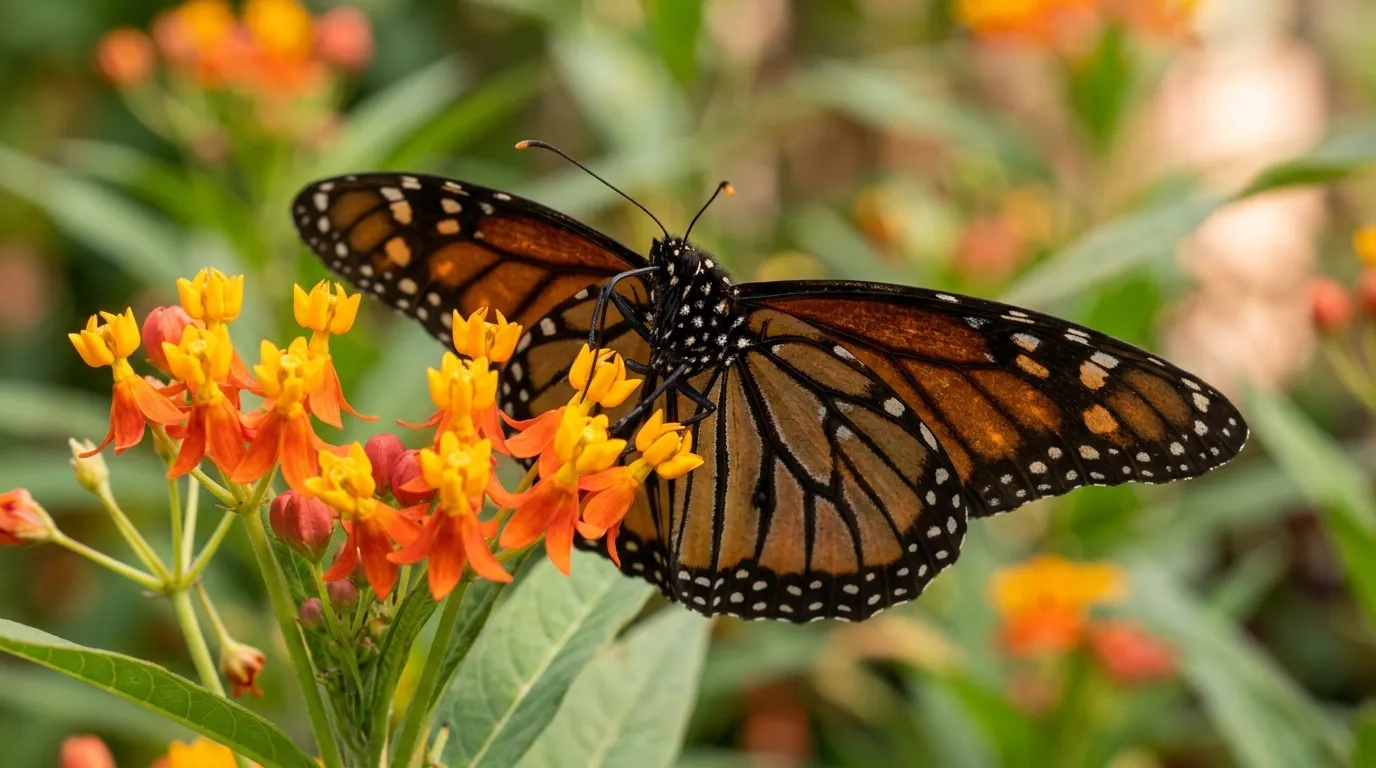
Like all members of the genus Danaus, the Jamaican monarch butterfly depends on milkweed plants in the family Asclepiadaceae for its larval development. The primary host plant across its range is Asclepias curassavica, commonly known as tropical milkweed or blood flower. This is the same species widely planted in butterfly gardens throughout the Americas, and it is native to the Caribbean region rather than introduced.
A second host plant, Asclepias nivea, is also used in some parts of the range. Other Caribbean Asclepias species and related genera in the milkweed family may serve as occasional hosts, though documented records are limited. The caterpillars feed on the leaves and sequester cardiac glycosides (cardenolides) from the plant tissue, making both the larvae and the adult butterflies unpalatable to most predators.
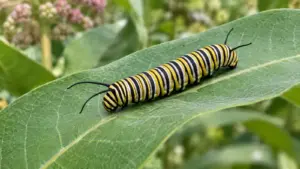
The caterpillars of Danaus cleophile look similar to North American monarch caterpillars – banded in white, black, and yellow with a pair of black filaments at each end of the body. They go through the standard lepidopteran development of egg, four to five larval instars, pupa, and adult. The chrysalis is pale green with gold markings, much like its continental cousin’s. How long the full cycle takes depends on temperature and food quality, but in tropical conditions, the generation time from egg to adult runs around four to six weeks. For broader context on butterfly lifespans and life cycles, this guide to butterfly lifespans covers the range across species.
Jamaican Monarch vs. North American Monarch
People often ask whether the Jamaican monarch butterfly is just a subspecies or color variant of the North American monarch. It is not. Danaus cleophile and Danaus plexippus are separate species with distinct evolutionary histories. Genetic studies confirm they diverged millions of years ago, and while they share a common ancestor within the Danaus lineage, they have followed different evolutionary paths shaped by very different environments.
Here is how the two stack up across key traits.
Size: D. cleophile has a wingspan of 7 to 8 cm. D. plexippus averages 9 to 10 cm.
Color: D. cleophile is dark brown to deep tawny-orange. D. plexippus is bright orange.
Range: D. cleophile is restricted to Jamaica and Hispaniola. D. plexippus ranges across North America, Central America, and has established populations in Australia, parts of Europe, and various Pacific islands.
Migration: D. cleophile does not migrate. D. plexippus undertakes one of the longest insect migrations on Earth.
Host plants: Both use Asclepias species, but D. cleophile relies on Caribbean-native milkweeds while D. plexippus uses a broader range of milkweed species across its continental range.
The two species can occur in the same area, because D. plexippus does pass through and occasionally breed in the Caribbean. When both are present, identification requires a close look at wing color and size. At a distance, they fly in a similar style, and it is easy to assume every Danaus you see in Jamaica is plexippus if you are not looking carefully.
Conservation Status and Threats
The Jamaican monarch butterfly faces a set of conservation challenges that differ from the ones threatening its more famous North American relative. The primary threat is habitat loss. Jamaica has lost a large percentage of its original forest cover to agriculture, urban development, and mining. Hispaniola has experienced even more severe deforestation, with Haiti in particular having lost the vast majority of its native tree cover.
Because the Jamaican monarch butterfly cannot migrate, habitat loss hits this species harder than it would hit a butterfly with continental mobility. Every hectare of forest or scrubland that disappears on Jamaica or Hispaniola is a permanent loss for the species. There is no population reservoir somewhere else that can recolonize the cleared areas.
Pesticide use in agricultural areas adjacent to remaining habitat is another concern, particularly on Hispaniola where agrochemical regulation is inconsistent. Milkweed plants growing on farmland edges get sprayed or cleared, reducing the availability of host plants in areas that might otherwise support the butterfly.
The IUCN has not yet assessed Danaus cleophile separately, and it does not appear on the IUCN Red List with its own formal status. The species is listed under broader conservation frameworks for Caribbean biodiversity, and organizations like the Natural History Museum maintain reference data on its taxonomy. The lack of a formal IUCN assessment means the species gets less international conservation attention than it probably deserves.
Local conservation efforts in Jamaica have focused on protecting montane forest habitat through the Blue and John Crow Mountains National Park, which covers a significant portion of the butterfly’s preferred elevation range. This park, a UNESCO World Heritage Site, provides some of the best remaining habitat for the species on Jamaica.
Frequently Asked Questions
Is the Jamaican monarch butterfly the same species as the North American monarch?
No. The Jamaican monarch butterfly (Danaus cleophile) is a separate species from the North American monarch (Danaus plexippus). They belong to the same genus and share a common ancestor, but they diverged millions of years ago. The Jamaican monarch is smaller, darker, and non-migratory.
Where can you find the Jamaican monarch butterfly?
The Jamaican monarch butterfly is found only in Jamaica and Hispaniola (Haiti and the Dominican Republic). It does not occur naturally anywhere else in the world. Within those islands, it favors mid-elevation forests, forest edges, and areas where native milkweed grows.
Does the Jamaican monarch butterfly migrate?
No. Unlike the North American monarch, the Jamaican monarch butterfly is entirely non-migratory. It lives on Jamaica and Hispaniola year-round and breeds continuously in the tropical climate. This lack of migration is one of the most important differences between the two species.
What do Jamaican monarch caterpillars eat?
Jamaican monarch caterpillars feed on milkweed plants native to the Caribbean, primarily Asclepias curassavica (tropical milkweed) and Asclepias nivea. Like other Danaus caterpillars, they sequester toxic cardiac glycosides from the milkweed, which makes them unpalatable to birds and other predators.
Is the Jamaican monarch butterfly endangered?
The Jamaican monarch butterfly has not received a formal IUCN Red List assessment, so it does not have an official conservation status. It faces real threats from deforestation and habitat loss on both Jamaica and Hispaniola. Its extremely limited range and non-migratory nature make it more vulnerable than species with larger distributions.
Can you raise Jamaican monarch butterflies in captivity?
Raising Jamaican monarch butterflies in captivity would require access to fresh Caribbean milkweed and the butterflies themselves, which are not commercially available outside of their native range. Some researchers in Jamaica and the Dominican Republic have reared them for study purposes. For hobbyists outside the Caribbean, the North American monarch remains the accessible option for home rearing.