


The monarch butterfly lifespan depends almost entirely on which generation you’re talking about. A monarch born in June might live just two to six weeks – long enough to mate, lay eggs, and die. But a monarch born in late August or September belongs to the “super generation,” and that butterfly can live eight to nine months, flying thousands of miles to Mexico and back. Same species, same DNA, radically different lifespans. Understanding why those numbers are so different gets at some of the most interesting biology in the insect world.
I’ve raised monarchs in my garden for years, and watching a summer generation butterfly wear out its wings in a matter of weeks while a fall migrant stays strong for months is one of those things that never stops being wild to watch. The difference isn’t random – it’s built into the butterfly’s hormonal programming and triggered by environmental cues.
Key Takeaways
- Spring and summer monarchs live approximately two to six weeks as adults, spending most of that time reproducing and laying eggs on milkweed.
- The fall migratory generation enters reproductive diapause, which shuts down breeding and extends the adult lifespan to eight or nine months.
- Ophryocystis elektroscirrha (OE), a protozoan parasite, is one of the single biggest threats to monarch longevity and can reduce lifespan by 50% or more in heavily infected individuals.
- Temperature, milkweed quality, predation, and pesticide exposure all affect how long a given monarch lives, but generation membership is the dominant factor.

Monarch Butterfly Lifespan by Generation
Monarchs east of the Rockies typically produce four to six generations per year, depending on latitude and weather. Each generation has a distinct role and a corresponding lifespan. The whole system works like a relay race moving northward from spring through summer, followed by a single long-haul generation that heads south in fall.
The first generation hatches in the southern United States in March and April from eggs laid by the returning migrants. These butterflies live about two to five weeks as adults. They breed, lay eggs on fresh milkweed pushing up in spring, and die. Their offspring – generation two – continue the northward push into the central states, living a similar two to six weeks. Generation three pushes into the northern US and southern Canada by midsummer, again living a few weeks at most.
Then comes generation four or five, born in late August through September. This is the super generation. These butterflies are physically different from their parents and grandparents – not in appearance, but in internal chemistry. Instead of maturing sexually and breeding immediately, they enter a state called reproductive diapause. Their reproductive organs remain undeveloped. Juvenile hormone levels stay low. Energy that would have gone into eggs and mating goes instead into fat storage and flight muscle maintenance. The result is a butterfly that can live nine months instead of four weeks.
When you compare the lifespan across butterfly species, monarchs stand out specifically because of this generational split. Most butterflies have a single, consistent adult lifespan. Monarchs have two very different programs running on the same hardware.
How Reproductive Diapause Extends Lifespan
Reproductive diapause is the single mechanism responsible for the migratory generation’s extended life. It works by suppressing the production of juvenile hormone, which in normal summer monarchs drives sexual maturation, egg development, and mating behavior. Without that hormonal signal, the butterfly’s body shifts into a conservation mode.
What triggers diapause is a combination of decreasing day length and cooling temperatures in late summer. Monarchs born when days are getting shorter and nights are getting cooler receive environmental signals that flip the developmental switch. Research from the Monarch Joint Venture has documented how even slight changes in photoperiod during larval development can determine whether an adult enters diapause or matures normally.
The physiological changes go beyond just delaying reproduction. Migratory monarchs build up lipid reserves in their abdomen – essentially body fat – that fuel the 2,000 to 3,000-mile journey to central Mexico. Their flight muscles are proportionally larger and more efficient than those of summer breeders. Their wings tend to be slightly larger and more elongated, which improves gliding efficiency. Even their metabolism shifts. Summer monarchs burn energy fast and replace it through frequent nectar feeding. Fall migrants run on a slow burn, conserving every calorie.
These butterflies arrive at their overwintering sites in Mexico’s oyamel fir forests in November and hang in dense clusters on the trees through the winter. Their metabolic rate drops further in the cool mountain air. They barely eat. Heart rate slows. They survive on stored fat for months. In February and March, rising temperatures and lengthening days finally trigger juvenile hormone production. The butterflies mate in the Mexican forests, begin flying north, and the females lay eggs on the first milkweed they find in Texas and the Gulf states. Most of these migrants die shortly after laying eggs, having lived roughly eight to nine months in total.
Factors That Shorten or Extend a Monarch’s Life
Beyond generation membership, several factors push monarch lifespan up or down. Some of these are within our control, which matters for anyone raising monarchs or managing habitat.
Milkweed quality directly affects larval health and adult longevity. Caterpillars that feed on healthy, pesticide-free milkweed in the genus Asclepias develop into larger adults with greater fat reserves and stronger immune responses. Caterpillars raised on stressed, drought-damaged, or chemically treated milkweed produce smaller adults that live shorter lives. The cardenolide compounds in milkweed – the chemicals that make monarchs toxic to predators – also vary by milkweed species. Tropical milkweed (Asclepias curassavica) produces different cardenolide profiles than native species like common milkweed (A. syriaca) or swamp milkweed (A. incarnata), and there’s evidence that year-round tropical milkweed plantings in southern states can disrupt the migration cycle itself.
Temperature plays a direct role. Monarchs are ectothermic – their body temperature matches their environment. In excessively hot conditions (above 95F consistently), adult monarchs burn through energy reserves faster, dehydrate more readily, and show reduced lifespans. During the overwintering period, temperatures that drop below freezing at the Mexican roosting sites can cause mass mortality. The U.S. Forest Service documents how winter storms have killed millions of monarchs in single events when temperatures dipped below the survival threshold at high-elevation roost sites.
Predation takes a constant toll. Birds, spiders, wasps, ants, and praying mantises all eat monarchs even with the cardenolide toxins. Some bird species – notably black-backed orioles and black-headed grosbeaks at the Mexican overwintering sites – have evolved tolerance to the toxins and feed heavily on clustered monarchs. Tachinid flies parasitize monarch caterpillars. Paper wasps raid chrysalises. In the garden, I’ve lost more monarchs to Chinese mantises than to any other single predator.
Pesticide exposure, particularly to neonicotinoids and glyphosate, affects monarchs both directly and indirectly. Direct contact with insecticides kills adults and larvae outright. Glyphosate doesn’t kill monarchs directly but eliminates milkweed from agricultural fields, which has been one of the primary drivers of population decline in the eastern monarch population over the past two decades.
The OE Parasite and Monarch Longevity
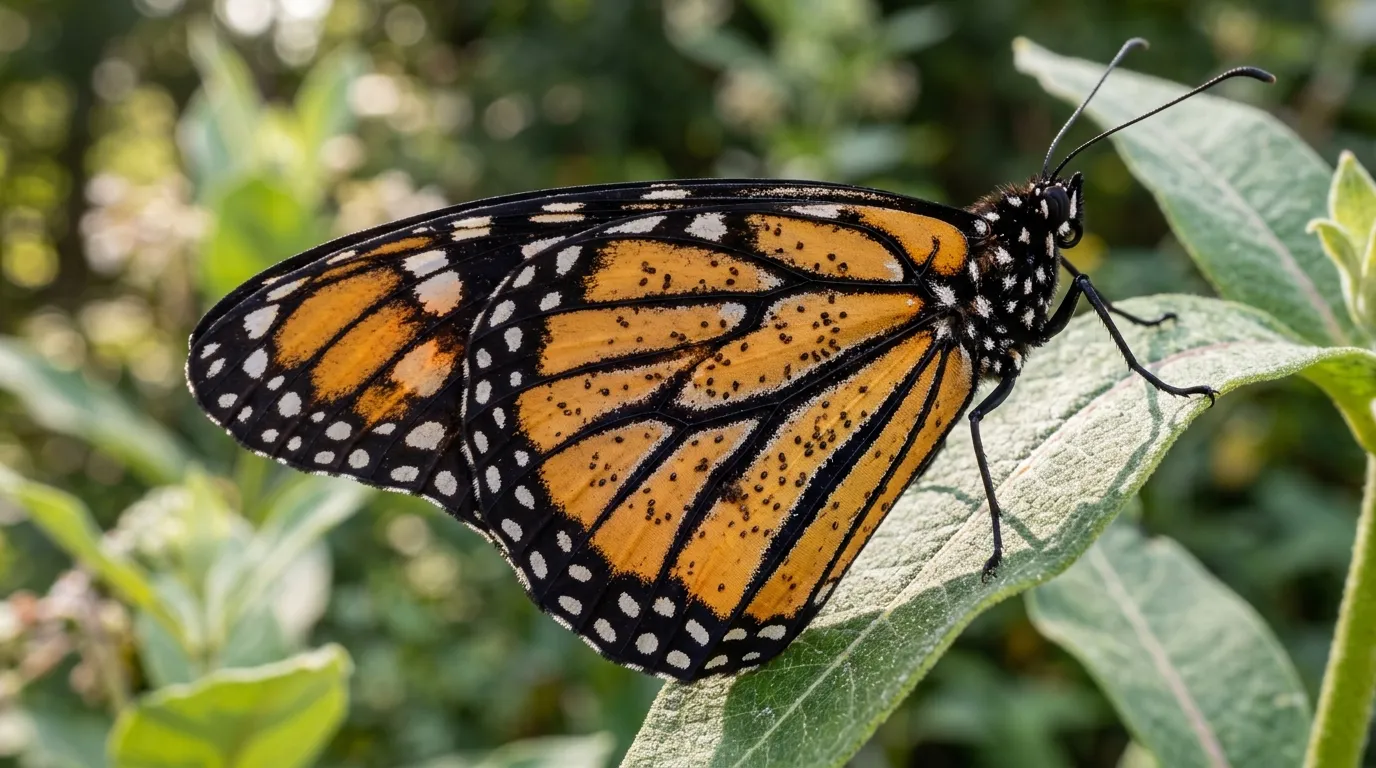
Ophryocystis elektroscirrha – universally called OE – is a protozoan parasite that specifically infects monarch and queen butterflies. It’s one of the most significant factors affecting monarch lifespan that many butterfly enthusiasts don’t know about until they start raising caterpillars and wondering why some adults emerge looking weak or deformed.
OE spores are microscopic and sit on the outside of an infected butterfly’s body, concentrated on the abdomen and wings. When an infected female lays eggs on milkweed, she scatters spores onto the leaf surface. Caterpillars ingest the spores while eating. The parasite replicates inside the caterpillar’s body during the pupal stage, and when the adult butterfly emerges, it carries a new load of spores on its scales. Heavily infected monarchs emerge with crumpled wings, reduced body mass, weaker flight ability, and significantly shortened lifespans.
Research from the Xerces Society and university labs has shown that OE infection rates vary geographically. The migratory eastern population typically shows relatively low infection rates – around 8% of sampled butterflies – because the annual migration effectively filters out heavily infected individuals. Butterflies too sick to complete the journey die en route, removing their spores from the breeding population. Western monarchs in California show higher infection rates, around 30%. But the highest infection rates – sometimes exceeding 70% – are found in non-migratory monarch populations in South Florida and Hawaii, where year-round breeding on tropical milkweed allows the parasite to build up continuously without the cleansing effect of migration.
This is one of the strongest arguments against planting tropical milkweed (Asclepias curassavica) in southern states where it doesn’t die back in winter. When milkweed stays green year-round, monarchs stop migrating and breed continuously in the same area. OE accumulates on the plants. Each successive generation picks up heavier parasite loads. The result is a local population of short-lived, weakened butterflies that wouldn’t survive migration even if they tried.
How the Migratory Generation Differs from Summer Monarchs
The physical and behavioral differences between summer monarchs and the fall super generation go well beyond just lifespan. These are measurably different animals in several respects, even though they’re genetically identical to their parents and siblings.
Wing morphology shifts in the migratory generation. Studies using digital wing measurements have found that fall migrants have larger, more angular forewings compared to summer breeders. The difference isn’t dramatic – we’re talking a few millimeters – but it measurably improves gliding efficiency. Migrants spend much of their southward journey soaring on thermals rather than actively flapping, and those slightly larger wings help them cover more distance per calorie burned.
Sun compass navigation is another distinguishing trait. All monarchs can orient using the sun, but migratory monarchs show a calibrated directional preference toward the southwest in fall. Their internal clock adjusts their flight heading throughout the day to compensate for the sun’s movement across the sky. Summer monarchs don’t show this directional bias – they fly in whatever direction food or mates take them. The broader characteristics of monarch butterflies include this navigational ability, but it’s really the migratory generation where it becomes most apparent and most critical.
Fat body composition sets migrants apart in a measurable way. A summer monarch’s abdomen contains relatively little stored lipid. A pre-migration fall monarch packs on lipids aggressively during September and October, nectaring heavily on goldenrod, asters, and other fall-blooming flowers. By the time they reach Mexico, their abdomens are noticeably rounder and heavier than a summer butterfly’s. Those fat reserves are the fuel tank for overwintering – months of survival with minimal food intake.
Behavioral differences round out the picture. Summer monarchs are territorial and aggressive toward other males. They court females persistently. They’re active throughout the day. Fall migrants are gregarious – they roost communally each evening during migration, sometimes gathering in trees by the thousands. They show little to no mating interest until spring hormones kick in months later. Aggression drops. Social tolerance goes up. It’s a completely different behavioral profile driven by the absence of juvenile hormone.
Frequently Asked Questions
How long does a monarch butterfly live in total from egg to death?
The complete life cycle from egg to adult death takes about six to eight weeks for summer generations. The egg stage lasts three to five days, the larval (caterpillar) stage runs about two weeks through five instars, the pupal (chrysalis) stage takes eight to fifteen days, and the adult lives two to six weeks. For the migratory generation, the total from egg to death stretches to roughly nine to ten months, with most of that time spent as an adult.
Do monarchs in captivity live longer than wild monarchs?
Captive monarchs sometimes live slightly longer than wild ones because they’re protected from predators, weather extremes, and food scarcity. A summer-generation monarch kept in a mesh enclosure with regular nectar access might live six to eight weeks instead of two to four. But captive monarchs don’t get the flight exercise or environmental cues that wild butterflies experience, and there are concerns that captive-raised monarchs released into the wild may have impaired navigation abilities.
Can you tell which generation a monarch belongs to by looking at it?
Not reliably by appearance alone. Fall migrants tend to have slightly fresher, less worn wings when they begin migration compared to a summer breeder at the same age, and their abdomens may appear fuller due to fat storage. But the differences are subtle enough that you can’t make a confident call without knowing when and where the butterfly was born. Behavioral cues are more telling – a monarch flying strongly southwest in September is almost certainly a migrant.
What is the oldest a monarch butterfly has ever lived?
The longest documented monarch lifespans fall in the range of nine months, which is the normal maximum for the migratory generation. Occasional reports of monarchs living ten or eleven months exist in research literature, but these are exceptional cases where late-season emergence and favorable conditions combined. No monarch has been documented surviving a full year. The biological limits of their wing structure – which can’t regenerate lost scales – and their finite energy reserves set a hard ceiling on adult lifespan.
Does milkweed species affect how long a monarch lives?
Yes. Caterpillars raised on different milkweed species show variation in adult size, cardenolide content, and immune function, all of which influence lifespan. Native milkweeds like common milkweed (Asclepias syriaca), swamp milkweed (A. incarnata), and butterflyweed (A. tuberosa) generally produce robust adults. Tropical milkweed (A. curassavica) grows well and monarchs will use it readily, but in warm climates where it persists year-round it can enable OE parasite buildup and disrupt migration patterns, both of which reduce average lifespan in those local populations.
How does climate change affect monarch butterfly lifespan?
Climate change affects monarch lifespan through multiple pathways. Hotter summers increase metabolic rates and shorten summer generation lifespans. Warmer winters at overwintering sites can cause monarchs to burn through fat reserves too quickly, reducing survival through the overwintering period. Shifting seasons can cause mismatches between monarch emergence and milkweed availability. More frequent extreme weather events – severe storms at the Mexican roosting sites, droughts that kill milkweed in breeding areas – introduce additional mortality that didn’t exist at historical levels.