


The Papilio machaon, known as the Old World swallowtail, is one of the most widespread butterflies on the planet. It ranges from the British Isles across Europe and Asia all the way to Alaska, and it turns up in an astonishing variety of habitats along the way. But for all its range, it has a life cycle that follows a precise, well-documented sequence of stages worth understanding in detail.
If you’ve spotted a large yellow butterfly with black veining and blue hindwing patches drifting over a meadow or hillside, there’s a good chance you were looking at this species. The caterpillar is just as striking as the adult, dressed in bright green with black bands and orange dots that make it one of the most recognizable butterfly larvae in the world.
Key Takeaways
- Papilio machaon completes a four-stage life cycle: egg, caterpillar (larva), chrysalis (pupa), and adult butterfly, with one to three generations per year depending on climate.
- The caterpillar is bright green with black stripes and orange-red dots, and it defends itself with an osmeterium, a forked gland that releases a foul-smelling chemical when threatened.
- The chrysalis overwinters in cold climates, with the adult emerging the following spring after months of dormancy inside the pupal case.
- Host plants include wild carrot, fennel, milk parsley, and other members of the carrot family (Apiaceae), making it easy to attract this species by planting these in your garden.
About Papilio Machaon
Papilio machaon belongs to the family Papilionidae and is one of the founding members of a genus that includes some of the most familiar swallowtails in the world. It is the type species for the entire genus Papilio, which means taxonomists have used it as the reference point for classifying all other species in the group. That’s a distinction not many butterflies hold.
The adult butterfly has a wingspan of roughly 65 to 86 mm. The wings are pale yellow with bold black veining and a broad black border along the outer edges. The hindwings carry a band of blue scaling near the margin and a red eyespot at the inner corner. The hindwings also have short, paddle-shaped tails, which is the feature that earns this family the common name “swallowtail.” For a broader look at the family and how to tell species apart, this guide to swallowtail species identification covers the key field marks across many related butterflies.
More than 30 subspecies have been described across the butterfly’s enormous range. The subspecies P. m. britannicus is restricted to the Norfolk Broads in England, where it depends almost entirely on milk parsley (Peucedanum palustre). Continental European and Asian populations use a wider range of Apiaceae plants, which is part of why the species is so successful across such diverse landscapes.
Egg Stage
Females lay eggs singly, depositing one per plant or per leaf rather than in clusters. This spreading behavior reduces competition between caterpillars and lowers the chance that a single predation event wipes out an entire clutch. The eggs are roughly spherical, about 1.2 mm in diameter, and pale yellow-green when first laid.
Within a few days, a dark spot becomes visible through the egg shell as the developing larva inside grows. By the time the egg is ready to hatch, it has darkened noticeably. The entire egg stage typically lasts between four and thirteen days, depending heavily on temperature. In warm summer conditions, development is faster. In cooler spring weather, it can stretch toward the longer end of that range.
Females are selective about where they lay. They prefer sun-exposed plants growing in open, warm spots such as south-facing slopes, road verges, and disturbed ground where the Apiaceae host plants are common. The caterpillar’s survival odds are strongly tied to the quality of that initial plant choice, which is why female Papilio machaon will spend considerable time assessing a plant before committing to an egg.
Caterpillar Stage
The caterpillar stage spans five instars and involves a dramatic change in appearance from start to finish. What hatches from the egg looks nothing like the bright larva you find in most photographs.
In the first and second instars, the young caterpillar is dark brownish-black with a white saddle marking across its midsection. This pattern closely resembles a bird dropping, which is widely understood as a form of protective camouflage. It works. Young caterpillars sitting still on a leaf stem are genuinely easy to overlook.
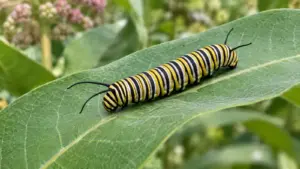
Around the third instar, the caterpillar begins its transformation. Green pigmentation increases, and the characteristic black transverse bands appear across the body. Each band is dotted with bright orange-red spots. By the fifth and final instar, the caterpillar is fully green, roughly 45 mm long, and strikingly marked. The contrast between the vivid green, black, and orange makes it one of the most visually distinctive caterpillars in Europe.
All five instars share one important defensive feature: the osmeterium. This is a forked, fleshy gland located just behind the head that the caterpillar can evert rapidly when threatened. The osmeterium in Papilio machaon is orange-yellow and releases a pungent odor described as a mix of isobutyric acid and 2-methylbutyric acid. It’s effective enough against many predators and parasitoids that it’s worth the energy cost to maintain.
Host plant use varies by region. In most of Europe, wild carrot (Daucus carota) and fennel (Foeniculum vulgare) are the most commonly used plants. Milk parsley, hogweed, rue, and various other Apiaceae are also accepted. The UK’s britannicus subspecies is essentially obligate on milk parsley in its fenland habitat. If you’re gardening to support this species, fennel and wild carrot are the most reliable choices almost anywhere in the butterfly’s European range. The complete rundown on choosing and growing host plants for swallowtails and other butterflies is covered in this guide to caterpillar host plants.
The full caterpillar stage lasts about three to four weeks in summer conditions. When the final instar is fully grown and ready to pupate, it leaves the host plant and wanders in search of a pupation site. It typically travels several meters before selecting a suitable stem, twig, or fence post and spinning a silk pad and girdle to anchor itself in place.
Chrysalis Stage and Overwintering
The chrysalis of Papilio machaon is well-camouflaged and comes in two main color forms: green and brown. The color is determined partly by the surface the caterpillar pupates on and the light conditions it perceives before spinning its silk, and it’s a useful example of how flexible development can be within a single species. A chrysalis formed on a green stem in bright light tends to be green; one formed on brown bark or in shadier conditions often develops a brown coloration.
The chrysalis is angular with distinct ridges running along the back and a pointed head case. It is held to its attachment surface by the silk girdle around the middle and the cremaster, a hook-like structure at the tail end that grips the silk pad at the base. This upright, head-up posture is typical of swallowtail pupae and distinguishes them from the hanging pupae of, say, monarchs.
In regions with a single generation per year, the chrysalis is the overwintering stage. The pupa enters diapause, a state of arrested development that allows it to survive cold winters inside the pupal case without the adult butterfly forming until temperature and light conditions signal that spring has arrived. In central and northern Europe, chrysalises from late summer can remain in diapause for six to eight months before the adult emerges.
Where conditions allow two or even three generations per year, such as in parts of southern Europe and lowland Asia, summer chrysalises take only about two to three weeks to complete development. The overwintering diapause is triggered specifically by the short days of late summer and autumn. Chrysalises from eggs laid in June or July typically develop without pause; those from late July or August onward enter diapause. The comparison with closely related species is instructive here, and the black swallowtail life cycle follows a similar seasonal pattern, with the chrysalis serving as the overwintering stage in northern populations.
Adult Butterfly
When the adult is ready to emerge, the chrysalis case becomes transparent and the yellow and black wing pattern is visible through it. Eclosion, the act of the adult pushing free of the case, takes only a few minutes. The newly emerged butterfly then hangs from the empty chrysalis, pumping fluid into its wing veins to expand the wings to full size. This process takes roughly 20 to 30 minutes, after which the wings need another hour or two to harden before the butterfly can fly.
Adult Papilio machaon are strong fliers and often cover significant distances. Males are territorial and will investigate hilltops and ridge lines, a behavior called hilltopping, where they patrol and wait for females to pass through. In areas with good populations, you can sometimes observe two or three males chasing each other in spiraling aerial displays over a favored hilltop on warm spring afternoons.
Both sexes nectar freely at a wide range of flowers. Thistles, knapweeds, marjoram, and buddleia are among the most frequently visited nectar sources. Adults live for roughly two to three weeks in the wild, though males in good condition can persist longer. Mating occurs soon after the adults have had time to feed and gain condition, typically within the first week of the adult’s life.
Females carry enough sperm from a single mating to fertilize all the eggs they will lay. After mating, they begin the process of locating suitable host plants and depositing eggs, which can continue for the remainder of their adult lives. A single female can lay over 100 eggs across her lifespan, though survival rates from egg to adult are low enough that most of those offspring will not complete development.
Where to Find Papilio Machaon
Papilio machaon is found across a range that spans from western Europe through temperate Asia and into subarctic North America. In Europe it is most commonly seen in open, flower-rich habitats: chalk downland, limestone grassland, road verges, and river valleys where Apiaceae plants grow in sunny, sheltered spots. In the UK, the wild population is restricted to a few fenland sites in Norfolk, though occasional migrants from continental Europe are spotted elsewhere.
In Asia, the species adapts to a remarkable range of elevations and landscapes, from lowland meadows to alpine zones above 3,000 meters in parts of the Himalayas and central Asian ranges. The subspecies found in Alaska and western Canada, P. m. aliaska, is one of the few swallowtail butterflies found in subarctic conditions. It completes just one generation per year and flies for a relatively short window in summer.
If you want to see this butterfly, timing matters as much as location. In southern and central Europe, the first brood flies from April to June, with a second brood in July and August. The best conditions are warm, sunny days with light winds. Adults are active and visible when temperatures are above about 18°C and will disappear into vegetation or rest with wings closed on cooler, overcast days.
Gardens with fennel, wild carrot, or rue are worth checking during the flight season, particularly in regions where populations are strong. According to Butterfly Conservation, the UK’s Papilio machaon britannicus subspecies is a priority conservation species, with most of the surviving population concentrated in the Norfolk Broads. The IUCN Red List currently lists the species globally as Least Concern, reflecting its wide range, though regional subspecies face more localized pressures from habitat loss and changes in land management.
Frequently Asked Questions
How many generations does Papilio machaon have per year?
It depends on where the population lives. In northern and upland areas with short summers, one generation per year is typical. In central Europe at lower elevations, two broods are common. In the warmest parts of the Mediterranean range, three generations per year are possible. The number of generations is primarily controlled by temperature and day length, with the chrysalis entering diapause when late-season conditions signal an approaching winter.
What does the Papilio machaon caterpillar eat?
The caterpillar feeds on plants in the carrot family (Apiaceae). Wild carrot (Daucus carota), fennel (Foeniculum vulgare), and milk parsley (Peucedanum palustre) are among the most commonly used host plants across its range. Other accepted plants include hogweed (Heracleum spp.), angelica, rue (Ruta graveolens), and occasionally plants in related families. Rue is notable because it belongs to the Rutaceae family rather than Apiaceae, making it a slight outlier among the host plant choices.
How long does the Papilio machaon life cycle take?
In summer, a generation from egg to adult takes roughly six to eight weeks. The egg stage lasts about one to two weeks, the caterpillar stage three to four weeks, and the summer chrysalis stage two to three weeks. Overwintering chrysalises add several months to the total, meaning the complete cycle from egg to adult can span seven to nine months when a pupa enters winter diapause. Adult lifespan is typically two to three weeks.
Is Papilio machaon the same as the swallowtail butterfly?
“Swallowtail” is used as a common name for many species in the family Papilionidae, so it can refer to dozens of different butterflies depending on context. In the UK specifically, “the swallowtail” almost always means Papilio machaon britannicus, since it is the only member of the swallowtail family that breeds in Britain. In North America, the name is more often attached to species like the eastern tiger swallowtail or the black swallowtail. When precision matters, using the scientific name Papilio machaon removes any ambiguity.
What is the orange organ on the Papilio machaon caterpillar?
That is the osmeterium, a defensive gland found in all caterpillars of the family Papilionidae. In Papilio machaon, it is a forked, orange-yellow structure that sits just behind the head and is normally kept hidden inside the body. When the caterpillar feels threatened, it everts the osmeterium rapidly, making it visible and releasing a strong, unpleasant smell. The scent comes from a mix of short-chain fatty acids and is effective at deterring some parasitoid wasps and small predators. After the threat passes, the caterpillar retracts the osmeterium back inside.