


Papilio xuthus: The Asian Swallowtail You Should Know
Papilio xuthus is one of the most common swallowtail butterflies across East Asia, found in gardens, parks, and citrus orchards from southern China to northern Japan. If you have ever walked through a Japanese garden between May and October, there is a good chance you have seen one. It’s a medium-sized butterfly with yellow and black tiger-striped wings, and while it looks superficially like the North American eastern tiger swallowtail, the two are not closely related and occupy completely different ranges.
I find this species interesting because it sits at the intersection of entomology, agriculture, and cultural tradition. It is one of the most studied butterflies in Japanese science, a minor citrus pest in commercial farming, and a recurring motif in East Asian art. That combination makes it worth understanding in some detail.
Key Takeaways
- Papilio xuthus is native to East Asia with established populations in China, Japan, Korea, Taiwan, and the Hawaiian Islands, where it was introduced in the 1970s.
- Its caterpillars feed on plants in the Rutaceae family, including cultivated citrus trees (lemon, orange, grapefruit) and wild species like Japanese prickly ash (Zanthoxylum).
- Adults produce two to four generations per year depending on latitude, with pupae entering diapause to survive winter in colder regions like Hokkaido and northern Honshu.
- This species has been a major model organism in butterfly genetics and wing pattern research, particularly at Japanese universities studying sex determination and pigmentation.
Identification and Appearance
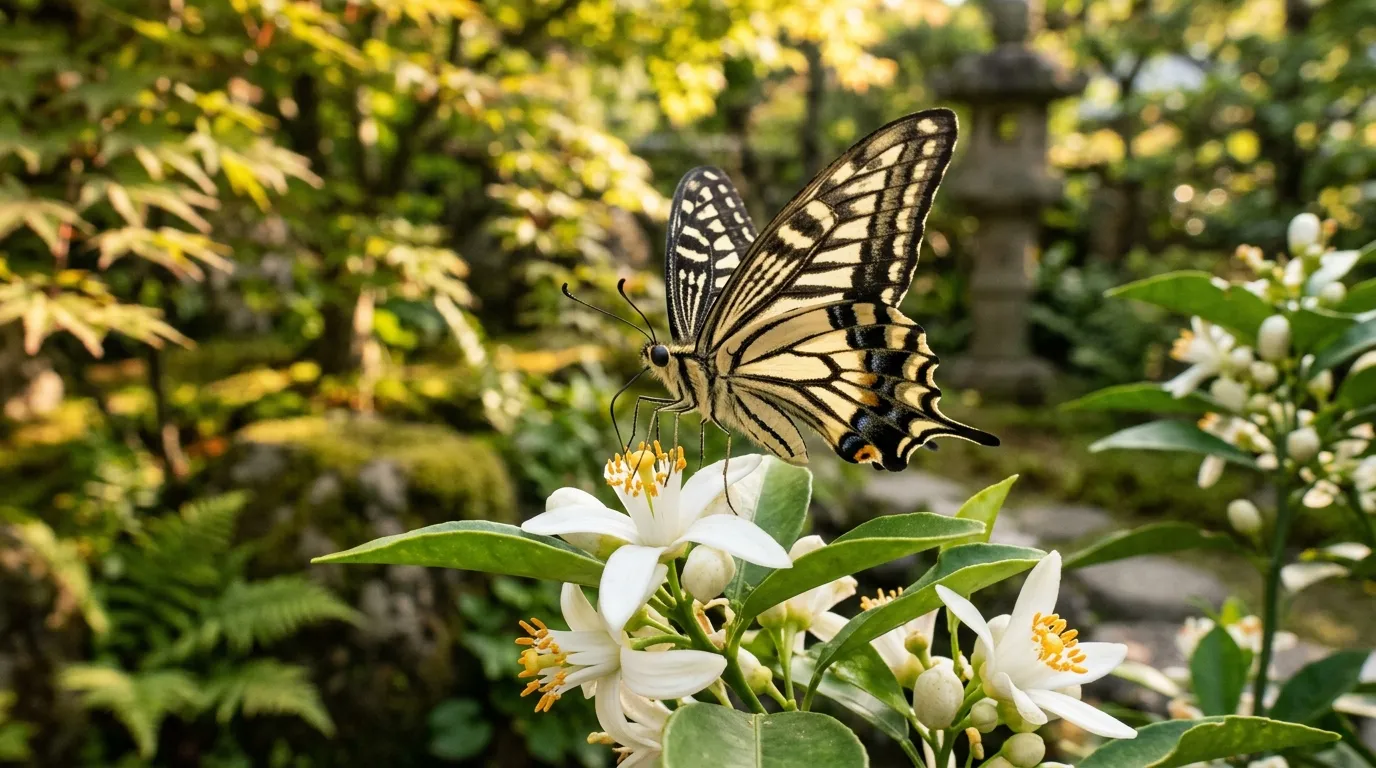
Papilio xuthus has a wingspan of 65 to 90 mm, putting it in the medium range for swallowtails. The forewings are predominantly black with yellow vertical bands running from the leading edge to the trailing edge. The hindwings carry similar yellow banding but with added blue and orange-red spots along the lower margin, near the short tail extensions that are typical of many Papilio species.
The underside of the wings is paler, with more muted coloring and additional orange markings on the hindwing. This ventral view is what you usually see when the butterfly is resting with wings closed, which makes field identification a bit trickier from below. A quick way to confirm you are looking at P. xuthus rather than a different Asian swallowtail is to check the forewing cell – it has a distinctive pattern of yellow and dark bars that other similar species lack.
Males and females are quite similar in appearance, though females tend to be slightly larger and the blue hindwing spots are often more pronounced in females. Sexual dimorphism in this species is subtle enough that wing pattern alone is not always reliable for sexing individuals in the field. The body is black with yellow lateral stripes running along the thorax.
People sometimes confuse Papilio xuthus with other Papilio species in its range, particularly Papilio machaon (the Old World swallowtail) and Papilio macilentus. The easiest distinguishing feature is the wing pattern geometry – P. xuthus has clearly defined yellow bands rather than the spotted pattern of P. machaon.
Geographic Range and Habitat
The native range of Papilio xuthus stretches across a wide band of East Asia. It is found throughout mainland China, the Korean Peninsula, Japan (all four main islands plus many smaller ones), Taiwan, and parts of Myanmar and Vietnam. The species reaches its northern limit in Hokkaido, Japan, and extends south into tropical and subtropical zones.
In Japan, it is arguably the most recognizable butterfly species and is abundant in urban gardens, rural farmland, and forest edges from April through October. Tokyo residents see it regularly in neighborhood parks and balcony planters where citrus or sansho pepper grows. It adapts well to human-modified environments, which is why it thrives in cities.
Outside its native range, Papilio xuthus became established in the Hawaiian Islands after being accidentally introduced sometime in the early 1970s. It is now common on Oahu, Maui, and the Big Island, where feral citrus and ornamental Rutaceae provide host plants. According to records from the University of Hawaii, the species was first documented on Oahu in 1971 and spread to other islands within a decade.
In terms of habitat preference, this is a lowland and mid-elevation butterfly. It favors gardens, orchards, forest margins, and river valleys where Rutaceae plants grow. You will not typically find it above about 1,500 meters elevation, and it avoids dense closed-canopy forest.
Host Plants and Larval Diet
Papilio xuthus caterpillars are Rutaceae specialists. This plant family includes all commercially grown citrus (oranges, lemons, limes, grapefruits, yuzu, kumquats) as well as wild and ornamental species. In Japan, the most common wild host plant is Zanthoxylum ailanthoides (Japanese prickly ash) and Zanthoxylum piperitum (sansho, the Japanese pepper used in cooking). In China, caterpillars are frequently found on Citrus reticulata (mandarin orange) and other cultivated citrus.
The preference for citrus trees is why Papilio xuthus sometimes gets called the “citrus swallowtail” in English, though that common name is more often applied to Papilio demoleus, a different species with its own wider distribution. Both species share the same host plant family, and in areas where their ranges overlap in Southeast Asia, they can be found on the same trees.
Female Papilio xuthus choose host plants by drumming the leaf surface with their forelegs, which carry chemoreceptors that detect the specific chemical profile of Rutaceae leaves. Research published in the Japanese Journal of Applied Entomology and Zoology has shown that females can distinguish between suitable and unsuitable host species within seconds of landing. They tend to lay single eggs on young, tender leaves near the tips of branches.
In commercial citrus orchards, the caterpillars can cause noticeable defoliation of young trees but are rarely considered a serious economic pest. Mature citrus trees tolerate the leaf loss without significant yield reduction. Most Japanese citrus growers view the caterpillars as a nuisance rather than a threat.
Life Cycle from Egg to Adult
The complete life cycle of Papilio xuthus takes roughly 30 to 45 days under warm summer conditions, though this varies with temperature and photoperiod. Understanding each stage gives you a clear picture of how this species fits into its environment across the typical butterfly lifespan range.
Eggs
Females lay spherical, pale yellow eggs singly on the upper surface of young citrus or Zanthoxylum leaves. Each egg is about 1.2 mm in diameter. The egg darkens as the larva develops inside and hatches in 4 to 7 days depending on temperature. A single female can lay between 200 and 300 eggs over her lifetime, though she spreads them across many plants rather than concentrating them.
Caterpillars
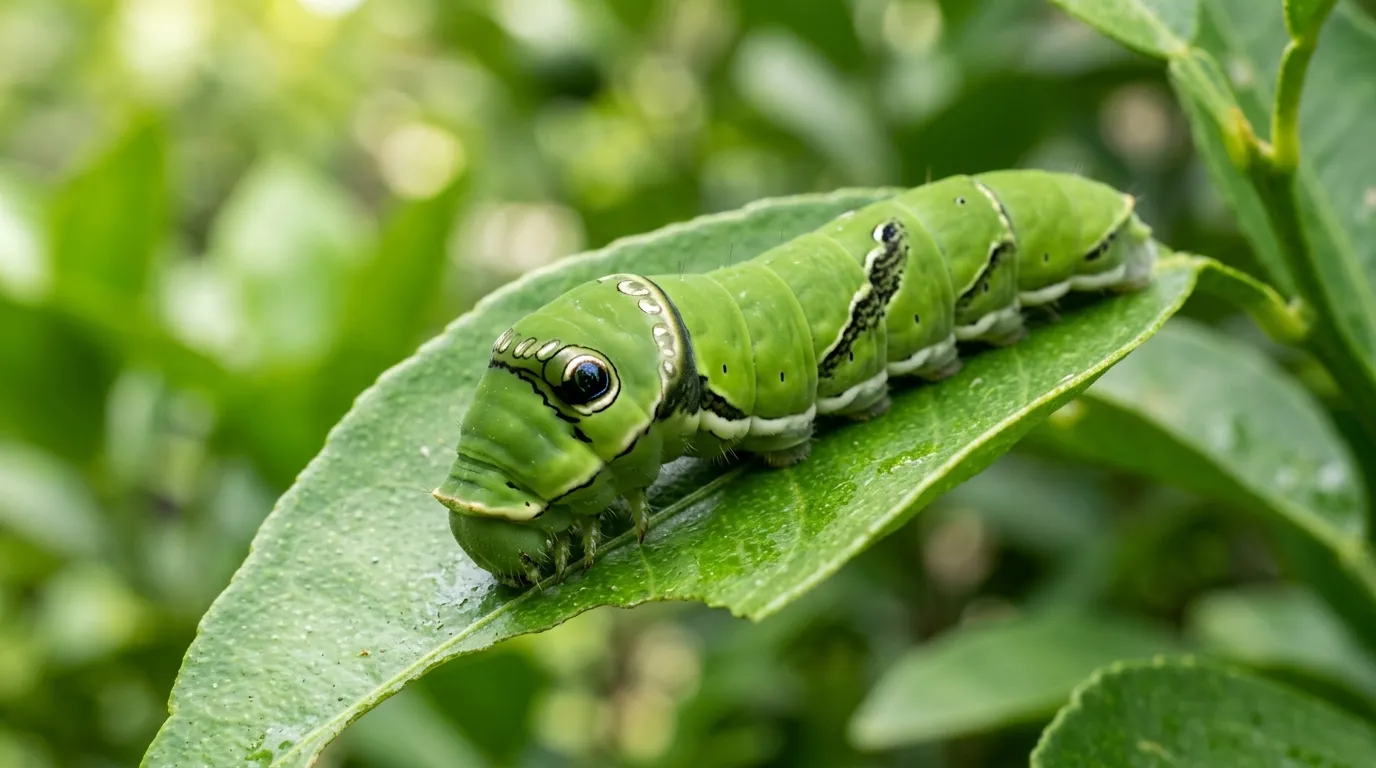
The caterpillars go through five instars over about 15 to 20 days. Early instars are dark brown and white, resembling bird droppings – a common camouflage strategy among Papilio larvae. By the fourth and fifth instar, they turn bright green with darker markings and a pair of blue-and-orange eyespots on the thorax.
Like all Papilio caterpillars, Papilio xuthus larvae have an osmeterium – a forked, orange, horn-like organ behind the head that they can evert when disturbed. It releases a pungent chemical cocktail that smells something like rancid citrus oil. The combination of the sudden visual display and the bad smell is effective at deterring parasitic wasps and small predators.
Pupae and Diapause
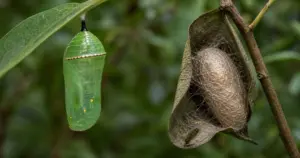
Pupation occurs away from the host plant. The caterpillar wanders and attaches itself to a branch, fence post, wall, or other firm surface using a silk girdle and cremastral pad. The chrysalis is either green or brown, depending on the surface it attaches to – a color-matching response triggered by the texture of the substrate.
In summer, the pupal stage lasts 10 to 14 days. But pupae formed in late autumn enter diapause, a state of developmental arrest triggered by shorter day lengths. These overwintering pupae remain dormant for four to six months, emerging the following spring when temperatures rise above about 15 degrees Celsius consistently. Diapause is how Papilio xuthus survives winters as far north as Hokkaido, where temperatures regularly drop well below freezing.
Adults
Adult butterflies live roughly 2 to 4 weeks. They feed on flower nectar from a variety of plants, with particular preference for azaleas, lantana, zinnia, and citrus blossoms. Males patrol along flight paths near host plants, looking for females, and engage in hilltop and ridge-crest territorial behavior in mountainous areas.
The species is multivoltine, producing two generations per year in northern Japan and up to four in southern China and Taiwan. The spring brood (emerging from overwintering pupae) tends to be slightly smaller with paler coloring than the summer broods, a common pattern in multivoltine Papilio species.
Cultural Significance in East Asia
Butterflies hold a different cultural weight in East Asia than they do in Western countries, and Papilio xuthus is one of the species that contributes to that tradition. In Japan, butterflies (cho) appear frequently in family crests (kamon), kimono textiles, and seasonal art. While the butterfly in Japanese art is often stylized and not always species-specific, P. xuthus is the swallowtail that most Japanese people encounter in daily life, and it shapes the popular image of what a “butterfly” looks like.
The species appears in Japanese elementary school science curricula. Raising Papilio xuthus from caterpillar to adult is a standard classroom project for third and fourth graders, similar to how American schools use painted ladies or monarchs. Kids collect caterpillars from citrus trees in the schoolyard or neighborhood and observe the full life cycle. This direct experience is one reason the species is so widely recognized across all age groups in Japan.
In Chinese culture, butterflies as a category symbolize love, happiness, and the soul. The famous legend of the Butterfly Lovers (Liang Shanbo and Zhu Yingtai) is one of the most retold stories in Chinese literature, and while it doesn’t name a specific species, swallowtails including P. xuthus are commonly depicted in artistic interpretations. In Korean traditional art and embroidery, butterflies often accompany floral motifs representing longevity and spring.
As a member of the broader Papilionoidea superfamily, Papilio xuthus connects to a lineage of swallowtails that have captured human attention worldwide. But in East Asia specifically, the frequency of everyday encounters with this butterfly – in the backyard, on the balcony, during a walk to the train station – gives it a familiarity that most butterfly species don’t achieve.
Papilio xuthus in Scientific Research
This species has been a workhorse in Japanese entomology labs for decades. Several characteristics make it ideal for research: it breeds easily in captivity, has a short generation time, accepts commercially available citrus as a host plant, and displays interesting genetic traits related to wing color and sex determination.
One of the most cited lines of research involves color vision. A team led by Kentaro Arikawa at Sokendai (the Graduate University for Advanced Studies) used Papilio xuthus to demonstrate that butterflies have tetrachromatic or even pentachromatic color vision – they can perceive ultraviolet, violet, blue, green, and red wavelengths through distinct photoreceptor types. This research, published in the Journal of Experimental Biology, changed the understanding of how insect visual systems work and has implications for pollination ecology.
Sex determination in Papilio xuthus has also been a focus. Butterflies use a WZ sex determination system (the reverse of mammals, where females are the heterogametic sex with WZ chromosomes and males are ZZ). Studies on P. xuthus have contributed to the broader understanding of how this system functions in Lepidoptera, including the roles of sex-linked genes in wing pattern expression.
Pupal color dimorphism – the ability of chrysalises to match their background color – has been experimentally manipulated in this species to study how environmental cues trigger developmental switches. Researchers have identified that surface texture, rather than color, is the primary signal the caterpillar uses when selecting a pupation site and triggering the green-versus-brown response.
Frequently Asked Questions
Is Papilio xuthus the same butterfly as the eastern tiger swallowtail?
No. Papilio xuthus and the eastern tiger swallowtail (Papilio glaucus) are separate species in the same genus. They share a similar yellow-and-black color scheme because of convergent evolution, not recent common ancestry. P. glaucus is native to eastern North America, while P. xuthus is native to East Asia. They do not overlap in range and have different host plant preferences – P. glaucus feeds on tulip tree, wild cherry, and sweetbay magnolia rather than citrus.
Is Papilio xuthus found in the United States?
Only in Hawaii. Papilio xuthus was accidentally introduced to the Hawaiian Islands in the early 1970s and is now well established on several islands, particularly Oahu, Maui, and the Big Island. It has not been recorded from the US mainland. If you see a yellow swallowtail in California or the eastern states, it is almost certainly a different species.
Does Papilio xuthus damage citrus trees?
The caterpillars eat citrus leaves, and heavy infestations on young trees can cause noticeable defoliation. On mature, established citrus trees, the damage is typically cosmetic and does not reduce fruit yield in any meaningful way. Most growers in Japan and China do not treat for this species specifically, though it can be an issue in nurseries with small seedlings.
What does the Papilio xuthus caterpillar look like?
Early-stage caterpillars are dark brown with white markings that mimic bird droppings. Later instars are bright green with a swollen thorax, dark diagonal bands on each segment, and a pair of blue-and-orange eyespots behind the head. When threatened, they extend an orange forked organ (osmeterium) that releases a strong citrus-like defensive odor.
How many generations does Papilio xuthus have per year?
It depends on location. In northern Japan (Hokkaido, northern Honshu), the species produces two generations per year. In central Japan and Korea, three generations are typical. In southern China, Taiwan, and Hawaii, four generations per year are common. The final generation of the year enters pupal diapause and overwinters as a chrysalis.
Can you raise Papilio xuthus at home?
Yes, and it is one of the easier swallowtails to rear in captivity. You need a steady supply of fresh citrus or Zanthoxylum leaves for the caterpillars, a well-ventilated container, and reasonable room temperature. In Japan, raising P. xuthus caterpillars from eggs found on backyard citrus trees is a common hobby for kids and adults. The entire cycle from egg to adult takes about five to six weeks in summer.