


Swallowtail Butterfly California | 6 Species to Find
If you’re looking for swallowtail butterfly species in California, you have six to track down – and every one of them is worth the effort. The most common is the western tiger swallowtail, a large yellow-and-black butterfly you’ll see cruising along riparian corridors from the Oregon border down to San Diego County. But California also hosts the anise swallowtail, pipevine swallowtail, pale swallowtail, two-tailed swallowtail, and the recently split western giant swallowtail (Papilio rumiko). Each occupies different habitat, flies at different times of year, and uses different host plants – so knowing what to look for and where to look matters.
I’ve spent a lot of time watching swallowtails across California, and one thing that keeps striking me is how the state’s extreme geographic diversity – coast, desert, mountains, valleys – creates pockets where different species dominate. A spring morning in the Sierra foothills gives you a completely different swallowtail lineup than an afternoon in a San Diego canyon. Here’s what you need to know about each species, where to find it, and when it flies.
Key Takeaways
- California has six resident swallowtail butterfly species, all in the family Papilionidae, ranging from sea level to above 8,000 feet in the Sierra Nevada.
- The western tiger swallowtail and anise swallowtail are the two most widespread and commonly seen species statewide, while the western giant swallowtail (Papilio rumiko) is the rarest and most range-limited.
- Host plants vary widely between species – western tigers use willows and sycamores, anise swallowtails use fennel and parsley-family plants, and pipevine swallowtails depend entirely on native Aristolochia pipevines.
- Flight season in California can stretch from February through October depending on species, elevation, and latitude, with some lowland populations producing two or three broods per year.
Western Tiger Swallowtail (Papilio rutulus)
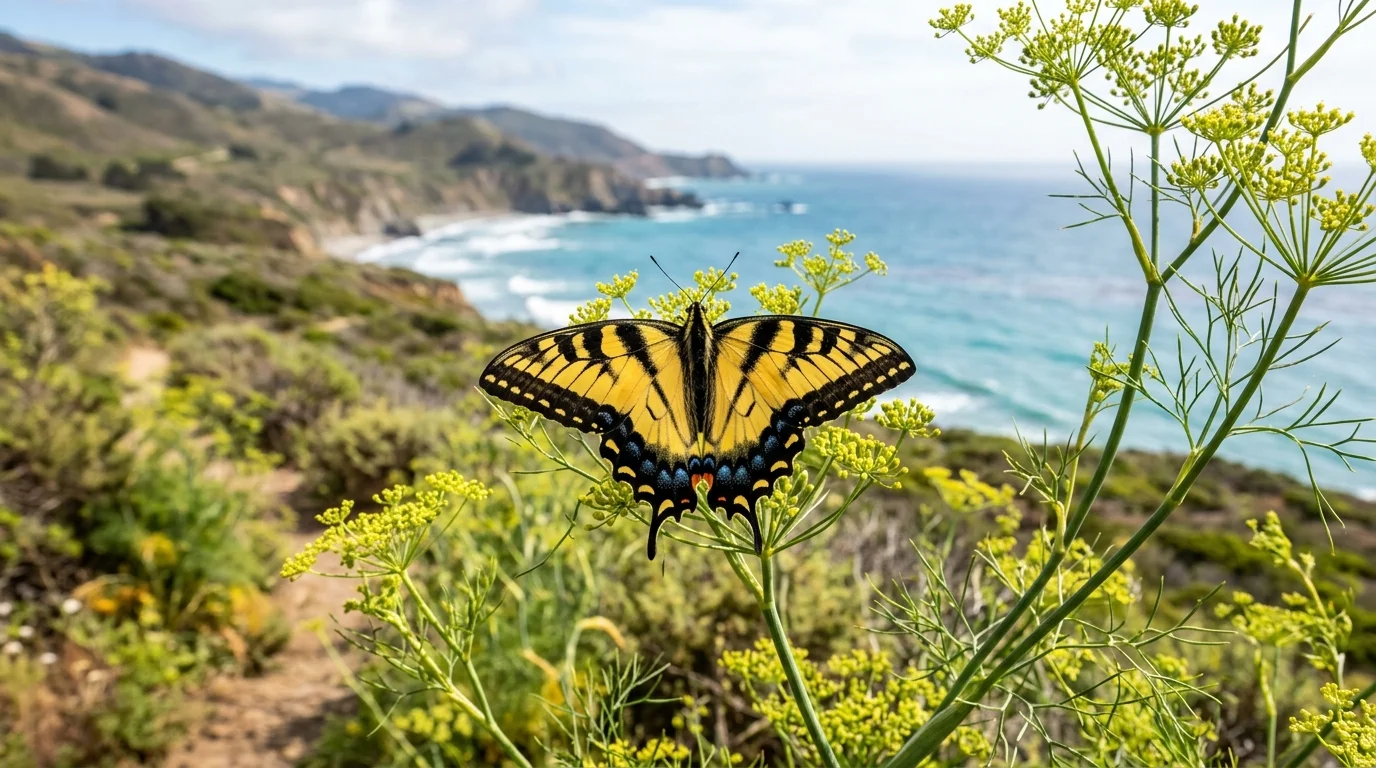
The western tiger swallowtail is the swallowtail butterfly most Californians know, even if they don’t know its name. It’s big – 3.5 to 4 inches across – with bold yellow wings crossed by four black tiger stripes and a row of blue and orange crescents along the hindwing margin. You’ll see it sailing along creeks, rivers, and irrigated neighborhoods from March through September, sometimes later in warm coastal areas.
Unlike its eastern cousin, the western tiger swallowtail doesn’t produce a dark morph female. Every individual is yellow-and-black, which makes field identification straightforward. Males are frequently seen puddling on damp sand or gravel along stream banks, where they gather sodium and minerals. Females spend more time in the tree canopy, ovipositing on willows (Salix), cottonwoods (Populus), and California sycamore (Platanus racemosa).
The best places to watch western tigers in California include any riparian corridor with mature sycamores – try the American River Parkway near Sacramento, Eaton Canyon in the San Gabriel Mountains, or Oak Creek Canyon near Sedona. In the Sierra foothills, they swarm around flowering California buckeye trees in May and June. The species typically produces one brood at higher elevations and two at lower elevations.
Anise Swallowtail (Papilio zelicaon)
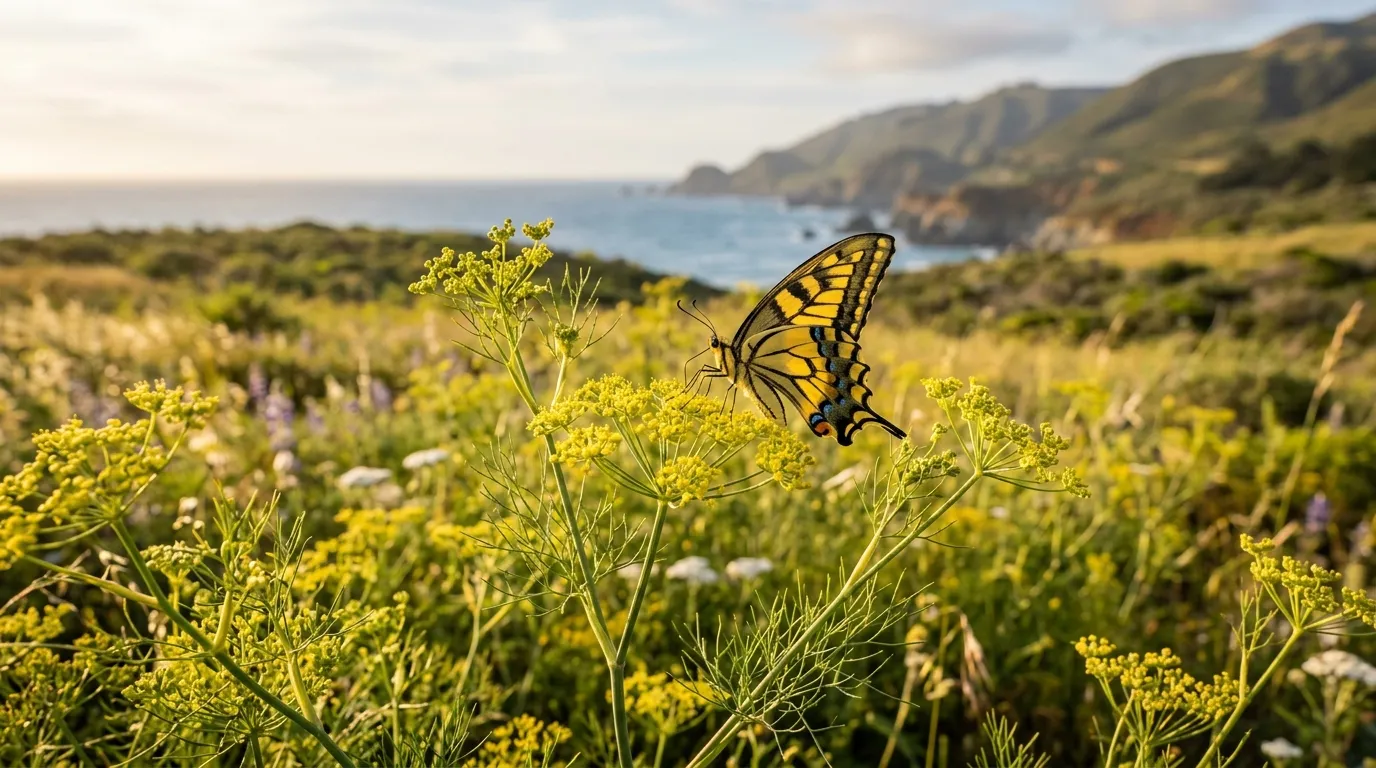
The anise swallowtail is California’s other common yellow swallowtail, and separating it from the western tiger trips up a lot of beginners. The anise swallowtail is slightly smaller, lacks the distinct tiger stripes, and instead shows a pattern of broad black bands with yellow spots across both wings. The hindwing has a prominent row of blue spots above the orange eyespot near the tail, and the overall look is more “spotted” than “striped.”
What makes this species especially visible in California is its love of non-native fennel (Foeniculum vulgare). Fennel has colonized roadsides, vacant lots, and coastal bluffs across much of the state, and anise swallowtail caterpillars treat it as a primary host plant alongside native members of the carrot family (Apiaceae) like Lomatium and Tauschia. If you grow parsley, dill, or fennel in your garden, there’s a decent chance you’ve hosted anise swallowtail caterpillars without knowing it.
This species flies from sea level to well above 8,000 feet in the Sierra Nevada and White Mountains. Coastal populations start flying as early as February and can produce two or three broods, while mountain populations are single-brooded, flying from June into August. Some of my best sightings have been on coastal headlands in Mendocino and Sonoma counties, where they nectar on seaside daisies and wild radish while wind whips off the Pacific.
Pipevine Swallowtail (Battus philenor)
The pipevine swallowtail is the dark, iridescent member of California’s swallowtail lineup – and the only one that’s genuinely toxic to predators. Both sexes are mostly black with a brilliant blue-green metallic sheen on the upper hindwings that shifts color in the light. The hindwing underside shows a single row of bold orange spots against a dark blue-black background, a pattern so distinctive that several other butterfly species have evolved to mimic it.
In California, pipevine swallowtails are tied entirely to California pipevine (Aristolochia californica), a native woody vine that grows in shady foothill woodlands and riparian areas from the North Coast ranges south through the central Sierra foothills. The caterpillars sequester aristolochic acids from the vine, making both larvae and adults unpalatable. This chemical defense is the foundation of a mimicry complex that includes the female dark morph of the spicebush swallowtail in the eastern US.
The species is most common in the Sacramento Valley foothills, Napa and Sonoma counties, and the central coast ranges. Flight season runs from February through October in lowland areas, with peak abundance in April and May when California pipevine is in active growth. A National Park Service profile notes that urban habitat loss has reduced pipevine swallowtail populations in the San Francisco Bay Area, though restoration plantings of Aristolochia californica in gardens and parks have helped stabilize some local colonies.
Pale Swallowtail, Two-Tailed, and Western Giant
The remaining three California swallowtails are each tied to specific habitats and less frequently encountered than the big three above.
The pale swallowtail (Papilio eurymedon) is a creamy white butterfly with black stripes – think of a western tiger swallowtail pattern painted in white instead of yellow. It favors foothill and mountain habitats, flying through chaparral, oak woodland, and mixed conifer forests from April through July. Host plants include California coffeeberry (Frangula californica), ceanothus, and other Rhamnaceae species. You’ll find pale swallowtails hilltopping on exposed ridges and peaks throughout the Coast Ranges and Sierra Nevada, often sharing summits with western tigers and anise swallowtails.
The two-tailed swallowtail (Papilio multicaudata) is California’s largest swallowtail, reaching up to 5.5 inches across. It gets its name from two distinct tail projections on each hindwing instead of the usual one. The color pattern resembles a western tiger but with narrower black stripes and that extra tail. In California, two-tails are primarily found in riparian canyons of southern California and the desert foothills – San Bernardino, Riverside, and San Diego counties, plus scattered records in the Central Valley. They use ash (Fraxinus) and chokecherry (Prunus virginiana) as host plants. Flight season peaks in May and June, with a smaller second brood in August and September in warmer locations.
The western giant swallowtail (Papilio rumiko) is the rarest swallowtail in California and was only formally split from the eastern giant swallowtail (P. cresphontes) in 2014. It’s a large, dark brown butterfly with bold yellow spot-bands across the wings, giving it a very different look from the tiger-striped species. In California, it’s found primarily in southern California’s coastal sage scrub and riparian habitats, from Los Angeles County south. Host plants include various native and planted citrus-family plants (Rutaceae), particularly hop tree (Ptelea) and cultivated citrus in residential areas. Sightings have been increasing in recent years, possibly due to range expansion northward linked to warming temperatures.
Best Locations for Swallowtail Watching in California
A few spots stand out for seeing the most species in one area. The Sierra Nevada foothills between 1,000 and 3,000 feet, especially along the Highway 49 corridor through Gold Country, offer western tiger, anise, pale, and pipevine swallowtails all flying together from April through June. The California Department of Fish and Wildlife manages several ecological reserves in this zone with good trail access.
For southern California species including the two-tailed and western giant swallowtails, the canyons behind San Diego – Mission Trails Regional Park, Torrey Pines, and the riparian corridors of the Santa Ana Mountains – are productive from March through August. The Anza-Borrego Desert State Park transition zone between desert floor and montane can also produce interesting sightings when desert willows and desert lavender are blooming.
The San Francisco Bay Area is particularly good for pipevine swallowtails. The San Francisco Botanical Garden has an active California pipevine planting program, and the butterfly has become a local conservation mascot. Nearby Tilden Regional Park in the East Bay hills hosts all four of the state’s most common species along its fire roads and ridgelines.
Timing matters as much as location. The general swallowtail season in California peaks between late March and mid-June at low to mid elevations. Mountain populations shift later – late June into August in the high Sierra. If you can visit a Sierra foothill riparian area during the first two weeks of May, you have the best chance of seeing four species in a single morning. Understanding how long each species lives as an adult helps explain why timing your visits to peak emergence windows matters so much.
Host Plants and How to Attract California Swallowtails
If you want swallowtails in your California garden, plant their host plants. It’s that simple – and that specific. Each species has strong preferences, and a general “butterfly garden” full of only nectar flowers won’t get you breeding populations.
For western tiger swallowtails, plant a California sycamore or willow if you have room. Even a small weeping willow in a suburban yard will attract egg-laying females. Anise swallowtails are the easiest to attract – let some fennel, parsley, or dill go to seed in your herb garden. I’ve had multiple generations of anise swallowtail caterpillars on a single fennel patch over a summer.
Pipevine swallowtails require California pipevine (Aristolochia californica), which is available from native plant nurseries throughout the state. It’s a deciduous vine that goes dormant in summer, so pair it with an evergreen trellis neighbor for year-round coverage. The vine can take a few years to establish before caterpillars find it, but once they do, you’ll have a self-sustaining colony.
For nectar sources that attract all species, California native plants like woolly blue curls (Trichostema lanatum), California buckeye, and yerba santa (Eriodictyon) are excellent. Non-native lantana, butterfly bush, and Mexican sunflower also work well in gardens where native-only plantings aren’t a priority. The full swallowtail species guide covers host plant relationships for the broader family.
Frequently Asked Questions
How do I tell a western tiger swallowtail from an anise swallowtail in California?
Look at the wing pattern. Western tiger swallowtails have four bold, continuous black stripes across a yellow background – the “tiger” pattern. Anise swallowtails have broader black areas with yellow spots and bands broken up into individual patches rather than long stripes. The anise swallowtail also has a more prominent blue band on the hindwing and tends to be slightly smaller. Once you’ve seen both side by side, the difference is obvious.
Are any swallowtail butterflies endangered in California?
None of California’s six swallowtail species are federally listed as endangered. The pipevine swallowtail has experienced significant local population declines in urbanized areas, particularly around the San Francisco Bay, due to loss of its host plant. The western giant swallowtail remains uncommon and range-limited but doesn’t currently have protected status. California’s most endangered butterfly overall is the Lange’s metalmark (Apodemia mormo langei), which is critically endangered but belongs to the metalmark family, not the swallowtail family.
What time of year should I look for swallowtails in California?
The main flight season runs from March through August at most elevations. Coastal and lowland populations start earliest – pipevine swallowtails can appear as early as late February in the Sacramento Valley. Peak diversity, when the most species are flying simultaneously, is typically mid-April through May at foothill elevations (1,000 to 3,000 feet). Mountain populations in the Sierra fly later, from June into August.
Can I raise California swallowtail caterpillars at home?
Yes, anise swallowtail caterpillars are among the easiest North American butterflies to raise. Collect a caterpillar from your fennel or parsley, provide fresh cuttings of the host plant in a ventilated container, and watch it grow through its instars to pupation. The chrysalis may either eclose in two to three weeks (summer brood) or enter diapause and wait until the following spring. Western tiger swallowtail caterpillars can also be raised on willow cuttings but need more space due to their larger size.
Do California swallowtails migrate?
California’s swallowtails are not true migrants like monarchs. They don’t make long-distance seasonal movements. Some species do make short altitudinal shifts – western tiger swallowtails in the Sierra may move downslope in fall to find suitable pupation sites at lower elevations. And individual butterflies can disperse considerable distances, sometimes turning up well outside their normal range. But there’s no organized, directional migration happening with any of the state’s swallowtail species.
Why do swallowtails puddle on wet ground?
Puddling is almost exclusively a male behavior. Males land on damp sand, mud, or animal droppings and pump fluid through their bodies to extract dissolved sodium and amino acids, which they transfer to females during mating as a nuptial gift. In California, you’ll see male western tiger swallowtails and pale swallowtails puddling along creek banks in large groups during warm spring mornings. If you find a good puddle spot, sit and wait – they’ll keep coming back to the same patch of damp ground all day.
What is the difference between a western giant swallowtail and an eastern giant swallowtail?
The western giant swallowtail (Papilio rumiko) was split from the eastern giant swallowtail (P. cresphontes) in 2014 based on DNA analysis and subtle differences in wing pattern and genitalia. Visually, the two are very similar – both are large, dark brown butterflies with yellow spot-bands. P. rumiko tends to have slightly narrower yellow bands and differs in the shape of markings near the hindwing tail. In the field, range is the most practical separator: if you’re in California, it’s P. rumiko.