


Swallowtail Meaning | Symbolism Across Cultures
The swallowtail meaning that appears most consistently across world cultures is personal transformation paired with joy. These large, conspicuous butterflies have caught human attention for thousands of years, and nearly every culture that encounters them has attached spiritual or symbolic weight to their presence. From Japanese family crests to Native American creation stories, swallowtails carry messages that go well beyond what most people expect from a butterfly’s general symbolism.
What separates swallowtail symbolism from general butterfly symbolism is specificity. While any butterfly might represent change, the swallowtail’s size, striking color patterns, and distinctive tailed wings give it a presence that cultures have singled out by name. The long tail extensions on their hindwings are themselves a symbol – they suggest grace under pressure, since swallowtails can still fly even after losing those tails to a predator’s grasp.
Key Takeaways
- Swallowtail meaning centers on transformation, resilience, and spiritual connection across nearly every culture that has named these butterflies, from the Navajo and Hopi peoples of North America to the samurai families of feudal Japan.
- In Japanese culture, the swallowtail (ageha) appears on over 50 family crests called kamon, where it represents courage, rebirth, and noble lineage – the Taira clan’s swallowtail crest is among the most recognized in Japanese heraldry.
- Color-specific swallowtail meanings vary significantly: black swallowtails are tied to mystery, shadow work, and ancestral messages, while yellow swallowtails signal hope and creative energy, and blue swallowtails point toward calm communication and truth.
- When a swallowtail visits you repeatedly, many spiritual traditions interpret it as a prompt to pay attention to personal growth you’ve been avoiding or a sign that a period of stagnation is about to break open.
Swallowtail Meaning in Native American Traditions
Native American symbolism for swallowtails varies by nation, but common threads run through many tribal traditions. Among the Navajo, butterflies including swallowtails appear in the creation narrative as symbols of happiness and rebirth. The Navajo word for butterfly, k’aalogii, appears in healing ceremonies where the butterfly’s transformation from caterpillar to winged adult mirrors the patient’s journey from illness back to health.
The Hopi people connect swallowtails to the kachina tradition. Butterfly Maiden (Poli Mana) is a kachina spirit associated with spring, fertility, and the return of warmth. While she represents all butterflies, the swallowtail’s size and visibility during planting season made it a frequent inspiration for her depictions on pottery and in dance regalia. Her presence in ceremony marks the time for seeds to go into the ground – a practical message wrapped in spiritual clothing.
Blackfoot tradition treats swallowtails as dream messengers. Women would sometimes embroider butterfly shapes onto children’s clothing or cradle boards to encourage restful sleep and meaningful dreams. The Papilionidae family’s characteristic features – the long tails, the bold patterns – made swallowtails especially recognizable in these textile designs.
Among the Zuni people of the Southwest, butterflies carry prayers to the spirit world. A swallowtail landing near you during a difficult time was read as confirmation that your concerns had been heard. This isn’t a generic “good luck” interpretation – it’s specific to communication between the living and the spiritual realm, and it required the butterfly to arrive unprompted. Chasing one down didn’t count.
Swallowtail Symbolism in Japanese Culture
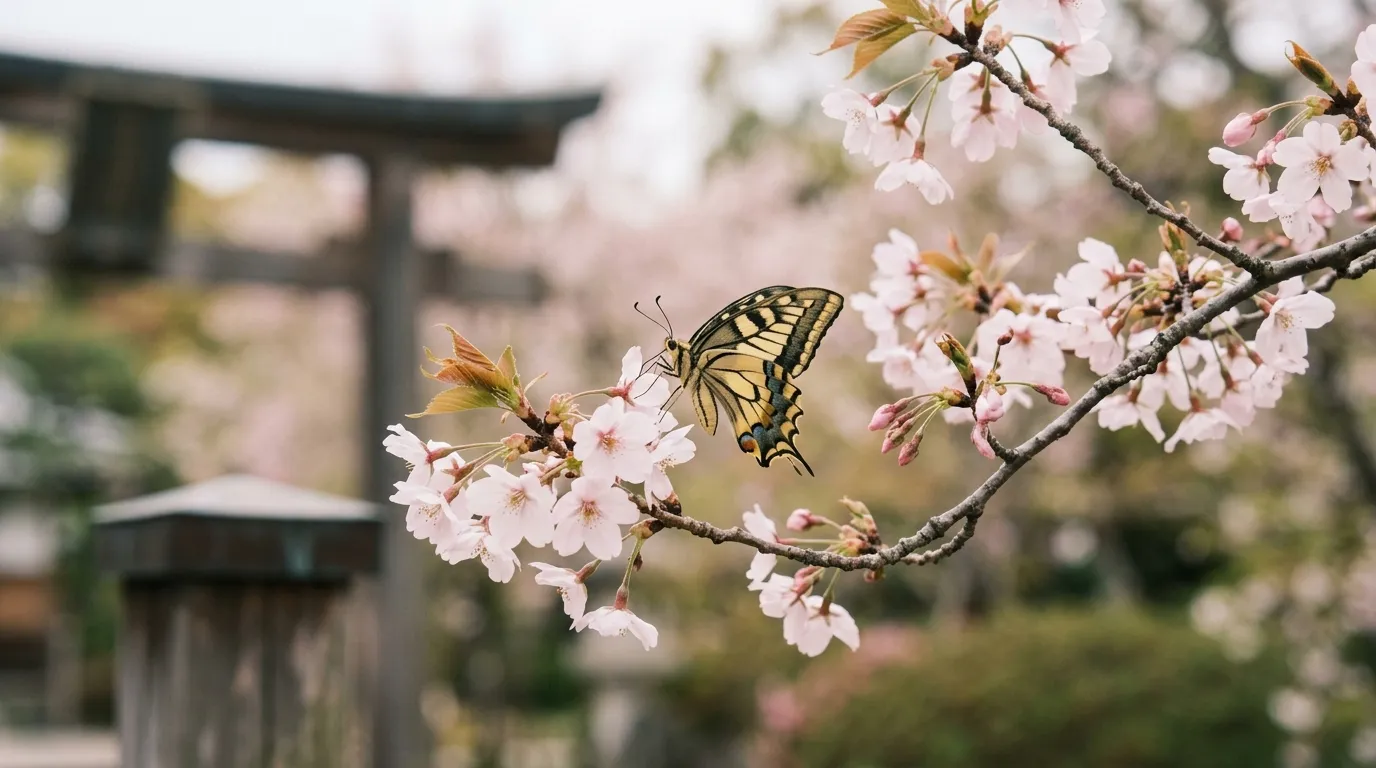
Japan’s relationship with swallowtail symbolism runs deeper than in almost any other culture. The Japanese swallowtail (Papilio xuthus) and the Chinese windmill swallowtail (Atrophaneura alcinous) are common across the Japanese archipelago, and their cultural presence stretches back more than a thousand years.
The most concrete expression of swallowtail meaning in Japan is the kamon system – family crests that identify lineage the way coats of arms do in European heraldry. The ageha-cho (swallowtail butterfly) kamon ranks among the most popular crest designs, with over 50 documented variations. Some show the butterfly from above with wings spread, others show it in profile or stylized into geometric patterns that barely resemble a butterfly until you know what you’re looking at.
The Taira clan, one of the four great clans of feudal Japan, adopted the ageha-cho as their family crest. For a warrior clan to choose a butterfly – an animal most cultures associate with delicacy – says something about what the swallowtail meant to them. In the samurai context, the swallowtail represented not fragility but rebirth through struggle. The butterfly’s complete dissolution inside the chrysalis and reassembly into a new form paralleled the warrior’s willingness to face destruction and emerge changed. Several branch families of the Taira continued using swallowtail variations on their kamon for centuries after the clan’s political decline.
Beyond heraldry, swallowtails appear in Japanese textile design, lacquerware, and seasonal poetry. The butterfly is a summer kigo (seasonal word) in haiku, and its appearance signals the warmth and abundance of the growing season. In the language of flowers and insects that pervades Japanese gift-giving culture, a swallowtail motif on a gift suggests wishes for the recipient’s personal growth and flourishing.
Christian Symbolism and Western Spiritual Traditions
In Christian symbolism, butterflies broadly represent resurrection – the emergence from the chrysalis mirroring Christ’s emergence from the tomb. Swallowtails, being among the largest and most visible butterflies in Europe and the Americas, frequently appeared in Christian art from the Renaissance onward as shorthand for the spirit’s journey after death.
Medieval European manuscripts sometimes include butterfly illustrations alongside passages about the afterlife. The three life stages – crawling caterpillar, seemingly dead chrysalis, risen butterfly – mapped neatly onto the Christian narrative of earthly life, death, and resurrection. While these illustrations weren’t always identifiable to species, the ones with visible tail extensions on the hindwings clearly reference swallowtails.
Some Christian writers extended the symbolism to include the spirit’s purification. The caterpillar’s earthbound existence represents the burden of sin; the chrysalis represents the period of transformation through faith; and the butterfly represents the purified spirit. The swallowtail’s habit of spiraling upward in flight – a behavior related to thermals and mate searching – was interpreted as the spirit ascending toward heaven.
In broader Western spiritual thought outside formal Christianity, swallowtails picked up associations with common butterfly sayings and their origins that emphasize freedom, lightness, and the temporary nature of beauty. Victorian-era butterfly collectors often wrote about swallowtails in almost reverential terms, treating them as living proof that nature contained a design sensibility that pointed toward something beyond the material.
Swallowtail as Spirit Animal and Totem
In contemporary spiritual practice, the swallowtail as a spirit animal carries a specific set of associations that differs from generic butterfly spirit guidance. People who identify the swallowtail as their spirit animal or totem tend to share certain characteristics: they’ve been through significant life disruptions that forced reinvention, they process change slowly but thoroughly, and they emerge from difficult periods with more capacity than they started with.
The swallowtail spirit animal is specifically connected to creative transformation. Where a monarch spirit animal might emphasize endurance and long-distance persistence, and a painted lady might emphasize adaptability, the swallowtail emphasizes the quality of what comes out the other side. It’s not about surviving change – it’s about becoming something genuinely different and more developed through the process.
As a totem, the swallowtail is sometimes called on during periods when someone feels stuck between their old identity and a new one that hasn’t fully formed yet. That in-between state – which parallels the chrysalis stage – is uncomfortable, and the swallowtail totem’s message is essentially patience with the process. Trying to rush the transformation produces a half-formed result, like a butterfly that emerges before its wings have fully developed.
People working with swallowtail energy in meditation or guided imagery often report being drawn to themes of color and self-expression. This makes sense given that swallowtails are among the most colorful types of butterflies in any region where they fly. The message isn’t subtle: don’t hide what makes you stand out.
What It Means When a Swallowtail Visits You
A swallowtail landing near you or circling around you carries different weight depending on who you ask, but several interpretations show up repeatedly across traditions. The most common reading is that you’re approaching a turning point. The swallowtail’s arrival functions as a heads-up: something in your life is about to shift, and the nature of the shift depends partly on your willingness to let it happen.
If a swallowtail visits you during a period of grief, many traditions interpret this as a message from someone who has passed. This belief appears in Mexican, Filipino, Irish, and several Native American cultures independently, which suggests either cultural cross-pollination or a common human impulse to connect butterflies with departed loved ones. The swallowtail’s specific association with this varies by color – a dark or black swallowtail visiting during mourning is considered especially significant.
Repeated swallowtail visits – seeing the same species multiple times in a short period, or having one appear at unusual moments – get interpreted as urgency. The message isn’t changing; you’re just not acting on it yet. This might mean a creative project you’ve been avoiding, a relationship conversation you’ve been postponing, or a life change you know you need to make but keep finding reasons to delay.
I want to be honest that these are folk interpretations and spiritual readings, not science. A swallowtail visiting your garden probably means you have the right flowers or host plants. But the line between “that butterfly likes my parsley” and “that butterfly is here for a reason” is one that individual people get to draw for themselves.
Color-Specific Swallowtail Meanings
Not all swallowtails carry the same symbolic weight, and color plays a major role in how different traditions read their meaning. The three most symbolically discussed color groups are black, yellow, and blue.
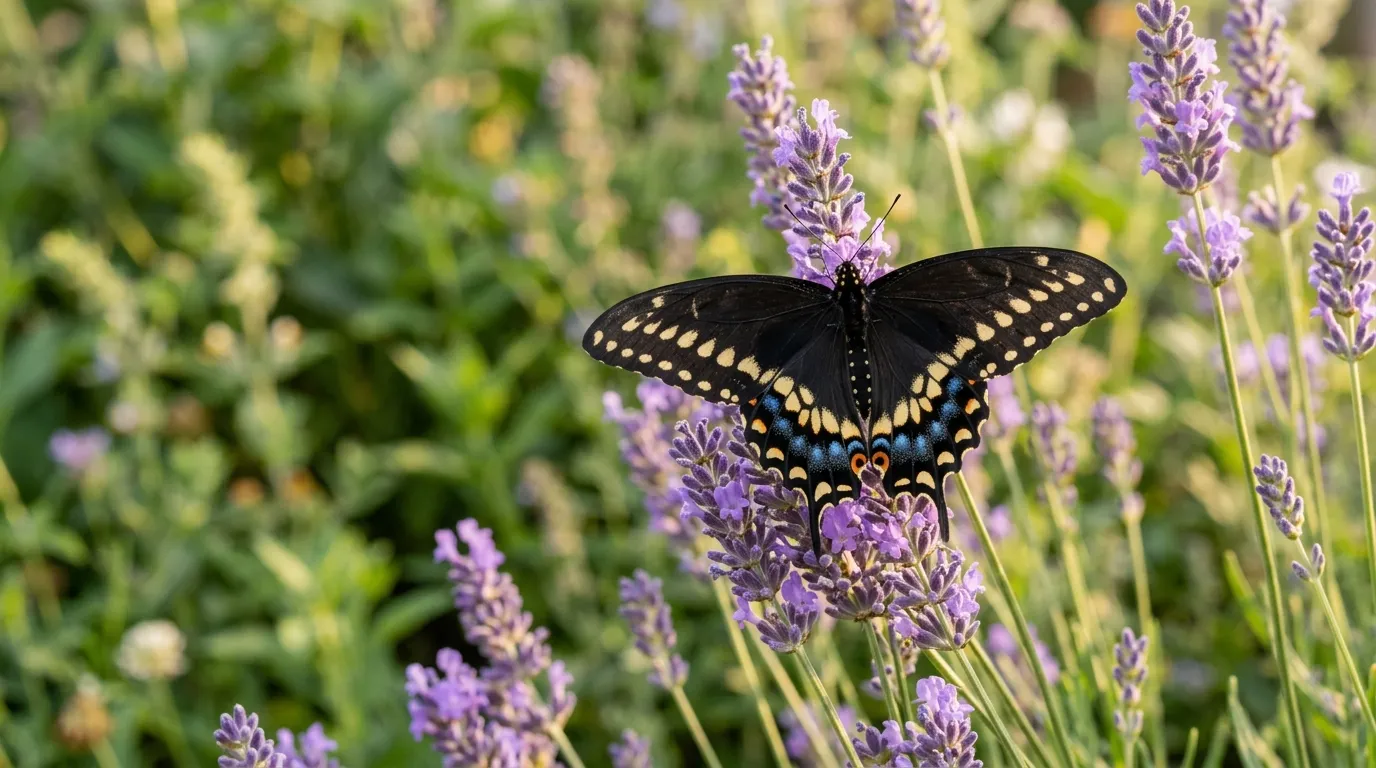
Black swallowtails carry meanings tied to mystery, the unknown, and shadow work – the psychological process of confronting parts of yourself you’d rather ignore. In many traditions, a black swallowtail appearing points to something you’ve been avoiding. The color black in butterfly symbolism doesn’t carry the negative connotations it holds in some Western contexts; instead, it points toward depth, the unseen, and the fertile darkness from which new things grow. Some interpret black swallowtails as ancestral messengers, particularly in African American folk traditions and in parts of the Caribbean where black butterflies are closely associated with visiting spirits.
Yellow swallowtails – including eastern and western tiger swallowtails – are associated with hope, intellectual energy, and creative inspiration. Yellow is the color of the solar plexus chakra in Hindu-derived energy systems, connecting these butterflies to personal power and confidence. Seeing a yellow swallowtail is often read as encouragement to pursue a new idea or take a risk on something you’ve been considering. In Chinese symbolism, yellow butterflies connect to prosperity and good fortune, making yellow swallowtails doubly positive – they carry both the general butterfly meaning and the specific weight of the color.
Blue swallowtails – like the pipevine swallowtail with its blue-black iridescence or the blue morpho-like sheen on some tropical Papilionidae – symbolize calm communication, emotional truth, and spiritual clarity. Blue connects to the throat chakra, suggesting that seeing a blue-toned swallowtail is a prompt to speak honestly about something you’ve been keeping quiet. In some New Age interpretations, blue swallowtails signal that psychic or intuitive abilities are strengthening.
Swallowtail Tattoo Meanings
Swallowtail butterfly tattoos carry layered meanings that combine general butterfly symbolism with the specific cultural associations outlined above. The most common reason people choose a swallowtail over another butterfly species for a tattoo is the visual drama – those long tails and bold color patterns translate well to skin and give tattoo artists more design material to work with.
A realistic swallowtail tattoo typically represents personal transformation that the wearer has already lived through. Unlike a phoenix tattoo, which suggests rising from destruction, the swallowtail tattoo emphasizes the completeness of the change. The person who got it isn’t the same person who entered the difficult period. The caterpillar didn’t just survive and recover – it became an entirely different creature.
Watercolor-style swallowtail tattoos have grown popular in the last decade. These use color bleeding and splashes outside the wing outlines to emphasize freedom and the release of rigid boundaries. People choosing this style often connect it to letting go of perfectionism or control.
Placement carries meaning too. A swallowtail on the shoulder blade references wings and flight directly – the desire for freedom or escape. On the wrist or forearm, it stays visible to the wearer as a daily reminder. Behind the ear or on the ankle, it’s more private, suggesting a personal transformation that doesn’t need public acknowledgment. Memorial swallowtail tattoos – honoring someone who has died – often include the person’s name, a date, or a flower that was meaningful to the relationship.
The Japanese kamon-style swallowtail has become a popular tattoo choice for people interested in Japanese culture or martial arts. These geometric, circular designs work well as standalone pieces and carry the samurai-era associations of courage through transformation. A traditional Japanese tattoo artist (tebori or machine) might incorporate the ageha-cho into a larger back piece alongside water, wind, or floral elements.
Frequently Asked Questions
What does a swallowtail butterfly symbolize spiritually?
Spiritually, the swallowtail symbolizes deep personal transformation, the courage to change completely rather than just adapt, and communication between the physical and spiritual worlds. It differs from general butterfly spiritual meaning by emphasizing the quality and depth of change rather than change itself. Many spiritual practitioners associate swallowtails specifically with creative rebirth – becoming something more expressive and authentic than your previous form.
Is a swallowtail butterfly a sign of good luck?
In most traditions, yes, but with a nuance. The “luck” a swallowtail brings is less about random fortune and more about readiness. Chinese, Japanese, and several Native American traditions read swallowtail appearances as signs that conditions are right for positive change. The luck isn’t passive – it requires you to act on whatever opportunity or transformation the butterfly signals. A swallowtail landing on you is considered especially auspicious in Filipino and Mexican folk belief.
What does it mean when a black swallowtail crosses your path?
A black swallowtail crossing your path is most commonly interpreted as a signal to look inward at something you’ve been avoiding. In African American and Caribbean spiritual traditions, it can indicate a visit or message from an ancestor. The black coloring amplifies the butterfly’s general symbolism of transformation by adding an element of the unknown or hidden – suggesting that the change coming involves confronting something in the shadows rather than pursuing something bright and obvious.
Why are swallowtails used in Japanese family crests?
Swallowtails became prominent in the Japanese kamon system because their symmetrical wing shape translates naturally into circular crest designs, and their symbolic meaning aligned with samurai values. The butterfly’s complete transformation from caterpillar to winged adult mirrored the warrior’s ideal of constant self-refinement. The Taira clan’s adoption of the ageha-cho crest in the Heian period (794-1185) set a precedent that dozens of other families followed over subsequent centuries.
What does a yellow swallowtail mean when it appears in your garden?
From a symbolic standpoint, a yellow swallowtail in your garden is read as a sign of incoming creative energy, hope, or intellectual breakthrough. Practically, it means your garden has plants that attract them – tiger swallowtails are drawn to zinnias, butterfly bush, and other nectar-rich flowers. Both readings can coexist. The garden you built to attract butterflies and the symbolic meaning you find when they arrive aren’t in competition with each other.
Do swallowtail butterflies represent death?
Not death in the morbid sense, but many cultures connect swallowtails to the transition between life and afterlife. In Christian art, they represent resurrection. In Mexican and Filipino traditions, they can carry messages from the deceased. In Native American traditions, they serve as intermediaries between the living and spirit worlds. The common thread is transition rather than ending – swallowtails symbolize that something continues beyond the physical, not that something stops.
What is the difference between swallowtail symbolism and monarch butterfly symbolism?
Monarch symbolism emphasizes endurance, migration, and long-term persistence – reflecting the monarch’s famous multi-generational journey across continents. Swallowtail symbolism focuses more on the depth and completeness of transformation, creative expression, and cultural identity (especially through the Japanese kamon tradition). Monarchs are about the journey; swallowtails are about what you become. Both overlap in their general association with change and the spirit, but the tone and emphasis differ.