

The blue swallowtail butterfly is a common name that almost always refers to the pipevine swallowtail, Battus philenor, the only North American swallowtail whose hindwings flash a deep, metallic blue when sunlight hits them at the right angle. It ranges across most of the eastern and southern United States, and its toxic body chemistry makes it one of the most ecologically influential butterflies on the continent.
Several other swallowtail species mimic the blue swallowtail’s dark coloring to avoid predators, which makes accurate identification worth learning. If you have ever seen a dark butterfly with iridescent blue hindwings drifting through a woodland clearing or nectaring on garden phlox, there is a good chance you were watching Battus philenor.
Key Takeaways
- The blue swallowtail butterfly is the pipevine swallowtail (Battus philenor), recognized by iridescent blue-black hindwings, a single row of orange spots on the hindwing underside, and a wingspan of 2.75 to 4 inches
- Adults and caterpillars are toxic because larvae feed on pipevine (Aristolochia) plants, which contain aristolochic acids that make the butterfly unpalatable to birds
- At least four other butterfly species in eastern North America mimic the blue swallowtail’s appearance, including the dark morph female eastern tiger swallowtail and the spicebush swallowtail
- Populations are stable across most of their range, though habitat loss and the decline of native pipevine plants threaten local colonies in some areas
How to Identify the Blue Swallowtail Butterfly
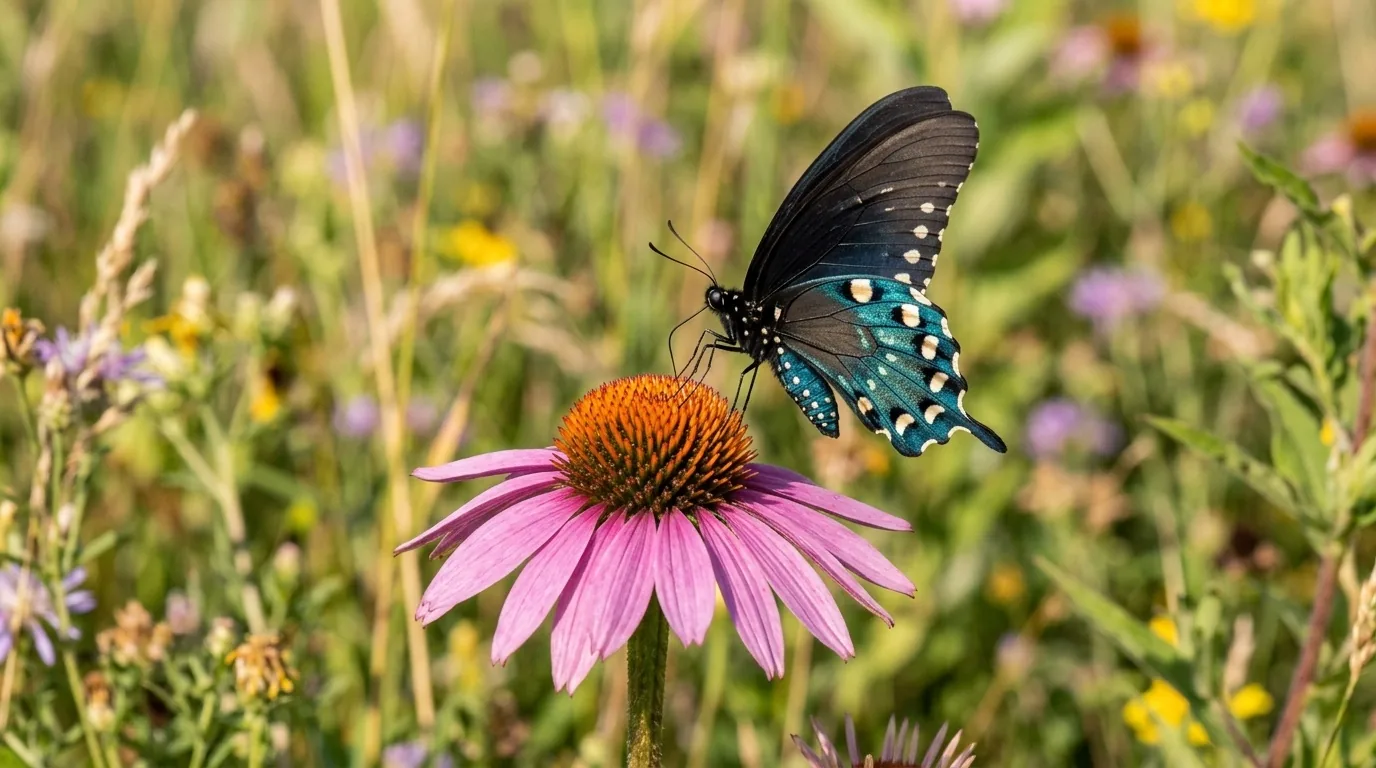
From above, the blue swallowtail appears mostly black. The forewings are uniformly dark with no stripes, bands, or colored spots visible at rest.
The hindwings carry the signature field mark: a brilliant iridescent blue or blue-green sheen that shifts in intensity depending on the viewing angle and light conditions. This structural color comes from the microscopic arrangement of scales on the wing surface rather than from pigment, which is why it appears to change as the butterfly moves.
For more on how that structural coloring works, our guide to butterfly wing structure and patterns covers the physics in detail.
Flip the butterfly over (or wait for it to land with wings open) and the underside tells a different story. The hindwing underside is black with a single row of seven bright orange spots set in a field of iridescent blue.
This orange-spotted underside is the most reliable way to separate a blue swallowtail from the species that mimic it. The spicebush swallowtail has similar orange spots but adds a greenish-blue wash to the hindwing and shows pale spots on the forewing that the pipevine lacks.
Both sexes look similar, though females tend to be slightly larger and carry less iridescent blue on the upper hindwing surface. Males show a more intense, electric blue sheen.
Wingspan runs from about 2.75 to 4 inches, placing the blue swallowtail in the mid-range for North American swallowtails.
Range and Habitat
The blue swallowtail occupies a broad range across the United States. It is most common from the Mid-Atlantic states south through the Southeast, west across Texas and the southern Great Plains, and into parts of California and Oregon.
Scattered populations exist as far north as southern New England and the Great Lakes region, though it becomes uncommon above roughly 40 degrees latitude. The Butterflies and Moths of North America (BAMONA) database maintains county-level sighting records that show its full distribution.
Habitat preferences center on areas where native pipevine grows. In the eastern states, that means open deciduous woodlands, forest edges, stream corridors, and old fields with scattered trees.
In California, it occupies foothill oak woodlands and chaparral edges where California pipevine (Aristolochia californica) climbs through the understory. The species does well in suburban gardens where homeowners have planted ornamental pipevine on fences and trellises.
Blue swallowtails are strong, fast fliers. Males patrol woodland paths and sunny clearings throughout the day, flying low and steady with a distinctive shallow wingbeat that experienced observers can recognize from a distance.
Females spend more time near pipevine plants, circling them slowly before landing to lay eggs.
The Pipevine Connection and Toxicity
Everything about the blue swallowtail’s ecology traces back to one plant genus: Aristolochia, commonly called pipevine or Dutchman’s pipe. The caterpillars feed on pipevine leaves and sequester aristolochic acids from the plant tissue into their own bodies.
These acids persist through pupation into the adult stage, making both the caterpillar and the adult butterfly toxic and foul-tasting to vertebrate predators.
Birds that eat a blue swallowtail usually vomit shortly afterward and learn to avoid anything that looks similar. This is the foundation of one of the most studied mimicry complexes in North America.
According to research reviewed in a University of Kentucky entomology fact sheet, the pipevine swallowtail serves as the toxic model in a Batesian mimicry ring that includes the spicebush swallowtail (Papilio troilus), the dark morph female eastern tiger swallowtail (Papilio glaucus), the black swallowtail (Papilio polyxenes), the red-spotted purple (Limenitis arthemis), and the female Diana fritillary (Argynnis diana).
This mimicry relationship has a direct impact on the populations of those other species. In areas where the blue swallowtail is common, the mimics gain strong protection because local birds have learned to avoid that dark, blue-sheened wing pattern.
Where blue swallowtail populations are thin or absent, the mimics lose their advantage and face higher predation rates. Our overview of swallowtail butterfly species and identification covers how to tell the mimics apart in the field.
Life Cycle from Egg to Adult
Females lay clusters of reddish-brown eggs on the undersides of young pipevine leaves, often depositing 10 to 20 eggs in a single group. This clustering behavior is unusual among swallowtails, which more commonly lay eggs singly.
The eggs hatch in about a week, and the tiny caterpillars feed together in groups during their early instars.
Young caterpillars are dark reddish-brown to black with rows of fleshy, spined tubercles along their bodies. As they grow through four larval instars over two to four weeks, they become more conspicuous.
Late-instar caterpillars are velvety black or dark purplish-brown with prominent orange-red tubercles and long, fleshy filaments. The bold coloring is a warning signal, since these caterpillars are already loaded with aristolochic acids and taste terrible.
Pupation and Overwintering
When the caterpillar is ready to pupate, it wanders away from the host plant and forms a chrysalis on a nearby stem, fence, or tree trunk. The chrysalis is brown or greenish-brown and held in place by a silk girdle, looking much like a curled dead leaf.
In warmer parts of the range (the Deep South and California), the species can produce two or three broods per year, with adults flying from March through October.
In the northern part of the range, one or two broods are typical. The final generation of the year overwinters as a chrysalis, entering diapause until spring temperatures trigger emergence.
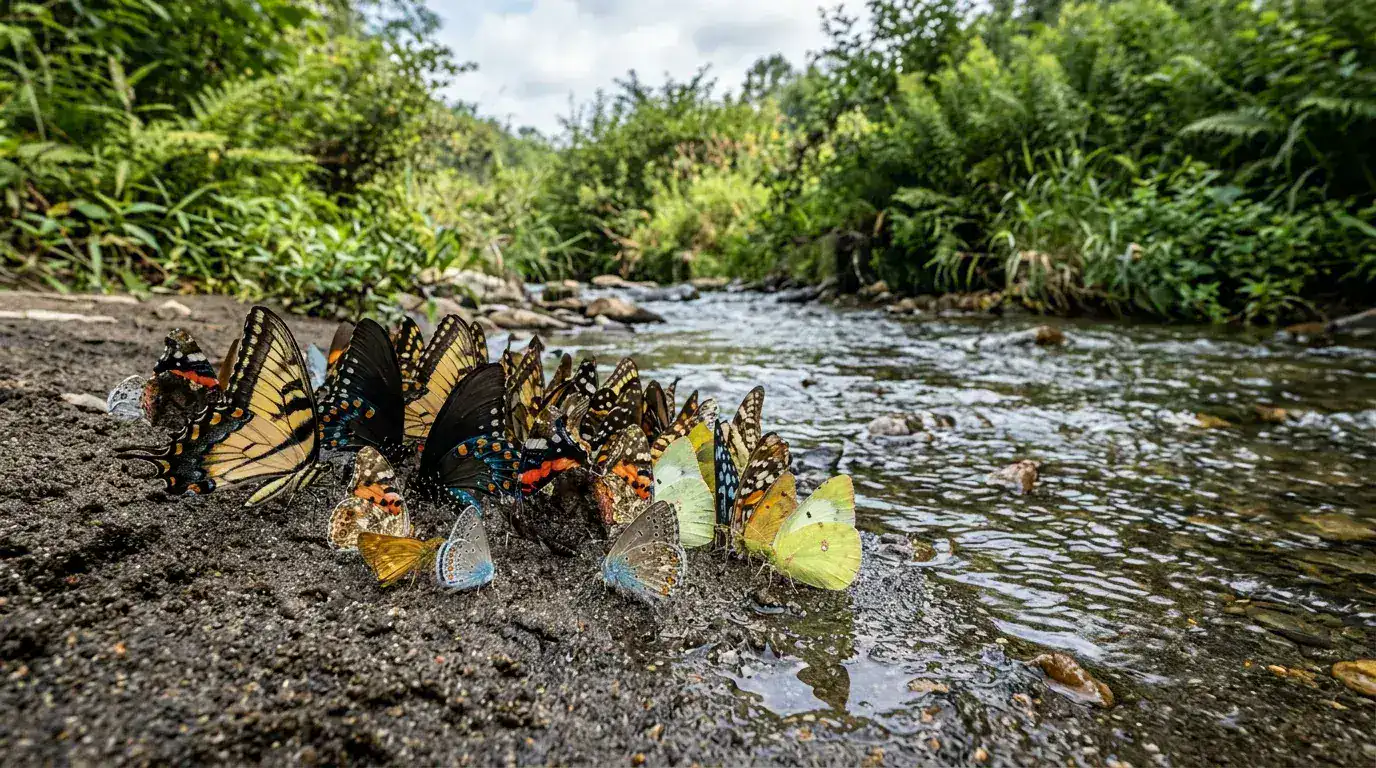
Adults live roughly two to three weeks on the wing. Males spend much of that time patrolling for females and puddling on wet ground to collect sodium and amino acids.
Females focus on locating pipevine plants and laying their full complement of eggs, which can total several hundred over a lifetime.
How to Attract Blue Swallowtails to Your Garden
Planting native pipevine is the single most effective thing you can do. In the eastern United States, Virginia snakeroot (Aristolochia serpentaria) and woolly Dutchman’s pipe (Aristolochia tomentosa) are native species that serve as larval hosts.
In California, the native choice is California pipevine (Aristolochia californica). These are vigorous climbing vines that do well on trellises, arbors, and fences in partial shade to full sun.
Avoid the tropical ornamental species Aristolochia elegans (calico flower). Blue swallowtail females will lay eggs on it, but the caterpillars often cannot complete development on tropical species, turning the plant into an ecological trap.
Stick with native species that are appropriate for your region.
For adult nectar sources, blue swallowtails are drawn to purple, pink, and orange flowers with tubular shapes. Phlox, bee balm, milkweed, ironweed, zinnia, and lantana all work well.
A patch of damp sand or bare mud in a sunny spot gives males a puddling station. Our guide to the best butterfly plants and what to grow includes planting plans organized by region and bloom time.
Conservation and Population Status
The blue swallowtail has no federal or state endangered listing and is considered secure across most of its range. It adapts well to suburban and agricultural landscapes as long as pipevine plants remain available.
Population monitoring through citizen science programs like BAMONA and the North American Butterfly Association (NABA) counts shows stable numbers in most areas.
Local threats do exist. The removal of native pipevine from hedgerows and woodlots during land clearing eliminates breeding habitat, and pesticide drift from agricultural operations kills both caterpillars and adults.
In California, development pressure in foothill habitats has reduced the availability of California pipevine in some counties. The broader concern is that blue swallowtail declines would ripple through the mimicry complex, removing the protection that several other butterfly species depend on.
Gardeners and land managers who plant native pipevine are directly contributing to the stability of this species and, by extension, to the survival of its mimics. Even a single established pipevine in a backyard can support a small breeding colony year after year.
Frequently Asked Questions
Is the blue swallowtail butterfly the same as the pipevine swallowtail?
Yes. The blue swallowtail butterfly is a common name for the pipevine swallowtail, Battus philenor.
It gets the “blue” name from the iridescent blue-black sheen on its hindwings. No other North American swallowtail shows that same intensity of metallic blue on the upper wing surface.
Are blue swallowtail butterflies poisonous?
They are toxic but not dangerous to humans. The caterpillars accumulate aristolochic acids from their pipevine host plants, and those chemicals persist into the adult stage.
Birds that eat a blue swallowtail typically vomit and learn to avoid the species afterward. Handling the butterfly will not harm you.
What plants do blue swallowtail caterpillars eat?
The caterpillars feed only on plants in the genus Aristolochia, commonly called pipevine or Dutchman’s pipe. In the eastern US, Virginia snakeroot and woolly Dutchman’s pipe are the primary native hosts.
In California, the host is California pipevine (Aristolochia californica). Adults drink nectar from a wide range of flowers including phlox, bee balm, milkweed, and ironweed.
How can I tell a blue swallowtail from a spicebush swallowtail?
Look at the hindwing underside. The blue swallowtail (pipevine swallowtail) has a single row of seven round orange spots against an iridescent blue-black background with no other markings.
The spicebush swallowtail also has orange spots on the hindwing underside, but it shows a greenish-blue wash rather than a pure blue and has pale whitish spots on the forewing that the pipevine lacks.
Where do blue swallowtail butterflies live in the United States?
They are most common in the southeastern United States, from Virginia south to Florida and west to Texas. Populations also exist in California, Oregon, and scattered areas of the Midwest and Great Lakes region.
The species is uncommon in northern New England and the northern Great Plains. It lives wherever native pipevine plants grow, including forest edges, stream corridors, suburban gardens, and open woodlands.
How many species mimic the blue swallowtail butterfly?
At least four butterfly species in eastern North America mimic the blue swallowtail’s appearance to gain protection from bird predators. These include the spicebush swallowtail, the dark morph female eastern tiger swallowtail, the red-spotted purple, and the female Diana fritillary.
The black swallowtail is sometimes included in the mimicry ring as well, though its resemblance is less precise than the others.