

Key Takeaways
- The monarch butterfly scientific name is Danaus plexippus, first described by Carl Linnaeus in his 1758 edition of Systema Naturae.
- The genus name Danaus comes from a mythological Greek king, while the species name plexippus translates to “one who urges horses,” also drawn from Greek legend.
- Monarchs belong to the family Nymphalidae (brush-footed butterflies) and the subfamily Danainae, which includes milkweed butterflies known for their chemical defenses.
- Two recognized subspecies exist: D. p. plexippus, the migratory North American population, and D. p. megalippe, found across the Caribbean and parts of Central America.
What Is the Monarch Butterfly Scientific Name?
The monarch butterfly scientific name is Danaus plexippus. Swedish naturalist Carl Linnaeus assigned this name in 1758 when he published the tenth edition of Systema Naturae, the foundational text that introduced the system of binomial nomenclature still used by biologists today.
You might see the name written as Danaus plexippus (Linnaeus, 1758) in scientific literature. The parenthetical citation credits Linnaeus as the original authority and notes the year of the first formal description.
The Full Taxonomy of the Monarch Butterfly
Scientific classification organizes living things into nested groups based on shared characteristics and evolutionary relationships. For the monarch, the full taxonomic hierarchy looks like this, according to the Integrated Taxonomic Information System (ITIS).
| Rank | Classification |
|---|---|
| Kingdom | Animalia |
| Phylum | Arthropoda |
| Class | Insecta |
| Order | Lepidoptera |
| Family | Nymphalidae |
| Subfamily | Danainae |
| Genus | Danaus |
| Species | Danaus plexippus |
The family Nymphalidae is the largest butterfly family on Earth, containing roughly 6,000 described species according to the Smithsonian Institution. Members of this group are sometimes called brush-footed butterflies because their front pair of legs is reduced and brush-like, held close to the body instead of being used for walking.
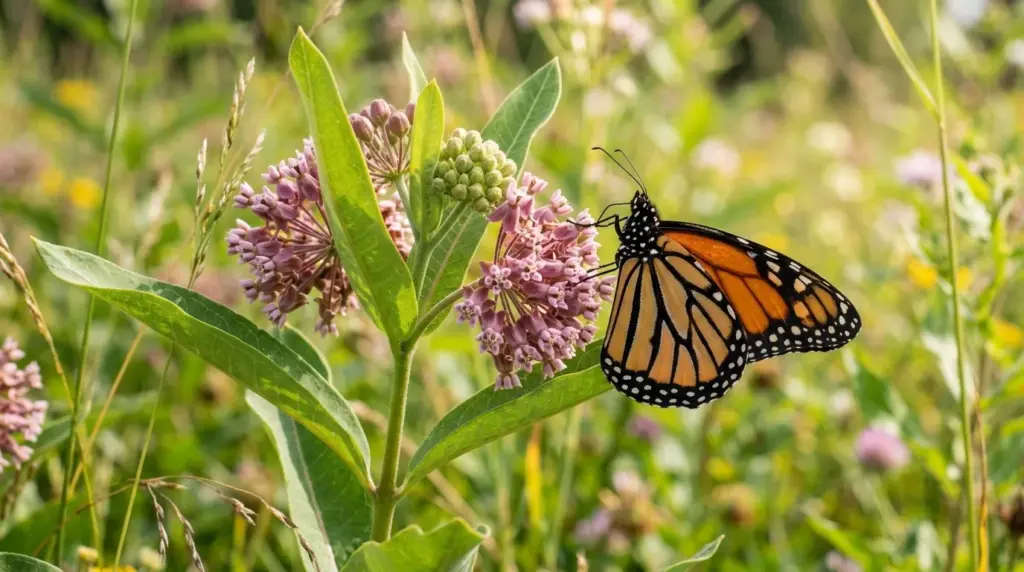
Within Nymphalidae, monarchs sit in the subfamily Danainae. This group is commonly referred to as the milkweed butterflies because their larvae feed almost exclusively on plants in the genus Asclepias. Eating milkweed gives them cardenolide toxins that make them distasteful to predators, which is the whole reason for that bold orange-and-black coloring.
What Does Danaus plexippus Actually Mean?
Linnaeus had a habit of naming butterflies after figures from Greek mythology. The genus name Danaus refers to Danaus, a legendary king of Egypt and great-grandson of Zeus in Greek myth. Danaus was the father of fifty daughters, the Danaides, who appear throughout classical literature.
The species name plexippus also has mythological roots. Plexippus was one of the sons of Aegyptus, Danaus’s twin brother. The name itself translates roughly to “one who urges horses” or “horse driver,” from the Greek words plesso (to strike) and hippos (horse).
Linnaeus grouped many butterfly species under names from the same mythological family tree. He seemed to enjoy the literary connection, and these names stuck. It is a good reminder that taxonomy has always been as much an art of naming as a science of classification.
Why the Common Name “Monarch”?
The common name “monarch” likely came later in the 18th or early 19th century. Some entomologists believe the name refers to King William III of England (William of Orange), whose signature color was, well, orange. Others argue the name simply reflects the butterfly’s status as one of the largest and most recognizable types of butterflies in North America.
Either way, the name fits. Few butterflies command as much public attention or scientific study as this one.
How Binomial Nomenclature Works
The two-part naming system Linnaeus introduced, called binomial nomenclature, gives every species a unique combination of genus and species names written in Latin or Latinized Greek. The genus name is always capitalized, the species name is always lowercase, and both are italicized.
Before Linnaeus standardized this approach, naturalists used long descriptive phrases in Latin to identify organisms. A single species might have a different name in every country, every university, every book. Binomial nomenclature solved that problem by giving each species one universally accepted label.
The system works because it is hierarchical. Related species share a genus name, so Danaus plexippus (the monarch) and Danaus gilippus (the queen butterfly) are immediately recognizable as close relatives. That shared genus tells you something meaningful about their evolutionary history before you read a single research paper.
The International Commission on Zoological Nomenclature (ICZN) governs the rules for naming animal species. If two scientists independently describe the same species under different names, the ICZN’s principle of priority dictates that the earliest published name wins. Linnaeus’s 1758 description of Danaus plexippus has never been challenged, so the name has remained stable for over 260 years.
Monarch Butterfly Subspecies
Not all monarchs are the same. Scientists currently recognize two subspecies of Danaus plexippus, each with distinct geographic ranges and behaviors.
D. p. plexippus (the Migratory Monarch)
This is the subspecies most people picture when they think of monarchs. It breeds across the United States and southern Canada during summer, then migrates thousands of miles to overwintering sites in central Mexico’s oyamel fir forests or along the California coast. The eastern population can travel up to 3,000 miles in a single migration, according to the U.S. Fish and Wildlife Service.
This subspecies has faced serious population decline in recent years. The IUCN assessed the migratory monarch as Endangered in 2022, citing habitat loss, pesticide use, and climate change as primary threats.
D. p. megalippe (the Non-Migratory Monarch)
Found in the Caribbean, parts of Central America, and portions of southern Florida, this subspecies does not undertake the dramatic long-distance migration that its northern relative is famous for. It tends to be slightly smaller, and its wing patterns show subtle differences that trained entomologists can spot in the field.
Because D. p. megalippe populations are resident year-round in tropical and subtropical habitats, they face a different set of pressures. Habitat fragmentation and the loss of milkweed host plants remain concerns, but the extreme weather exposure of a multi-thousand-mile journey is not part of their life story.
Why Scientific Names Matter for Butterfly Conservation
Knowing the scientific name of a butterfly species is not just academic trivia. When conservation agencies, lawmakers, and researchers across different countries need to coordinate protection efforts, they need a single unambiguous name that everyone agrees on.
The monarch is a perfect case study. “Monarch butterfly” means something clear in English, but in Spanish it is “mariposa monarca,” in French “monarque,” and dozens of regional common names exist. Danaus plexippus cuts through all of that. A researcher in Mexico, a policy analyst in Ottawa, and a field biologist in Australia can all reference the exact same organism with zero confusion.
This precision becomes especially important for species with varying lifespans and life histories across their range. Without standardized naming, it would be far too easy to mix up data from different populations or even different species entirely.
Frequently Asked Questions
What is the scientific name for the monarch butterfly?
The monarch butterfly’s scientific name is Danaus plexippus.
Carl Linnaeus first described and named the species in 1758 in his Systema Naturae.
Who gave the monarch butterfly its scientific name?
Carl Linnaeus, a Swedish botanist and zoologist considered the father of modern taxonomy, assigned the name Danaus plexippus in 1758.
Linnaeus created the binomial nomenclature system that scientists worldwide still use to classify and name organisms.
What does Danaus plexippus mean in English?
Danaus refers to a king from Greek mythology, while plexippus translates to “one who urges horses.”
Both names come from characters in the mythological family of Danaus and Aegyptus, reflecting Linnaeus’s habit of using classical references.
How many subspecies of monarch butterfly are there?
There are two recognized subspecies: D. p. plexippus and D. p. megalippe.
D. p. plexippus is the famous migratory population of North America, while D. p. megalippe lives year-round in the Caribbean and parts of Central America.
What family does the monarch butterfly belong to?
Monarchs belong to the family Nymphalidae, commonly known as the brush-footed butterflies.
Within that family, they are classified under the subfamily Danainae, the milkweed butterflies, because their caterpillars feed on milkweed plants.
Is the monarch butterfly endangered?
The migratory monarch (D. p. plexippus) was assessed as Endangered by the IUCN in July 2022.
Population declines have been driven by habitat loss, pesticide exposure, and the effects of climate change on both breeding and overwintering habitats.