
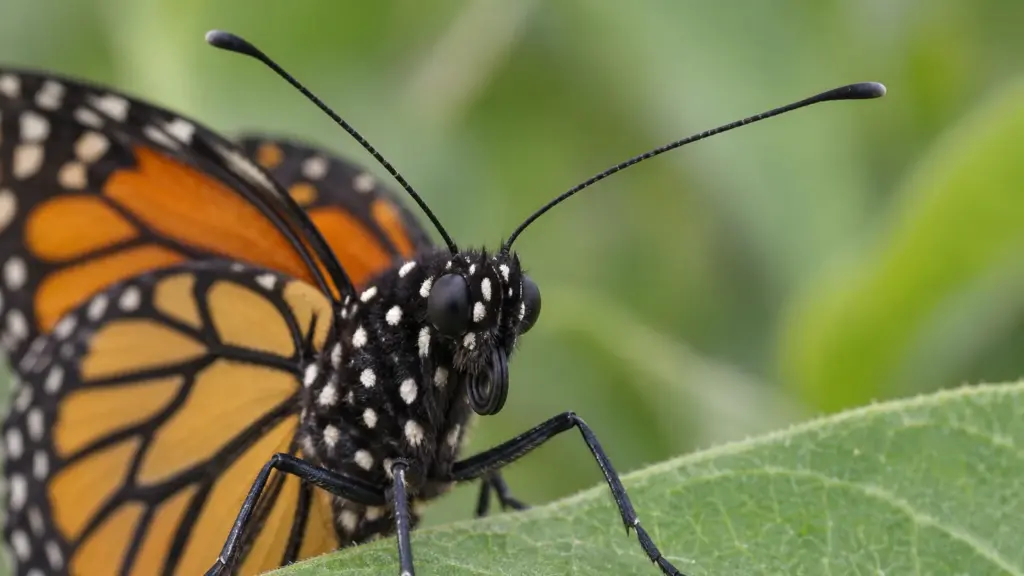

Butterfly antennae are thin sensory stalks with a club at the tip, and they do far more than smell. In monarchs they also keep time for the sun compass and help sense Earth’s magnetic field during migration.
The club shape is also the quickest way to tell a butterfly from most moths. Here is how butterfly antennae are built and what research has found they do.
Key Takeaways
- Butterflies have long, thin antennae with a club at the tip, while most moths have feathery or tapered antennae.
- Antennae carry sensors for smell and touch, plus an organ at the base that senses movement.
- Monarch antennae contain circadian clocks that let the butterfly correct its sun compass for the time of day.
- A 2014 study found monarchs use a light-dependent magnetic compass that relies on their antennae.
How Butterfly Antennae Are Built
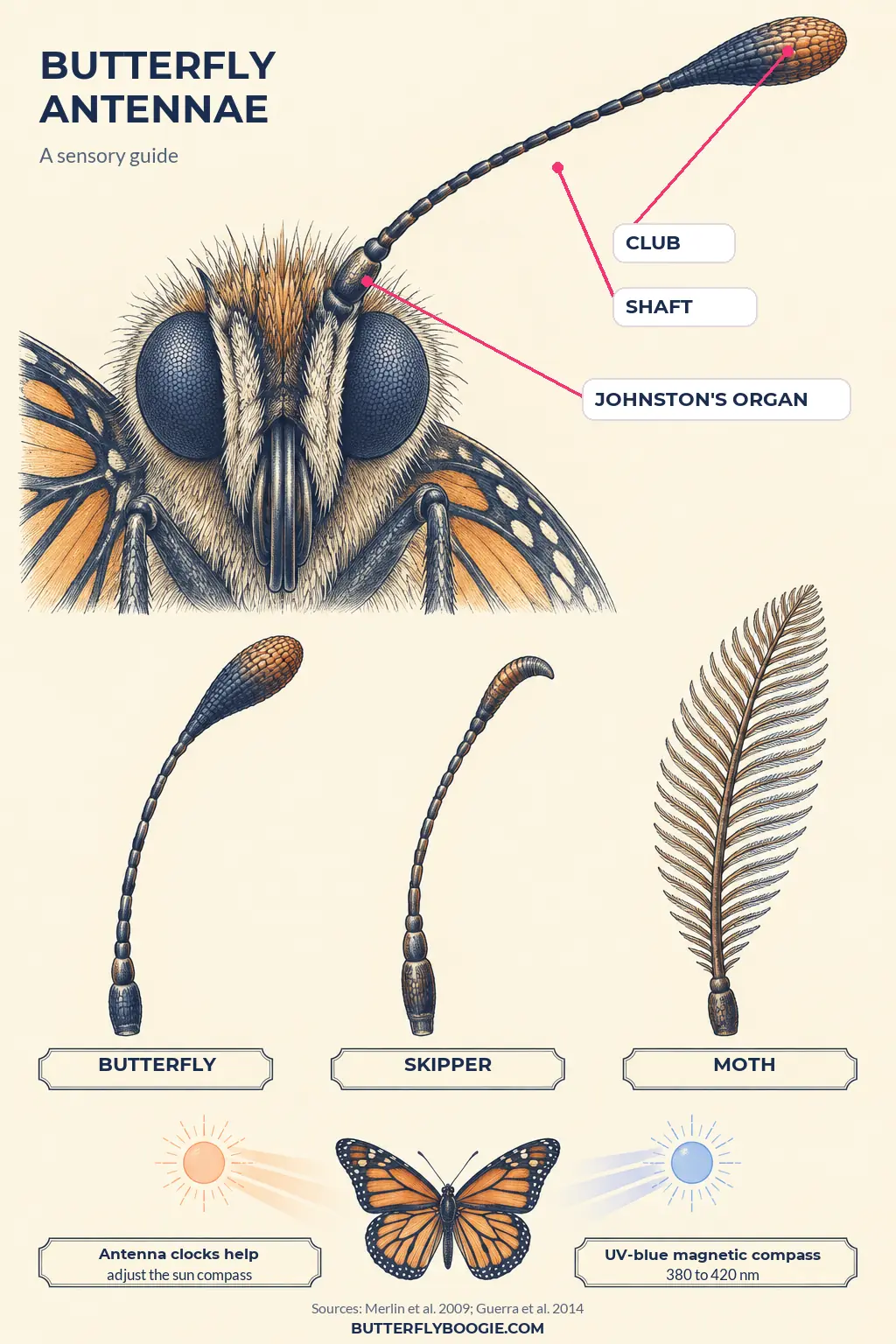
Each antenna is a chain of small segments joined to the head. The long shaft ends in a thickened club, which is the classic butterfly shape.
The first two segments at the base hold the muscles and sensors that move and monitor the antenna. The second segment houses Johnston’s organ, a cluster of sensory cells that detects how the rest of the antenna bends and vibrates.
The surface of the antenna is covered in tiny sensory hairs and pegs. Many of them detect odors, which helps butterflies find flowers and mates.
Butterfly Antennae vs Moth Antennae
Clubbed antennae are the quickest field mark for a butterfly. Most moths have antennae that are feathery, comb-like or tapered to a point, with no club at the end.
Skippers sit in between. Their antennae end in a club with a small hook at the tip, one of the features that sets skippers apart from other butterflies.
For the other differences, from how they rest to when they fly, see our breakdown of moth vs butterfly differences.
What Butterfly Antennae Do
Smell comes first. Odor sensors on the antennae pick up flower scents and chemical signals from other butterflies, which helps with feeding and finding mates.
Antennae also help with balance. The movement sensors at the base register how the antennae swing during flight, feedback that helps a flying insect stay stable.
Taste is handled elsewhere. Butterflies taste with sensors on their feet, which is why a female often drums a leaf with her legs before laying eggs.
Our guide to butterfly anatomy shows where the antennae fit with the eyes, legs and proboscis.
Monarch Antennae Help Them Navigate
Migrating monarchs use the sun as a compass, but the sun moves across the sky during the day. To hold a steady heading, the butterfly has to correct for the time.
In 2009, Christine Merlin, Robert Gegear and Steven Reppert showed in Science that monarch antennae contain their own circadian clocks. Monarchs with their antennae removed could no longer orient properly, and the antennal clocks appear to supply the timing for the sun compass.
A 2012 follow-up in Nature Communications found that either antenna’s clock is enough on its own. When the two antennae sent out-of-sync timing signals, the butterflies flew in the wrong direction.
A Magnetic Compass in the Antennae
Monarchs have a backup for cloudy days. A 2014 study by Patrick Guerra, Robert Gegear and Steven Reppert in Nature Communications found that migrating monarchs use an inclination magnetic compass to head toward the equator in fall.
The compass only works in ultraviolet-A and blue light, between 380 and 420 nanometers. The antennae appear to contain the light-sensitive magnetic sensors that make it work.
For more on where the migration takes them, see our guide to monarch butterflies in Mexico.
FAQ
What are butterfly antennae used for?
Mainly smell, touch and balance.
In monarchs, the antennae also keep time for the sun compass and help sense Earth’s magnetic field.
Why do butterfly antennae have a club at the end?
The club is a thickened tip made of wider segments, and it’s the typical antenna shape for butterflies.
It helps tell butterflies apart from most moths, which have feathery or tapered antennae.
Can a butterfly live without its antennae?
It can survive, but a monarch without antennae loses its ability to orient with the sun compass, according to a 2009 study.
Do butterflies smell with their antennae?
Yes. Odor sensors on the antennae detect flower scents and chemical signals from other butterflies.