



Eastern monarch butterflies run through several generations a year: up to four short-lived summer generations, then one long-lived migratory generation. The month, your location and the condition of the butterfly’s wings will usually tell you which generation you’re looking at.
The difference is dramatic. Summer monarchs live 2 to 5 weeks, while the migratory generation can live as long as 9 months, according to the USDA Forest Service.
Key Takeaways
- Monarchs have up to four generations each summer, and each one breeds a little farther north than the last.
- The last generation of the year hatches in late summer, skips breeding and migrates to Mexico or coastal California.
- A faded, tattered monarch in the southern U.S. in March is likely a migrant that has been alive since the previous August or September.
- Migratory monarchs tend to have larger, more elongated forewings, and redder wings are linked to longer flights.
How Many Monarch Butterfly Generations Are There in a Year?
The Forest Service describes up to four generations each summer, each traveling a little farther north than the one before. Add the migratory generation that carries the population through winter, and a full year can hold four or five generations.
Only the migratory generation breaks the pattern. Shorter, cooler days in late summer keep these butterflies in reproductive diapause, so they put their energy into flying south and storing fat instead of mating.
Which Monarch Generation Is This? Month by Month
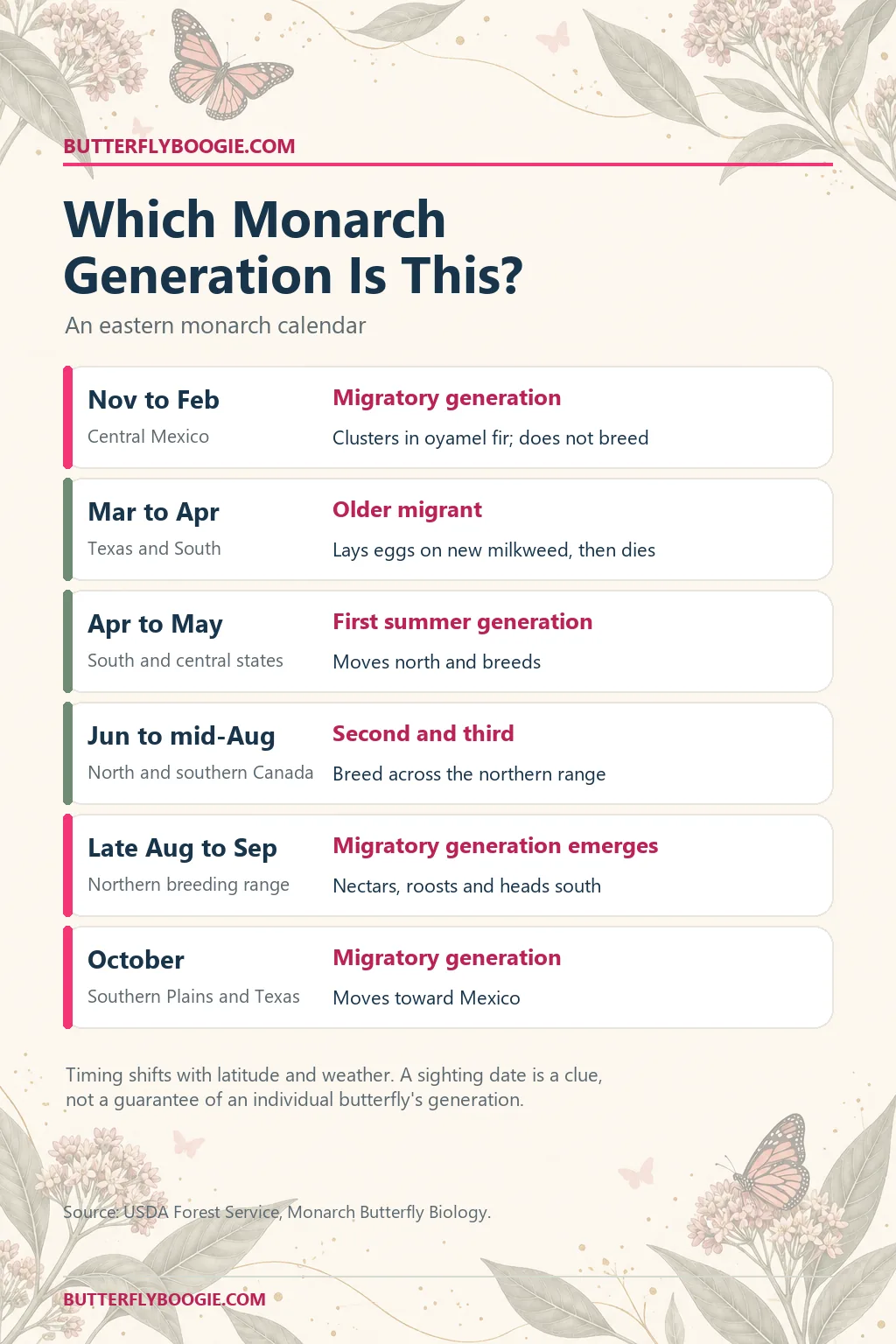
Use this table as a starting point for eastern monarchs. Timing shifts by a few weeks with latitude and weather, so a butterfly in Texas runs ahead of one in Minnesota.
| When you see it | Where | Most likely generation | What it’s doing |
|---|---|---|---|
| November to February | Central Mexico | Migratory generation | Clustering in oyamel fir forests, not breeding |
| March to April | Texas and the southern states | Migratory generation, now months old | Laying eggs on new milkweed, then dying |
| April to May | Southern and central states | First summer generation | Moving north and breeding |
| June to mid-August | Midwest, Northeast and southern Canada | Second and third generations | Breeding across the northern range |
| Late August to September | Northern breeding range | Migratory generation emerges | Nectaring hard, roosting in groups, heading south |
| October | Southern Plains and Texas | Migratory generation | Funneling toward Mexico |
If you raise caterpillars, the date your butterfly emerges is the strongest clue. A monarch that ecloses in a northern garden in late August or September is almost certainly a migrant.
How to Tell the Migratory Generation From a Summer Monarch
You can’t see diapause, but you can see its effects. These clues work best together.
- Timing and place come first, since migrants emerge in late summer in the northern range and travel south through fall.
- Behavior helps, because migrants spend their days nectaring instead of courting or laying eggs, and many gather in evening roosts.
- Wing shape points the same way, since a 2010 study in Evolution found migratory monarch populations have larger, more elongated forewings than non-migratory ones.
- Color adds a hint, since a 2012 PLOS ONE study found monarchs with darker, redder wings flew longer distances.
The shape finding comes from Sonia Altizer and Andrew Davis, who compared migratory and resident populations. The color finding comes from Davis and colleagues, who tested flight in monarchs with lighter and darker orange wings.
Worn Wings Tell You Age
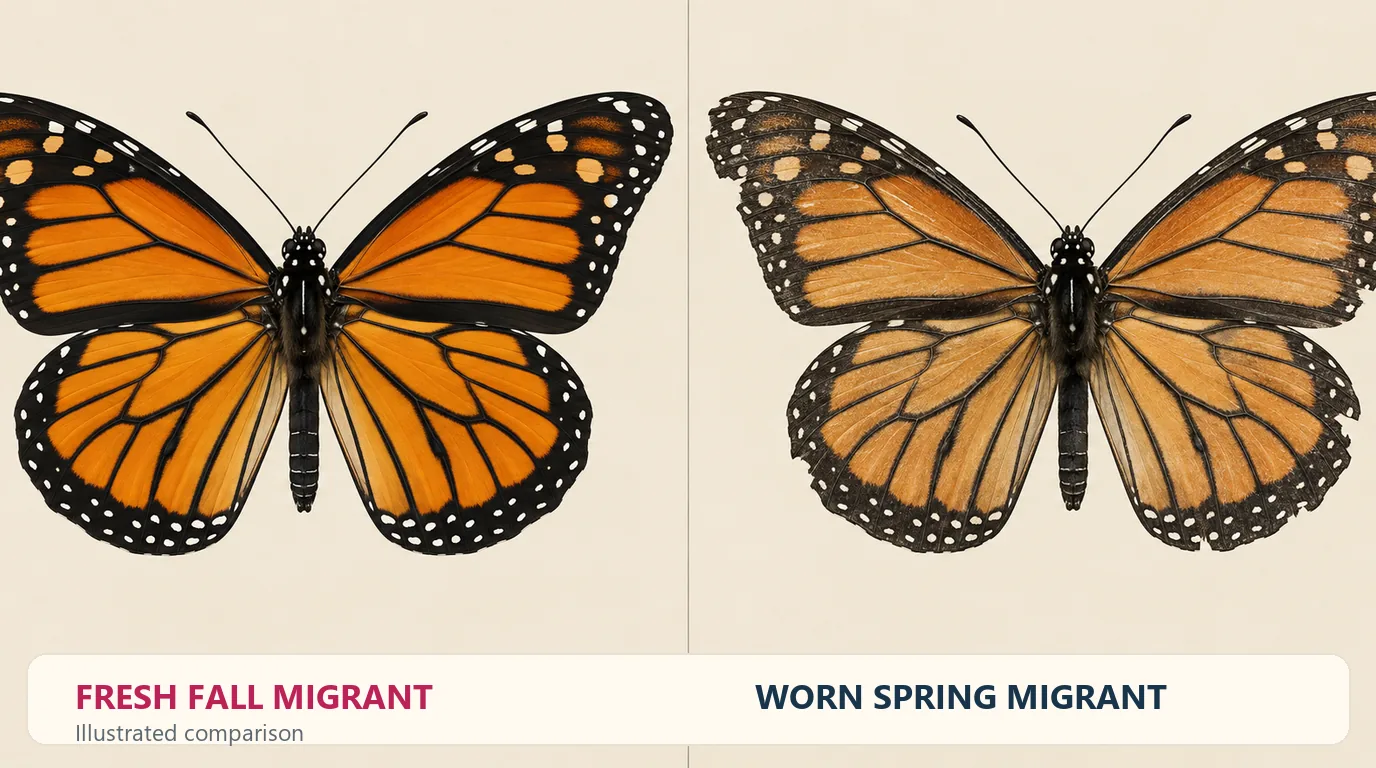
A migrant that has survived the winter shows it. By March and April its wings are faded, scratched and often torn along the edges, and it has been alive for six months or more.
Summer monarchs rarely get that ragged before they die. Our guide to estimating a butterfly’s age from its wings explains the 1 to 5 wing wear scale researchers use.
For the full picture of how long each generation lives, see our monarch butterfly lifespan guide. Our breakdown of monarch caterpillar survival rates shows how few eggs make it to any generation at all.
Where the Generations Go in Winter
Eastern migrants spend the winter in Mexico, which we cover in our guide to monarch butterflies in Mexico. Western monarchs, from west of the Rocky Mountains, winter in coastal California instead.
If you want to help map the generations, report sightings to Journey North. Its volunteer maps show each wave moving north in spring and south in fall.
FAQ
How long does each monarch generation live?
Summer generations live about 2 to 5 weeks as adults.
The migratory generation can live as long as 9 months, according to the USDA Forest Service.
What is the monarch super generation?
It’s a nickname for the migratory generation that hatches in late summer.
These monarchs delay breeding, fly to Mexico or California and live many times longer than their parents.
How can I tell if a monarch in my garden will migrate?
Check the date first. A monarch that emerges in the northern range in late August or September, spends its time nectaring and ignores mating is very likely a migrant.
Do monarchs from different generations look different?
Mostly in condition and, on average, in wing shape and color.
Migrants tend to have larger, more elongated forewings, and spring migrants look worn after months of travel.