

Key Takeaways
- Danaus chrysippus, the Plain Tiger, is one of the most widespread butterfly species on Earth, found across Africa, Asia, Australia, and parts of southern Europe.
- Adults display orange-brown wings with black borders and white spots, and their bright coloring warns predators of toxins absorbed from milkweed host plants during the larval stage.
- The Plain Tiger participates in Müllerian mimicry rings with other toxic species, meaning multiple unpalatable butterflies share similar warning patterns for mutual protection.
- Females lay eggs on Calotropis and Asclepias species, and the full life cycle from egg to adult takes roughly four to six weeks depending on temperature.
What Is Danaus Chrysippus?
Danaus chrysippus is a medium-sized butterfly in the family Nymphalidae, subfamily Danainae. Most people know it as the Plain Tiger, though it also goes by African Monarch or Lesser Wanderer in different parts of its range.
Linnaeus first described this species in 1758, making it one of the earliest butterflies formally classified in Western taxonomy. The genus name Danaus references the mythological king of Argos, while chrysippus honors a Greek philosopher.
If you are trying to figure out where this butterfly fits among other species, our types of butterflies guide breaks down the major families and groups. The Plain Tiger belongs to the same subfamily as the North American Monarch (Danaus plexippus), and the two are often confused at first glance.
How to Identify the Plain Tiger Butterfly
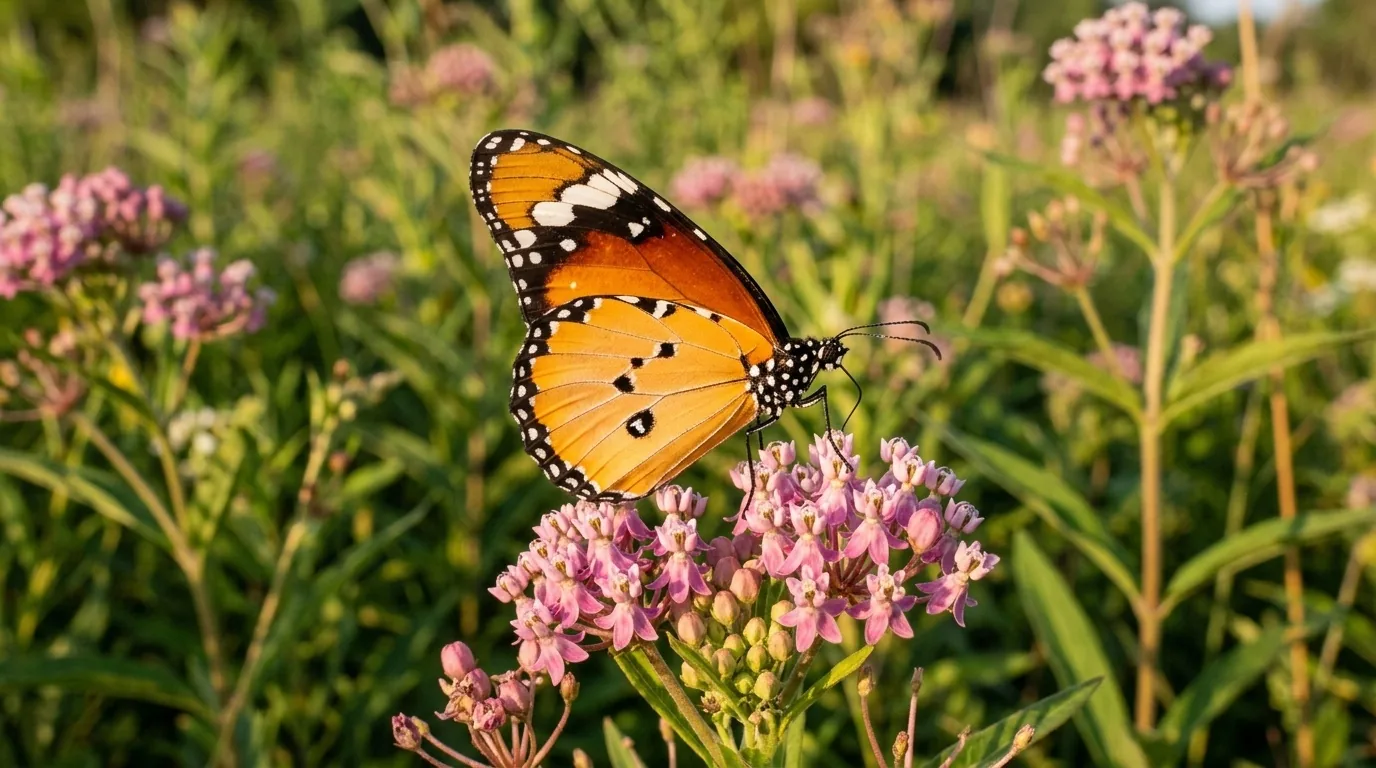
The forewings are orange-brown at the base, shifting to a black apex with a band of white spots. The hindwings are a slightly paler orange, bordered by a thin black margin dotted with small white crescents.
Wingspan ranges from 70 to 80 millimeters in most populations, according to research published in the Journal of the Lepidopterists’ Society. Males tend to be slightly smaller than females and carry a noticeable dark scent patch on their hindwings, which releases pheromones during courtship.
Color Forms and Regional Variation
Danaus chrysippus shows striking polymorphism across its range. The nominate form, chrysippus, has the classic orange-and-black pattern that most field guides depict.
The form dorippus lacks the black forewing apex and appears almost entirely orange. Another form, alcippus, features a large white patch on the hindwing instead of orange. These forms coexist in the same population, linked to a chromosomal inversion system documented by Smith and colleagues in a 2010 study in Heredity.
Understanding how butterfly wing patterns work helps explain why these color forms persist. Wing scale pigmentation in Danaus chrysippus is controlled by a handful of genes, and natural selection maintains multiple forms because each offers slightly different advantages in different habitats.
Where Does Danaus Chrysippus Live?
The Plain Tiger has one of the broadest distributions of any butterfly species. It is resident across sub-Saharan Africa, the Middle East, South and Southeast Asia, and northern Australia.
Seasonal migrants appear in southern Europe, particularly around the Mediterranean. Populations have been recorded in Spain, Greece, Turkey, and occasionally as far north as the United Kingdom, though these northern sightings represent temporary range expansions rather than permanent colonies.
Habitat Preferences
This butterfly thrives in open, sunny landscapes where its host plants grow abundantly. Dry scrubland, grassland edges, gardens, and agricultural margins all support stable populations.
In tropical Africa, it is among the most commonly encountered butterflies at any elevation below 1,500 meters. You will often see it in city parks and along roadsides wherever Calotropis or other milkweed plants have established themselves.
Life Cycle and Reproduction
Female Plain Tigers lay single pale yellow eggs on the undersides of milkweed leaves. Each egg hatches within two to four days in warm conditions.
The caterpillar goes through five instars over roughly two weeks. Larvae are banded in white, black, and yellow, with three pairs of fleshy black filaments along the body. These colors serve as an honest warning signal, since the caterpillars sequester toxic cardenolides from the milkweed they consume.
Pupation and Adult Emergence
The chrysalis is a smooth, jade-green structure with gold spots, suspended by a silk pad from a leaf or stem. Pupation lasts seven to twelve days.
Adults typically live two to four weeks in tropical populations, though individuals in cooler or seasonal climates may survive longer. For comparison with other species, our guide on butterfly lifespans by species shows how Danaus chrysippus stacks up against closely related Danainae members.
Host Plants
The primary host plants are milkweed species in the genera Calotropis and Asclepias. In Africa and Asia, Calotropis procera (the apple of Sodom) and Calotropis gigantea (the crown flower) are the most commonly used larval food sources.
Females will also oviposit on Asclepias curassavica, Pergularia daemia, and several other Apocynaceae family members. The choice of host plant directly affects the level of cardenolide toxicity in both larvae and adults, which in turn influences how well predators learn to avoid the butterfly.
Müllerian Mimicry and Defense
Danaus chrysippus is a textbook example of Müllerian mimicry, where two or more toxic species evolve to look alike. In Africa, the Plain Tiger shares its orange-and-black warning pattern with Acraea butterflies and other Danaus species, and all of them are genuinely unpalatable to birds.
The benefit is mutual. When a young bird tastes one toxic butterfly and gets sick, it learns to avoid anything with that pattern. Since multiple species share the cost of “educating” predators, each individual species loses fewer members to trial-and-error predation.
Cardenolide Toxicity
The toxins responsible are cardiac glycosides, specifically cardenolides, absorbed from milkweed during the larval stage. These compounds interfere with sodium-potassium pumps in vertebrate heart muscle, causing vomiting and cardiac distress in birds that eat a toxic butterfly.
Not all Plain Tiger individuals are equally toxic. A 1991 study by Brower and colleagues in Ecological Entomology showed that toxicity varies with the specific milkweed species consumed. Butterflies reared on high-cardenolide plants like Calotropis procera are far more distasteful than those raised on low-cardenolide alternatives.
Behavior and Migration
Danaus chrysippus does not undertake the dramatic long-distance migrations of its cousin the Monarch, but it is a strong flier. Populations in semi-arid regions track rainfall patterns, moving into newly green areas where host plants have sprouted.
Males patrol open areas and hilltops searching for females. Courtship involves aerial chases followed by the male brushing specialized scent scales (called hair pencils) near the female’s antennae, releasing pyrrolizidine alkaloid-derived pheromones obtained from wilted Boraginaceae plants.
Conservation Status
The IUCN does not list Danaus chrysippus as threatened, and its global population appears stable. Its adaptability to disturbed habitats, broad host plant range, and widespread distribution all work in its favor.
Localized declines have been reported in parts of the Mediterranean where pesticide use and habitat loss reduce milkweed availability. A 2021 review published in Insects noted that monitoring programs remain sparse across much of Africa and Asia.
Planting native milkweed species in gardens is one of the simplest ways to support local Plain Tiger populations. In tropical and subtropical regions, a single Calotropis procera shrub can sustain multiple generations throughout the year.
FAQ
Is Danaus chrysippus the same as the Monarch butterfly?
No, they are separate species in the same genus. Danaus chrysippus is the Plain Tiger, while Danaus plexippus is the Monarch.
They share the Danainae subfamily and look similar due to their orange-and-black coloring, but they differ in wing pattern details, geographic range, and migratory behavior.
Where can I find Danaus chrysippus in the wild?
The Plain Tiger lives across sub-Saharan Africa, the Middle East, South and Southeast Asia, and parts of Australia.
Look for it in open sunny habitats like grasslands, gardens, scrubland edges, and roadsides where milkweed plants grow.
What do Plain Tiger caterpillars eat?
Caterpillars feed on milkweed plants, primarily species of Calotropis and Asclepias.
In Africa and Asia, Calotropis procera and Calotropis gigantea are the most common host plants. The caterpillars store toxic compounds from these plants in their bodies as a defense against predators.
Why is Danaus chrysippus toxic to birds?
The larvae absorb cardenolides (cardiac glycosides) from the milkweed they eat, and these toxins persist through pupation into the adult stage.
When a bird eats a cardenolide-laden butterfly, the compounds cause vomiting and cardiac distress, teaching the bird to avoid similar-looking prey in the future.
How long does the Plain Tiger butterfly live?
Adults typically survive two to four weeks in tropical populations.
The entire life cycle from egg to adult death spans roughly six to ten weeks. In cooler climates with a defined wet and dry season, some individuals may live slightly longer as they wait for favorable breeding conditions.
What is Müllerian mimicry and how does Danaus chrysippus use it?
Müllerian mimicry occurs when two or more toxic species evolve to share similar warning colors, so predators learn faster to avoid all of them.
Danaus chrysippus participates in this system alongside Acraea butterflies and other Danaus relatives in Africa and Asia. All these species are genuinely unpalatable, and their shared orange-and-black patterns reduce predation losses for every species in the ring.