


European Swallowtail Caterpillar: Full Field Guide
If you spot a plump green grub striped with black bands and flecked with orange-red dots munching on your fennel, you’re likely looking at a European swallowtail caterpillar. This is the larval form of Papilio machaon, the Old World Swallowtail, and it ranks among the most photogenic larvae on the continent. Gardeners across Europe find them on carrot tops, dill stalks, and wild umbellifers, where they feed quietly until ready to pupate.
The larva passes through five growth stages before spinning a silk pad and shifting into a chrysalis. Each stage looks a bit different, which throws off observers who expect a single appearance. This guide walks through what to look for, where to find them, how they defend themselves, and how local populations vary across European regions.
Key Takeaways
- The European swallowtail caterpillar is the larval stage of Papilio machaon, feeding mainly on umbelliferous plants.
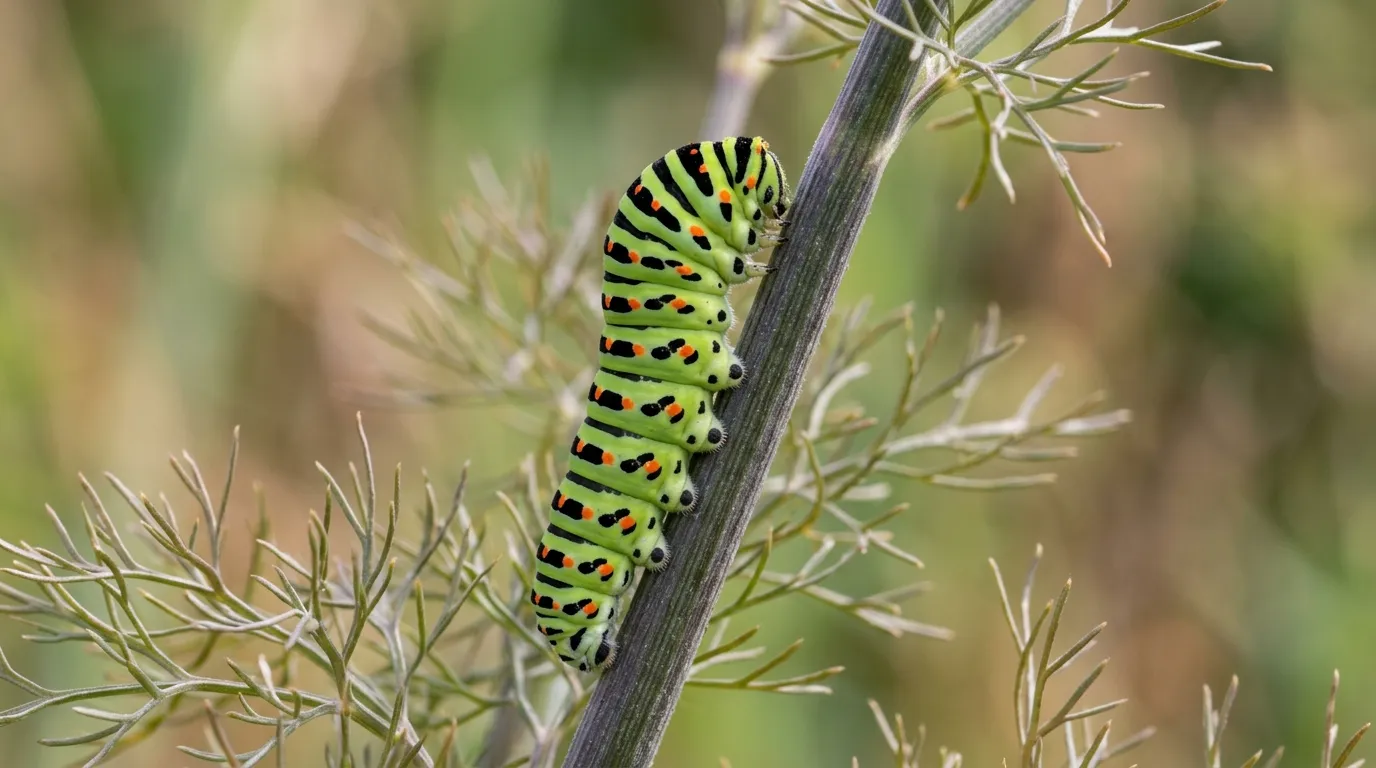
- Mature larvae show a bright green base color with black cross-bands interrupted by orange or red spots.
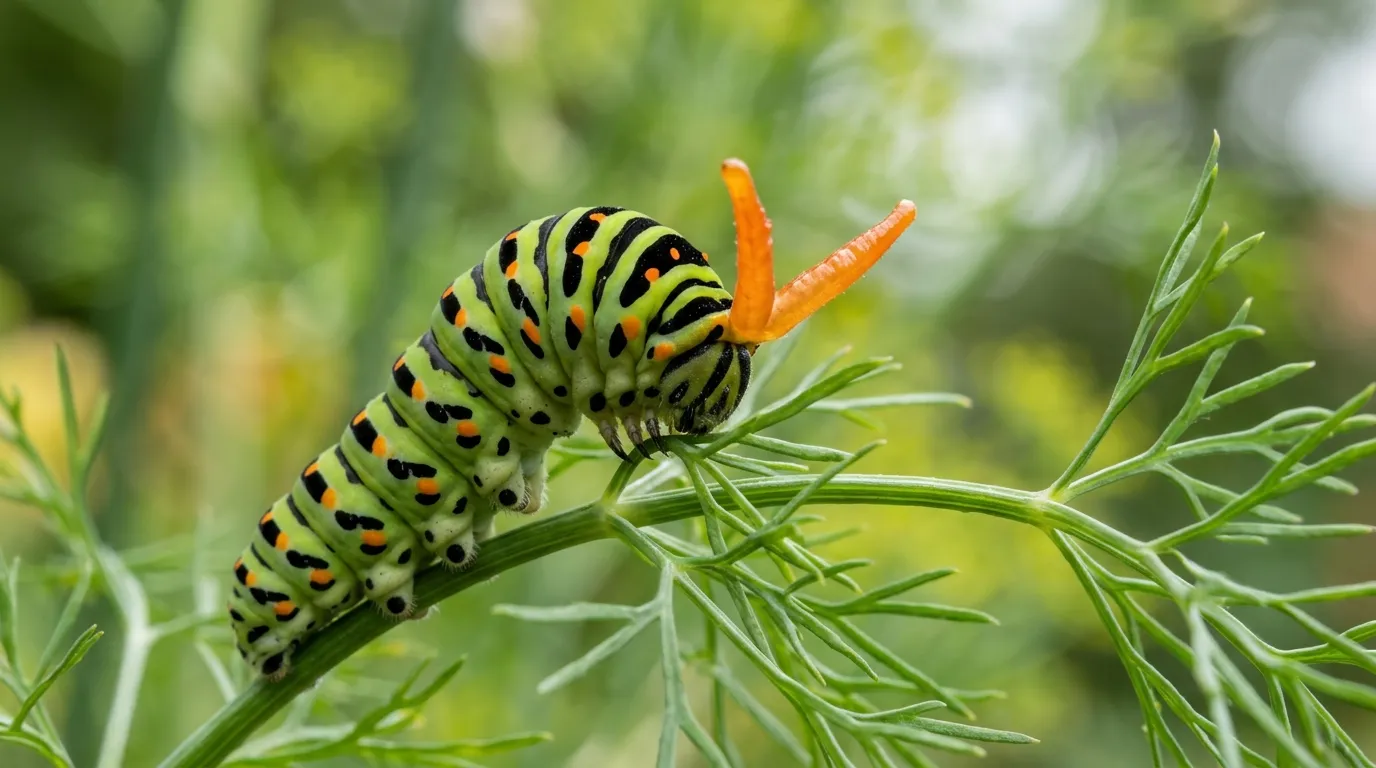
- When threatened, the caterpillar everts a forked orange organ called an osmeterium that releases a sharp chemical odor.
- Populations across Europe display noticeable differences in size, host preference, and voltinism depending on latitude and climate.
What the European Swallowtail Caterpillar Looks Like
Fully grown larvae stretch to roughly 45 millimeters, sometimes a touch longer in warmer southern regions. The body has a smooth, waxy finish and a bright apple-green ground color. Across each segment runs a black band broken by two to four orange-red spots, giving the larva a sort of striped-and-dotted pattern that stands out against green foliage.
The head is dark, often hidden behind the first thoracic segment when the larva rests. The spiracles sit flush with the body and blend into the black banding. Prolegs match the body color, while the true legs near the head take on a slightly darker tone.
Young larvae look nothing like the mature form. Freshly hatched caterpillars are almost black with a white saddle across the middle of the back. This mimics a bird dropping and offers protection during the tiny, vulnerable stage. The shift to the green and black pattern happens gradually as the larva molts through successive instars.
The Five Instars Explained
Like other swallowtails, Papilio machaon progresses through five larval instars. Each molt brings changes in size, color, and sometimes behavior.
The first instar emerges from a pale yellow egg laid singly on the underside of a host leaf. The tiny hatchling eats the eggshell before starting on plant tissue. Its black body with a white patch persists through the second and third instars, though the proportions shift as the larva grows.
Around the fourth instar, things start looking very different. The ground color pales to green, and the first traces of orange spotting appear against a widening black pattern. By the fifth and final instar, the caterpillar has reached its full size and adopts the classic green-black-orange look most people recognize. The entire larval period lasts about three to four weeks in warm conditions, stretching longer when temperatures drop.
For a side-by-side comparison of larval stages in a related species, the Spicebush Swallowtail caterpillar stages guide offers a useful contrast in instar development.
Host Plants Across Europe
European swallowtail larvae feed almost exclusively on plants in the family Apiaceae, better known as the umbellifers. Garden fennel tops the list for many populations, especially in Mediterranean zones where bronze fennel grows wild along roadsides. Wild carrot, cultivated carrot, dill, parsley, and lovage all serve as reliable hosts.
In northern Britain and Scandinavia, the picture narrows sharply. The British race Papilio machaon britannicus feeds almost exclusively on milk-parsley (Peucedanum palustre), a scarce fenland plant that ties the subspecies to a handful of reserves in Norfolk. This specialist diet makes the British population one of the most range-restricted swallowtails in Europe, and you can read more about its conservation status in our overview of rare UK butterflies.
Continental populations are far less picky. Rue (Ruta graveolens) and a few other non-umbellifers also get eaten in the south, though the bulk of feeding still happens on classic carrot-family plants. Gardeners growing culinary herbs often find multiple larvae on a single fennel plant during peak season.
The Osmeterium and Other Defenses
When a curious finger or a hungry wasp gets too close, the caterpillar rears up and shoots out a bright orange forked organ from behind its head. This structure is called the osmeterium, and it looks like a pair of fleshy horns. The tissue releases volatile compounds, mainly isobutyric acid and related chemicals, that smell sharp and unpleasant. The scent drives off parasitic wasps, ants, and small vertebrate predators.
The osmeterium is not the only trick in the book. Early instars rely on their bird-dropping disguise, sitting motionless on leaf surfaces during daylight. Mid-stage larvae can drop from the host plant when disturbed, curling into a tight C-shape on the ground. The fifth instar adds the warning coloration approach, advertising its distastefulness through the bold orange spots.
Related North American species use different larval defenses entirely. The Eastern Tiger Swallowtail caterpillar leans heavily on snake-mimicking eyespots, showing how swallowtail lineages tackle predation pressure in distinct ways.
Regional Variation Across Europe
European swallowtail caterpillars show clear differences from one region to another, both in appearance and in life history. Southern populations tend to grow slightly larger and produce two or three broods per year, with larvae active from April through September. The spot coloration often runs closer to red than orange in Mediterranean stock.
Central European larvae from France, Germany, and Poland look fairly typical. Two broods per year is standard, with the first emerging from overwintered pupae in late May and the second reaching maturity by August. Our Papilio machaon gorganus guide covers the continental subspecies in more detail.
Scandinavian and Alpine populations face shorter summers, so they usually complete just one generation per year. Larvae grow more slowly and can take up to six weeks to reach full size. The British britannicus subspecies shows subtle differences in adult wing pattern, though the larvae themselves look very similar to continental relatives.
Altitude matters too. Mountain populations in the Pyrenees and Alps often show darker, more heavily banded larvae compared to lowland cousins. Whether this reflects genetic isolation, thermoregulation needs, or both remains an open question among lepidopterists.
Finding and Rearing European Swallowtail Caterpillars
The best time to search is late June through August in most of Europe, when second-brood larvae are feeding heavily on garden herbs. Check the tops of fennel stalks, flower heads of wild carrot, and the upper foliage of dill plants. Larvae usually rest in plain view on upper leaves, confident in their warning colors.
If you plan to rear a few, collect only a small number from abundant populations and leave wild hosts alone. A ventilated container with fresh host-plant cuttings works well. Replace the food every day or two and clean out frass regularly to prevent mold. The fifth instar will eventually stop eating and wander in search of a pupation site, at which point it needs twigs or vertical surfaces to attach.
Pupation lasts about two weeks in summer broods. The chrysalis comes in two color forms, green or brown, matching the surface the larva chose. Overwintering pupae hold tight from autumn through the following spring, only releasing the adult when temperatures climb and daylight stretches past a certain threshold.
Frequently Asked Questions
Are European swallowtail caterpillars poisonous to touch?
No, handling them is safe for humans. The osmeterium releases a smelly chemical that feels unpleasant but causes no harm to skin. Wash your hands afterward if the scent lingers. The caterpillars do not sting, bite, or carry irritating hairs.
Will they destroy my herb garden?
A handful of larvae can strip a single fennel or dill plant, but they rarely wipe out an entire patch. Most gardeners find the damage tolerable and welcome the adults that emerge later. If you want to protect specific plants, move larvae gently to a sacrificial host planted nearby.
How do I tell a European swallowtail caterpillar from a monarch or other striped larva?
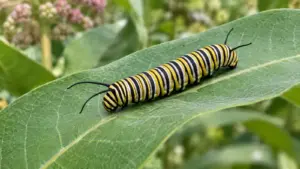
Monarchs are not native to most of Europe, so confusion is rare on the continent. The key features to look for are the smooth body (no fleshy filaments), the green base with black bands, and the orange-red spots embedded in the bands. Monarchs carry black and yellow stripes with paired tentacles at both ends, which Papilio machaon larvae lack entirely.
What should I feed a captive larva if my fennel runs out?
Switch to another umbellifer such as dill, wild carrot, parsley, or lovage. Store-bought carrot tops work in a pinch, though organic is safer since insecticide residues can kill the larva. Avoid sudden changes in later instars, as fifth-stage caterpillars sometimes refuse new hosts.
Why is my caterpillar changing color before pupation?
Shortly before pupating, the fifth instar often turns a slightly duller green or takes on a yellowish tint. This is normal and signals that the larva is about to stop feeding and search for a pupation site. Provide a stick or rough vertical surface so it can spin its silk pad and attachment girdle.
Do European swallowtails overwinter as caterpillars?
No, they overwinter as pupae. Late-season larvae finish feeding in autumn, pupate on sheltered stems, and remain dormant through winter. Adults emerge the following spring, usually in May, to begin the cycle again. Only in the warmest parts of southern Europe do any stages persist through the cold months in active form.