

Spicebush Swallowtail Caterpillar Stages: All 5 Instars
The spicebush swallowtail caterpillar stages include five instars that take the larva from a tiny brown speck mimicking bird droppings to a plump green creature with a fake snake face that startles birds mid-strike. Papilio troilus is one of the most visually dramatic caterpillars in eastern North America, and each instar brings a distinct shift in color, size, and defensive strategy. The whole progression from egg hatch to chrysalis takes roughly 3 to 4 weeks depending on temperature, and watching it unfold on a spicebush or sassafras branch is one of those experiences that hooks people on raising caterpillars for good.
I’ve raised dozens of these over the years, and the transition from the bird-dropping phase to the snake-mimic phase still catches me off guard every time. One day you’ve got a lumpy brown blob on a leaf. A few days later, it’s a smooth green tube with eyespots that make you do a double-take from across the yard. Here’s what happens at each stage and what to look for if you’re tracking them in your garden or in the wild.
Key Takeaways
- Spicebush swallowtail caterpillars pass through five instars over roughly 3 to 4 weeks, starting as tiny brown larvae that mimic bird droppings and transforming into green snake mimics with large false eyespots on the swollen thorax.
- The primary host plants are spicebush (Lindera benzoin) and sassafras (Sassafras albidum), though caterpillars will also feed on camphor tree, red bay, and other plants in the laurel family.
- From the first instar onward, the caterpillar folds leaves into shelters using silk, hiding inside during the day and feeding at night – a behavior that makes them harder to find than most swallowtail larvae.
- The color shift from brown to green typically happens at the fourth instar, and the snake-head illusion with its prominent eyespots is fully developed by the fifth and final instar.
Spicebush Swallowtail Caterpillar Stages: The Egg
Before the instars begin, there’s the egg. Female spicebush swallowtail butterflies lay single, pale greenish-yellow eggs on the underside of host plant leaves. Each egg is about 1 mm in diameter – round, smooth, and easy to overlook unless you’re specifically flipping leaves. Females are selective about placement. They prefer younger leaves near the tips of branches, and they rarely lay more than one egg per leaf.
The egg stage lasts 4 to 10 days depending on temperature. Warmer conditions speed development. In midsummer heat, eggs can hatch in as few as 4 days. In cooler spring weather, they may take the full 10. When the tiny caterpillar chews its way out, it usually eats part of the eggshell before starting on the leaf. That first meal provides nutrients that help the neonate larva survive until it’s feeding steadily on plant tissue.
First and Second Instars: The Bird-Dropping Phase
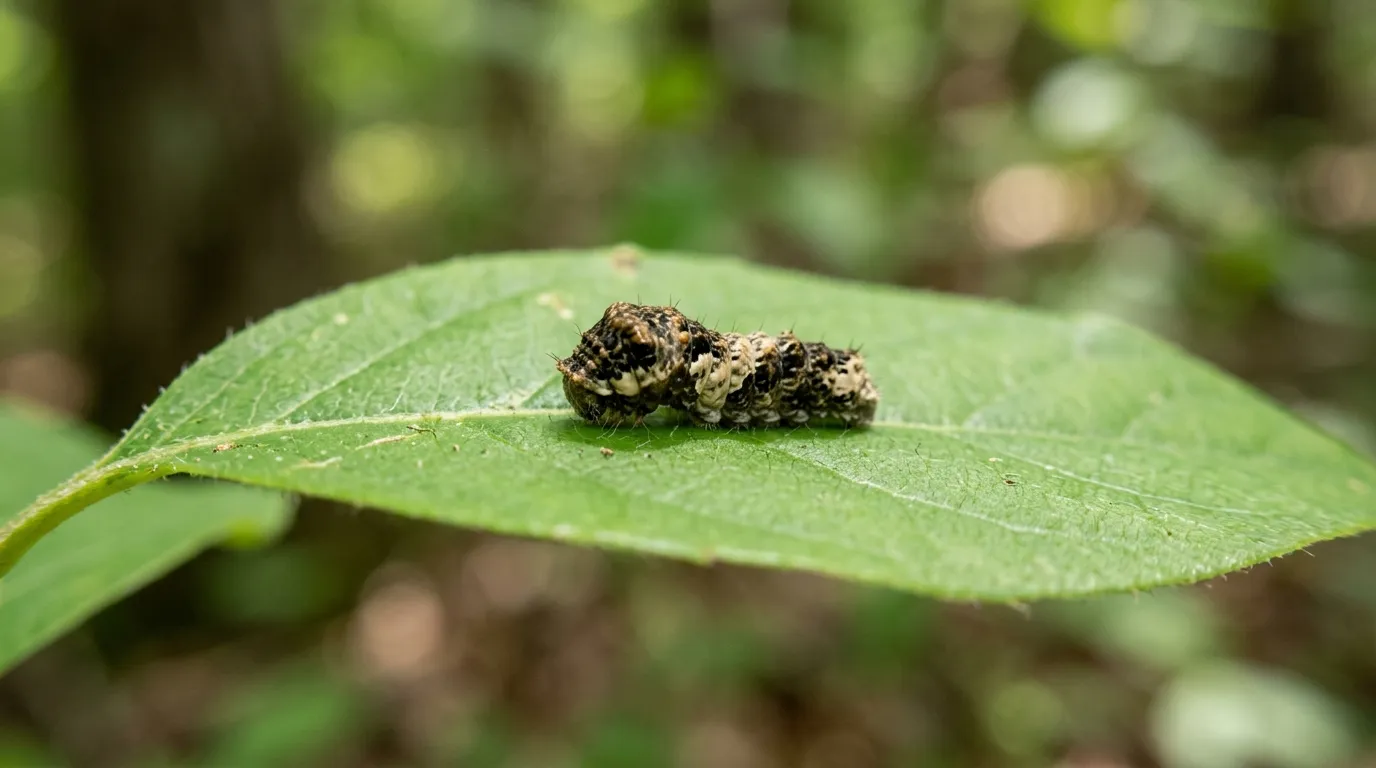
The first instar caterpillar is small – about 3 to 4 mm long – and dark brown with a faint whitish saddle mark across its middle. It looks remarkably like a tiny, fresh bird dropping on the surface of a leaf. This is not a coincidence. Bird-dropping mimicry is a well-documented defensive strategy in Lepidoptera, and the spicebush swallowtail is one of its best practitioners in the early instars.
At this stage, the caterpillar’s first order of business is building a leaf shelter. Using silk produced from its spinneret, the first instar folds over the edge of the leaf it hatched on, creating a small flap or tent. It rests inside this shelter during daylight hours and emerges to feed on the leaf surface at night. This nocturnal feeding combined with the daytime hiding behavior makes first instar spicebush caterpillars genuinely difficult to find, even when you know which plant to check.
The second instar looks similar but slightly larger, reaching about 7 to 10 mm. The brown and white coloring becomes more pronounced, and the bird-dropping resemblance actually improves at this size. A second instar spicebush caterpillar sitting motionless on a green leaf is almost indistinguishable from actual avian waste to a casual observer. The caterpillar continues its leaf-folding habit, sometimes constructing a more elaborate shelter by folding a larger section of leaf and securing it with additional silk lines.
Both of these early instars last about 3 to 5 days each. Molting happens inside the leaf shelter, where the caterpillar is protected from predators and parasitoid wasps during the vulnerable period when its new cuticle is still soft.
Third Instar: Transition Period
The third instar is the in-between stage. The caterpillar reaches about 15 to 20 mm and remains brown with a white or cream saddle, but the body proportions start changing. The thoracic segments – the three segments just behind the head – begin to swell slightly, foreshadowing the dramatic snake-head shape that will develop in later instars. Some third instars begin showing faint greenish tones mixed into the brown, especially on the ventral surface.
The leaf shelters get bigger during this stage. A third instar caterpillar needs more leaf area to feed and more space inside its silk tent. You’ll sometimes find leaves that are folded almost completely in half lengthwise, with the caterpillar resting in the fold during the day. The feeding damage also becomes more visible – instead of the tiny nibbles of the first two instars, you’ll see noticeable chunks missing from leaf margins.
This instar lasts about 4 to 6 days. By the end of it, the caterpillar has consumed substantially more leaf tissue than in the first two instars combined, and it’s preparing for the major color and shape change that defines the species.
Fourth and Fifth Instars: The Snake Mimic
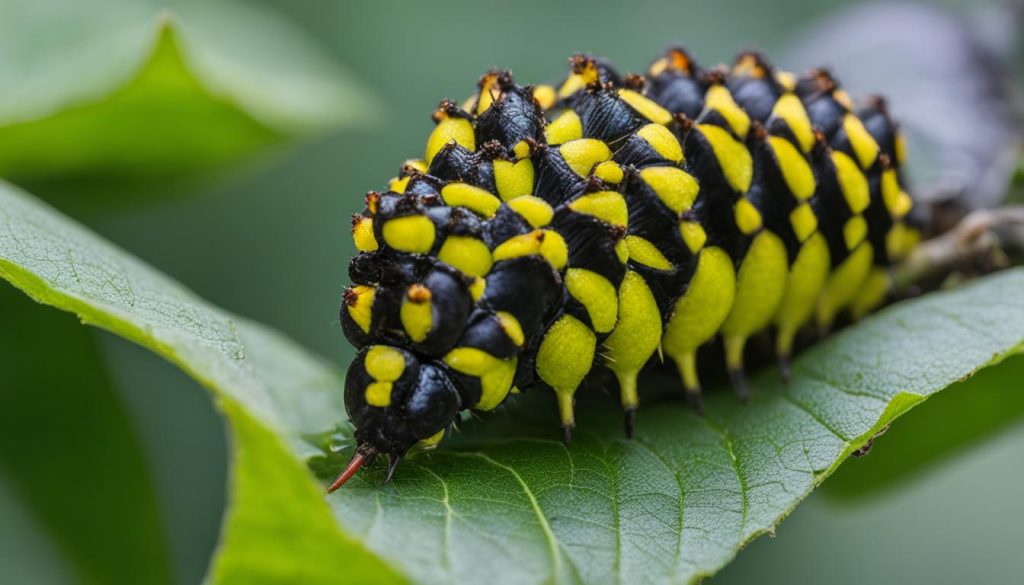
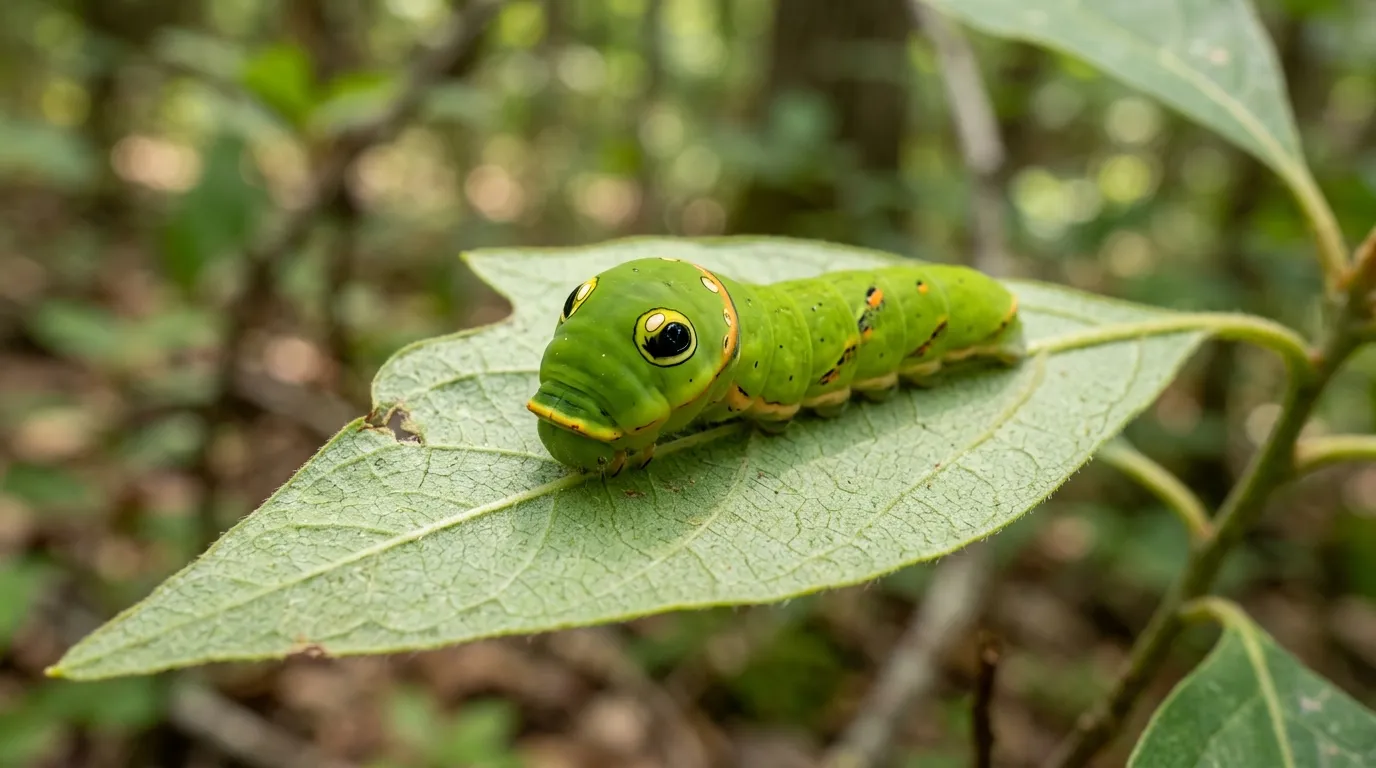
The fourth instar is where the transformation happens, and it’s striking. After molting from the third instar, the caterpillar emerges bright green (or occasionally yellow-green to blue-green depending on the individual and the host plant). The swollen thorax is now prominently enlarged, giving the front end of the caterpillar a bulbous, rounded shape. Two large false eyespots appear on the dorsal surface of the thorax – black circles with yellow and white highlights that look convincingly like the eyes of a small snake.
These eyespots are not just decorative. When threatened, the caterpillar retracts its true head into the thorax and raises the front of its body, presenting the eyespot-bearing thorax face-on to the predator. The effect is a startlingly good imitation of a green snake’s head. Small birds – which are the primary predators of caterpillars this size – react to this display with genuine alarm. Researchers have documented birds flinching, hesitating, or flying away entirely when confronted with a displaying spicebush caterpillar. For a soft-bodied, slow-moving larva with no venom or physical defenses, this bluff is the difference between being eaten and surviving to pupate.
The fourth instar also has a line of small blue dots along each side of the body and a yellow-cream stripe running laterally. The host plant can influence the exact shade of green – caterpillars on sassafras sometimes appear slightly more yellow-toned than those on spicebush, though this varies.
The fifth instar is the final and largest stage, and it’s the one most people encounter because it lasts the longest and the caterpillar is now big enough to spot easily. A fully grown fifth instar measures 40 to 55 mm (roughly 1.5 to 2 inches) and is impressively thick-bodied. The eyespots are at their largest and most detailed, with concentric rings of black, yellow, blue, and white that have a wet, glossy appearance. The swollen thorax at this stage is dramatically enlarged – it looks disproportionate to the rest of the body, which is exactly the point for the snake-head illusion.
Fifth instars are eating machines. A single caterpillar in this stage can consume an entire sassafras leaf in one night. The leaf shelters are correspondingly large – some fifth instars fold whole leaves into tubes using silk, while others will silk together two adjacent leaves into a roomy bivouac. If you’re raising them indoors, this is the stage where you go through host plant cuttings at a noticeable rate.
The fifth instar lasts about 7 to 10 days before the caterpillar is ready to pupate. In the final day or two before pupation, the caterpillar stops eating, its green color may dull or shift slightly, and it becomes restless – crawling off the host plant and wandering in search of a pupation site. This wandering phase sometimes brings them to unexpected places like porch railings, fence posts, or garden shed walls.
Host Plants and Feeding
The two primary host plants for spicebush swallowtail caterpillars are spicebush (Lindera benzoin) and sassafras (Sassafras albidum). Both belong to the laurel family (Lauraceae), and the caterpillars are specialists on this plant family. In southern portions of the range, they’ll also use camphor tree (Cinnamomum camphora), red bay (Persea borbonia), and occasionally other native laurels.
Spicebush is the more common host in the northern half of the range. It’s an understory shrub that grows in moist woodlands and along stream edges. Sassafras is more of a forest edge and old field species, often found in sunnier locations. Both plants are aromatic – crush a leaf and you’ll smell the characteristic spicy-citrus scent. If you’re planting host plants specifically for this butterfly, spicebush is the more reliable choice in most eastern gardens because it tolerates shade, stays a manageable size, and produces attractive red berries that songbirds eat in fall.
The caterpillar’s exclusive relationship with the laurel family means that if you don’t have any of these plants on or near your property, you won’t have spicebush swallowtail caterpillars. The adults will fly through your yard to nectar on flowers, but females won’t lay eggs without a suitable larval host. This is different from generalist species like painted ladies or cabbage whites that can eat a wide range of plants. Spicebush swallowtails are locked into the laurel family, and that’s that.
From Final Instar to Chrysalis
When the fifth instar caterpillar is finished growing, it enters a prepupal wandering phase. It leaves the host plant and searches for a sheltered spot to form its chrysalis. Common pupation sites include the underside of sturdy leaves, twigs, bark crevices, and overhanging structures. The caterpillar spins a silk pad and a girdle – a thin silk thread across its body – that anchors it in place.
The chrysalis itself can be either green or brown, and the color is influenced by the pupation surface and the photoperiod at the time of pupation. Summer-generation chrysalises that will emerge in 2 to 3 weeks tend toward green. Fall-generation chrysalises that will overwinter are more often brown, matching dead vegetation. This color matching isn’t random – the caterpillar detects environmental cues through its skin during the prepupal phase.
Summer broods produce adults in about 10 to 20 days. Overwintering chrysalises remain dormant from fall through the following spring, with adults emerging in April or May depending on the region. Most populations in the eastern U.S. are bivoltine – two generations per year – with a spring brood and a summer brood. In the Deep South, a partial third brood sometimes occurs. The adult butterflies live about 6 to 14 days in the wild.
Frequently Asked Questions
How many stages does a spicebush swallowtail caterpillar go through?
Five larval instars plus the egg stage and the chrysalis stage. The total development from egg to adult takes about 5 to 7 weeks, with 3 to 4 weeks spent as a caterpillar moving through the five instars, and another 2 to 3 weeks in the chrysalis (or 6 to 7 months for overwintering pupae).
When do spicebush swallowtail caterpillars turn green?
The color change from brown bird-dropping mimic to green snake mimic typically happens at the molt into the fourth instar. Some individuals begin showing traces of green during the late third instar, but the full green coloring with prominent eyespots is consistently present by the fourth instar and reaches its peak in the fifth.
Why do spicebush swallowtail caterpillars have eyespots?
The false eyespots on the swollen thorax create a convincing snake-head illusion that startles bird predators. When threatened, the caterpillar tucks its real head into the thorax and raises the front of its body, presenting the eyespot-studded thorax as a face. Research has shown that birds hesitate or retreat when confronted with this display. The caterpillar also has an osmeterium – a forked, orange, scent-emitting organ behind the head – that it can evert as a secondary defense, releasing a foul smell.
What do spicebush swallowtail caterpillars eat?
They feed exclusively on plants in the laurel family (Lauraceae). The two most common host plants are spicebush (Lindera benzoin) and sassafras (Sassafras albidum). In the southern U.S., they also use camphor tree, red bay, and other native laurels. They will not eat plants outside this family, so planting at least one laurel-family host plant is necessary to support them in your yard.
Why do spicebush caterpillars fold leaves?
Leaf folding provides daytime shelter from predators and parasitoid wasps. Starting in the first instar, the caterpillar uses silk to fold a portion of its host plant leaf into a tent or tube, then rests inside this structure during the day. It emerges at night to feed. This behavior reduces the caterpillar’s exposure to visually hunting predators like birds, paper wasps, and stink bugs during peak predator activity hours.
How can I find spicebush swallowtail caterpillars in the wild?
Look for folded or rolled leaves on spicebush and sassafras plants, especially along woodland edges and stream corridors. Gently unfold suspect leaves – if a caterpillar is inside, you’ll see frass (droppings) and feeding damage on the inner leaf surface. Search in late June through September for the best odds. Early instars are tiny and very well camouflaged, so focus on finding the leaf shelters rather than the caterpillars themselves. Fifth instars are large enough that their shelters create visible distortion in the plant’s normal leaf arrangement.
Are spicebush swallowtail caterpillars poisonous?
No. They are not toxic and are completely harmless to handle. The snake-head display is a bluff – they have no venom, no stinging spines, and no urticating hairs. The osmeterium organ can release a mildly unpleasant smell when the caterpillar feels threatened, but it’s not harmful to humans. They are safe to pick up, photograph, and return to their host plant. Just handle them gently and avoid touching the eyespot area on the thorax, as the caterpillar will interpret pressure there as a predator attack and may thrash defensively.