

Key Takeaways
- Butterflies fly using a figure-eight wing stroke that generates both lift and thrust, not a simple up-and-down flap.
- A 2021 Lund University study confirmed that butterflies use a “clap-and-fling” technique where flexible wings trap and push air like cupped hands, producing a downward jet that boosts takeoff force.
- Most butterfly species fly between 5 and 12 mph, though some skippers can reach 30 mph in short bursts.
- Butterflies cannot fly until their thoracic muscles reach about 30 degrees Celsius (86 degrees Fahrenheit), which is why they bask in sunlight before taking off.
How Do Butterflies Fly With Such Large, Fragile Wings?
How do butterflies fly when their wings look paper-thin and their flight pattern seems so random? The answer comes down to wing flexibility, aerodynamic tricks, and a stroke pattern that engineers are still working to fully understand.
Unlike birds and bats, butterflies have proportionally massive wings for their body weight. That low wing loading, combined with a complex figure-eight motion, lets them stay airborne at slow speeds where rigid-winged flyers would stall.
The Structure Behind the Flight
A butterfly wing is a thin membrane stretched between a network of hollow veins. Those veins carry hemolymph (insect blood), provide structural support, and act like the frame of a kite. The membrane itself is only a few micrometers thick, covered on both sides by thousands of overlapping scales.
The scales create the color patterns we recognize, reduce drag by channeling airflow, and shed easily when a predator grabs hold. For a deeper breakdown of wing anatomy, see our guide to butterfly wing structure and patterns.
Each wing connects to the thorax through a hinge joint that allows rotation, tilting, and folding. This range of motion is what makes the figure-eight stroke possible.
The Figure-Eight Wing Stroke
When a butterfly flaps, the wingtips trace a figure-eight path through the air. On the downstroke, the wings push air backward and downward, generating both thrust and lift. On the upstroke, the wings rotate so the leading edge tilts upward, reducing drag while still producing some forward force.
Birds rely heavily on the downstroke, with the upstroke mainly a recovery movement. Butterflies extract useful aerodynamic force from both halves of the cycle, which partly explains how they stay aloft despite flapping at only 8 to 12 beats per second, according to research published by the Journal of the Royal Society Interface.
The Clap-and-Fling Mechanism
In 2021, researchers at Lund University in Sweden used high-speed cameras and aerodynamic modeling to show that butterflies clap their wings together at the top of the upstroke, then fling them apart. Per Henningsson and his team published the findings in the Journal of the Royal Society Interface.
Because butterfly wings are flexible, they cup like two hands when pressed together, trapping a pocket of air. As they peel apart from front to back, that trapped air shoots downward as a jet. The Lund team measured a 28% increase in force production compared to what rigid wings would generate with the same motion.
This clap-and-fling technique is especially useful during takeoff, when a butterfly needs maximum thrust from a standstill.
Flight Speeds by Species
Not all butterflies fly at the same pace. Body size, wing shape, and wing loading all influence speed. Here are recorded flight speeds for common species, based on data from entomological field studies compiled by the Florida Museum of Natural History.
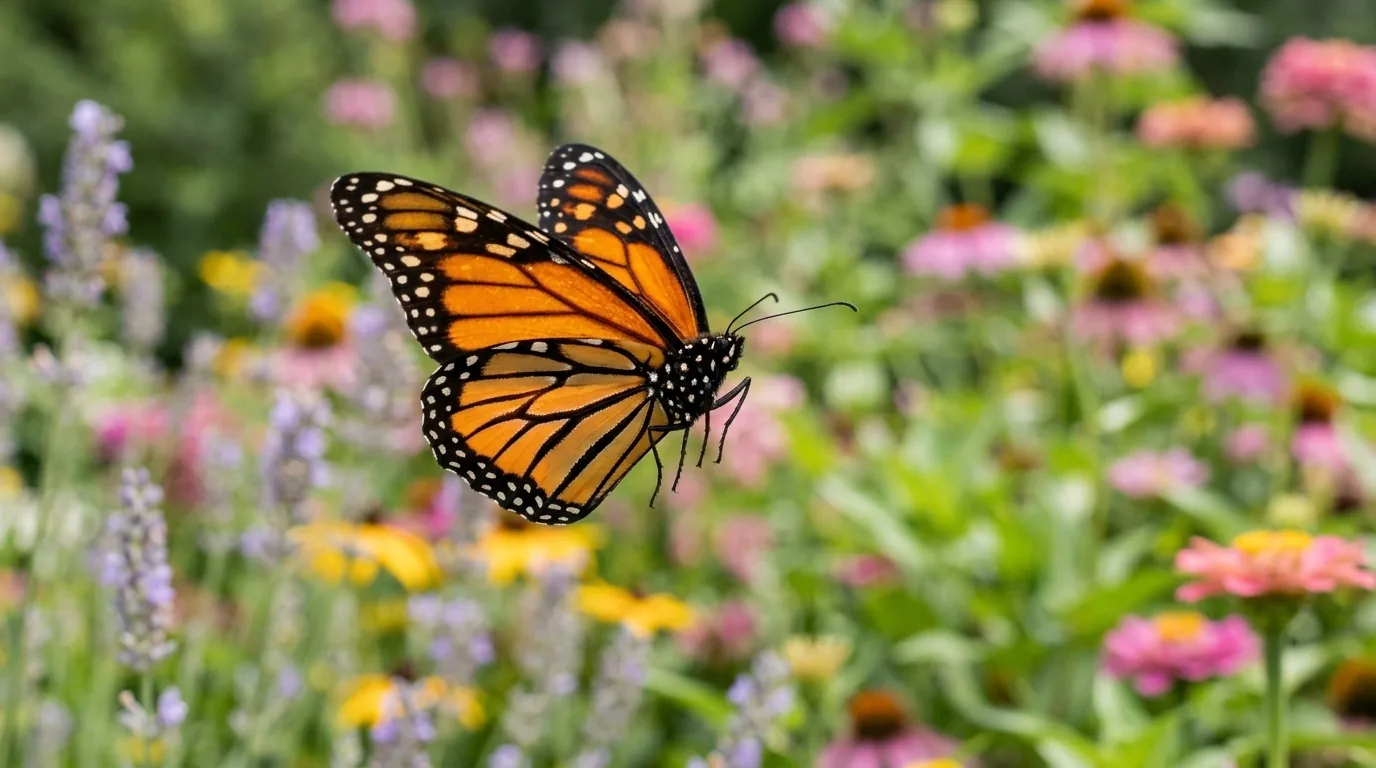
- Monarch butterfly (Danaus plexippus): 5 to 12 mph during migration, with tailwind-assisted bursts up to 25 mph
- Painted Lady (Vanessa cardui): 9 to 18 mph
- Skipper butterflies (Hesperiidae family): up to 30 mph in short dashes, making them the fastest butterflies recorded
- Cabbage White (Pieris rapae): 4 to 7 mph
- Swallowtails (Papilionidae family): 8 to 14 mph
- Glasswing butterfly (Greta oto): roughly 8 mph, notable for sustained long-distance flight
Wing shape matters a lot here. Skippers have small, triangular, pointed wings built for speed. Monarchs and swallowtails have broader, rounder wings that favor endurance gliding over short-burst acceleration. Lifespan also affects flight strategy, as species that live longer tend to favor energy-efficient gliding. You can compare lifespans in our butterfly lifespan guide.
Flapping Versus Gliding
Butterflies alternate between active flapping and passive gliding to conserve energy. During gliding, the wings are held open and flat, catching rising thermal currents the same way a hawk would. Monarchs rely on this strategy during their multi-thousand-mile migrations from Canada to central Mexico.
Gliding works best in warm conditions when thermals are strong. On cool mornings or in shade, butterflies rely almost entirely on powered flapping because the air offers less free lift.
Thermoregulation and Basking
Butterflies are ectothermic, meaning they depend on external heat to regulate body temperature. Their flight muscles need to reach approximately 30 degrees Celsius (86 degrees Fahrenheit) before they can contract fast enough for flight, based on research by Bernd Heinrich at the University of Vermont.
This is why you often see butterflies sitting with their wings spread wide in a sunny spot. That posture, called lateral basking, angles the wings to absorb maximum solar radiation, which transfers through the wing veins into the thorax.
Dark-colored butterflies heat up quicker than pale ones because darker wing scales absorb more solar energy. Moths and butterflies share this reliance on temperature for flight, though many moths generate their own heat through rapid wing vibration, a trick butterflies generally cannot pull off.
How Wing Damage Affects Flight
Butterfly wings do not heal or regenerate. Researchers at Georgia Tech found that butterflies can lose up to 40% of their total wing area and still fly, though maneuverability and speed decline with each lost section.
Hindwing damage is less critical than forewing damage. Butterflies missing parts of their hindwings can still fly in relatively straight lines but struggle with sharp turns. Forewing loss directly reduces lift and thrust, grounding the butterfly much sooner.
Wing damage accumulates over a butterfly’s life from predator strikes, collisions with vegetation, rain impact, and simple wear. Late-season monarchs arriving in Mexico often have heavily tattered wings after flying thousands of miles.
Frequently Asked Questions
How do butterflies fly in the rain?
Most butterflies avoid flying in heavy rain. A single raindrop can weigh as much as an entire butterfly, so a direct hit can knock one out of the air.
Light drizzle is manageable because the hydrophobic scales on their wings cause water to bead and roll off quickly. When storms approach, butterflies typically seek shelter under leaves or in dense vegetation.
Can butterflies fly at night?
Almost all butterfly species are strictly diurnal, meaning they fly only during daylight. Their compound eyes are adapted for bright-light vision and perform poorly in darkness.
Without sunlight, their body temperature also drops below the threshold needed for flight. A few tropical species are known to fly at dusk, but true nocturnal flight belongs to moths.
How high can butterflies fly?
Migrating monarchs have been recorded at altitudes above 3,000 feet (roughly 900 meters) by glider pilots. Painted Ladies have been tracked by radar at over 3,000 feet during their autumn migration across the Sahara, according to data from the University of Exeter.
At those altitudes, butterflies ride high-speed wind currents that carry them much farther than flapping alone could manage.
Why do butterflies seem to fly in a zigzag pattern?
That erratic, bouncing flight path is actually a predator-avoidance strategy. A zigzagging target is harder for a bird or dragonfly to track and intercept than one flying in a straight line.
Some species exaggerate this effect more than others. The Wood White, for example, has an especially slow, fluttering flight that makes it difficult for visual predators to predict its next position.
Do butterflies get tired from flying?
Yes. Butterflies have limited energy reserves stored as fat in their abdomens. Extended flight burns through these reserves, and once depleted, the butterfly must feed on nectar to refuel.
Migratory species like monarchs manage this by alternating between powered flight and passive gliding on thermals, which can reduce energy expenditure by over 50% compared to continuous flapping.
How does wind affect butterfly flight?
Gentle breezes (under 8 mph) actually help butterflies by providing additional lift and carrying them forward with less effort. Strong winds above about 15 mph ground most species because the turbulence makes controlled flight impossible.
Migrating butterflies wait for favorable wind conditions before launching. Monarchs have been documented delaying departure by days until wind direction shifts to give them a tailwind heading south.