

The viceroy butterfly (Limenitis archippus) is the orange-and-black butterfly people most often mistake for a monarch. The fastest way to tell them apart is a thin black line curving across each hindwing, which a monarch never has.
That resemblance made the viceroy a textbook example of mimicry for most of the 20th century. A bird-feeding experiment in 1991 rewrote the story, and it remains one of the best plot twists in butterfly biology.
Key Takeaways
- The black band across the middle of the viceroy’s hindwing is the most reliable way to separate it from a monarch.
- Viceroys have a wingspan of about 2.5 to 3.4 inches and range from the Northwest Territories to central Mexico.
- Caterpillars feed on willows, poplars and cottonwoods, and young larvae pass for bird droppings.
- Birds find both species distasteful, so the viceroy and monarch are Müllerian mimics sharing one warning pattern.
Viceroy Butterfly vs Monarch: How to Tell Them Apart
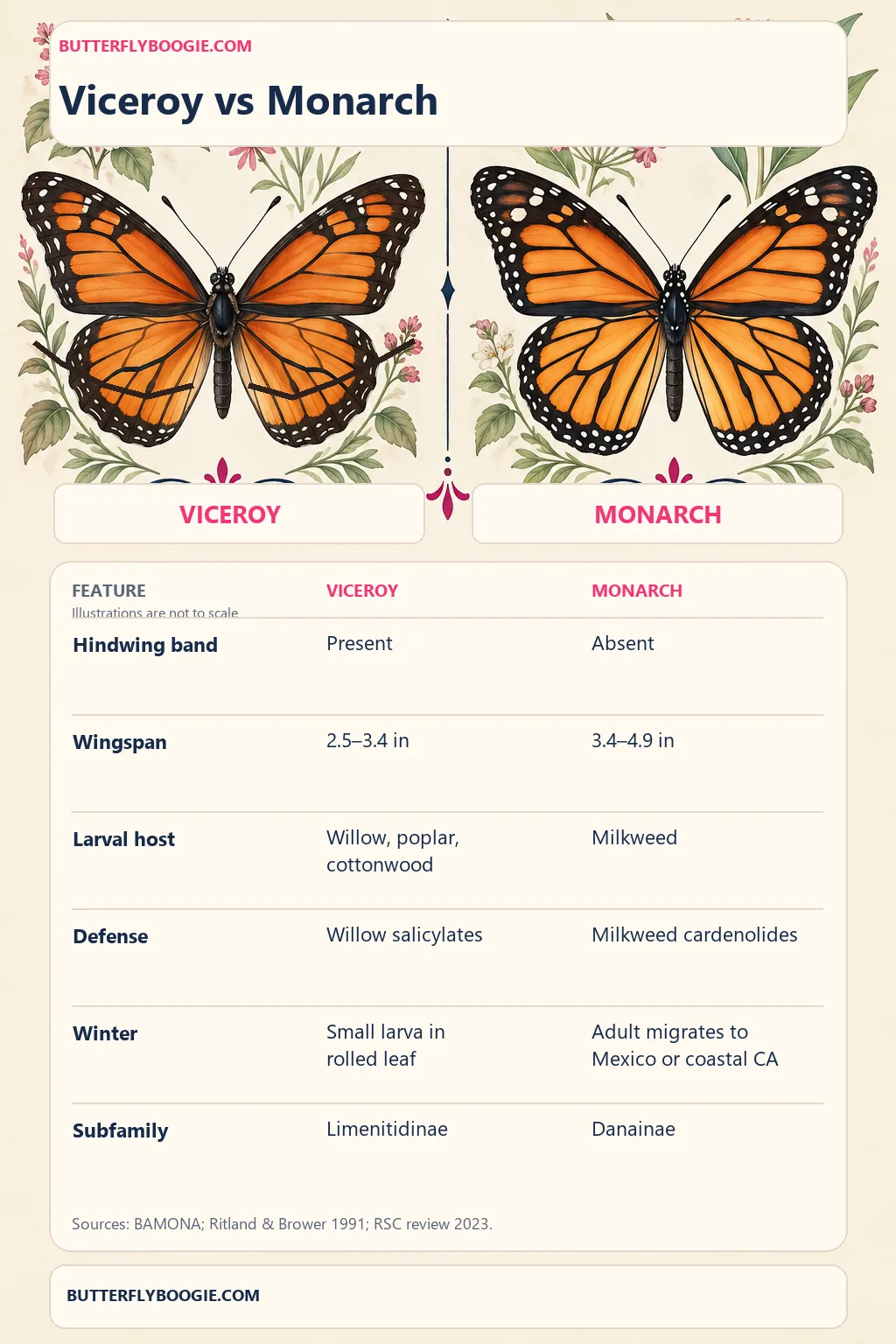
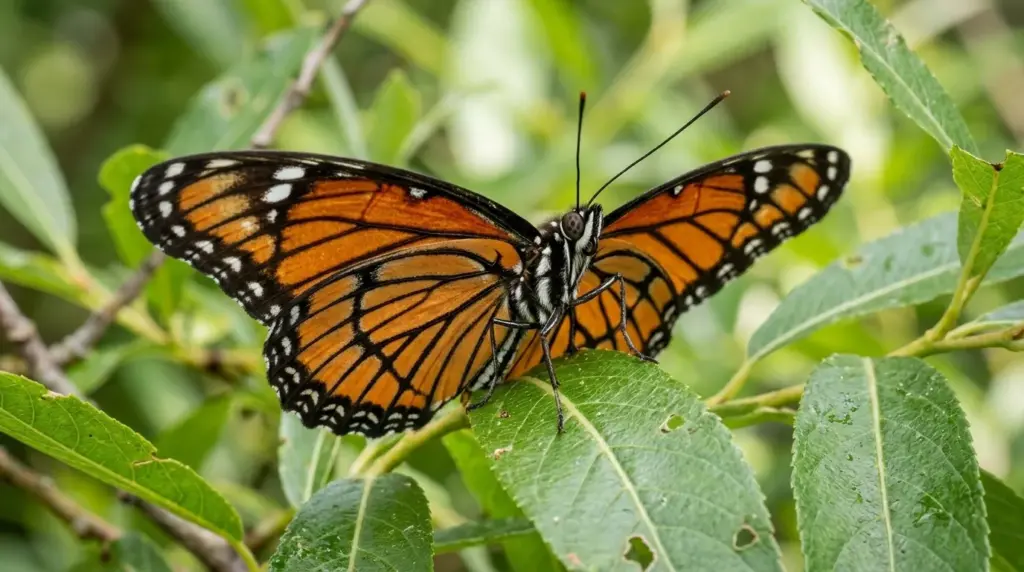
Check the hindwing first. A viceroy has a thin black band running across the middle of each hindwing, roughly parallel to the outer edge, and a monarch’s hindwing has no band at all.
Size is a weaker clue that still helps. According to Butterflies and Moths of North America, viceroys span 2.5 to 3.4 inches, while monarchs run 3.4 to 4.9 inches, so a small orange butterfly deserves a second look.
Flight style gives it away at a distance. Viceroys mix quick wingbeats with short flat-winged glides, while monarchs flap more slowly and glide with their wings held in a shallow V.
| Feature | Viceroy | Monarch |
|---|---|---|
| Black line across hindwing | Yes | No |
| Wingspan | 2.5 to 3.4 in | 3.4 to 4.9 in |
| Caterpillar food | Willows, poplars, cottonwoods | Milkweed |
| Where the bad taste comes from | Salicylates from willow leaves | Cardenolides from milkweed |
| How it spends the winter | Small caterpillar in a rolled leaf | Migrates to Mexico or coastal California |
| Subfamily | Limenitidinae (admirals) | Danainae (milkweed butterflies) |
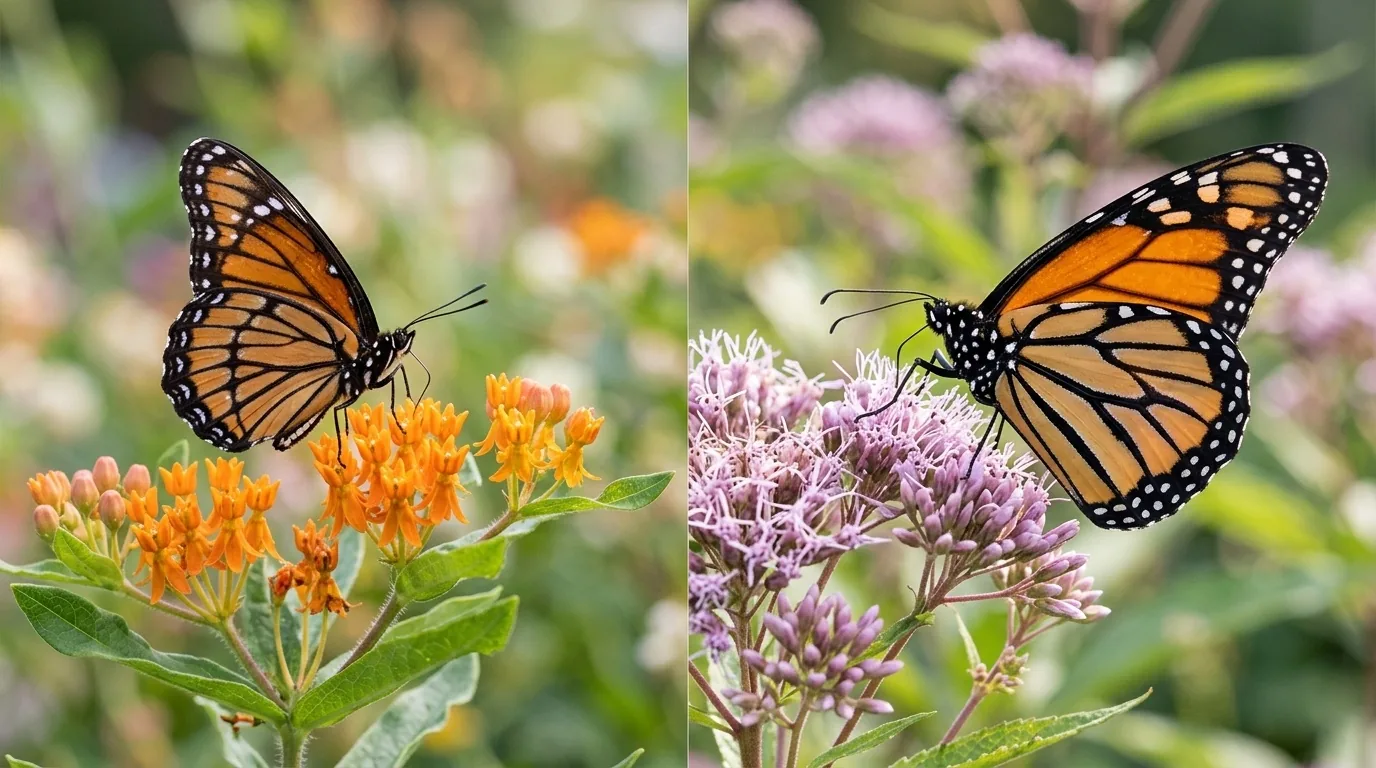
If the butterfly in front of you has no hindwing line, it could still be something other than a monarch. Our guide to butterflies that resemble monarchs covers the queen, the soldier and the other common mix-ups, and the monarch size guide helps with the measurements.
Where Viceroys Live
Viceroys cover more of North America than most butterflies. Their range runs from the Northwest Territories south along the eastern edge of the Cascade and Sierra Nevada ranges to central Mexico, and east through the entire eastern United States.
Wet ground ties that huge range together. Look along pond edges, marshes, slow streams, wet meadows and roadside ditches, anywhere willows grow in the sun.
In Florida and the desert Southwest, viceroys wear a darker, browner orange. That shade matches the queen butterfly, the monarch’s close relative that dominates those regions.
Life Cycle and Host Plants
Females lay single eggs on the tips of leaves in the willow family, including willows, poplars and cottonwoods. The caterpillars that hatch are mottled brown and white and look almost exactly like bird droppings.
Caterpillars that hatch in late summer stop eating while still small. Each one rolls the base of a leaf into a tube, ties it to the twig with silk and spends the winter inside this shelter, called a hibernaculum.
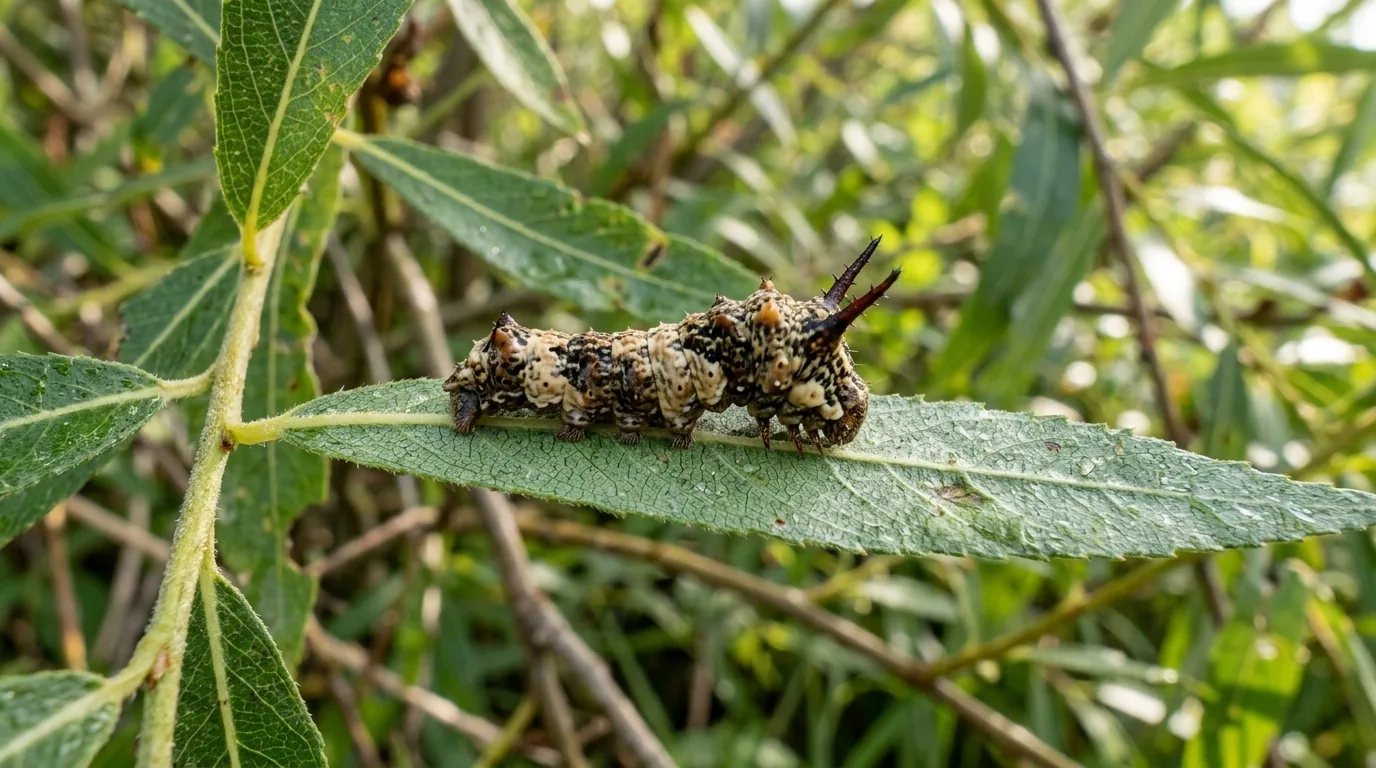
In spring the caterpillars resume feeding, grow a set of knobby horns behind the head and pupate in a small mottled chrysalis. If the chrysalis and cocoon terms trip you up, our breakdown of the cocoon vs chrysalis difference sorts them out.
Most of the range sees two or three broods between May and September, and Florida has adult viceroys on the wing all year, according to Butterflies and Moths of North America. For a closer look at each stage, the University of Florida’s Featured Creatures profile covers the species in depth.
The Mimicry Twist
For decades, textbooks called the viceroy a Batesian mimic. In that version, a harmless and tasty viceroy survived by copying the toxic monarch that birds had learned to avoid.
In 1991, David Ritland and Lincoln Brower tested the idea in a study published in Nature. They offered red-winged blackbirds butterfly abdomens with the wings removed, so the birds judged each one by taste alone.
The blackbirds rejected viceroys about as readily as monarchs. The viceroy was distasteful in its own right, which makes the pair Müllerian mimics: two defended species sharing one warning pattern so predators learn it faster.
The viceroy’s bitterness is linked to its host plants. Willow leaves carry salicylates, the chemical family behind aspirin, while monarchs build their defense from milkweed toxins.
Conservation Status
Viceroys are common across most of their range and have no federal protection because they don’t need it. Their host plants thrive in ditches, floodplains and other wet ground that development often skips.
Local colonies still shrink where wetlands are drained, willow thickets are cleared or roadsides are mowed while caterpillars are feeding. Leaving a patch of willow uncut along a pond or drainage ditch is one of the easiest ways to keep them around.
FAQ
Is the viceroy butterfly poisonous?
Not to people. Birds find viceroys distasteful, which is why the 1991 Ritland and Brower experiment reclassified them as Müllerian mimics.
Are viceroys and monarchs related?
Only distantly. Both belong to the brush-footed family Nymphalidae, but monarchs are milkweed butterflies and viceroys are admirals.
Their matching colors evolved because a shared warning pattern protects both species.
Do viceroys migrate like monarchs?
No. Viceroys spend the winter as small caterpillars inside rolled willow leaves and resume their life cycle in spring.
When is the best time to see viceroys?
Across most of North America, look from May through September on sunny days near willows and wet ground.
In Florida, viceroys fly year-round.