

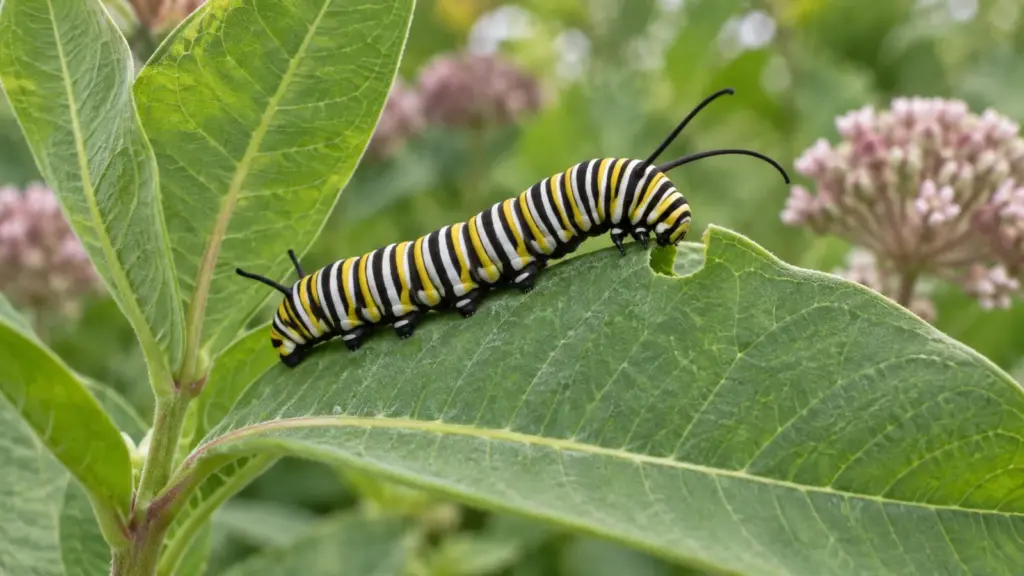

How much milkweed does a monarch caterpillar eat? Enough to grow to almost 2,000 times its hatching mass in 9 to 14 days, according to the Monarch Joint Venture.
The eating picks up sharply toward the end, when a big caterpillar can finish a whole leaf in minutes.
The exact leaf count depends on the milkweed species, since leaf size varies enormously. What researchers have measured is daily intake, which plants monarchs prefer and how caterpillars move between plants, and those numbers are more useful for planning a garden.
Key Takeaways
- A monarch caterpillar grows to almost 2,000 times its starting mass over five instars in 9 to 14 days.
- In a 2026 lab study, newly hatched caterpillars ate about 3 milligrams of leaf a day and third instars ate 16 to 19 milligrams.
- Caterpillars leave a plant before eating all of it, so you need more milkweed plants than a simple leaf count suggests.
- Swamp and common milkweed received the most eggs among nine native species tested in Iowa.
How Much a Monarch Caterpillar Eats, Stage by Stage
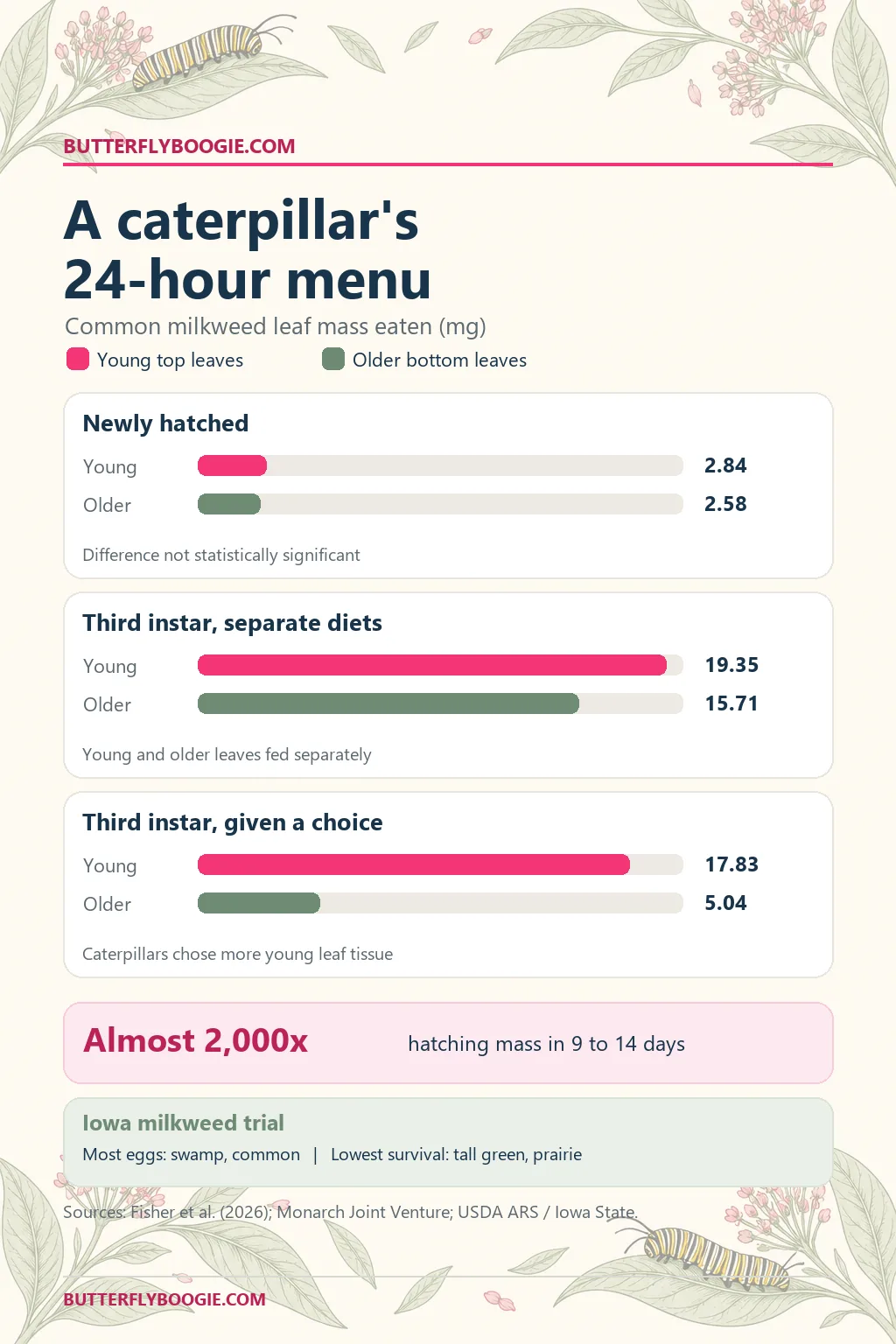
Monarchs pass through five larval instars, shedding their skin between each one. The Monarch Joint Venture says the whole caterpillar stage lasts 9 to 14 days in normal summer temperatures, with caterpillars taking few breaks from eating.
A 2026 study in the journal Insects weighed how much common milkweed caterpillars ate in 24 hours. The researchers compared young leaves from the top of the plant with older leaves from the bottom.
| Caterpillar stage | Young top leaves eaten in 24 hours | Older bottom leaves eaten in 24 hours |
|---|---|---|
| Newly hatched (first instar) | 2.84 mg | 2.58 mg |
| Third instar | 19.35 mg | 15.71 mg |
Given a choice, caterpillars strongly favored the young leaves. Third instars ate 17.83 mg of top leaves and only 5.04 mg of bottom leaves in the same day.
Leaf age also changed how fast they grew. Caterpillars fed top leaves pupated in about 14.1 days, nearly a day sooner than those fed bottom leaves.
The Big Eating Happens at the End
Those milligram numbers look tiny because they come from young caterpillars. Intake climbs steeply as a caterpillar grows, and fifth instars eat the most by far.
Save Our Monarchs says a large caterpillar can finish an entire milkweed leaf in under five minutes. That speed is why a plant that looked fine on Monday can be bare stems by Thursday.
Our guide to monarch caterpillar stages shows what each instar looks like, so you can tell when the heavy eating is about to start.
Why You Need More Plants Than You Think
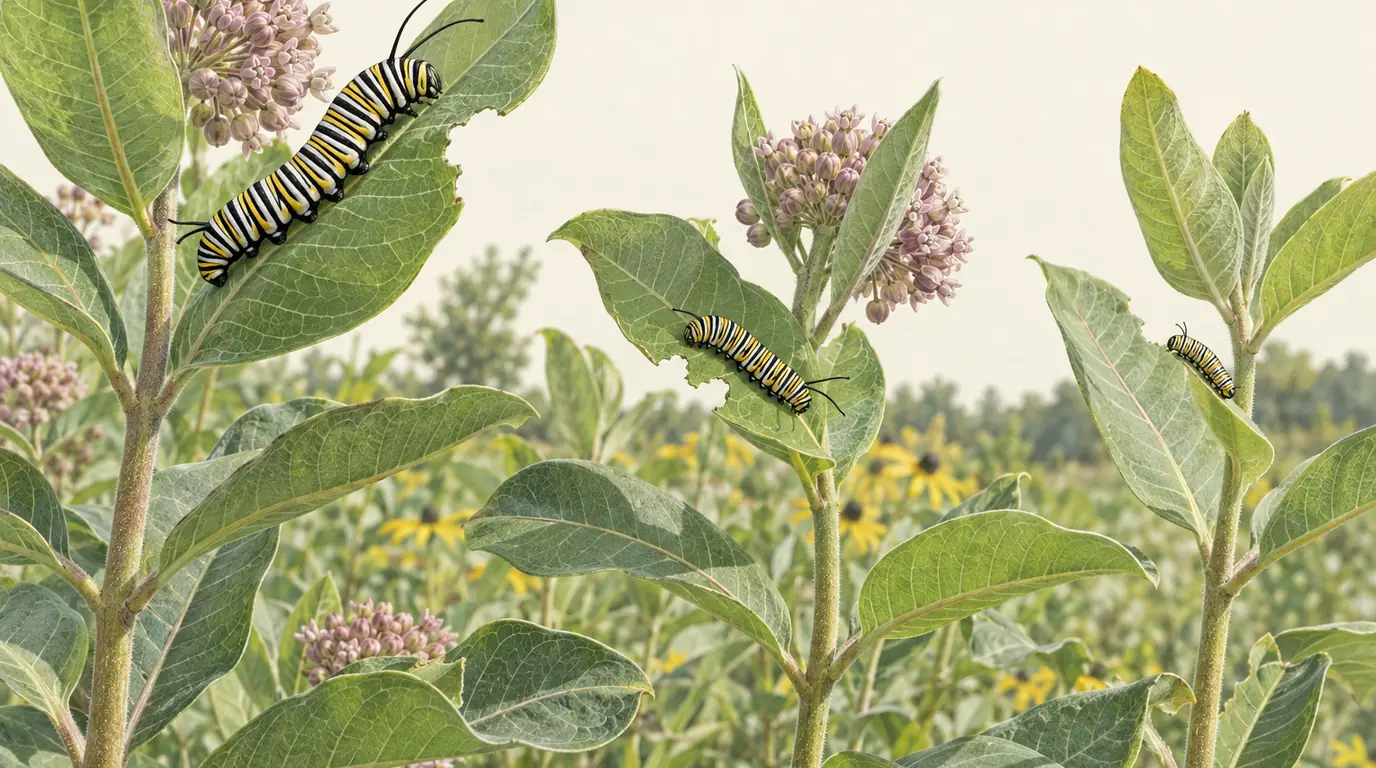
Caterpillars don’t stay put and strip one plant bare. A 2020 study in the Journal of Insect Conservation found monarch caterpillars left their first milkweed stem, and later stems, before eating all the available leaves.
That wandering spreads feeding across many plants. The same study estimated that 1.6 to 1.8 billion additional milkweed stems would be needed in the breeding range to support a healthy population of about 6 hectares in Mexico.
For a home garden, Save Our Monarchs suggests planting milkweed at about one plant per square foot. The Monarch Joint Venture recommends several patches in different spots, which spreads out both the eggs and the eating.
Which Milkweed Do Monarchs Prefer?
An Iowa State University study with the USDA Agricultural Research Service, led by Victoria Pocius, tested nine milkweeds native to Iowa. The USDA summary reports clear winners and losers.
| Milkweed species | What the Iowa study found |
|---|---|
| Swamp milkweed (Asclepias incarnata) | Among the highest average egg counts |
| Common milkweed (Asclepias syriaca) | Among the highest average egg counts |
| Tall green milkweed (Asclepias hirtella) | Among the lowest caterpillar survival |
| Prairie milkweed (Asclepias sullivantii) | Among the lowest caterpillar survival |
The researchers warned against planting a single species. Monarchs spread their eggs across many milkweeds, and their choices shift with the season and the habitat.
If you’re in the South, stick with native species over tropical milkweed. Our guide to tropical vs native milkweed explains the parasite problem, and the common milkweed growing guide covers planting.
What to Do When the Milkweed Runs Out
If you raise caterpillars indoors, have more leaves ready than you think you’ll need. Fifth instars eat constantly, so a few spare stems in a jar of water saves a late-night scramble.
Outdoors, the fix is more plants and more patches. A garden with milkweed spread across several beds gives wandering caterpillars somewhere to go when one plant is stripped.
FAQ
How many milkweed leaves does a monarch caterpillar eat?
It depends on the species, since common milkweed leaves are many times larger than the narrow leaves of whorled milkweed.
What stays constant is growth, as each caterpillar reaches almost 2,000 times its hatching mass.
How many milkweed plants do I need for monarchs?
Plant more than you expect, spread across several patches.
Save Our Monarchs suggests about one plant per square foot, and caterpillars will move between plants as they feed.
How fast does a monarch caterpillar eat a leaf?
A large caterpillar can eat a whole milkweed leaf in under five minutes, according to Save Our Monarchs.
Do monarch caterpillars prefer young or old milkweed leaves?
Young leaves. In a 2026 study, third-instar caterpillars given a choice ate about three times as much from young top leaves as from older bottom leaves.