


Butterfly evolution stretches back roughly 100 million years, placing these insects firmly in the age of dinosaurs. I find it wild that the same group of organisms fluttering around my garden has roots in the Cretaceous period, when flowering plants were just starting to take over the planet. The story of how butterflies split from moths, developed their trademark wing scales, and locked into a partnership with flowers is one of the most compelling in all of natural history. And thanks to a growing fossil record and modern genetic research, we now have a much clearer picture of how it all unfolded.
Key Takeaways
- Butterflies diverged from moths approximately 100 million years ago during the Cretaceous period, evolving alongside the rapid expansion of flowering plants.
- The oldest confirmed butterfly fossil dates to roughly 55 million years ago, but molecular clock studies push the lineage’s origin back to around 101 million years.
- Coevolution with angiosperms drove some of the most distinctive butterfly traits, including the coiled proboscis for nectar feeding and color patterns used in pollinator signaling.
- Adaptations like wing scale microstructures, chemical defense systems, and mimicry complexes evolved over tens of millions of years in response to predation and competition.
When Did Butterflies First Appear?
Pinning down the exact origin of butterflies has been a moving target for scientists. For a long time, the oldest known butterfly fossil was a specimen from the Eocene epoch, roughly 55 million years old. But a landmark 2019 study published in Proceedings of the National Academy of Sciences used molecular clock analysis to estimate that the butterfly lineage – the superfamily Papilionoidea – originated around 101 million years ago in western North America.
That timeline places butterflies squarely in the mid-Cretaceous, a period of intense biological change. The continents were still drifting apart. Dinosaurs dominated terrestrial ecosystems. And angiosperms – flowering plants – were undergoing their own explosive diversification.
The fossil record for butterflies is notoriously thin compared to beetles or flies. Butterflies are fragile, and their habitats don’t lend themselves to fossilization the way swamps or lake beds do. So most of what we know about deep butterfly evolution comes from DNA-based phylogenetics rather than actual rocks and amber. The few fossils we do have, like Prodryas persephone from the Eocene Florissant Formation in Colorado, show that by 34 million years ago, butterflies already looked a lot like the ones we recognize today.
How Butterflies Split From Moths
Butterflies are, in a real sense, just a specialized subgroup of moths. All butterflies belong to the order Lepidoptera alongside moths, and the differences between moths and butterflies are less clear-cut than most people assume. The split happened when one lineage of moths shifted from nocturnal to diurnal activity – flying during the day instead of at night.
That behavioral shift had cascading consequences. Daytime flight changed the selection pressures on these insects entirely. Nocturnal moths rely heavily on chemical signals and hearing to navigate the world. Diurnal butterflies, operating in bright sunlight, came under intense selection for visual communication. This drove the evolution of the bold color patterns we associate with butterflies today.
Club-shaped antennae – the classic field mark separating butterflies from most moths – also appear to be linked to the shift toward daytime activity. Moths typically have feathery or filament-like antennae optimized for detecting airborne pheromones in still night air. Butterfly antennae, with their thickened tips, seem better suited for sensing wind direction and maintaining stable flight in turbulent daytime conditions.
Genetic studies suggest this diurnal transition happened once, meaning all butterflies share a single common ancestor that made the switch. That ancestor was likely a small, drab moth-like insect in the Cretaceous. Nothing about it would have screamed “butterfly” to a modern observer.
Coevolution With Flowering Plants
The timing of butterfly evolution is no coincidence. Butterflies diversified in lockstep with angiosperms, and the relationship between the two groups is one of the best-documented cases of coevolution in biology.
Early Lepidoptera had chewing mouthparts, much like their caterpillars still do. But as flowering plants began producing nectar as a reward for pollinators, one lineage developed a coiled, tube-like proboscis capable of reaching deep into flower tubes. This was a game-changer. The proboscis allowed adult butterflies to access a high-energy food source that other insects couldn’t reach as efficiently.
In return, butterflies became effective pollinators, carrying pollen between plants as they moved from flower to flower. Plants that attracted butterfly visitors had a reproductive advantage, so they evolved brighter colors, specific flower shapes, and landing platforms suited to butterfly anatomy. This mutual feedback loop pushed both groups toward greater diversity.
The caterpillar side of the equation tells a different story. While adults cooperate with plants by pollinating them, larvae are herbivores that eat plant tissue. This created an evolutionary arms race. Plants developed chemical defenses – alkaloids, cardiac glycosides, mustard oils – to deter caterpillars. Butterflies, in turn, evolved resistance to these toxins. Some lineages, like the Monarch and its relatives, went further and began sequestering plant toxins in their own bodies, making themselves poisonous to predators.
According to research published by the journal Nature Ecology and Evolution, this host-plant arms race has been one of the primary engines driving butterfly speciation. When a butterfly lineage colonizes a new plant family, it often undergoes rapid diversification as different populations specialize on different host species.
Wing Scales and the Evolution of Color
The name Lepidoptera literally means “scale wing,” and those tiny overlapping scales are one of the order’s most important evolutionary innovations. Every butterfly wing is covered in thousands of them, each one a flattened, modified hair.
Scales serve multiple functions. They create the color patterns used in mate recognition, species identification, and predator deterrence. They provide some degree of thermal regulation, helping butterflies warm up faster in the sun. And they even help butterflies escape spider webs – scales flake off when stuck to silk, allowing the butterfly to pull free.
Color in butterfly wings comes from two distinct sources. Pigment-based colors use chemical compounds – melanins for blacks and browns, pterins for whites and yellows, ommochromes for reds and oranges. These pigments are deposited directly into the scale during development.
Structural colors work differently. The Blue Morpho’s iridescent blue, for instance, doesn’t come from any blue pigment at all. Instead, nanoscale ridges on the surface of each scale interfere with light waves, selectively reflecting blue wavelengths. This kind of structural coloration can produce intense, angle-dependent colors that no pigment can match. The evolution of these nanostructures represents one of the more impressive feats of natural selection, having independently evolved in multiple butterfly lineages across different life history strategies.
Mimicry and Chemical Defense
Mimicry systems are among the most studied products of butterfly evolution. The basic concept is simple – if you’re toxic, advertise it. If you’re not toxic, pretend to be something that is. But the reality is far more layered than that summary suggests.
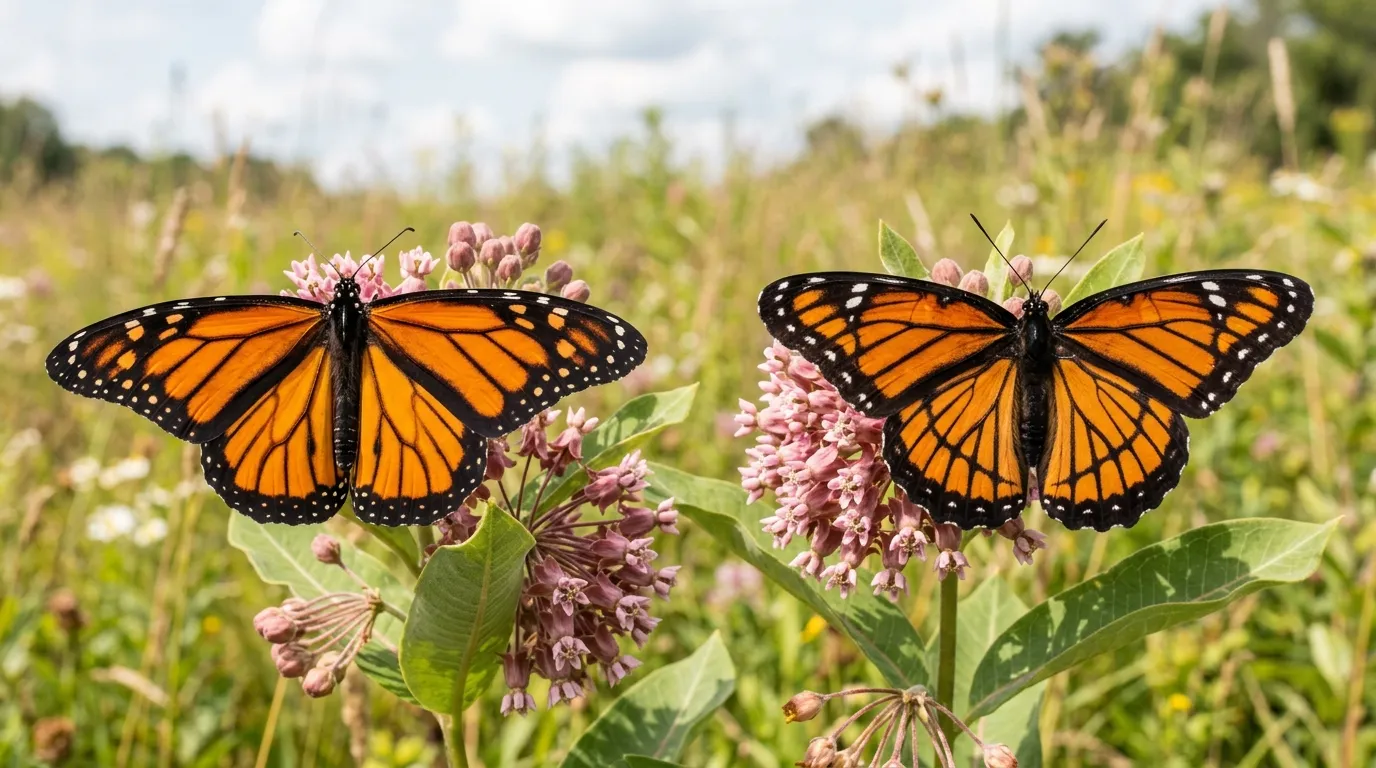
Batesian mimicry occurs when a palatable species evolves to resemble a toxic one. The Viceroy butterfly in North America looks strikingly similar to the Monarch, which is loaded with cardiac glycosides from milkweed. For decades, textbooks cited this as the textbook case of Batesian mimicry. Then researchers found that Viceroys are actually somewhat toxic themselves, making the system partially Mullerian – where two toxic species converge on the same warning pattern because it benefits both.
Mullerian mimicry rings in tropical regions can involve dozens of species, all sharing similar orange-and-black or red-and-black warning patterns. The Heliconius butterflies of Central and South America are the best-known example. Different species in the same forest often look nearly identical, and they’ve been shown to share mimicry genes through occasional hybridization – a process that blurs the line between species in ways that challenge traditional taxonomy.
These defense systems didn’t appear overnight. They evolved through gradual steps, each providing a small survival advantage. A caterpillar that tolerates a plant toxin slightly better than its siblings survives more often. Over thousands of generations, tolerance becomes sequestration, and sequestration becomes active chemical defense with a visual warning signal to match.
What the Fossil Record Tells Us
The butterfly fossil record is sparse but growing. Every new find pushes our understanding a bit further. The oldest undisputed butterfly fossil comes from Eocene deposits, roughly 55 million years old. But Cretaceous-era fossils of related moth groups strongly suggest butterflies were already present by that time, even if we haven’t found their fossils yet.
In 2018, researchers reported Lepidoptera wing scales from 200-million-year-old sediments in Germany – long before flowering plants existed. These weren’t butterfly scales specifically, but they showed that the fundamental scale architecture predates the butterfly-moth split by tens of millions of years. The scales likely evolved first for waterproofing or thermoregulation and were later co-opted for color display.
Amber inclusions from the Dominican Republic and Myanmar have preserved moth and butterfly specimens in three-dimensional detail. Some of these amber fossils still show original wing color patterns, allowing direct comparison with living species. The overall takeaway from the fossil record is that once the basic butterfly body plan was established, it changed surprisingly little. A 40-million-year-old butterfly would look quite familiar to anyone who’s spent time watching modern Papilionoidea.
Frequently Asked Questions
How old are butterflies in evolutionary terms?
Molecular clock studies estimate that butterflies originated approximately 100 to 101 million years ago during the mid-Cretaceous period. The oldest confirmed butterfly fossils are around 55 million years old, from the Eocene epoch. The gap between genetic estimates and fossil evidence reflects the poor fossilization potential of butterflies due to their fragile body structures and terrestrial habitats.
Did butterflies evolve from moths?
Yes. Butterflies are technically a subgroup within the larger moth lineage. All butterflies belong to the superfamily Papilionoidea, which arose from a single ancestral moth lineage that transitioned from nocturnal to diurnal (daytime) activity. So all butterflies are moths in a phylogenetic sense, but not all moths are butterflies. The differences we observe today – clubbed antennae, daytime flight, brighter wing colors – are adaptations to a diurnal lifestyle.
Why did butterflies develop colorful wings?
Colorful wings evolved primarily for two reasons – communication and defense. Bright colors and patterns help butterflies recognize members of their own species for mating. Warning colors (often orange, red, or yellow combined with black) advertise toxicity to predators. Structural colors, like the blue iridescence of Morpho butterflies, are produced by nanoscale wing surface structures rather than pigments. Sexual selection also played a role, as females in many species prefer males with brighter or more symmetrical patterns.
What is coevolution and how does it relate to butterflies?
Coevolution is a process where two or more species reciprocally influence each other’s evolution over time. Butterflies and flowering plants are a textbook example. As plants evolved nectar-rich flowers, butterflies developed long proboscises to access that nectar. Plants evolved chemical defenses against caterpillars, and caterpillars evolved resistance to those chemicals. This back-and-forth has driven diversification in both groups for approximately 100 million years.
What was the earliest butterfly ancestor like?
The earliest butterfly ancestor was likely a small, nocturnal, moth-like insect with drab coloring and chewing mouthparts. It probably fed on plant material as a larva and possibly on plant secretions or decaying matter as an adult. Over millions of years, the transition to daytime flight reshaped its body plan – antennae became clubbed, wings developed bolder pigmentation and structural colors, and mouthparts evolved into a coiled proboscis for drinking nectar.
Are butterflies still evolving today?
Absolutely. Butterflies continue to evolve in response to environmental changes. Some populations are shifting their ranges northward or to higher elevations as temperatures warm. The Brown Argus butterfly in Britain has expanded its host plant range in just the last few decades, switching from rock-rose to dove’s-foot cranesbill. Rapid evolution of mimicry patterns has been documented in Heliconius butterflies in real time. Evolution never stops – it just operates on timescales that can be hard to observe directly.