


Papilio machaon Scientific Name: Meaning and Origin
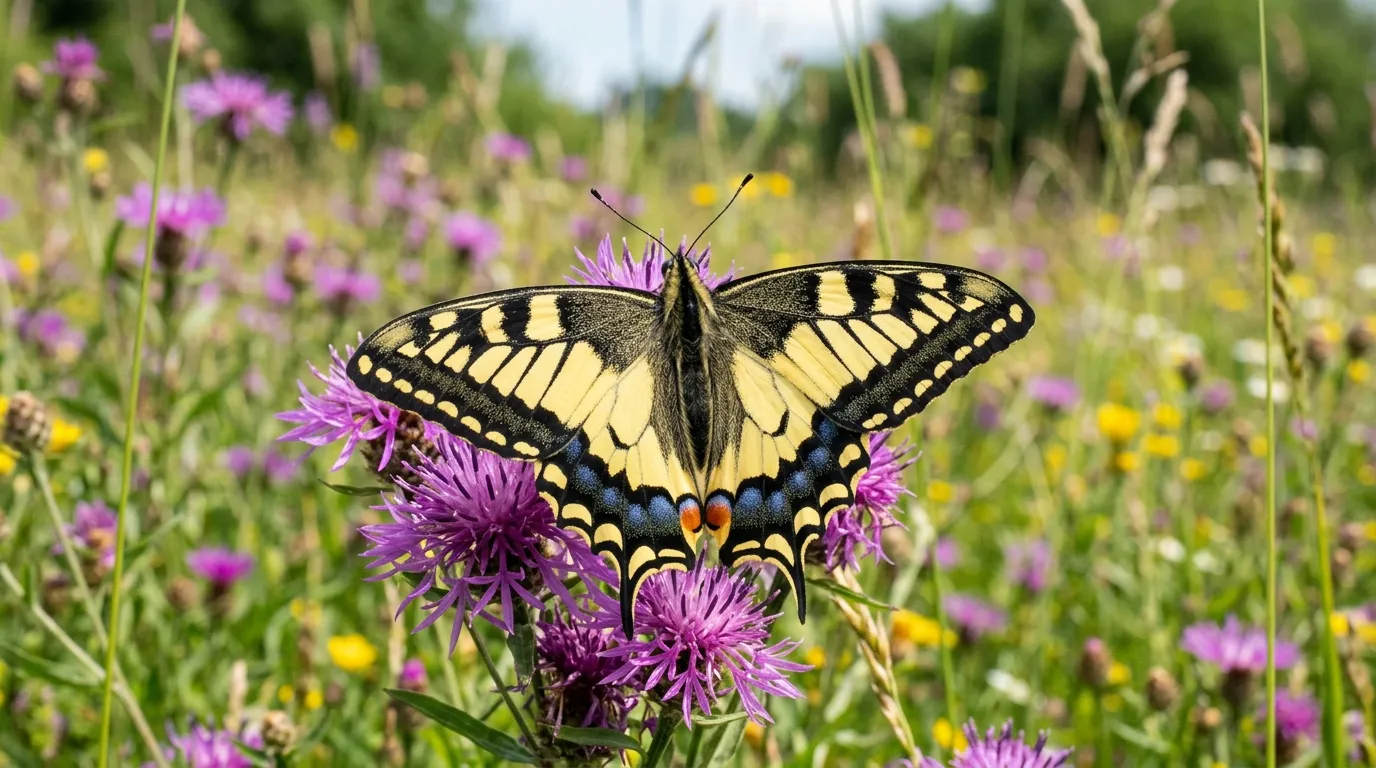
The Papilio machaon scientific name belongs to the Old World Swallowtail, one of the most recognizable butterflies across Europe, Asia, and North Africa. Carl Linnaeus gave the species its formal binomial in 1758, pairing the Latin word for butterfly with a character pulled straight from Greek mythology. The full name breaks down into two pieces: Papilio (the genus) and machaon (the species epithet), and each carries its own story. Knowing where those words come from makes the name easier to remember and a lot more interesting to pronounce out loud.
Key Takeaways
- Papilio machaon is the binomial scientific name for the Old World Swallowtail, published by Carl Linnaeus in the 10th edition of Systema Naturae in 1758.
- Papilio is Latin for “butterfly” and serves as the type genus for the whole swallowtail family Papilionidae, while machaon refers to Machaon, a surgeon-warrior and son of Asclepius in Greek mythology.
- The species is pronounced pah-PIL-ee-oh mah-KAY-on in standard English entomological usage, with the stress on PIL in the genus and on KAY in the species epithet.
- Taxonomists currently recognize around 30 subspecies of Papilio machaon, each tied to a specific geographic region, with the type locality given by Linnaeus as Sweden.
Breaking Down the Papilio machaon Scientific Name
A scientific name is never random. Every binomial follows the two-part Linnaean system, where the first word identifies the genus and the second word identifies the species within that genus. For the Old World Swallowtail, those two words are Papilio and machaon, and the full name is always written with the genus capitalized, the species lowercase, and the whole thing in italics.
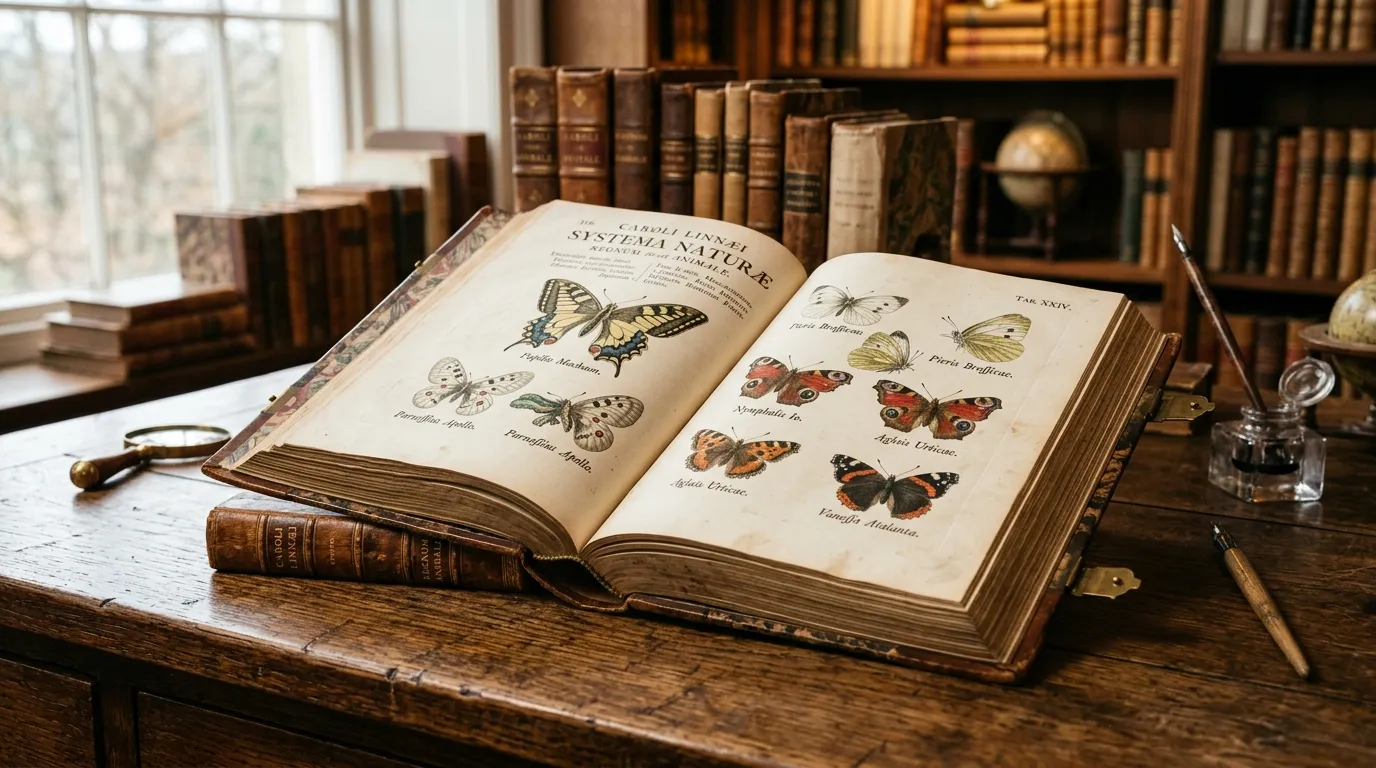
When you see the name spelled out in a field guide or scientific paper, you will often also see an author citation after it, like this: Papilio machaon Linnaeus, 1758. That extra bit tells you who first described the species and in what year. In this case, the author is Carl Linnaeus, the Swedish naturalist who built the modern classification system for all living things. The year 1758 refers to the 10th edition of his landmark work Systema Naturae, which zoologists treat as the official starting point for animal nomenclature.
If you want a broader overview of how butterfly binomials are structured, our Lepidoptera scientific name explainer covers the whole hierarchy from order down to species.
What Papilio Means
Papilio is the Latin noun for “butterfly.” The word goes back to classical Latin and shows up in the writings of Pliny the Elder and other Roman naturalists. Linnaeus chose it as the genus name for every butterfly he knew about when he wrote Systema Naturae, which meant the original genus Papilio once held hundreds of species from across the globe. Later taxonomists split that mega-genus into dozens of separate genera, and today Papilio is restricted to the swallowtails proper.
Even after all the splitting, Papilio remains an enormous genus with more than 200 species worldwide. It includes the Eastern Tiger Swallowtail of North America (Papilio glaucus), the Citrus Swallowtail of Africa (Papilio demodocus), and the Giant Swallowtail of the Americas (Papilio cresphontes). The Old World Swallowtail happens to be the type species of the genus, which means it is the reference point against which every other Papilio gets compared.
Being the type species also makes Papilio machaon the type species for the whole family Papilionidae. If you want a closer look at what sets the family apart, our guide to Papilionidae characteristics walks through the features that define swallowtails as a group.
Where the Name Machaon Comes From
The species epithet machaon is more interesting than the genus name. It is not a Latin word at all. Linnaeus borrowed it from Greek mythology, where Machaon was a figure tied to both medicine and war. In Homer’s Iliad, Machaon is one of two sons of Asclepius, the god of healing. He serves the Greeks at Troy as a skilled surgeon, tending to wounded warriors, and he also fights in battle before eventually being killed during the siege.
Linnaeus had a habit of reaching into Greek mythology when naming butterflies. Several other Papilio species he described carry names drawn from the same pool of characters. Papilio priamus references King Priam of Troy, Papilio hector points to the Trojan prince Hector, and Papilio helenus nods to Helen of Troy. The swallowtails, with their dramatic wings and tails, seemed to invite grand mythological titles, and Linnaeus leaned into that pattern.
There does not appear to be any specific reason why Linnaeus picked Machaon for this particular swallowtail over another Homeric character. The choice reflects the broader Enlightenment fashion of tying natural history to classical learning. Scientific names from that era often feel more like poetry than anatomy, and Papilio machaon is a good example.
Taxonomic Position of Papilio machaon
Every species sits inside a nested set of taxonomic ranks, and Papilio machaon is no exception. Moving from broadest to most specific, the classification goes: Kingdom Animalia, Phylum Arthropoda, Class Insecta, Order Lepidoptera, Superfamily Papilionoidea, Family Papilionidae, Subfamily Papilioninae, Tribe Papilionini, Genus Papilio, Species Papilio machaon.
Within the genus Papilio, the Old World Swallowtail belongs to a group of closely related species sometimes referred to as the machaon complex or the machaon group. This cluster includes the Oregon Swallowtail (Papilio oregonius), the Anise Swallowtail (Papilio zelicaon), and the Old World Swallowtail’s close Asian relative Papilio xuthus. Some early taxonomists treated a few of these as subspecies of machaon before DNA evidence showed they deserve full species status.
According to the Integrated Taxonomic Information System (ITIS), Papilio machaon is currently recognized as a valid species with a global distribution stretching from Ireland and Spain east across the entire Palearctic to Japan, plus a foothold in Alaska and parts of western Canada. That makes it one of the most geographically widespread butterfly species on Earth.
Subspecies and Regional Naming
Across its huge range, Papilio machaon has evolved into about 30 recognized subspecies. Each gets a third name added to the binomial, producing a trinomial like Papilio machaon britannicus or Papilio machaon gorganus. The third word is the subspecies epithet, and it usually reflects either the geographic region where the subspecies lives or the name of the person who first described it.
Some of the better-known subspecies illustrate the naming logic clearly. Papilio machaon britannicus is the British race confined to the Norfolk Broads, and its name literally means “British.” Papilio machaon gorganus is the continental European race that ranges from France east to central Asia, named after the Gorgan region of Iran. Papilio machaon aliaska is the Alaskan race, as the spelling makes obvious. Papilio machaon hippocrates covers populations in Japan and Korea and references another figure from Greek medical history.
Other subspecies include Papilio machaon syriacus (Middle East), Papilio machaon centralis (central Asia), Papilio machaon asiaticus (central and eastern Asia), and Papilio machaon mauretanicus (northwest Africa). Not every authority agrees on which populations deserve full subspecies status, and some of these names have been shuffled around or synonymized over the years. If you want a deeper look at one of the most widespread races, check out our dedicated Papilio machaon gorganus guide.
Subspecies names matter for conservation work, because they let biologists refer precisely to local populations that might face different threats. The British britannicus, for example, is restricted to a single fenland habitat and requires management strategies that do nothing for the much commoner gorganus across the Channel.
Type Locality and the 1758 Description
When Linnaeus described Papilio machaon in the 10th edition of Systema Naturae, he had to indicate where the specimens he used came from. That place is called the type locality, and for Papilio machaon it is Sweden. More specifically, most sources cite the type locality as southern Sweden, which is where Linnaeus did most of his fieldwork and where he would have encountered the species in the wild.
The type locality is not just a historical footnote. It anchors the scientific name to a specific geographic population, so that future taxonomists can compare other populations back to that reference point. If someone tomorrow proposed splitting Papilio machaon into two separate species, they would have to decide which of the new species retains the name machaon based on which one matches the Swedish type specimens most closely.
The original type specimens from Linnaeus’s own collection are held at the Linnean Society of London, which acquired his natural history materials after his death. According to the Linnean Society’s records, several of the butterfly specimens Linnaeus used for his original descriptions are still preserved and available for taxonomic study, though natural decay and handling have taken a toll on some of the older material.
How to Pronounce Papilio machaon
Saying Papilio machaon out loud trips people up more than it should. The standard English pronunciation is pah-PIL-ee-oh mah-KAY-on. Papilio has four syllables with the stress on PIL, while machaon has three syllables with the stress on KAY. Put together, the whole name sounds like pah-PIL-ee-oh mah-KAY-on, with a natural pause between the two words.
Some European entomologists prefer a more classically Latin version: pah-PEE-lee-oh mah-KHA-on, where the “ch” in machaon gets a harder, almost throaty sound like in Scottish “loch” or German “Bach.” That pronunciation follows the original Greek more faithfully, since the Greek character is spelled with a chi (Χ), which is traditionally transliterated as “ch” but sounded as a velar fricative. In practice, most English speakers go with the softer “mah-KAY-on” and nobody blinks.
A few common mistakes worth avoiding: do not say “PAP-ih-lee-oh” with the stress on the first syllable, and do not say “mah-CHAY-on” with a “ch” as in “chair.” Both shift the word away from its Latin and Greek roots. If you get confused, our Lepidoptera pronunciation guide has phonetic breakdowns for dozens of butterfly names and general rules that apply to Papilio machaon as well.
Why Scientific Names Matter More Than Common Names
Common names for butterflies change from country to country, from language to language, and sometimes from one field guide to the next. In English alone, Papilio machaon goes by Old World Swallowtail, Common Yellow Swallowtail, Swallowtail, and Yellow Swallowtail depending on the source. In German it is Schwalbenschwanz. In French, Machaon. In Japanese, Kiageha. None of these common names reach the same species with global precision.
The scientific name Papilio machaon cuts through all that noise. A researcher in Tokyo, a field guide author in Madrid, and a naturalist in Quebec can all talk about the same butterfly without confusion. That consistency is the entire point of the Linnaean binomial system, and it is why amateur naturalists who learn even a handful of scientific names find their reading across languages much easier.
The International Code of Zoological Nomenclature, maintained by the International Commission on Zoological Nomenclature, sets the rules for how these names get created, modified, and applied. Any taxonomist proposing a new species, genus, or subspecies has to follow the Code, which is why names as old as Papilio machaon from 1758 still work just fine alongside names coined last year.
Frequently Asked Questions
What is the scientific name of the Old World Swallowtail?
The scientific name of the Old World Swallowtail is Papilio machaon. It was published by Carl Linnaeus in 1758 in the 10th edition of Systema Naturae. Papilio is the genus and machaon is the species epithet, and the full formal citation is Papilio machaon Linnaeus, 1758.
What does Papilio machaon mean in English?
Papilio is Latin for “butterfly,” and machaon is a Greek name taken from the character Machaon, a warrior-surgeon and son of Asclepius in Homer’s Iliad. Put together, the name roughly translates to “Machaon’s butterfly” or “the butterfly named for Machaon.” Linnaeus chose the mythological reference as part of his broader pattern of naming swallowtails after figures from Greek epic poetry.
How do you pronounce Papilio machaon?
The standard English pronunciation is pah-PIL-ee-oh mah-KAY-on. Papilio has four syllables with the stress on the second syllable (PIL), and machaon has three syllables with the stress on the second syllable (KAY). A more classical Latin rendering uses a harder “ch” in machaon, but the softer KAY version is the most common in English-speaking entomology.
Who named Papilio machaon and when?
Carl Linnaeus named Papilio machaon in 1758 when he published the 10th edition of Systema Naturae. That book is treated as the official starting point for zoological nomenclature, which means any animal species described before 1758 has to be re-dated to that year if the name is still in use. Linnaeus based his description on specimens from Sweden, which remains the type locality for the species.
How many subspecies of Papilio machaon are there?
Most current sources recognize around 30 subspecies of Papilio machaon, though the exact number depends on the taxonomic authority consulted. Well-known subspecies include britannicus (British Isles), gorganus (continental Europe and central Asia), aliaska (Alaska), hippocrates (Japan and Korea), and syriacus (Middle East). Each subspecies is tied to a specific geographic region and shows subtle differences in wing pattern, size, or host plant preference.
Is Papilio machaon the type species of its family?
Yes. Papilio machaon is the type species of the genus Papilio, and because Papilio is the type genus of the family Papilionidae, machaon serves as the ultimate anatomical and taxonomic reference point for the entire swallowtail family. Every other swallowtail species on Earth gets compared back to Papilio machaon at some level when taxonomists work out family-level relationships.